Tuesday, April 18, 2023
Livestreams for the Hybrid Solar Eclipse April 20, 2023

If you can't be at Northwest cape for the April 20, Hybrid Solar eclipse, then you can watch it on several live streams set up for the purpose.
The live streams should start around 10:00 am AWST (11:30 am ACST, 12:00 AEST, 0136 UT) Totality is 11:29 AWST (13:30 ACST, 14:00 AEST)
Perth Observatory: https://perthobservatory.com.au/astronomy/solar-eclipse-live-stream
Time and date: https://www.timeanddate.com/live/eclipse-solar-2023-april-20
Gravity discovery Center: https://www.youtube.com/watch?v=IWEv1DWel3Y
For a guide to the partial eclipse seen from the rest of Australia See my eclipse page (don't forget do NOT look directly at the Sun! and use safe solar observing techniques):
http://astroblogger.blogspot.com/2023/04/hybrid-solar-eclipse-april-20-2023.html
Labels: eclipse, solar, solar eclipse, Sun

Saturday, June 20, 2020
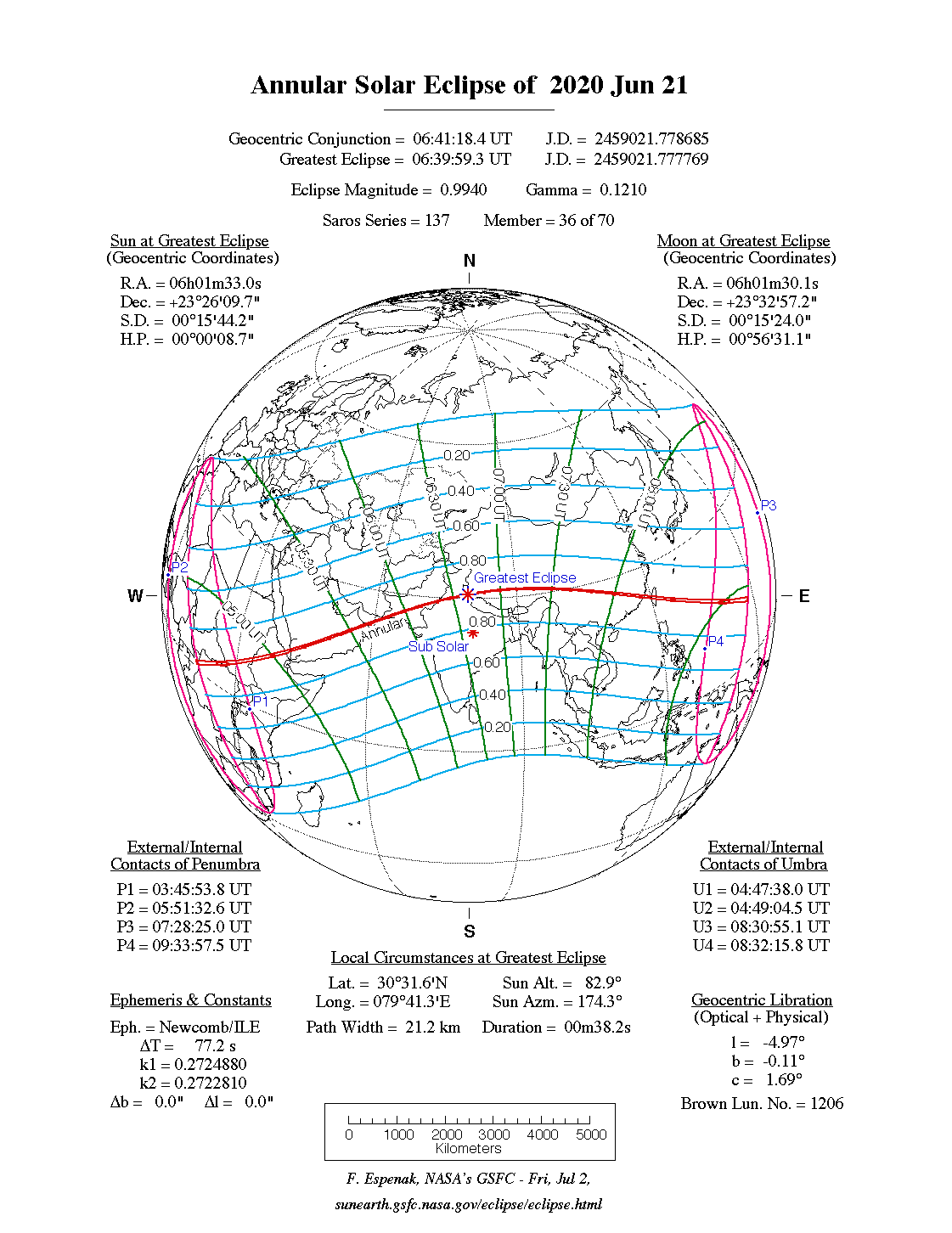
Live streams of the Annular eclipse of Sunday, June 21, 2020

Sunday, June 21 is not only the winter Solstice, but also when an annular eclipse of the sun occurs.
In an annular eclipse, the Moon does not fully cover the Sun's dsk leaving a thin rim of sun at maximum eclipse. These so called :ring of Fire Eclipses can be very dramatic especially if caught as the sun is rising or setting.
The eclipse path travels though Asia, the Arabian peninsula and Africa. Asutalia misses out except for DArwin, which sees a tiny chip out of the edge of the Sun just on sunset.
Because of the COVID-19 epidemic, there will be fewer expeditions and few live streams of this event, whoever this Universe Today article links to a couple.
Gianluca Masi and the Virtual Telescope Project will be doing a live webcast of the "ring of fire" eclipse from across Asia and Africa starting at 5:30 UT (15:30 AEST, 15:00 ACST).
Another is from Indian Astronomer Ajay Talwar starting at 5:00 UT (15:00 AEST. 14:30 ACST)
https://www.youtube.com/watch?v=-DnLP7e3XX0
So set your alarms and happy watching.
Labels: eclipse, live-stream, solar, webcast
Monday, July 01, 2019
Live Wecasts/streaming of the Total Solar eclipse July 2, 2019
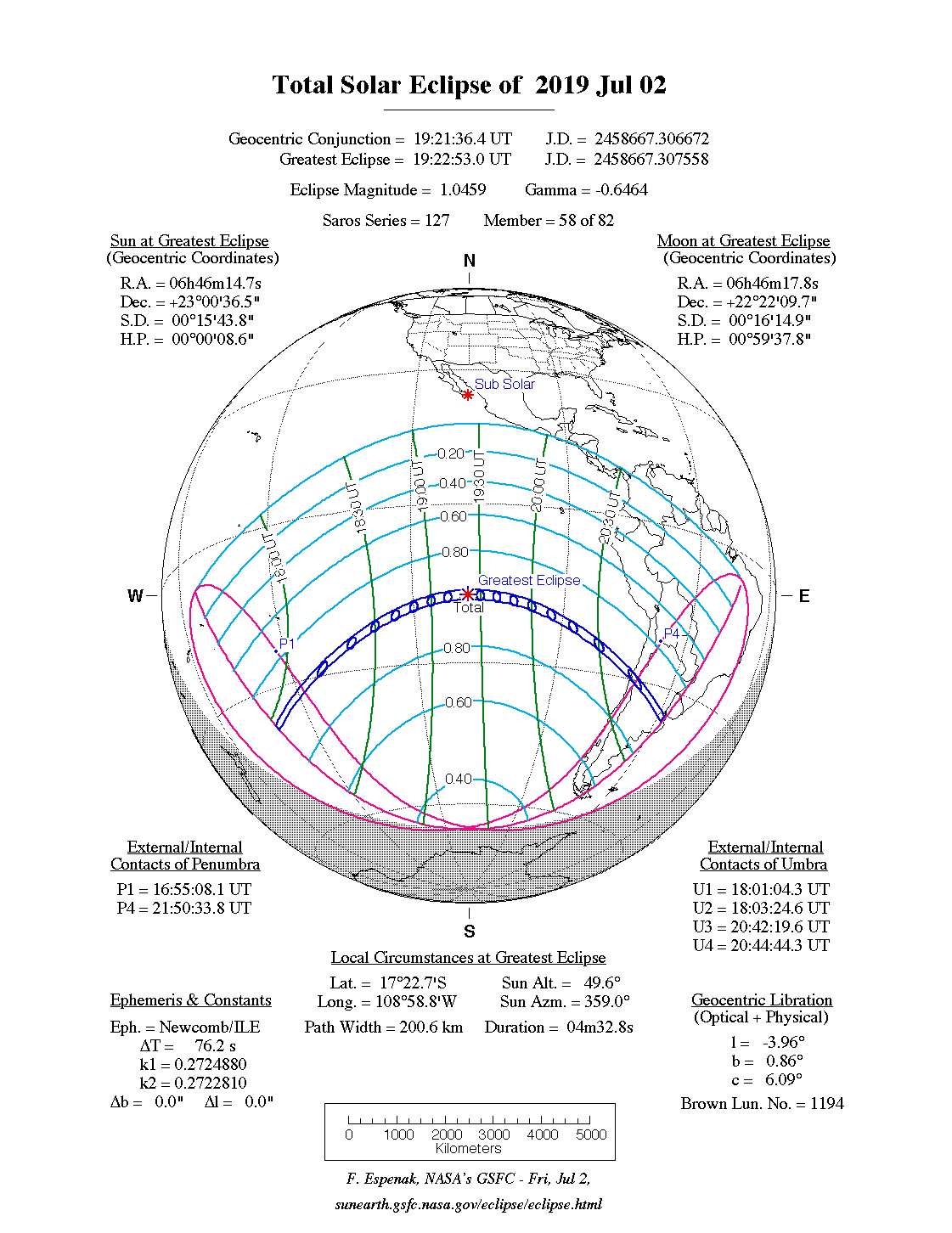
While Australia will not see this there are a number of webcams and live sterams you can watch it on.
The ESO live stream from LaSilla begins 19:15 UT (5:15 am AEST July 3) almost one and a half hours before totality.
https://www.eso.org/public/events/astro-evt/solareclipse2019/
The exploratorium will webcast from Chile at a similar time
https://www.exploratorium.edu/video/total-solar-eclipse-live-july-2-2019
Time and date will livestream the eclipse on YouTube beginning at 1900 UT (5:00 am AEST July 3)
The the Space.com home page will also have live eclipse views.SO you have a lot to pick from to view as you enjoy your morning coffee.
Labels: eclipse, live-stream, public outreach, solar, webcam
Monday, August 21, 2017
Seeing the August 21 (UT) total eclipse on livestream

Unless you have been living under a rock you will know that on August 21 (UT) a total eclipse will sweep across the United States. The eclipse (beginning partial) starts at 16:05 UT (2:05 22 August AEST, 1:35 ACST) on the west coast of the US, ending (end of partial eclipse) at 20:09 UT on the east coast (6:09 AEST 22 August, 5:39 ACST).
This interactive map shows you that path of the eclipse and the timings for partial eclipse and totality along the path. For those of us who cannot be there to enjoy the spectacle, there are multitudes of live streams (weather permitting of course).
Of course, the number of people attempting to watch will be enormous, so be prepared for frequent crashes, but here are some highly recommended sites (Australians note, this take place in the early hours of the morning for us):
NASA live stream 12pm – 4pm EDT 21 August (2 am-6am AEST 22 August):
NASA TV https://www.nasa.gov/eclipselive
Facebook live https://www.facebook.com/NASA/videos/10155497958441772/
YouTube https://www.youtube.com/watch?v=wwMDvPCGeE0
Ustream http://www.ustream.tv/nasahdtv
NASA EDGE Live from Carbondale (21 August 11:45am – 4:15pm EDT - 1:45 am- 6:15 am AEST 22 August)
NASA Edge https://www.nasa.gov/eclipselive/#NASA+EDGE
Ustream http://www.ustream.tv/nasaedge
Facebooklive https://www.facebook.com/nasaedgefan/
Full NASA site: https://eclipse2017.nasa.gov/eclipse-live-stream
Virtual telescope project (1 p.m. EDT (1700 GMT. 1 am AEST 22 Aug)): https://www.virtualtelescope.eu/webtv/
SLOOH live cast starting at 12 pm EST (16 UT; 2 am AEST 22 August) https://live.slooh.com/shows/event-details/393
Space.com live cast (via SLOOH) https://www.space.com/19195-night-sky-planets-asteroids-webcasts.html 1:30 a.m. EDT (1530 GMT) Aug. 21 (1:30 am 22 August AEST)
The Exploratorium12 p.m. EDT (1600 GMT, 2 am AEST 22 Aug) https://www.exploratorium.edu/eclipse
Labels: eclipse, live-stream, public outreach, solar, webcam
Monday, April 18, 2016
Sunspot 2529 visible with safe viewing techniques

The sunspot is the large dark spot (click to embiggen) and the other dark stuff is junk on the CCD chip.
Sunspot 2529 is big enough to be visible with use safe solar viewing techniques. It will rotate off the sun in a the next two days, but is worthwhile looking at.
Tuesday, March 08, 2016
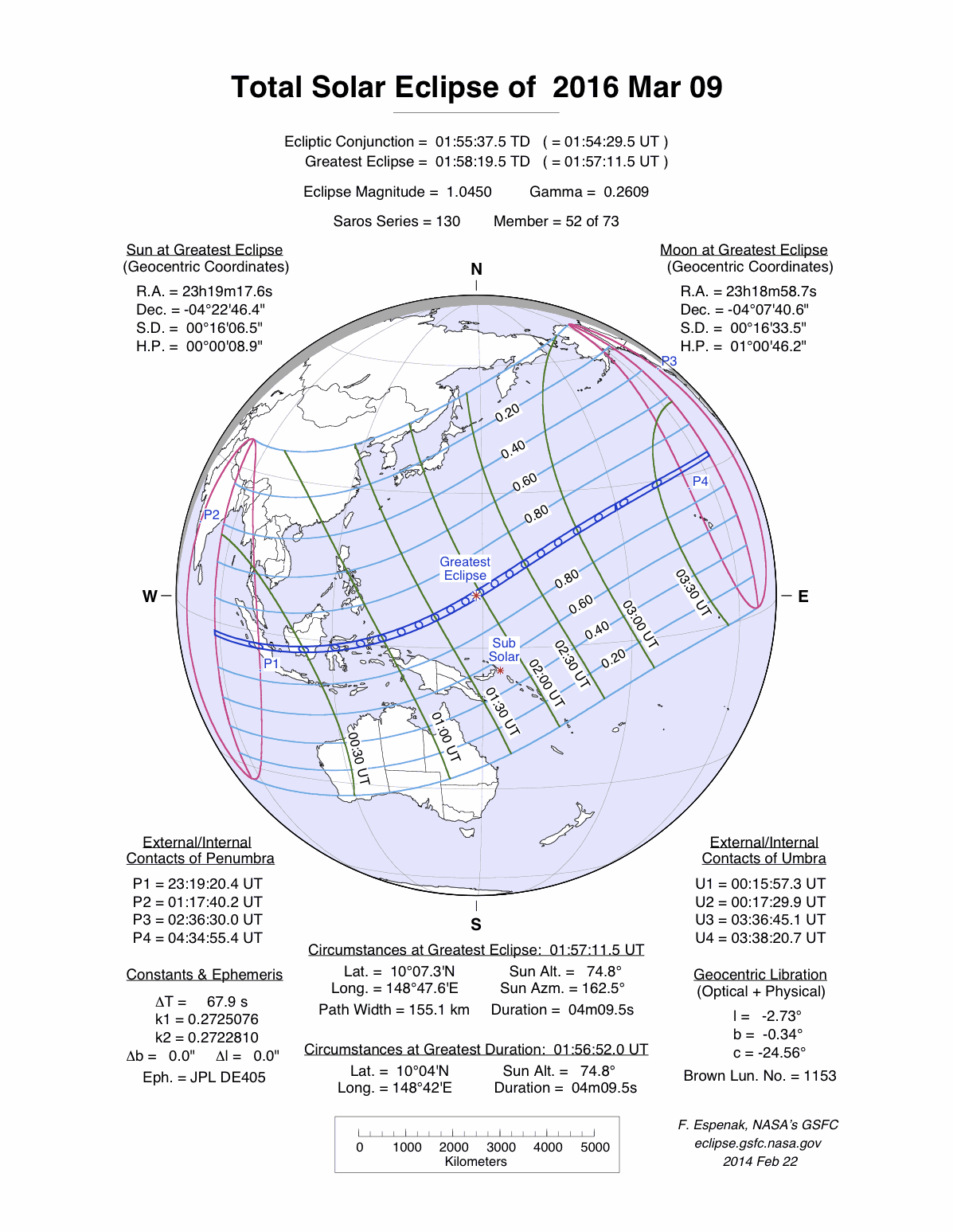
Live Webcasts of Tomorrows (March 9) Solar Eclipse.
 March 9 Partial Eclipse as seen from Darwin near maximum eclipse, 10:17 am AEST. Simulated in Stellarium.
Just a reminder that on the morning of March 9, there will be a Solar eclipse. From Australia though, we only get to see a partial eclipse, and then only from northern Australia.
Detailed timings and viewing hints for Australia are at this page.
However, if the weather is rubbish, you may want to try and watch a live webcast of the Total Solar Eclipse. Live webcasts are at:
Space.com http://www.space.com/32173-total-solar-eclipse-march-2016-webcasts.html
The Exploratorium (1:00–2:15 UT, 12-13:15 AEDST) http://www.exploratorium.edu/eclipse
NASA TV (from 01:00 UT; 12 pm AEDST) http://www.nasa.gov/multimedia/nasatv/index.html
Slooh (23:00 UT; 10 am AEDST) http://live.slooh.com/
Stars4All (22:32 UT; 10:32 AEDST) http://www.iac.es/divulgacion.php?op1=16&id=1035&lang=en
Labels: eclipse, solar, webcam
Tuesday, March 01, 2016
Partial Solar Eclipse March 9, 2016
March 9 Partial Eclipse as seen from Darwin near maximum eclipse, 10:17 am AEST. Simulated in Stellarium.On the morning of March 9, there will be a Solar eclipse. From Australia though, we only get to see a partial eclipse, and then only from northern Australia.
Viewers will see between 50% (Darwin) - 1% (Perth) of the Sun covered by the Moon, with northern Australia favoured (the opposite of last years annular eclipse). The partial solar eclipse occurs in the morning, but the sun will have well and truly risen by the time of the eclipse.
A table showing eclipse times for more Australian cities in Universal Time is here, and an interactive map of the path is here.
Do NOT look directly at the Sun! Do not use so called filters. Over exposed film, smoked glass etc. used as filters are NOT, repeat NOT safe. Only special solar-rated viewing spectacles from astronomical suppliers should be used (for one example see here), they may cost a bit, but your eyesight is without price. Never use eyepiece filters for telescopes. These can crack at inopportune times and destroy your eyesight. At no time is it safe to view the eclipse with the unaided eye.
The easiest and cheapest way to observe this event is by making a pinhole in a stiff square of cardboard and projecting the image of the Sun onto a flat surface. You are basically making a simple pinhole camera, which will reveal the changes to the Suns outline quite satisfactorily. A card with a 1 mm hole should be projected onto a surface (eg white paper, or a white wall) about 20 cm away, a 5 mm hole should be projected onto a surface 1 to 1.5 meters away.
You need to create a reasonable sized image, so you need a fair distance between the pinhole and the surface you project the image on. This will mean the image is going to be fairly dim, so you also need some sort of sun shield to keep in image in shadow. I use the longest available postpac postal tube, with alfoil over the top (and the pinhole in the alfoil), and wide ring of stiff cardboard to ensure that the image of the sun is projected into a dark area. This link will show you several methods to make pinhole projection systems.
You can also use binocular and telescopic projection systems. This link will show you how to make safe solar viewing and telescope projection systems. Here is my step by step guide to making a binocular projection system, and a guide to aiming your binoculars or telescope when you can't actually look at the Sun. And this is the projection system I use with my refractor telescope.
Remember, do NOT look directly at the Sun, as irreparable eye damage or blindness can occur (see this video for a graphic demonstration).
| City | Eclipse Start | Mid Eclipse | Eclipse End | % Sun covered |
| Alice Springs (ACST) | 9:29 am | 10:16 am | 11:06 am | 11 |
| Broome (AWST) | 7:32 am | 8:32 am | 9:37 | 37 |
| Cairns (AEST) | 10:12 am | 11:12 am | 12:15 | 18 |
| Darwin (ACST) | 9:07 am | 10:17 am | 5:28 am | 4 |
| Perth (AWST) | 8:06 am | 8:26 am | 8:47 am | 1 |
| Rochampton (AEST) | 10:55 am | 11:16 am | 11:38 | 1 |
| Townsville (AEST) | 10:21 am | 11:12 am | 12:05 | 10 |
Wednesday, April 30, 2014
My Solar Eclipse, Tuesday April 29 2014.
 |  |
 |  |
 |  |
So I'm standing in the carpark across from where SmallestOne goes for his tutoring. SmallestOne, his tutor, his class mate and her family are taking turns to use the eclipse glasses to see the Sun with a chunk out of it. Behind me my telescope sits neglected, maximum eclipse has passed and I still haven't set it up. Instead I'm showing people how to use a water cracker as a pinhole camera to see the cresent Sun.
I couldn't be happier.

So instead of camping out somewhere overlooking the sea, I tossed as much gear as I could in the back of the car on the off-chance that the sky would clear and took SmallestOne to tutor while the clouds broke and scudded fitfully across the eclipsing Sun.
When I dropped him off I invited the tutor and the kids to come out and have a look at the eclipse, then wandered back to the car and began setting up my gear.
Then I got a phone call from radio 774 ABC Melbourne about the eclipse, Melbourne being clouded out I did a live "what the eclipse looks like" commentary with added water crackers (I picked that up off the net somewhere, I wish I could remember where, but it worked a treat). While I talk the clouds come and go, but have thinned out enough the the elipse Sun is glimpsed more often than not.
SmallestOne, his tutor, his class mate and her family then joined me in the car park, and other folk gather around to see what is happening, eclipse glasses are a passed around and people Ohh and Awww.
SmallestOne and his group go back to study, and I set up the telescope in the retreating wedge of light where the Sun shines between buildings. It takes me a while to set up, pointing a telescope at the Sun when you can't actually look at it or use the viewfinder is tricky, but I finally get set up and start snapping as more people wander up and ask what is going on.
Maximum eclipse is well and truly over but I don't care, SmallestOne has experienced his first Solar eclipse.
Monday, April 28, 2014
Final Reminder: Partial Solar Eclipse Visible in Australia on Tuesday 29 April, 2014
 Partial Solar Eclipse as seen from Adelaide near maximum eclipse, 4:37 pm
ACST 29 April 2014. Simulated in Celestia. Click to embiggen.
Partial Solar Eclipse as seen from Adelaide near maximum eclipse, 4:37 pm
ACST 29 April 2014. Simulated in Celestia. Click to embiggen. This is a final reminder that on the late afternoon of April 29, there will be a partial eclipse of the Sun, visible from almost all of Australia.
Unlike this month’s Total Lunar eclipse, a partial Solar Eclipse is never safe to look at, and you will need to use safe solar viewing techniques.
 During the May 10, 2013 Partial Solar eclipse, gaps between the vine leaves on my verandah acted as a pinhole camera and cast shadows of the eclipse on the wall. Click to embiggen.
 While you may baulk at trying to see a partial Solar Eclipse late on a work day where you can’t drag equipment around with you, even a simple pinhole or leaf shadows will allow you to see the eclipse (more leaf images here).
The eclipse will be very low to the horizon, with maximum eclipse in some places like Brisbane and Sydney occurring as the Sun is setting. Nonetheless, it is well worth trying to observe using safe solar viewing techniques (as noted above).
You will need some place with a low, clear horizon (some place high preferably) as the Sun will be low to the horizon (at maximum eclipse in Melbourne, the Sun will be a mere handspan from the horizon, in Adelaide 2 handspans and in Hobart a mere two fingerwidths). If you have a good view over the water, you will able to see the crescent Sun sinking below the waves. Even viewing the eclipse using pinhole projection in a towering high-rise will be interesting (and may impress your co-workers).
Of course, if you start looking earlier, you will see the early parts of the eclipse when the Sun is a bit higher. At maximum eclipse southern Australia will notice a definite chill and a slight but definite darkening as the Suns face is obscured.
Eclipse timings (eclipse start, maximum eclipse and eclipse end) for major cites (and links to times for other areas), more viewing guides and further safe solar observing instructions can be found at my eclipse site.
You can get predictions of cloud cover on the day from Skippy Sky.
Saturday, April 26, 2014
Reminder, Partial Solar Eclipse Visible in Australia Tuesday 29 April, 2014

Just a reminder that there is a partial solar eclipse visible in Australia on the afternoon of Tuesday the 29th of April.
Unlike the recent Total Lunar Eclipse you CANNOT look at the eclipse directly and must use safe solar viewing techniques (projection or special solar glasses, see my link below)
This will be visible from all of Australia, although the best views will be from Southern Australia, with Tasmania favoured.
The eclipse occurs in the late afternoon, with the sun setting at maximum eclipse in places like Brisbane and Sydney. Eclipse timings, viewing guides and safe solar observing instructions can be found at my eclipse site.
Thursday, April 17, 2014
Partial Solar Eclipse, April 29 2014


On the afternoon of April 29, there will be an annular Solar eclipse. In an annular eclipse the Moon does not completely cover the Sun, and the Sun forms a thin ring around the Moon at maximum eclipse depth. From Australia though, we only get to see a partial eclipse.
Viewers will see between 64% (Hobart) - 4% (Darwin) of the Sun covered by the Moon, with southern Australia favoured (the opposite of last years annular eclipse). The partial solar eclipse occurs close to sunset and in some places such as Sydney and Brisbane the Sun sets during maximum partial eclipse (see the table below). This is an excellent opportunity of get dramatic images of the "Crescent" sun setting. You will, however, need a flat, unobstructed horizon to see the eclipse at its best.
A table showing eclipse times for more Australian cities in Universal Time is here, and a map of the path is here.
Do NOT look directly at the Sun! Do not use so called filters. Over exposed film, smoked glass etc. used as filters are NOT, repeat NOT safe. Only special solar-rated viewing spectacles from astronomical suppliers should be used (for one example see here), they may cost a bit, but your eyesight is without price. Never use eyepiece filters for telescopes. These can crack at inopportune times and destroy your eyesight. At no time is it safe to view the eclipse with the unaided eye.
The easiest and cheapest way to observe this event is by making a pinhole in a stiff square of cardboard and projecting the image of the Sun onto a flat surface. You are basically making a simple pinhole camera, which will reveal the changes to the Suns outline quite satisfactorily. A card with a 1 mm hole should be projected onto a surface (eg white paper, or a white wall) about 20 cm away, a 5 mm hole should be projected onto a surface 1 to 1.5 meters away.
You need to create a reasonable sized image, so you need a fair distance between the pinhole and the surface you project the image on. This will mean the image is going to be fairly dim, so you also need some sort of sun shield to keep in image in shadow. I use the longest available postpac postal tube, with alfoil over the top (and the pinhole in the alfoil), and wide ring of stiff cardboard to ensure that the image of the sun is projected into a dark area. This link will show you several methods to make pinhole projection systems.
You can also use binocular and telescopic projection systems. This link will show you how to make safe solar viewing and telescope projection systems. Here is my step by step guide to making a binocular projection system, and a guide to aiming your binoculars or telescope when you can't actually look at the Sun. And this is the projection system I use with my refractor telescope.
Remember, do NOT look directly at the Sun, as irreparable eye damage or blindness can occur (see this video for a graphic demonstration).
| City | Eclipse Start | Mid Eclipse | Eclipse End | % Sun covered |
| Adelaide (ACST) | 3:25 pm | 4:37 pm | sets 5:35 pm | 51 |
| Alice Springs (ACST) | 3:44 pm | 4:47 pm | 5:54 pm | 26 |
| Brisbane (AEST) | 4:31 pm | 5:17 pm | sets mid eclipse | 24 |
| Cairns (AEST) | 4:25 pm | 5:01 pm | sets 5:59 pm | 10 |
| Canberra (AEST) | 4:05 pm | 5:12 pm | sets 5:22 pm | 46 |
| Darwin (ACST) | 4:21 pm | 4:55 pm | 5:28 pm | 4 |
| Hobart (AEST) | 3:51 pm | 5:00 pm | sets 5:17 pm | 64 |
| Melbourne (AEST) | 3:58 pm | 5:07 pm | sets 5:35 pm | 55 |
| Perth (AWST) | 1:17 pm | 2:42 pm | 3:59 pm | 49 |
| Sydney (AEST) | 4:14 pm | 5:15 pm | sets mid eclipse | 41 |
| Townsville (AEST) | 4:49 pm | 5:30 pm | sets 5:52 pm | 10 |
Sunday, February 09, 2014
Coming Events: A Year of Southern Astronomy for 2014

Significant Astronomical events that can be seen with the unaided eye or minimal equipment in 2014 in Australia (and to some degree elsewhere in the Southern Hemisphere, ocultations and eclipses are very region specific).
While I've written of the high profile events of this year for ABC science online (see here) there's a lot more on offer.
Special events are bolded. April has both a lunar eclipse and a partial solar eclipse.
| Date | Event |
| 6 January 2014; | Jupiter at opposition |
| 15 January 2014; | Moon Near Jupiter |
| 23 January 2014; | Moon Near Mars |
| 26 January 2014; | Moon Near Saturn |
| 29 January 2014; | Moon Near Venus |
| 11 February 2014; | Moon Near Jupiter |
| 19 February 2014; | Moon Near Mars |
| 22 February 2014; | Moon Near Saturn |
| 22 February 2014; | Ocultation of Saturn (daytime) |
| 26 February 2014; | Moon Near Venus |
| 28 February 2014; | Moon Near Mercury |
| 10 March 2014; | Moon close to Jupiter |
| 18 March 2014; | Moon close to Mars |
| 20-21 March 2014; | Moon close to Saturn |
| 27-28 March 2014; | Moon close to Venus |
| 29 March 2014; | Moon close to Mercury |
| 7 April 2014; | Moon close to Jupiter |
| 9 April 2014; | Mars at opposition |
| 14 April 2014; | Moon close to Mars |
| 15 April 2014; | Total Lunar Eclipse |
| 17 April 2014; | Moon close to Saturn |
| 26 April 2014; | Moon close to Venus |
| 29 April 2014; | Annular eclipse of the Sun |
| 4 May 2014; | Moon and Jupiter close together. |
| 7 May 2014; | Eta Aquarid meter shower. |
| 11 May 2014; | Moon and Mars close together. |
| 11 May 2014; | Opposition of Saturn. |
| 14 May 2014; | Moon and Saturn close. |
| 14 May 2014; | Occultation of Saturn. |
| 26 May 2014; | Moon close to Venus |
| 1 June 2014; | Crescent Moon and Jupiter close together. |
| 7-8 June 2014; | Moon and Mars close together. |
| 10 June 2014; | Moon and Saturn close. |
| 25 June 2014; | Crescent Moon and Venus close. |
| 26 June 2014; | Crescent Moon near Mercury. |
| 29 June 2014; | Crescent Moon near Jupiter. |
| 6 July 2014; | Moon, Spica and Mars close. |
| 8 July 2014; | Moon and Saturn close. |
| 13 July 2014; | Mars and star Spica closest. |
| 24 July 2014; | Venus and crescent Moon close. |
| 25 July 2014; | Mercury and crescent Moon close. |
| 3 August 2014; | Mars and waxing Moon close. |
| 4 August 2014; | Occultation of Saturn by Moon. |
| 18 August 2014; | Venus and Jupiter close. |
| 24 August 2014; | Venus and crescent Moon close. |
| 25 August 2014; | Mars and Saturn close. |
| 27 August 2014; | Mercury and crescent Moon close. |
| 31 August 2014; | Saturn and Moon close. |
| September: | Comets C/2012 K1 PanSTARRS and C/2103 V5 Oukaimaden (just) visible to the unaided eye |
| 1 September 2014; | Moon close to Mars. |
| 20 September 2014; | Mercury and Spica close. |
| 20-21 September 2014; | Moon close to Jupiter. |
| 26 September 2014; | Crescent Moon close to Mercury and Spica. |
| 28 September 2014; | Moon and Saturn close. |
| 29 September 2014; | Moon and Mars close. |
| October: | Comets C/2012 K1 PanSTARRS and C/2103 V5 Oukaimaden (just) visible to the unaided eye, comet 2013 A1 Siding Spring comes close to Mars |
| 8 October 2014; | Total Eclipse of the Moon. |
| 18 October 2014; | Moon close to Jupiter. |
| 22 October 2014; | Orionid meteor shower. |
| 28 October 2014; | Mars close to crescent Moon. |
| 15 November 2014; | Moon close to Jupiter. |
| 26 November 2014; | Moon close to Mars. |
| 17 November 2014; | Leonid Meteor Shower. |
| 11-12 December 2014; | Moon close to Jupiter. |
| 15 December 2014; | Geminid Meteor shower. |
| 20 December 2014; | Crescent Moon close to Saturn. |
| 23 December 2014; | Crescent Moon close to Venus and Mercury. |
Labels: comet, eclipse, Jupiter, Mars, Moon, Occultation, Saturn, solar
Sunday, January 12, 2014
Say Farewell to Sunspot AR1944

Focus not so crash hot today. Click to embiggen
See previous images here.
Sunday, January 05, 2014
Giant Sunspot AR 1944 Easily Visible with Safe Solar Observing Techniques.

Giant Sunspot AR 1944 is big enough to be seen without magnification, just using eclipse viewing glasses. I could easily see it this afternoon with just eclipse glasses (I did get the scope out as well, as you can see above).
It is readily visible in other safe solar projection systems. The following link will show you several methods to make pinhole projection systems.
You can also use binocular and telescopic projection systems. This link will show you how to make safe solar viewing and telescope projection systems. Here is my step by step guide to making a binocular projection system, and a guide to aiming your binoculars or telescope when you can't actually look at the Sun. And this is the projection system I use with my refractor telescope.
For aurora fans, AR 1944 has the complex magnetic field that can produce X class flares. If a strong flare goes off in the next day or so we may be in for aurora-producing conditions.
(Hat tip to Suzy Webb and Andrew Wall)
Labels: aurora, solar, sunspot
Friday, May 10, 2013
Quick Images of the Solar Eclipse from Adelaide, 10 May 2013
 |  |
| The Sun finally rises above the cloud at 7:42 am (binocular projection) Click on this or any image to embiggen for greater viewing pleasure | Near maximum eclipse, 8:15 am. Taken through my 4" Newtonian with a 30 mm Plossl eyepiece and a Canon IXUS 400 ASA 1/500 sec exposure (infinity to infinity focussing). Nice and clear, good detail on the sunspots, shame about the guff on the CCD chip (upper left) |
|  |
| Gaps between the vine leaves on the verandah acted as a pinhole camera and cast shadows of the eclipse on the wall. | As the Moon moved off the Sun, the cloud came over again. This is a nice effect I think. The image is brighter due to auto exposure over compensating. |
 |  |
| The Moon edges off the Sun - Binocular Projection | 9:20 am, the Moon is just about to leave the Sun. Foolishly, I tried to swap lenses. This was a disaster, went back to the original lens, but forgot to adjust the focus (GRRR) so everything is slightly out of focus. |
so I got up at 5:30 am to prepare for the eclipse. Most of that preparation was making the boys lunches early so I didn't have to interrupt eclipse viewing to get them ready. Needn't have bothered as the cloud meant the Sun wasn't visible until after they had left for School.
All the plans I had made for viewing the eclipse were thrown out by the cloud lurking on the horizon. There was no point going to the viewing spot I selected as the cloud rendered it pointless, so I viewed from my back yard instead.
At least that gave me plenty of time to set up my telescope and binocular projection system. I was also going to set up the SLR camera, but the solar filter I had made for it was tidied away in the Great Room Renovation, and I stuck with the two systems I had.
The Sun finally struggled through the clouds, already significantly eclipsed. But it did look quite dramatic with the cloud streaked over it. This was the point everything started to go wrong with the telescope. First I couldn't get the scope pointed, after much struggle and a strategic move of a portable washing line to project the shadow of the scope, I finally got it lined up. Then the camera adaptor wouldn't adapt. I've been using it quite a lot, but this morning I just couldn't get anything to align.
I finally got it set up and taking pictures just before maximum eclipse, and got through util 8:30, when I had to take smallest one to School. He did see the eclipse at maximum, and the pinhole shadows made by the vine leaves though. I was noticeably cool as we walked to school.
When I got back, clouds had come over again. After a bit of futzing around I got imaging again.
Then I had the bright idea of swapping lenses from the 30 mm Plossl to the 25 mm Plossl, we that was a disaster, if I had trouble with the camera adaptor with the 30 mm, the 25 mm was a nightmare. Note that this is my workhorse combination for lunar imaging, so I have no idea why it went pear-shaped today.
Went back to the 30 mm, and started taking snaps, as the Moon edged off the Sun. To capture it clearly, I ran set of 10 auto exposures. It was only after the eclipse was over that I realised that I had forgotten to refocus after swapping lenses, so I have a complete set of the Sun moving off the Moon, out of focus.
Still, I got to see it, and it was awesome.The sight of the eclipsed Sun emerging through the clouds, the crescent shadows, the big bite through the Sun, the cool effects of thin cloud going over, and sharing it with SmallestOne. Who cares if a few photos are out of focus.
Labels: eclipse, partial, solar
Thursday, May 09, 2013
Reminder; Annular Eclipse Friday May 10, 2013

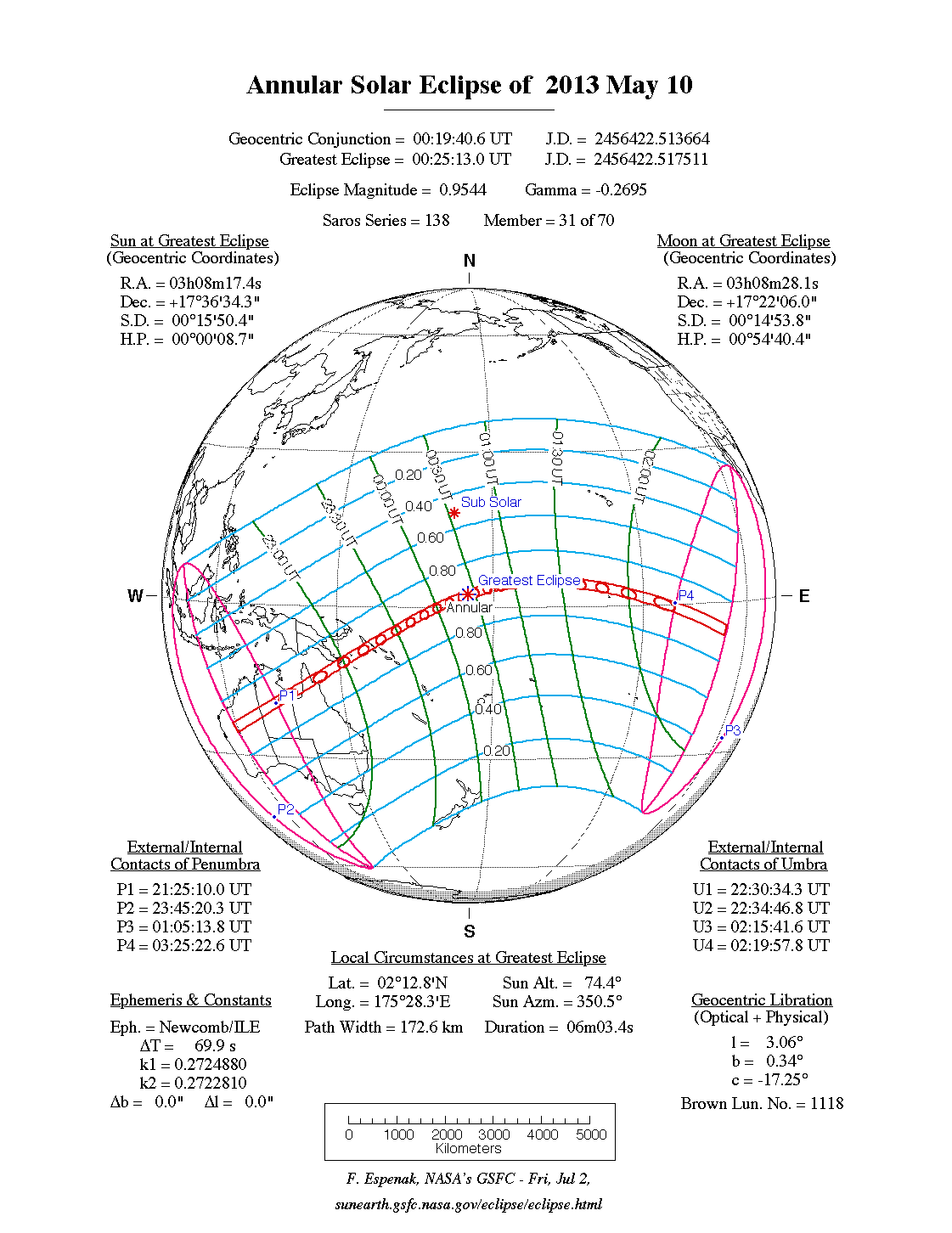
Just a reminder that an annular Solar eclipse will take place early this Friday morning, May 10.
The annular eclipse starts in remote Western Australia, and the eclipse track passes through the Northern Territory, over far North QLD, then passes over Papua New Guinea, the Solomon Islands and Gilbert Islands before reaching its greatest eclipse near Kiribati.
Outside the annular eclipse track, people will see a partial eclipse, with most of Australia, North Island New Zealand, Indonesia and many pacific nations such as New Britain, New Caledonia, Micronesia, Vanuatu, Tuvalu and the Marshal Islands seeing significant partial eclipses.
This Google Map from the NASA eclipse site will allow you zoom into the eclipse track. Click anywhere on the map and a pop-up will inform you when the eclipse is (in Universal Time, UT) and how much of the Sun will be covered. Or you may prefer a standard map with eclipse times in UT. Eclipse times for selected cities (Indonesia, Solomon Islands, New Zealand, Fiji, Honolulu etc.) along the path in UT are given in this table.
Full details of the eclipse as seen from Australia, and detailed safe viewing instructions are at my guide to the annular eclipse. I've also written an article for the ABC on viewing the eclipse.
Unlike a total eclipse, there is no time when it is safe to look at the sun without eye protection, do NOT look directly at the Sun, as irreparable eye damage or blindness can occur. Again, detailed safe viewing instructions are at my guide to the annular eclipse.
In Tasmania, the Queen Victoria Museum and Gallery is holding a safe eclipse viewing session. A live webcast will be put on by the SLOOH remote telescope.
For people coming to this page from Radio Australia, I've made the table below which show the eclipse times in local, rather than universal, time for selected localities. Other locations nearby will see similar eclipse times and durations. For the sites with Annular eclipses, the annular duration lasts between 4-5 minutes around the eclipse maximum. (Again, for Australian timings see my guide to the annular eclipse )
| City/Location | Eclipse Start | Mid Eclipse | Eclipse End | % Sun covered |
| Port Moresby | 7:30 am | 8:55 am | 10:37 am | 89 |
| Milne Bay | 7:32 am | 8:59 am | 10:46 am | 95 (annular) |
| Normanby Island | 7:33 am | 9:00 am | 10:48 am | 95 (annular) |
| Kimbe, New Britain | 7:36 am | 9:03 am | 10:50 am | 83 |
| Honiara, Solomon Islands | 8:42 am | 10:18 am | 12:19 pm | 88 |
| Choiseul, Solomon Islands | 8:39 | 10:15 am | 12:12 pm | 95 (annular) |
| Rontiki, Micronesia | 9:02 am | 10:36 am | 12:28 am | 63 |
| Mili Island, Marshal Islands | 9:20 am | 11:16 am | 1:20 pm | 83 |
| Tuvalu | 10:27 am | 12:27 pm | 2:26 pm | 66 |
| Bonriki, Kiribati | 10:15 | 12:15 pm | 2:22 pm | 95 (annular) |
Tuesday, April 30, 2013
Annular Solar Eclipse, May 10, 2013


On the morning of May 10, there will be an annular Solar eclipse. In an annular eclipse the Moon does not completely cover the Sun, and the Sun forms a thin ring around the Moon at maximum eclipse depth.
The annular eclipse will be seen from a thin strip in WA, the Northern Territory and remote far north Queensland. Everywhere else will see a partial eclipse of varying depth, the north-east coast of Australia having the best views. The eclipse starts shortly after sunrise. In places along the annular eclipse path, such as Tennant Creek (NT) and Musgrave Roadhouse (QLD), viewers will see a thin rim of Sun around the moon.
Elsewhere viewers will see between 13% (Hobart) - 83% (Cairns) of the Sun covered by the Moon (scroll down for local times for several Australian locations). A diagram showing eclipse times in Universal Time is here, and an interactive map of the path is here. Click on the map for local timings of the eclipse.
UPDATE: In addition to the local Australian times below (scroll down) I've created a table of local times for PNG and the pacific regions. That link also has a link to the SLOOH web cast and a live viewing in Tasmania. New Zealand and other places still have to make do with the dynamic Google Eclipse Map (click on the map and the times of the eclipse will pop up) or the hard copy table (all in UT).
Do NOT look directly at the Sun! Do not use so called filters. Over exposed film, smoked glass, CD's, chip packets etc. used as filters are NOT, repeat NOT safe. Only special solar-rated viewing spectacles from astronomical suppliers should be used (for one example see here), they may cost a bit, but your eyesight is without price. Never use eyepiece filters for telescopes. These can crack at inopportune times and destroy your eyesight. In the annular eclipse path, as there is always some of the solar disk visible, at no time is it safe to view the eclipse with the unaided eye.
The easiest and cheapest way to observe this event is by making a pinhole in a stiff square of cardboard and projecting the image of the Sun onto a flat surface. You are basically making a simple pinhole camera, which will reveal the changes to the Suns outline quite satisfactorily. A card with a 1 mm hole should be projected onto a surface (eg white paper, or a white wall) about 20 cm away, a 5 mm hole should be projected onto a surface 1 to 1.5 meters away.
You need to create a reasonable sized image, so you need a fair distance between the pinhole and the surface you project the image on. This will mean the image is going to be fairly dim, so you also need some sort of sun shield to keep in image in shadow. I use the longest available postpac postal tube, with alfoil over the top (and the pinhole in the alfoil), and wide ring of stiff cardboard to ensure that the image of the sun is projected into a dark area. This link will show you several methods to make pinhole projection systems.
You can also use binocular and telescopic projection systems. This link will show you how to make safe solar viewing and telescope projection systems. Here is my step by step guide to making a binocular projection system, and a guide to aiming your binoculars or telescope when you can't actually look at the Sun. And this is the projection system I use with my refractor telescope.
Remember, do NOT look directly at the Sun, as irreparable eye damage or blindness can occur (see this video for a graphic demonstration).
| City | Eclipse Start | Mid Eclipse | Eclipse End | % Sun covered |
| Adelaide (ACST) | 7:09 am | 8:15 am | 9:22 am | 38 |
| Alice Springs (ACST) | below horizon | 8:07 am | 9:31 am | 79 |
| Brisbane (AEST) | 7:41 am | 8:58 am | 10:28 am | 40 |
| Cairns (AEST) | 7:28 am | 8:49 am | 10:27 am | 83 |
| Canberra (AEST) | 7:50 am | 8:55 am | 10:10 am | 26 |
| Darwin (ACST) | below horizon | 8:07 am | 9:28 am | 68 |
| Hobart (AEST) | 8:06 am | 8:59 am | 9:57 am | 13 |
| Melbourne (AEST) | 7:50 am | 8:52 am | 10:02 am | 25 |
| Musgrave Roadhouse (AEST) | 7:26 am | 8:47 am | 9:29 am | 95 Annular Eclipse |
| Perth (AWST) | below horizon | below horizon | 7:45 am | - |
| Rockhampton (AEST) | 7:34 am | 8:54 am | 10:30 am | 56 |
| Sydney (AEST) | 7:50 am | 8:57 am | 10:14 am | 27 |
| Tennant Creek (ACST) | 6:57 am | 8:07 am | 9:28 am | 95 Annular Eclipse |
| Townsville (AEST) | 7:29 am | 8:49 am | 9:28 am | 74 |
Thursday, November 29, 2012
Still More Solar Eclipse Images (Port Douglas Edition)
 |  |
 |  |
 |  |
For these shots Cynthia used a Panasonic Lumix DC with Baader solar film. Terrific results with a really simple setup.
Labels: Cynthia Ma, eclipse, solar, Sun
Sunday, November 25, 2012
More Solar Eclipse Goodness
Labels: Comet Al, eclipse, solar, Sun
Thursday, November 22, 2012
More Eclipse Images (From NewZealand)
.jpg)
The clouds give it a nice atmospheric effect, and the sunspots are crisp and clear.
Labels: eclipse, solar, Sun, Tony Travaglia



 Click to read about or order
 Click to read about or order
 Click to read about or order
 Click to read about or order