Wednesday, November 18, 2026
No Leonid Meteor Storm tonight, but Maybe Leonid Storms in 2033+
To be read in conjunction with the Tangent section of the astrophiz podcast #245

Similar views will be seen elsewhere at the equivalent local time . Click to embiggen.
The starburst indicates the radiant, the apparent point of origin of the meteors (they can actually first appear much further away from the radiant).
Today is the 60th anniversary of the Spectacular Leonid storm of 1966 (and the 25th anniversary of the 2001 storm). The Leonids are an iconic meteor shower due to spectacular displays roughly every 33 years, with major storms in 1833, 1966, 2001 and 2002.
I particularly remember the 2001 Leonids, which I saw from Alice Springs. Meteors streaming above my head like rain.
Since then the Leonids have not been spectacular, this year under good conditions we can only expect to see around 3 per hour from Australia (from a ZHR of 15, The figure ZHR is zenithal hourly rate. This is the number of meteors that a single observer would see per hour if the shower's "point of origin", or radiant, were at the zenith and the sky was dark enough for 6.5-magnitude stars to be visible to the naked eye. In Australia the radiant does not get near the Zenith).
Meteor showers are predicable; they are the dust trails of comets (and the Asteroid Phaeton). Following the orbit of the parent comet and occurring at yearly intervals almost like clockwork as we cross the dust streams of emitted by the parent object.
Comet storms are not so predictable (or weren’t until seminal work back in 1999-2000 on the Leonid storms). The Leonids are due to dusty debris from Comet Tempel-Tuttle slamming into Earth's atmosphere. The next perihelion of the Leonids’ parent comet, 55P/Tempel-Tuttle, is due on May 20, 2031, so we should expect elevated rates around then.
Now, while Leonid meteor storms roughly coincide with the perihelion passage of the comet, the storms themselves are NOT due to the dust generated during perihelion passage, but older dust streams, the 2001 Leonids were due to impacts from the dust streams emitted centuries earlier in 1667, 1866 and 1699.
How can we decide that these dust streams are responsible? We model the behavior of dust emitted that those times, we know the orbit and the gravitation and non-gravitational (such as radiation pressure) on the dust trails, along with the resonance effects of Jupiter and an estimate of the ejection velocity of the dust grains.
From these we can model the obits of the ejected dust plumes and see when they will cross earths path, The predictions were spectacularly successful for 1999 and 2001, with accurate predictions of timing an a bit of an overestimate on the rates (but still predicting storms). Reviews of two decades of predictions conclude that peak times are routinely predicted to ±0.5 h. Rates not so much.
A new model has predicted storm conditions for 2033 to 2034. This model improves the analysis of dust ejection sites, fitted to comet observations. Error minimization was achieved by looking at past predictions and actual results, with more detailed modelling of the dust particles.
| Date and time | Rate | Location |
| 2033: November 17th, 22:56 UT | ZHR=~1400 meteors per hour. | Timing favours Asia. |
| 2034: two peaks. 1st peak: November 18th, 3:30 UTC, | ZHR=~1400 meteors per hour. | Timing favours Europe, Africa. |
| 2034:2nd peak: November 18th, 23:45 UT | ZHR=~1200 meteors per hour. | Peak favours: Asia, Europe, Africa. Europe & Africa get a meteor storm two nights in a row! |
| 2035: no storm, still a strong outburst. November 19th, 14:16 UT | ZHR=~650 meteors per hour. | Timing favours the Far East. |
Often there are increases in the Leonid rates 3-4 years before the comet Temple-Tuttle's perihelion, but new model (and some older models) suggest that there will be pretty much background rates until 2033.
Labels: Astrophiz, Leonids, Meteors, public outreach

Monday, November 16, 2026
Celebrate Voyager 1 Traveling One Light Day From Earth on Tuesday November 17
 |  |
| The western horizon as seen from Adelaide at 20:46 ACDST (10:16 UT) most of Ophiuchus and Voyager 1 is below the horizon (click to embiggen) | The western horizon as seen from Sydney at 21:16 AEDST (10:16 UT) most of Ophiuchus and Voyager 1 is below the horizon (click to embiggen) |
On Wednesday November 18, at 10:16 UT (19:16 AEDST, 20:46 ACDST, 16:16 AWST) Voyager 1 will be 1 light day from Earth. It will be the furthest human made object from Earth and is well and truly interstellar having passed the heliopause into interstellar space on 25 August 2012.

NASA invites you to celebrate this achievement early, by shining torches (or other light making equipment) at the sky after sunset on Tuesday 17 November.
I think the reason is that when Voyager crossed the light-day mark is 5:16:07 a.m. Eastern Standard Time (EST) on Wednesday 18 November in the US, and getting up at Dark O'Clock is hard to do, as I know only too well.
For most of us Australians, Voyager 1 and the constellation it is in, Ophiuchus, will have basically set on the 17th and the 18th, but you can still aim your light makers at the Western horizon to celebrate with the rest of humanity on the 17th, and again on the 18th when the real landmark is passed. In Western Australia it is still daylight, but Voyager will be in the sky as you flash the western horizon at 18:16 AWST.
NASA suggests you flash the Morse code for the Voyager abbreviation VGR at this time. ...-|--.|.-.
V - Dot-Dot-Dot-Dash
G - Dash-Dash-Dot
R - Dot-Dash-Dot
or use their computerized flasher on your mobile device.
Why not get thoghter with friends and family for this historic occasion and flash Morse at the sky?
Labels: public outreach, space probe
Thursday, February 26, 2026
No, you won't be able to see all 6 planets lined up on February 28, 2026
 |  |
| North-western sky on the evening of Saturday, February 28 as seen from Adelaide at 20:20 ACDST (30 minutes after sunset, click to embiggen). | Western sky on the evening of Saturday, February 28 as seen from Los Angeles at 18:29 local time (30 minutes after sunset, click to embiggen). |
Despite a variety of claims on the internet, you won't be able to see all 6 planets lined up on February 28, 2026 (UPDATE).
The good news is that they are lined up. The bad news is that they are too deep in the twilight to see.
At civil twilight, 30 minutes after sunset, if you have a clear, level, unobstructed horizon, Mercury, Venus, Saturn and Neptune are invisible in the twilight glow (Mercury has set in the southern hemisphere), as is Uranus. Jupiter *might* just be visible.
Venus may be visible in binoculars (or if you have very good eyesight) in the Northern hemisphere low in the twilight if the horizon conditions are clear. UDPATE: In some places in the Northern hemisphere, Venus may be high enough to see at nautical twilight. Daniel Fischer was able to image it at nautical twilight in Bochum in the EU https://scicomm.xyz/@cosmos4u/116133837700056539 .
60 minutes later at astronomical twilight, when the sky is darker, Venus and Saturn have set (well they are right on the horizon in the Northern Hemisphere and still is high in some places see update above) and Uranus will be just visible in binoculars (Jupiter will be well visible).
Labels: lineup, Mercury, Neptune, public outreach, Saturn, Venus
Wednesday, January 07, 2026
2026: From "Mini" Moons to "Super" Moons, a year of full Moons
 |  |  |
| Full Moon January 03, 20:33 ACDST (Moon below horizon, moon at 22:00 shown). | Full Moon February 2, 08:39 ACDST (Moon at 22:00 shown). | Full Moon March 3, 22:08 ACDST, Total Lunar Eclipse. |
 |  |  |
| Full Moon April 02, 12:42 ACST FM9:30 (Moon below horizon, moon at 21:00 shown). | Full Moon May, 2 02:52 ACST (shown at 18:58 ACST) | Full Moon May 31 18:17 ACST Antares is just coming out of occultation ("Blue" apogee moon +19hrs apogee 15:02 1st June, Full Moon 19:15 31st.) |
 |  |  |
| Full Moon June 30 09:27 ACST, shown at 18:49 ACST. | Full Moon July 30 00:06 ACST. | Full Moon August 28 13:48 ACST (Moon shown at 19:18 ACST) |
 |  |  |
| Full Moon September 27 02:19 ACST | Full Moon October 26 14:42 ACDST (Moon shown at 21:11 ACDST) | Full Moon November 25 01:23 ACDST (Perigee, 25th 21:59 ACDST +20h, Moon shown at Perigee time) |
 |  |  |
| Full Moon December 24 11:58 ACDST ( Perigee, 24th 9:31 ACDST +7h) Moon below horizon at both times, and show at 21:49 ACDST | First Quarter perigee moon at 21:58 ACDST on February 24. Actual First Quarter is 8:48 on the 25th and perigee is 21:58 (a 1 day 10 hour difference). | First Quarter apogee moon at 19:34 ACST on September 19, actual First Quarter is 07:19, apogee is 13:30 (an ~6 hour difference). The size difference will be clear in telescopes. |
 |  |  |
| First Quarter Moon at 21:20 ACST (10:50 UT) on April 24. The inset shows the Lunar X (top) and Lunar V (bottom), the dates and times that the Lunar X can be seen are shown in the table below | First Quarter Moon at 20:11 ACST (9:41 UT) on June 22. The inset shows the Lunar X (top) and Lunar V (bottom), | First Quarter Moon at 16:07 ACST (05:37 UT) on October 18. The moon is in daylight, but the lunar X is still visible in twilight.The inset shows the Lunar X (top) and Lunar V (bottom), |
Dates and time Lunar X and V are visible. Typically visible from about 4hours from the starting time, times in colour are daylight saving times.
| Date | UT | AEST | ACST | AWST |
| Feb 24 | 0731 | 18:30 | 18:01 | 15:31 (WA: X visible at twilight and when sky is full dark). |
| Apr 24 | 10:50 | 21:50 | 21:20 | 18:50 |
| June 22 | 09:41 | 20:41 | 20:11 | 17:41 (WA: X visible at twilight better when sky is full dark) |
| Aug 20 | 06:30 | 17:30 | 17:00 | 14:30 (moon in twilight on east coast, daylight WA, but X still visible in twilight) |
| Oct 18 | 05:37 | 16:37 | 16:07 | 13:37 (moon in daylight, X but still visible in twilight) |
| Dec 16 | 09:35 | 20:35 | 20:05 | 17:35 (moon in twilight on east coast, daylight WA, but X still visible in when full dark in all states) |
A year of full Moons showing the variation in size as the moons move from perigee to apogee. I also show the apogee and perigee First Quarter Moons and the dates and times you can see the Lunar X and V. All the moons are shown on the day and time they are full (unless they are below the horizon, in which case the size at astronomical twilight is shown and the time of actual full moon is shown as well), and although this is not the optimal time for size comparisons, you can clearly see the size difference over the year (compare May 31 to December 24) the original scale for all is 2 degrees of field of view cropped down). Although the field rotation of the Moon makes it less clear, you can also see the effect of libration (January 3 vs October 26)
In 2025 we have a good Perigee Moon (December 24). However, as you can see the differences are subtle, and it requires a keen eye and good memory to distinguish a perigee "super" Moon from more ordinary moons, the best contrast is with the apogee "mini" moon of May 31.
That doesn't mean you shouldn't try though. Daniel Fischer has been able to see the difference, you can read
his account and viewing tips here:
http://earthsky.org/space/can-you-discern-supermoons-large-size-with-the-eye-an-observer-says-yes
Photographing them can be more rewarding. You can see images of perigee Moon and apogee Moon pairs from 21 Jan 2019 here and 10 August 2014 here.Tips for photographing them are here.
There is also a nice Total Lunar Eclipse on Tuesday March 3 in the early evening, a good time to show the kids and family.
Labels: apogee, Moon, perigee, public outreach, Yearly Moons
Friday, January 17, 2025
The Planetary lineup (or planet parade) of January to February 2025, what will you see

You may have seen the rather breathless statements about the up coming planetary lineup (or planet parade) often illustrated with telescope images of the planets all rather close together and claiming 6-7 planets will be present in the evening sky.
While this is (mostly) true, you won't see anything like the illustrations. The hype distracts from what is a beautiful phenomenon.The planets, only 4 of which are bright dots, are strung out from west to east along the ecliptic like beads on a wire, Jupiter and Mars are bright and in some beautiful night sky territory.
I have some charts and spotting tips below to help you enjoy this without the hype.
 |  |  |
| Evening sky on Saturday, January 18 as seen from Adelaide at 21:34 ACDST (60 minutes after sunset, Similar views will be seen from the rest of Australia at roughly the equivalent local time, click to embiggen) | Evening sky on Saturday, January 25 as seen from Adelaide at 21:30 ACDST (60 minutes after sunset, Similar views will be seen from the rest of Australia at roughly the equivalent local time, click to embiggen) | Evening sky on Friday, February 28 as seen from Adelaide at 20:20 ACDST (30 minutes after sunset, Similar views will be seen from the rest of Australia at roughly the equivalent local time, click to embiggen) |
 |  |  |
| Orientation of the inner planets on Saturday, January 18 as seen from above the plane of the solar system | Orientation of the inner planets on Saturday, January 25 as seen from above the plane of the solar system | Orientation of the inner planets on Friday, February 28 as seen from above the plane of the solar system |
 |  |  |
| Orientation of the outer planets on Saturday, January 18 as seen from above the plane of the solar system | Orientation of the outer planets on Saturday, January 25 as seen from above the plane of the solar system | Orientation of the outer planets on Friday, February 28 as seen from above the plane of the solar system |
Basically, you can only see 4 of the 6-7 with your unaided eye, and rather than all being scrunched up close together, they are spread out over most of the sky from west to north-east.
From the 18th of January to mid February, face west, looking 60 minutes after sunset. Venus is obvious above the western horizon as the brightest object in the sky. Much dimmer Saturn is a spark just above obvious Venus. Turning to the north the next brightest object is golden Jupiter, the second brightest object in the sky after Venus, just below bright red star Aldebaran and the "V" of the Hyades, not far from the delightful Pleiades cluster. Then looking towards the north east, bright red Mars, just past opposition and the third brightest object in the sky, just edging out the bright star Sirius, is lined up with the pair of stars Castor and Pollux, in Gemini. Neptune is telescope visible only and will be difficult to see low on the horizon (see charts above).

The black and white chart suitable for printing shows the location of Uranus, the circle is the approximate field of view of 10x50 binoculars.
The best times to look are between 60 minutes (nautical twilight) and 90 minutes (astronomical twilight, when the sky is fully dark) after sunset, and it helps if you have a clear and level western horizon. Although Venus and Saturn set about 30 minutes or so after astronomical twilight, ~ 2 hours after sunset, trees and houses tend to get in the way.
You should be able to see this lineup from now until around 15 February, when Saturn is too low in the twilight to see (although you should be able to see it with binoculars).
After January the 18th, Saturn draws away from Saturn as the pair lower in the evening twilight. On February the first the crescent Moon is between Saturn and the obvious bright Venus low above the western horizon 60 minutes after sunset. The Moon then goes on to visit all the bright planets in turn over the next few days, this will look very nice . Venus is at its greatest brilliance on the 15th of February.
Although Jupiter and Mars move somewhat over this time they will be roughly where they are on the 18th of January, although Mars is fading rapidly.
Mercury Joins the line up around February the 15th, making 7 planets present, but is hard to see very low in the twilight. By Feb 28 Mercury is higher, but it, Saturn and Neptune are too deep in the twilight to see, and Venus is marginal. Binoculars will be required to see Mercury, and possibly Venus, which is now a thin crescent.
So ignore the hype and head out in the early evening to enjoy the sight as well the constellation of Orion and bright Sirius in Canis Major are there to look at too.
Labels: alignment, binocular, Jupiter, Mars, public outreach, Saturn, unaided eye, Venus
Monday, January 13, 2025
2025: From "Mini" Moons to "Super" Moons, a year of full Moons
 |  |  |
| Full Moon January 14, 08:57 ACDST (Moon below horizon, moon at 21:36 shown). | Full Moon February 13, 0:23 ACDST | Full Moon March 14, 17:43 ACDST, Moon below horizon (moon at 21:00 ACDST shown) |
 |  |  |
| Full Moon April 13, 09:52 ACST FM9:30 (Moon below horizon, moon at 19:18 shown). Apogee at 08:00 14 April +22hs. | Full Moon May, 13 02:26 ACST | Full Moon June 11 17:25 ACST (Moon is just rising) |
 |  |  |
| Full Moon July 11 06:07 ACST. | Full Moon August 09 17:25 ACST (Moon below horizon, moon at 20:06 ACST shown). | Full Moon September 8 039 ACST (Moon shown at 3:31 ACST as totality is starting) |
 |  |  |
| Full Moon October 07 14:17 ACDST (Moon below horizon, Moon at 20:50 ACDST shown) | Full Moon November 05 23:49 ACDST ( Perigee, 6th 09:30 ACDST +9h) | Full Moon December 05 9:44 ACDST ( Perigee, 4th 21:37 ACDST +12h) |
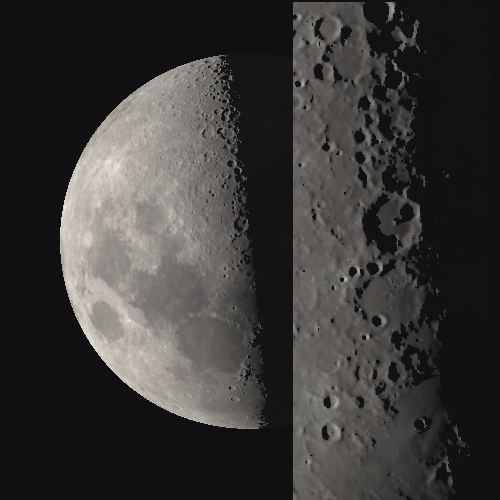 | ||
| First Quarter perigee moon at 22:18 ACDST on January 7. Actual First Quarter is midnight on the 7th and perigee is midnight on the 8th (a 24 hour difference). | First Quarter apogee moon at 23:11 ACST on August 1 at actual First Quarter, apogee is 6 am on the 2nd (an ~7 hour difference). The size difference will be clear in telescopes. | First Quarter Moon at 20:43 ACDST )10:13 UT) on January 7 the inset shows the Lunar X (top) and Lunar V (bottom), the dates and times that the Lunar X can be seen are shown in the table below |


Dates and time Lunar X and V are visible. Typically visible from about 4hours from the starting time, times in colour are daylight saving times.
| Date | UT | AEST | ACST | AWST |
| Feb 5 | 08:13 | 21:13 | 20:43 | 16:13 |
| Apr 5 | 12:43 | 22:43 | 22:17 | 20:43 |
| June 3 | 13:18 | 23:18 | 22:30 | 21:18 |
| Aug 1 | 10:57 | 20:57 | 20:17 | 18:57 |
| Sep 29 | 08:46 | 18:46 | 18:16 | 16:46 |
| Nov 27 | 10:43 | 21:43 | 21:15 | 18:43 |
A year of full Moons showing the variation in size as the moons move from perigee to apogee. I also show the apogee and perigee First Quarter Moons and the dates and times you can see the Lunar X and V. All the moons are shown on the day and time they are full (unless they are below the horizon, in which case the size at astronomical twilight is shown and the time of actual full moon is shown as well), and although this is not the optimal time for size comparisons, you can clearly see the size difference over the year (compare Apr 13 to Nov 5) the original scale for all is 2 degrees of field of view cropped down). Although the field rotation of the Moon makes it less clear, you can also see the effect of libration (January 3 vs May 13)
In 2025 we have two good Perigee Moons in a row (November 5, December 5). However, as you can see the differences are subtle, and it requires a keen eye and good memory to distinguish a perigee "super" Moon from more ordinary moons, the best contrast is with the apogee "mini" moon of April 13, even though this is not a good apogee Moon.
That doesn't mean you shouldn't try though. Daniel Fischer has been able to see the difference, you can read his account and viewing tips here:
http://earthsky.org/space/can-you-discern-supermoons-large-size-with-the-eye-an-observer-says-yes
Photographing them can be more rewarding. You can see images of perigee Moon and apogee Moon pairs from 21 Jan 2019 here and 10 August 2014 here.Tips for photographing them are here.
There is also a nice Total Lunar Eclipse on Monday September 8 in the early morning, so you will have to disturb your sleep to see it.
Labels: apogee, Moon, perigee, public outreach, Yearly Moons



 Click to read about or order
 Click to read about or order
 Click to read about or order
 Click to read about or order



