Wednesday, April 15, 2026
A morning planet dance 16-23 April, 2026
 |  |
| Eastern horizon on the morning of Thursday, April 16 as seen from Adelaide at 5:44 ACST (60 minutes before sunrise, click to embiggen). The Crescent Moon, Mercury, Mars and Saturn for a triangle approximately one hand-span across low to the horizon. | Eastern horizon on the morning of Sunday, April 19 as seen from Adelaide at 5:48 ACST (60 minutes before sunrise, click to embiggen). Mercury, Mars and Saturn for a triangle low to the horizon. |
 |  |
| Eastern horizon on the morning of Monday, April 20 as seen from Adelaide at 5:48 ACST (60 minutes before sunrise, click to embiggen). Mercury, Mars and Saturn for a close triangle low to the horizon. Mars is closest to Saturn on the 20th (1.1°). The inset is the binocular view at the time. | Eastern horizon on the morning of Tuesday, April 21 as seen from Adelaide at 5:48 ACST (60 minutes before sunrise, click to embiggen). Mercury, Mars and Saturn for a close triangle low to the horizon. Mercury is 0.6° from Saturn and 1.6° from Mars. The inset is the binocular view at the time. |
Over the past fews days in the morning twilight three bright planets, Mercury, Mars and Saturn, have been drawing closer.
On the 16th there is an attractive massing with three unaided eye planets just above the eastern horizon, all within a 6° circle.
Mercury at the top is 4° from Mars and 6° from Saturn, as a bonus, the slender crescent of the waning 28-day-old Moon is nearby. The planets then come closer and form a close triable between the 19th to 21st.
Mars is closest to Saturn on the 20th (1.1°).
On the 21st another nice close conjunction occurs with Mercury 0.6° from Saturn and 1.6° from Mars. Mars has close approaches with the Moon on the 16th (3°), Saturn on the 20th (1.1°) and Mercury on the 21st (1.7°).
After the close massing from the 23rd the planets stretch out into a line with Mercury heading towards the horizon and fading.
Labels: Mars, massing, Mercury, Moon, Saturn, unaided eye

Thursday, February 26, 2026
No, you won't be able to see all 6 planets lined up on February 28, 2026
 |  |
| North-western sky on the evening of Saturday, February 28 as seen from Adelaide at 20:20 ACDST (30 minutes after sunset, click to embiggen). | Western sky on the evening of Saturday, February 28 as seen from Los Angeles at 18:29 local time (30 minutes after sunset, click to embiggen). |
Despite a variety of claims on the internet, you won't be able to see all 6 planets lined up on February 28, 2026 (UPDATE).
The good news is that they are lined up. The bad news is that they are too deep in the twilight to see.
At civil twilight, 30 minutes after sunset, if you have a clear, level, unobstructed horizon, Mercury, Venus, Saturn and Neptune are invisible in the twilight glow (Mercury has set in the southern hemisphere), as is Uranus. Jupiter *might* just be visible.
Venus may be visible in binoculars (or if you have very good eyesight) in the Northern hemisphere low in the twilight if the horizon conditions are clear. UDPATE: In some places in the Northern hemisphere, Venus may be high enough to see at nautical twilight. Daniel Fischer was able to image it at nautical twilight in Bochum in the EU https://scicomm.xyz/@cosmos4u/116133837700056539 .
60 minutes later at astronomical twilight, when the sky is darker, Venus and Saturn have set (well they are right on the horizon in the Northern Hemisphere and still is high in some places see update above) and Uranus will be just visible in binoculars (Jupiter will be well visible).
Labels: lineup, Mercury, Neptune, public outreach, Saturn, Venus
Wednesday, January 11, 2023
Coming Events: A Year of Southern Astronomy for 2023

The table below shows significant astronomical events that can be seen with the unaided eye or minimal equipment in 2023 in Australia (and to some degree elsewhere in the Southern Hemisphere, ocultations and eclipses are very region specific).
This year we get a Partial Lunar eclipse best visible from western Australia. A Total Solar eclipse is visible from the tip of Western Australia and everywhere else sees a partial eclipse (best from WA and central north). There are good oppositions of Jupiter and Saturn. We also get an occultation of the Pleiades and a binocular comet.
As well we have some fantastic parings and lineups and good meteor showers.
Close pairings of the Moon and bright planets are given special
attention as not only is the Moon a ready guide to locating the planets
if you are not familiar with them, these massings are rather beautiful.
Special events are bolded.
| Date | Event |
| January | |
| 3 January 2023 | Moon between Mars and Pleiades |
| 5 January 2023 | Earth at Perihelion |
| 21 January 2023 | Crescent Moon near Mercury in morning twilight. |
| 23 January 2023 | Saturn, Venus and Crescent Moon close in the evening twilight |
| 26 January 2023 | Crescent Moon close to Jupiter |
| February | |
| 4 February 2023 | Comet C/2022 E3 visible above northern horizon (binocular) |
| 11-13 February 2023 | Comet C/2033 E3 comes close to Mars the enters the Hyades (binocular) |
| 19 February 2023 | Crescent Moon and Mercury close in the morning twilight |
| 22 February 2023 | Crescent Moon near Venus in evening twilight |
| 23 February 2023 | Crescent Moon close to Jupiter. |
| 28 February 2023 | Waning Moon close to Mars |
| 26-30 February 2023 | Venus and Jupiter come close together ahead of a spectacular conjunction in March |
| March | |
| 2 March 2023 | Venus and Jupiter in a spectacular close approach (0.5 degrees) in evening twilight |
| 3 March 2023 | Mercury very close (1 degrees) to Saturn deep in morning twilight |
| 20 March 2023 | Crescent Moon and Saturn close in early morning twilight |
| 21 March 2023 | Earth at Equinox |
| 24 March 2023 | Crescent Moon and Venus close in evening twilight |
| 28 March 2023 | Waning Moon close to Mars. |
| April | |
| 12 April 2023 | Venus near the Pleiades. |
| 16 April 2023 | Saturn and crescent Moon close in morning sky. |
| 20April 2023 | Total Solar Eclipse; Exmouth WA (partial in the rest of Australia) |
| 23April 2023 | Crescent Moon close to Venus in evening sky |
| 26 April 2023 | Waxing Moon close to Mars in evening sky |
| May | |
| 5/6 May 2023 | Penumbral eclipse of the Moon |
| 6-7 May 2023 | Eta Aquariid meteor shower |
| 14 May 2023 | Waning Moon close to Saturn in the morning sky |
| 18 May 2023 | Mercury, Jupiter and crescent Moon form a triangle in morning twilight |
| 23 May 2023 | Crescent Moon below Venus in the evening sky |
| 24-25 May 2023 | Mars with waxing Moon nearby |
| June | |
| 3 June 2023 | Mars in heart of Beehive cluster (M44), Venus forms line with Castor and Pollux |
| 10 June 2023 | Saturn near waning Moon in morning sky |
| 14 June 2023 | Crescent Moon near Jupiter in morning sky, Venus near Beehive cluster in evening sky |
| 17 June 2023 | Thin Crescent Moon, Mercury and red star Aldebaran form a line low in the morning twilight |
| 22 June 2023 | Earth at solstice |
| 22 June 2023 | Crescent Moon forms triangle with Mars and Venus in evening sky |
| July | |
| 7 July 2023 | Earth at aphelion, waning Moon near Saturn in the morning sky. |
| 8 July 2023 | Venus at greatest brilliance |
| 10 July 2023 | Venus, Mars and the bright star Regulus form a triangle in the evening twilight |
| 12 July 2023 | Crescent Moon close to Jupiter in the morning sky |
| 19 July 2023 | Thin Crescent Moon close to Mercury low in evening twilight |
| 20 July 2023 | Crescent Moon, Venus and bright star Regulus for a triangle in the evening twilight |
| 21 July 2023 | Mars near crescent Moon in the morning twilight |
| 26 July 2023 | Venus, Mercury and Regulus form a triangle |
| 30 July 2023 | Mercury Very close (0.5 degrees) to Regulus, Venus close by |
| 29-30 July 2023 | Southern Delta Aquarids meteor shower |
| August | |
| 2 August 2023 | Perigee Full Moon (“super” Moon) |
| 3 August 2023 | Saturn close (2 degrees) to Moon in evening sky |
| 8-9 August 2023 | Jupiter near waning Moon |
| 18 August 2023 | Thin crescent Moon forms triangle with Mercury and Mars in evening twilight |
| 19 August 2023 | Thin crescent Moon forms line with Mercury and Mars in evening twilight |
| 27 August 2023 | Saturn at opposition |
| 30 August 2023 | Saturn near waxing Moon in evening |
| 31 August 2023 | Perigee Full Moon (“Super” Moon) also Blue Moon |
| September | |
| 4 September 2023 | Jupiter close to waning Moon in evening sky |
| 12 September 2023 | Thin crescent Moon close to Venus in dawn sky |
| 16-17 September 2023 | Crescent Moon near Mars |
| 23 September 2023 | Earth at Equinox |
| 27 September 2023 | Saturn close to the waxing Moon |
| October | |
| 1-2 October 2023 | Jupiter and waning Moon near in evening sky |
| 11 October 2023 | Venus and crescent Moon close in morning sky |
| 24 October 2023 | Saturn and the waxing Moon close in evening sky |
| 21-22 October 2023 | Orionid meteor shower |
| 28 October 2023 | Twilight partial eclipse of the Moon (best from WA) |
| 29 October 2023 | Jupiter and the Full Moon close in evening sky |
| 30-31 October 2023 | Ocultation of the Pleiades (before midnight 30th to early morning 31st) |
| November | |
| 3 November 2023 | Opposition of Jupiter |
| 10 November 2023 | Crescent Moon near Venus in morning sky |
| 14 November 2023 | Opposition of Uranus |
| 18 November 2023 | Leonid Meteor Shower |
| 20 November 2023 | Waxing Moon near Saturn in the evening sky |
| 25 November 2023 | Waxing Moon near Jupiter in Evening sky |
| 29 November 2023 | Occultation of bright star Beta Tauri in morning sky |
| December | |
| 10 December 2023 | Venus and crescent Moon close |
| 14 December 2023 | Geminid Meteor shower in the morning |
| 14 December 2023 | Mercury near thin crescent Moon low in the twilight |
| 17-18 December 2023 | Waxing Moon near Saturn in the evening |
| 22 December 2023 | Earth is at Solstice |
| 22 December 2023 | Jupiter near waxing Moon in the evening |
| 23 December 2023 | Asteroid Vesta at opposition |
| 31 December 2023 | Venus, Mercury and Mars form a triangle low the twilight morning sky |
Labels: Asteroid, Conjunction, eclipse, Jupiter, Mars, Mercury, Moon, Opposition, Saturn, unaided eye, Venus, Yearly Sky Events
Wednesday, June 08, 2022
All Five bright Classical Planets in the Morning sky in rare line-up (10-30 June, 2022)
 |  |  |
| Morning sky on Sunday June 12 as seen from Adelaide at 5:50 am ACST (90 minutes before sunrise). Saturn, Jupiter, Mars, Venus and Mercury form a line (Uranus, Neptune and the Asteroid Vesta are in the line too, but all need at least binoculars to see). Venus and Uranus are at their closest.The inset shows the binocular appearance of Venus and Uranus at this time. Similar views will be seen from the rest of Australia at the equivalent local time (90 minutes before sunrise, click to embiggen). | Morning sky on Sunday June 19 as seen from Adelaide at 5:52am ACST (90 minutes before sunrise). The waning Moon is near Saturn. Similar views will be seen from the rest of Australia at the equivalent local time (90 minutes before sunrise, click to embiggen). | Morning sky on Wedensday June 22 as seen from Adelaide at 5:53 am ACST (90 minutes before sunrise). The waning Moon is near Jupiter. Similar views will be seen from the rest of Australia at the equivalent local time (90 minutes before sunrise, click to embiggen). |
 |  |  |
| Morning sky on Thursday June 23 as seen from Adelaide at 5:53 am ACST (90 minutes before sunrise). The crescent Moon is near Mars.The inset shows the binocular appearance of the Moon and Mars at 3:00 am local time. Similar views will be seen from the rest of Australia at the equivalent local time (90 minutes before sunrise, click to embiggen). | Morning sky on Saturday June 25 as seen from Adelaide at 5:53 am ACST (90 minutes before sunrise). The Moon and and Uranus are at their closest (occultation in WA, NT and FNQ). The inset shows the binocular appearance of the Moon and Uranus at this time. Similar views will be seen from the rest of Australia except the occulting states at the equivalent local time (90 minutes before sunrise, click to embiggen). | Morning sky on Sunday June 26 as seen from Adelaide at 6:24 am ACST (60 minutes before sunrise). The crescent moon forms a line with Venus, Aldebaran and Mercury, with the Pleiades cluster close by. Similar views will be seen from the rest of Australia at the equivalent local time (60 minutes before sunrise, click to embiggen). |
Over the next three weeks you will be able to see a rather rare sight, if you have clear morning skies. All 5 bright classical planets are lined up in the order they are from the Sun. Mercury, Venus, Mars, Jupiter and Saturn. In February 2016 we also had 5 bright planets in the morning skies but the lineup was Mercury, Venus, Saturn, Mars and Jupiter. We have to go back 21 December 2004 to have all 5 planets in the morning sky in solar order.
Also, unlike the other times we had all the bright classical planets together in the morning, we also have all the other planets (Uranus, Neptune), the Dwarf planet Pluto and the Asteroid 4 Vesta. These are not is solar system order.
To make up for this on the 12th we have a close approach of Venus and Uranus. The Moon joins the line-up from the 19th, and we have lots of nice close Moon approaches, with the Moon and Uranus being close on the 25th and occultations in Cairns (Dawn), Darwin, Alice Springs and Perth.
On the 26th Venus and the thin crescent Moon are close, the Pleiades and Aldebaran and Mercury make this an attractive sight. On the 27th the thin crescent Moon forms a rectangle with Mercury, Venus and Aldebaran. On the 30th Venus forms a second eye for Taurus the Bull.
Labels: 4 Vesta, Jupiter, Mars, Mercury, Neptune, Occultation, Saturn, unaided eye, Uranus, Venus
Monday, January 31, 2022
Coming Events: A Year of Southern Astronomy for 2022
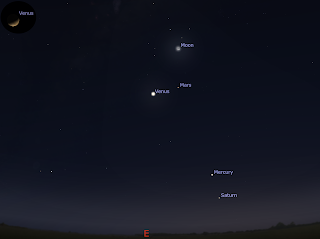
The table below shows significant astronomical events that can be seen with the unaided eye or minimal equipment in 2022 in Australia (and to some degree elsewhere in the Southern Hemisphere, ocultations and eclipses are very region specific).
This year we get a good Total Lunar eclipse. There are good oppositions of Mars, Jupiter and Saturn. Mars skims past the Pleiades and Hydaes clusters.
As well we have some fantastic parings and lineups and good meteor showers.
Close pairings of the Moon and bright planets are given special
attention as not only is the Moon a ready guide to locating the planets
if you are not familiar with them, these massings are rather beautiful.
Special events are bolded.
| Date | Event | |
| January | ||
| 1 January 2022 | Occultation of Mars | |
| 4 January 2022 | Earth at Perihelion | |
| 4 January 2022 | Crescent Moon, Mercury, and Saturn close low in the evening twilight | |
| 6 January 2022 | Jupiter and Crescent Moon close | |
| 30 January 2022 | Crescent Moon forms a triangle with Mars and Venus | |
| February | ||
| 2 February 2022 | Mars close to M28 | |
| 3 February 2022 | Jupiter close to the thin crescent Moon low in the twilight | |
| 6 February 2022 | Mars near globular cluster M22 | |
| 13 February 2022 | Mercury, Mars and Venus form a triangle in the morning sky. | |
| 27-28 February 2022 | Crescent Moon, Mars and Venus form a triangle in the morning sky. | |
| March | ||
| 1 March 2022 | Mercury, Saturn and thin crescent Moon form a triangle in the morning twilight | |
| 3 March 2022 | Mercury very close (0.6 degrees) from Saturn in morning twilight | |
| 21 March 2022 | Earth at Equinox, Five bright planets visible in the morning twilight, Jupiter and Mercury close in the morning twilight. | |
| 28 March 2022 | Crescent Moon, Saturn, Venus and Mars from a close massing in the morning twilight with the Moon above | |
| 29 March 2022 | Crescent Moon, Saturn, Venus and Mars from a close massing in the morning twilight with the Moon below | |
| 31 March 2022 | Thin crescent Moon close to Jupiter low in the morning twilight | |
| April | ||
| All April 2022 | Four bright planets in the morning sky Moon in the morning sky | |
| 5 April 2022 | Saturn and Mars very close (0.3 degrees apart) in the morning sky | |
| 13 April 2022 | Jupiter close to Neptune in the morning sky | |
| 26 April 2022 | Mars close to the crescent Moon in the morning sky | |
| 27-28 April 2022 | Crescent Moon close to Venus and Jupiter in the morning sky | |
| 28 April 2022 | Venus and Neptune in close conjunction (< 30 arc minutes) in the morning sky | |
| May | ||
| 1 May 2022 | Venus and Jupiter very close in the morning sky (0.2 degrees apart) | |
| 6-7 May 2022 | Eta Aquariid meteor shower | |
| 22 May 2022 | Waning Moon above Saturn | |
| 25 May 2022 | Mars, Jupiter and waning Moon form a triangle in morning sky | |
| 27 May 2022 | Crescent Moon above Venus | |
| 30 May 2022 | Mars and Jupiter very close in the morning sky (0.6 degrees apart) | |
| June | ||
| 1 June 2022 | Mars and Jupiter very close in the morning sky (1.0 degrees apart) | |
| 18 June 2022 | Saturn near waning Moon low in the late evening sky | |
| 14 June 2022 | Perigee Full Moon ("super Moon") | |
| 21 June 2022 | Earth at solstice | |
| 22 June 2022 | Mercury in head of Hyades near Aldebaran in morning sky, waning Moon near Jupiter | |
| 26 June 2022 | Crescent Moon between Venus and Pleiades in the morning sky | |
| 27 June 2022 | Crescent Moon near Mercury in the morning sky | |
| July | ||
| 1 July 2022 | Venus close to Aldebaran in the morning, forming a second eye for Taurus the Bull | |
| 4 July 2022 | Earth at aphelion | |
| 14 July 2022 | Syzygy Perigee full moon ("super Moon") closest of year | |
| 15 July 2022 | Moon close to Saturn | |
| 19 July | Moon close to Jupiter | |
| 22 July 2022 | Waning crescent Moon close to Mars (within binocular field) | |
| 27 July 2022 | Venus near crescent Moon in the morning twilight | |
| 29-30 July 2022 | Southern Delta Aquarids meteor shower | |
| 30 July 2022 | Mercury close to crescent moon in western evening twilight | |
| 31 July | Mars and Uranus 2 degrees apart (in same binocular filed) | |
| August | ||
| 1-3 August 2022 | Mars and Uranus less than 2 degrees apart (in same binocular filed) | |
| 4 August 2022 | Mercury very close to Regulus (0.7 degrees) in the evening twilight | |
| 12 August 2022 | Saturn close to Full Moon (perigee "super" Moon) | |
| 15 August 2022 | Saturn at opposition | |
| 15 August 2022 | Jupiter close to Waning Moon (1 degree) | |
| 20 August 2022 | Mars near Moon in Morning | |
| 22 August 2022 | Jupiter near Moon | |
| 29 August 2022 | Mercury near thin crescent Moon in evening sky, Mars between Pleiades and Hyades in the morning sky | |
| September | ||
| 3 September 2022 | Mars forms second "eye" in Taurus the Bull with Aldebaran in morning sky | |
| 8 September 2022 | Waxing moon close to Saturn in evening sky | |
| 11 September 2022 | Waning Moon close to Jupiter in evening sky | |
| 23 September 2022 | Earth at Equinox | |
| 27 September 2022 | Jupiter at Opposition | |
| October | ||
| 5 October 2022 | Saturn and waxing Moon close in evening sky | |
| 8 October 2022 | Jupiter and waxing Moon close in evening sky | |
| 14 October 2022 | Mars and the waxing Moon close in evening sky | |
| 21-22 October 2022 | Orionid meteor shower | |
| November | ||
| 2 November 2022 | Waxing Moon near Saturn in evening sky | |
| 4-5 November 2022 | Waxing Moon near Jupiter in evening sky | |
| 8 November 2022 | Total Lunar Eclipse | |
| 11 November 2022 | Waxing Moon near Mars in evening sky | |
| 18 November 2022 | Leonid Meteor Shower | |
| December | ||
| 2 December 2022 | Jupiter and waxing Moon close | |
| 8 December 2022 | Mars at opposition and close to Full Moon | |
| 14 December 2022 |
| |
| 22 December 2022 | Earth is at Solstice | |
| 24 December 2022 | Venus and Mercury and thin crescent Moon are close in evening twilight. | |
| 26 December | Saturn near crescent Moon | |
| 28-30 December 2022 | Venus and Mercury at their closest in evening twilight. | |
| 29 December 2022 | Jupiter close (1 degree) from the waning Moon in evening |
Labels: Asteroid, Conjunction, eclipse, Jupiter, Mars, Mercury, Moon, Opposition, Saturn, unaided eye, Venus, Yearly Sky Events
Friday, January 08, 2021
Coming Events: A Year of Southern Astronomy for 2021

The table below shows significant astronomical events that can be seen with the unaided eye or minimal equipment in 2021 in Australia (and to some degree elsewhere in the Southern Hemisphere, ocultations and eclipses are very region specific).
This year we get a good Total Lunar eclipse during a perigee "super" Full Moon and a partial lunar eclipse under very poor conditions. There is a good opposition of Jupiter and Saturn. Mars skims past the Pleiades and Beehive cluster. Venus too skims past the Beehive. There is also a good opposition of Vesta.
While we don't have a spectacular conjunction of Jupiter and Saturn this year, we have some fantastic parings and lineups and good meteor showers.
Close pairings of the Moon and bright planets are given special
attention as not only is the Moon a ready guide to locating the planets
if you are not familiar with them, these massings are rather beautiful.
Special events are bolded.
| Date | Event |
| January | |
| 2 January 2021 | Earth at Perihelion |
| 12 January 2021 | Crescent Moon and Venus close low in the morning twilight |
| 14 January 2021 | Crescent Moon, Mercury and Jupiter close low in the evening twilight |
| 21 January 2021 | Mars and waxing Moon close |
| 21 January 2021 | Uranus between Mars and the waxing Moon |
| February | |
| 6-7 February 2021 | Venus close to Saturn low in the twilight |
| 11 February 2021 | Venus close to Jupiter and the crescent moon low in the twilight |
| 19 February 2021 | Mars near first Quarter Moon |
| 20-28 February 2021 | Mercury between Jupiter and Saturn in the twilight |
| 28 February 2021 | Mars within binocular distance of the Pleiades cluster |
| March | |
| 1-9 March 2021 | Mars within binocular distance of the Pleiades cluster, closest on the 2nd |
| 4 March 2021 | Asteroid Vesta at opposition, just visible to the unaided eye, best in binoculars |
| 5 March 2021 | Mercury very close to Jupiter below Saturn in the morning |
| 10 March 2021 | Saturn close to the crescent Moon in the morning |
| 11 March 2021 | Mercury close to Jupiter and the crescent Moon in the morning |
| 19 March 2021 | Mars near waxing Moon |
| 20 March 2021 | Earth at Equinox |
| April | |
| 7 April 2021 | Saturn near to the waning Moon in the morning sky |
| 8 April 2021 | Jupiter near to the crescent Moon in the morning sky |
| 11 April 2021 | Mercury close to the crescent Moon in the morning twilight |
| 17 April 2021 | Mars close to the crescent Moon |
| 27 April 2021 | Mars on outskirts of open cluster M35 (binoculars best) |
| 28 April 2021 | Perigee Full Moon ("super" Moon), 1:00 am |
| May | |
| 4 May 2021 | Saturn close to waning Moon in the morning sky |
| 5 May 2021 | Jupiter near to the waning Moon in the morning sky |
| 6-7 May 2021 | Eta Aquariid meteor shower |
| 14 May 2021 | Thin crescent Moon above Mercury in morning sky |
| 26 May 2021 | Total eclipse Perigee Full Moon ("super" Moon), 12:00 pm (eclipse from 8 pm) |
| 29 May 2021 | Mercury and Venus close low in the twilight (binoculars best) |
| June | |
| 1 June 2021 | waning Moon near Jupiter |
| 12 June 2021 | Venus near thin crescent Moon low in the evening sky |
| 14 June 2021 | Waxing crescent Moon and Mars near in evening sky |
| 21 June 2021 | Earth at solstice |
| 23-24 June 2021 | Mars crosses beehive cluster (binoculars best) |
| 27 June 2021 | Waning Moon close to Saturn |
| 28 June 2021 | waning Moon near Jupiter |
| July | |
| 3 July 2021 | Venus at the edge of the beehive cluster, best in binoculars |
| 6 July 2021 | Earth at aphelion |
| 8 July 2021 | Mercury close to the thin crescent Moon in the morning |
| 12 July 2021 | Crescent Moon, Venus and Mars close in the evening |
| 13 July 2021 | Venus and Mars very close in the evening sky |
| 22 July 2021 | Venus very close to bright star Regulus |
| 24 July 2021 | Saturn near Moon |
| 26 July 2021 | Jupiter near Moon |
| 29-30 July 2021 | Southern Delta Aquarids meteor shower |
| 30 July 2021 | Mars very close to Regulus |
| August | |
| 2 August 2021 | Saturn at opposition |
| 10 August 2021 | Mars near thin crescent Moon |
| 11 August 2021 | Venus close to crescent Moon |
| 18 August 2021 | Variable star Mira predicted to peak in brightness |
| 19 August 2021 | Jupiter at opposition |
| 17-21 August 2021 | Mercury close to Mars, closest on the 19th |
| 20 August 20 | Saturn near Moon |
| 22 August 2021 | Jupiter near Moon |
| September | |
| 6 September 2021 | Venus close to bright star Spica |
| 9 September 2021 | Mercury and crescent Moon close in the evening sky |
| 10 September 2021 | Crescent Moon and Venus nearby forming triangle with Spica |
| 17 September 2021 | Waxing Moon near Saturn |
| 18 September 2021 | Waxing Moon near Jupiter |
| 23 September 2021 | Earth at Equinox |
| 21 September 2021 | Mercury close to bright star Spica |
| 24 September 2021 | Venus close to moderately bright star alpha2 Librae, below Scorpius and above the pair of Mercury and Spica |
| October | |
| 1 October 2021 | Mercury and bright star Spica still close |
| 10 October 2021 | Venus, the crescent Moon and the bright star Antares form a triangle |
| 14 October 2021 | Saturn and the waxing Moon close |
| 15 October 2021 | Jupiter and the waxing Moon close |
| 17 October 2021 | Venus and the bright star Antares at their closest |
| 21-22 October 2021 | Orionid meteor shower |
| 23-24 October 2021 | Venus close to globular cluster M19 (binocular or telescope) |
| November | |
| 4 November 2021 | Thin crescent Moon close to Mercury low in the twilight |
| 8 November 2021 | Venus close to thin crescent Moon below the teapot of Sagittarius |
| 8-24 November 2021 | Venus crosses the teapot of Sagittarius |
| 10-11 November 2021 | Waxing Moon near Saturn |
| 11-12 November 2021 | Waxing Moon near Saturn |
| 18 November 2021 | Leonid Meteor Shower |
| 19 November 2021 | Partial Lunar eclipse, difficult with mid eclipse in the twilight |
| December | |
| 3 December 2021 | Mars and thin crescent Moon close low in the morning twilight |
| 7-10 December 2021 | Three bright planets form a line in the evening with the thin crescent. moon joining them, Venus and Moon close on the 7th |
| 8 December 2021 | Saturn and crescent Moon close |
| 10 December 2021 | Jupiter and crescent Moon close |
| 14 December 2021 | Geminid Meteor shower in the morning (waxing Moon sets before best rates) |
| 18 December 2021 | Apogee Full Moon (12:00 pm) |
| 21 December 2021 | Earth is at Solstice |
| 23-30 December 2021 | four bight planets, Mercury, Venus, Saturn and Jupiter line up in the evening twilight, on the 29th Venus and Mercury are at their closest. |
| 1 January 2022 | Thin crescent Moon very close to Mars low in the morning sky. Occultation seen in south eastern and south central Australia |
Labels: asteroids, Conjunction, eclipse, Jupiter, Mars, Mercury, Meteors, Opposition, Saturn, unaided eye, Venus, Yearly Sky Events
Saturday, September 26, 2020
Catching Mercury's Tail
Mercury has a tail! And late September and early October will be the best times for amateurs to try and image it. Before going into details, a bit of background (this is an extended version of the tangent I did for the astrophiz podcast, the mercury tail talk starts around 17:11)

 Images of Mercury with a tail as seen in the STEREO spacecraft H1b imager. The left image is Mercury as seen in the H1a
imager on January 16 of 2010.
Images of Mercury with a tail as seen in the STEREO spacecraft H1b imager. The left image is Mercury as seen in the H1a
imager on January 16 of 2010.For contrast I've put the image from the H1b imager of 8 April to the right. The tail in the H1a imager is better on the 17th, but I've shown the 16th because of a rather unusual circumstance.
Back in 2008 famed STEROHUNTER Comet Al and I were trying to confirm a comet position in images from STEREO A. I pointed out the nice bright comet moving across the STEREO image field and Comet Al said, "That's not a comet, that's Mercury!". We exchanged the internet equivalent of startled looks.
The feeling on the Stereohunter list was that it was an artifact, but I remembered an article on sodium emission from Mercury, and went to track down the group and ask them what they thought our tail might be.
 This
is an image of Mercury's tail obtained from combining a full day of
data from a camera aboard the STEREO-A spacecraft. The reflected
sunlight off the planet's surface results in a type of over-exposure
that causes Mercury to appear much larger than its actual size. The
tail-like structure extending anti-sunward from the planet is visible
over several days and spans an angular size exceeding that of a full
Moon in the night sky.(Credit: Image courtesy of Boston University’s Center for Space Physics)
This
is an image of Mercury's tail obtained from combining a full day of
data from a camera aboard the STEREO-A spacecraft. The reflected
sunlight off the planet's surface results in a type of over-exposure
that causes Mercury to appear much larger than its actual size. The
tail-like structure extending anti-sunward from the planet is visible
over several days and spans an angular size exceeding that of a full
Moon in the night sky.(Credit: Image courtesy of Boston University’s Center for Space Physics)So began a saga that cumulated in the paper "Observations of Mercury’s Escaping Sodium Atmosphere by the STEREO Spacecraft" by Carl Schmidt, Jeffrey Baumgardner, Michael Mendillo, Christopher Davis and Ian Musgrave being read at the European Planetary Science Congress. This paper was the subject of a press release, and has spread wide into the internet (Science Daily, Space.com, and SpaceInfo are just a few examples). It is my first and only scientific paper on astronomy (as very minor co-author of course).
The intense heat of the Sun blasts sodium ions from Mercury’s surface into space. We can see this tail of sodium atoms as glow as they are ionized by the Sun’s UV light. The Moon also as a tail of sodium atoms streaming away from it.
So why bring it up now? In the wake of Karl Battams magnificent video of Comet C/1999 Y4 (Atlas) as it passed through the STEREO H1 field of view, also featuring Mercury’s sodium tail the question arose, can Mercury’s sodium tail be picked up by amateur astronomers?Mercury’s tail has been picked up from Earth by specialized astronomical telescopes with special filters. But what about amateurs? It turns out that they can. There have been several images of Mercury taken by amateurs with fairly modest telescopes and narrow band filters (see here for example). Narrow band filers are widely available (but somewhat pricey) a recent successful imaging used a 589.3/1.0 nm filer, sodium atoms need 589.0/589.6 nm light to glow.

But you will need a guided telescope and integrate a number of exposures (eg 100x 10 second exposures). Could you pick the tail up with simple broadband exposure rather than a narrow-band filter? That is a good question and maybe you could try if you have a guided telescope.

Evening sky at 19:45 ACST (90 minutes after sunset) on Friday, October 2 facing west as seen from Adelaide. At this time Mercury is at it's furthest elongation from the Sun. Mercury is easily seen above the Western horizon at astronomical twilight.
In September and October Mercury will be relatively high and good for trying. Mercury’s sodium tail is brightest at perihelion and aphelion. Aphelion is on September 19, but Mercury is only 4 degrees above the horizon at astronomical twilight, when the sky is full dark at the time.
Mercury is 7 degrees above the horizon at astronomical twilight between the 24th to 29th of September, which is better, but the tail will be fading.
While fading, this will be an excellent challenge for the telescope owners.
If you want to read more, there are some excellent academic papers here and here (hat tip to Daniel Fischer for the links)
Labels: Mercury, Stereo Satellite
Monday, April 13, 2020
The Moon climbs down the ladder of planets (Morning, 14-17 April 2020)
 |  |
| Morning sky at 5:44 ACST (60 minutes minutes before sunrise) facing east as seen from Adelaide on Tuesday, April 14. | Morning sky at 5:44 ACST (60 minutes minutes before sunrise) facing east as seen from Adelaide on Wednesday, April 15. |
 |  |
| Morning sky at 5:45 ACDST (60 minutes minutes before sunrise) facing east as seen from Adelaide on Thursday, April 16 | Morning sky at 5:46 ACDST (60 minutes minutes before sunrise) facing east as seen from Adelaide on Friday, April 17 |
The next four days offers some excellent sky viewing if you are prepared to get up in the early hours.
Staring tomorrow morning the Moon climbs down the ladder of planets. On Tuesday the 14th the waning Moon aligns with the four bright planets, on Wednesday the 15th the last quarter Moon is close to Jupiter, on Thursday the 14th the crescent Moon is between Saturn and Mars and finally on the Friday 17th the crescent Moon lines up with the planets again.
On the 22nd Mercury and the thin crescent Moon will be difficult to see low in the twilight.
On the 15th the Moon and Jupiter are in binocular range, but sadly not in telescope range.
Labels: alignment, Jupiter, Mars, Mercury, Moon, Saturn, unaided eye
Wednesday, March 18, 2020
The Moon climbs down the ladder of Planets (March 18-22. 2020)
 |  |
| Morning sky at 5:52 ACDST (90 minutes minutes before sunrise) facing east as seen from Adelaide on Wedensday, March 18. | Morning sky at 5:53 ACDST (90 minutes minutes before sunrise) facing east as seen from Adelaide on Thursday, March 19. |
 |  |
| Morning sky at 5:55 ACDST (90 minutes minutes before sunrise) facing east as seen from Adelaide on Saturday, March 21. | Morning sky at 5:56 ACDST (90 minutes minutes before sunrise) facing east as seen from Adelaide on Sunday, March 22. |
Staring on the morning of Wednesday 18 March there is a outstanding line up of 4 bright planets and the Moon, each day the Moon moves down the line-up bring superb views.
Two outstanding ones are on the 19th when Mars, Jupiter, Saturn and the crescent moon from an attractive grouping in the sky and on the 21st When Mars is cloosest to Jupiter.
The display finishes on the 22nd with the thin crescent Moon near mercury.
This is an excellent opportunity of astrophotography, as well as just being great to watch with the unaided eye.
Labels: astrophotography, Conjunction, Jupiter, Mars, Mercury, Moon, Saturn, unaided eye
Thursday, January 09, 2020
Coming Events: A Year of Southern Astronomy for 2020

The table below shows significant astronomical events that can be seen with the unaided eye or minimal equipment in 2020 in Australia (and to some degree elsewhere in the Southern Hemisphere, ocultations and eclipses are very region specific). This year we only get penumbral Lunar eclipses under very poor conditions. There is a very good opposition of Mars though, and a spectacular Jupiter and Saturn conjunction. Venus travels through the Pleiades and displays its crescent form.
Close pairings of the Moon and bright planets are given special attention as not only is the Moon a ready guide to locating the planets if you are not familiar with them, these massings are rather beautiful.
Special events are bolded.
| Date | Event |
| January | |
| 11 January 2020 | Penumbral lunar eclipse in the morning, close to dawn. |
| 21 January 2020 | Crescent Moon and Mars close in the morning |
| 23 January 2020 | Crescent Moon and Jupiter close in the morning |
| 27 January 2020 | Venus and Neptune close |
| 26 January 2020 | Mercury close to the crescent moon in the evening twilight |
| 28 January 2020 | Venus close to the crescent moon in the evening |
| February | |
| 18 February 2020 | Mars passes between the triffid and Lagoon Nebulae |
| 19 February 2020 | Waxing Moon close to Mars in the morning |
| 20 February 2020 | Waxing Moon extremely close to Jupiter in the morning |
| 21 February 2020 | Waxing Moon close to Saturn in the morning |
| 27 February 2020 | Waning Crescent Moon close to Venus |
| 29 February 2020 | Mars close to Globular cluster M22 |
| March | |
| 1 March 2020 | Mars still close to Globular cluster M22 |
| 8-9 March 2020 | Venus close to Uranus (binocular only) |
| 18 March 2020 | Waning Crescent Moon forms a line with Mars, Jupiter and Saturn in the morning sky |
| 19 March 2020 | Crescent Moon between Mars and Jupiter and Saturn |
| 20 March 2020 | Earth at Equinox |
| 21 March 2020 | Mars very close to Jupiter |
| 22 March 2020 | Mercury close to the crescent Moon in the morning |
| 29March 2020 | Venus close to the crescent Moon in the evening |
| April | |
| 1 April 2020 | Saturn close to Mars in the morning sky |
| 3-4 April 2020 | Venus passes through the Pleiades cluster |
| 4 April 2020 | Mercury close to Neptune |
| 8 April 2020 | Perigee Full Moon ("super" Moon), 3:10 am |
| 15 April 2020 | waning Moon close to Jupiter in the morning sky |
| 16 April 2020 | waning Moon close to Saturn in the morning sky |
| 22 April 2020 | Crescent Moon close to Mercury in the morning sky |
| 26-27 April 2020 | Crescent Moon near Venus in the evening sky |
| May | |
| 5 May 2020 | Eta Aquariid meteor shower |
| 12 May 2020 | Moon between Jupiter and Saturn in evening sky |
| 15-16 May 2020 | Mars near the waning Moon |
| 22 May 2020 | Mercury and Venus close |
| 24 May 2020 | Thin crescent Moon near Venus |
| June | |
| 6 June 2020 | Penumbral lunar eclipse early morning near dawn |
| 8 June 2020 | Moon and Jupiter close in evening |
| 9 June 2020 | waning Moon and Saturn close in evening |
| 13 June 2020 | Moon and Mars close in morning |
| 19 June 2020 | Thin crescent Moon and Venus close in the morning twilight |
| July | |
| 5 July 2020 | Jupiter close to the moon |
| 6 July 2020 | Moon and Saturn close |
| 11 July 2020 | Moon and Mars close in evening |
| 12 July 2020 | Venus close to bright star Aldebaran |
| 14 July 2020 | Jupiter at Opposition |
| 17 July 2020 | Thin crescent Moon near Venus in the morning |
| 21 July 2020 | Saturn at Opposition |
| 29 July 2020 | Southern Delta Aquarids meteor shower |
| August | |
| 2 August 2020 | Moon between Jupiter and Saturn |
| 9 August 2020 | Moon close to Mars |
| 15-16 August 2020 | Crescent Moon close to Venus |
| 28 August 20 | Asteroid Ceres at opposition (binoculars only) |
| 29 August 2020 | Moon between Jupiter and Saturn again |
| September | |
| 5-6 September 2020 | Mars close to the Moon |
| 14 September 2020 | Venus and crescent Moon close in morning sky |
| 19 September 2020 | Crescent Moon and Mercury close forming triangle with Spica |
| 24 September 2020 | Variable star Mira at its brightest |
| 22 September 2020 | Mercury and bright star Spica very close |
| 22 September 2020 | Earth at Equinox |
| 25 September 2020 | Waxing Moon, Jupiter form a triangle with Saturn |
| 30 September 2020 | Venus close to bright star Regulus |
| October | |
| 2-3 October 2020 | Mars and waning Moon close |
| 3 October 2020 | Venus and the bright star Regulus very close |
| 14 October 2020 | Venus and the crescent Moon close |
| 14 October 2020 | Mars at opposition |
| 18 October 2020 | Mercury and thin crescent Moon closeish in the evening twilight |
| 21 October 2020 | Orionid meteor shower |
| 22 October 2020 | Jupiter and waning Moon close |
| 23 October 2020 | Saturn and waning Moon close |
| 31 October 2020 | Blue Moon in WA. |
| November | |
| 1 November 2020 | Apogee Full Moon (mini-Moon). In WA full Moon occurs before midnight but for all states apogee is on the early morning of the 1st. |
| 13 November 2020 | Thin crescent Moon close to Venus |
| 14 November 2020 | Thin crescent Moon close to Mercury |
| 18 November 2020 | Leonid Meteor Shower |
| 19 November 2020 | Crescent Moon and Jupiter close forming triangle with Saturn |
| 24-25 November 2020 | Waxing Moon close to Mars |
| 30 November 2020 | Penumbral Lunar eclipse, only seen from eastern states. Blue Moon of all states except WA. (see above) |
| December | |
| 13 December 2020 | Venus and thin crescent Moon close |
| 14 December 2020 | Geminid Meteor shower (New Moon, good rates) |
| 17 December 2020 | Jupiter and Saturn spectacularly close with the thin crescent Moon close too. |
| 21 December 2020 | Jupiter and Saturn even more spectacularly close in a conjunction that will not be repeated for over a decade. The pair will easily be visible together in telescope eye pieces. |
| 21 December 2020 | Earth is at Solstice |
| 23-24 December 2020 | Waxing Moon close to Mars |
Labels: asteroids, Conjunction, eclipse, Jupiter, Mars, Mercury, Meteors, Opposition, Saturn, unaided eye, Venus, Yearly Sky Events
Monday, November 11, 2019
Live Streaming and Webcasts of the Transit of Mercury (12 November/11 November UT)
 Transit of Mercury as seen from Australia in November 2006 at around
8:30am, click to enlarge. Mercury is the tiny dot roughly in the
centre-top.
Transit of Mercury as seen from Australia in November 2006 at around
8:30am, click to enlarge. Mercury is the tiny dot roughly in the
centre-top.Sadly, Australia will not get to see it (we will get to see the next in 2032 though). However, there are any number of live web-casts you can follow.
While these are all at horrible times here in Australia, if you are a late stayer or an early riser, you can catch a rare event.
| Event | Universal Time | AEDST |
| Contact I | 12:35:27 | 23:35 (11th) |
| Contact II | 12:37:08 | 23:37 (11th) |
| Greatest Transit | 15:19:48 | 02:19 (12th) |
| Contact III | 18:02:33 | 05:04 (12th) |
| Contact IV | 18:04:14 | 05:04 (12th) |
Webcasts:
Time and date: https://www.timeanddate.com/live/
Space.com: https://www.space.com/mercury-transit-2019-viewing-guide.html
Vimeo: https://livestream.com/GriffithObservatoryTV/MercuryTransit2019
Royal Observatory: https://www.rmg.co.uk/discover/explore/when-is-the-next-transit-of-mercury
Labels: live-stream, Mercury, transit, webcast
Thursday, December 20, 2018
Coming Events: A Year of Southern Astronomy for 2019

The table below shows significant astronomical events that can be seen with the unaided eye or minimal equipment in 2019 in Australia (and to some degree elsewhere in the Southern Hemisphere, ocultations and eclipses are very region specific).
Close pairings of the Moon and bright planets are given special attention as not only is the Moon a ready guide to locating the planets if you are not familiar with them, these massings are rather beautiful.
Special events are bolded.
Sadly, the partial solar eclipse is just visible from parts of northern Australia, and the partial lunar eclipse is somewhat sad, but we have three occultations of Saturn and a number of beautiful planetary events to keep us occupied. The asteroid Vesta should be (just) visible to the unaided eye too.
| Date | Event |
| 2 January 2019 | Venus close to crescent Moon in morning |
| 3-4 January 2019 | Crescent Moon and Jupiter close |
| 4 January 2019 | Crescent Moon near Mercury |
| 12-13 January 2019 | waxing Moon and Mars close |
| 14 January 2019 | Mercury a bit over a finger-width from Saturn low in the morning twilight |
| 21 January 2019 | Perigee Full Moon ("super" Moon, strictly at its biggest on the morning of the 22nd) |
| 23 January 2019 | Venus and Jupiter close in the morning |
| 31 January 2019 | Crescent Moon and Jupiter close again |
| 1 February 2019 | Crescent Moon close to Venus in the morning sky |
| 2-3 February 2019 | Crescent Moon close to Saturn in the morning |
| 10 February 2019 | Waxing Moon close to Mars |
| 12-13 February 2019 | Uranus close to Mars (binocular viewing) |
| 20 February 2019 | Perigee Full Moon ("super" Moon, strictly at its biggest on the evening of the 19th) |
| 28 February 2019 | Waning Moon close to Jupiter |
| 2 March 2019 | Crescent Moon close to Saturn in the morning |
| 3 March 2019 | Crescent Moon close to Venus in the morning sky |
| 11 March 2019 | Crescent Moon close to Mars |
| 30 March 2019 | Waning Moon close to Saturn |
| 2-3 April 2019 | Crescent Moon close to Venus in the morning sky |
| 3 April 2019 | Crescent Moon close to Mercury in the morning sky |
| 9 April 2019 | Moon close to Mars in evening sky |
| 23 April 2019 | waning Moon close to Jupiter in the evening sky |
| 25 April 2019 | Occultation of Saturn by the Moon, very low on horizon |
| 4-25 May 2019 | Asteroid Ceres visible in binoculars (opposition on 28th) |
| 3 May 2019 | Crescent Moon close to Venus in the morning sky |
| 6 May 2019 | Eta Aquariid meteor shower. |
| 8 May 2019 | Crescent Moon close to Mars |
| 19 May 2019 | Venus and Uranus a finger-width apart in the morning twilight (binoculars) |
| 20 May 2019 | Jupiter near waning Moon |
| 22 May 2019 | Waning Moon close to Saturn |
| 1-29 June 2019 | Asteroid Ceres visible in binoculars |
| 2 June 2019 | Crescent Moon and Venus close in twilight |
| 4 June 2019 | Crescent Moon and Mercury close |
| 5 June 2019 | Crescent Moon and Mars close |
| 11 June 2019 | Jupiter at Opposition |
| 16 June 2019 | Jupiter and Full Moon close |
| 19 June 2019 | Moon and Saturn close |
| 4 July 2019 | Mercury close to Crescent Moon and Mars in the twilight |
| 10 July 2019 | Saturn at Opposition |
| 13-14 July 2019 | Moon and Jupiter close |
| 16 July 2019 | Moon and Saturn close |
| 16-17 July 2019 | Partial Lunar Eclipse, early morning, really only visible from WA and a bit in the Central states |
| 30 July 2019 | Southern Delta Aquarids meteor shower |
| 10 August 2019 | Moon close to Jupiter |
| 12 August 2019 | Moon close to Saturn, Occultation seen on East coast only |
| 6 September 2019 | Waxing Moon and Jupiter close |
| 8-9 September 2019 | Saturn close to Moon, Occultation in northern and Western Australia |
| 13 September 2019 | Apogee Full Moon (mini-Moon) |
| 29 September 2019 | Mercury close to bright star Spica |
| 30 September 2019 | Crescent Moon close to Spica and Mercury with Venus below |
| 3-5 October 2019 | Venus and the bright star Spica close |
| 4 October 2019 | Jupiter and waxing Moon close |
| 6 October 2019 | Saturn and waxing Moon close |
| 22 October 2019 | Orionid meteor shower |
| 24 October 2019 | Variable star Mira at its brightest |
| 29 October 2019 | Mercury, Venus and Crescent Moon close |
| 31 October 2019 | Jupiter and waxing Moon close |
| 2 November 2019 | waxing Moon close to Saturn |
| 9 November 2019 | Jupiter crescent Moon close |
| 11 November 2019 | Crescent Moon and Saturn close |
| 12 November 2019 | Asteroid Vesta at opposition, potentially (just) visible with the unaided eye |
| 17 November 2019 | Leonid Meteor Shower |
| 24 November 2019 | Jupiter and Venus just two finger-widths apart |
| 25 November 2019 | the Crescent Moon, Mars and Mercury form a triangle in the dawn sky |
| 28-29 November 2019 | the Crescent Moon, Jupiter and Venus form a line in the evening twilight |
| 2 December 2019 | Venus close to the globular cluster M22 in the evening twilight (binocular) |
| 11 December 2019 | Venus and Saturn two finger-widths apart |
| 15 December 2019 | Geminid Meteor shower (full Moon, poor rates) |
| 23 December 2019 | Crescent Moon close to Mars in morning sky |
| 26 December 2019 | Partial Eclipse of the Sun, visible only in northern Australia |
| 27 December 2019 | Crescent Moon close to Saturn in the evening twilight |
| 29 December 2019 | Crescent Moon close to Venus in the evening sky |
Labels: asteroids, Conjunction, eclipse, Jupiter, Mars, Mercury, Opposition, Saturn, unaided eye, Venus, Yearly Sky Events
Monday, March 12, 2018
Seeing Venus in the twilight (11 March 2018)
 |  |
| Venus seen in the twilight above the ocean at 20:08 ACDST. Taken with a Canon IXUS 400 ASA 1/20 minute exposure. Click to embiggen to see Venus clearly. | Enlarged crop of the area to show location of Mercury. Venus uis the bright dot above Mercury |
I have been able to see Venus for about a week (more due to the weather and clouds than due to its actual visibility), and yesterday was a good opportunity to see Venus and Mercury together. Sadly, although Veus was readily visible to the unaided eye 30 minutes after sunset, Mercury is still invisible without binoculars (it did {just] show up in the photos). Venus will become more prominent over the next weeks, with a nice encounter with the thin crescent Moon on the 19th. Mercury never gets better this month.
Labels: astrophotography, Mercury, unaided eye observation, Venus
Saturday, April 08, 2017
Coming Events: A Year of Southern Astronomy for 2017

The table below shows significant astronomical events that can be seen with the unaided eye or minimal equipment in 2017 in Australia (and to some degree elsewhere in the Southern Hemisphere, ocultations and eclipses are very region specific) are listed in this table.
Special events are bolded.
Sadly, we miss out on the total solar eclipse this year, but there are a number of beautiful planetary events and a partial lunar eclipse to keep us occupied.
| Date | Event |
| 2 January 2017; | crescent Moon Near Venus |
| 4 January 2016; | crescent Moon near Mars |
| 18 January 2017; | opposition of Vesta |
| 19 January 2017; | Moon near Jupiter |
| 25 January 2017; | Moon close to Saturn |
| 26 January 2017; | Moon close to Mercury |
| 31 January 2017; | Moon close to Venus, forming line with Mars |
| 1 February 2017; | Moon close to Mars, forming line with Venus |
| 11 February 2017; | Comet 45P closest to Earth, possibly visible in binoculars |
| 15 February 2017; | Moon close to Jupiter |
| 21 February 2017; | Moon near Saturn |
| 23 February 2017; | Variable star Mira at its brightest |
| 1 March 2017; | Moon close to Mars and Venus, making a triangle |
| 2 March 2017; | Moon close to Mars, making a line with Venus |
| 14-15 March 2017; | Moon close to Jupiter |
| 20 March 2017; | Moon close to Saturn |
| 29 March 2017; | Moon close to Mercury |
| 30-31 March 2017; | Moon close to Mars |
| 8 April 2017; | opposition of Jupiter |
| 10-11 April 2017; | Moon close to Jupiter |
| 16 April 2017; | Moon close to Saturn |
| 24 April 2017; | crescent Moon close to Venus in morning sky |
| 1-15 May 2017; | Comet 41P visible in the morning sky in binoculars |
| 6 May 2017; | Eta Aquariid meteor shower. |
| 7-8 May 2017; | Moon near Jupiter. |
| 13 May 2017; | Moon close to Saturn. |
| 23 May 2017; | crescent Moon close to Venus. |
| 4 June 2017; | Moon and Jupiter close. |
| 1-25 June 2017; | Comet C/2015 V2 Johnson potentially visible in binoculars. |
| 9-10 June 2017; | Moon near Saturn. |
| 15 June 2017; | Opposition of Saturn. |
| 21 June 2017; | crescent Moon and Venus close. |
| 1 July 2017; | Jupiter and Moon close. |
| 7 July 2017; | Saturn and Moon close. |
| 21 July 2017; | crescent Moon and Venus close. |
| 25 July 2017; | thin crescent Moon and Mercury very close, low in the twilight. |
| 29 July 2017; | Moon and Jupiter close. |
| 30 July 2017; | Southern Delta Aquarids meteor shower. |
| 3 August 2017; | Moon close to Saturn. |
| 8 August 2017; | Partial eclipse of the Moon in the early morning. |
| 19 August 2017; | Crescent Moon close to Venus. |
| 25 August 2017; | Jupiter and Crescent Moon close, forming a shallow triangle with Spica. |
| 5-16 September 2017; | Jupiter and Spica close. |
| 15 September 2017; | Crescent Moon close to Venus. |
| 22 September 2017; | Moon close to Jupiter, forming triangle with Spica. |
| 27 September 2017; | Moon and Saturn close. |
| 30 September 2017; | Moon and Mars close. |
| 6 October 2017; | Venus and Mars very close low in the twilight. |
| 17 October 2017; | Mars close to crescent Moon. Forms line with Venus |
| 18 October 2017; | Venus close to crescent Moon, forming triangle with Mars. |
| 22 October 2017; | Orionid meteor shower. |
| 24 October 2017; | crescent Moon close to Saturn. |
| 13 November 2017; | Venus and Jupiter very close in the twilight. |
| 13 November 2017; | Mercury and Antares close in the twilight. |
| 15 November 2017; | crescent Moon close to Mars. |
| 17 November 2017; | Leonid Meteor Shower. |
| 17 November 2017; | crescent Moon close to Venus and Jupiter in the twilight. |
| 21 November 2017; | Crescent Moon close to Saturn. |
| 28 November 2017; | Mercury close to Saturn. |
| 14 December 2017; | Crescent Moon close to Mars. |
| 15 December 2017; | Geminid Meteor shower. |
| 15 December 2017; | Crescent Moon close to Jupiter. |
| 31 December 2017; | Mars and Jupiter close. |
| 31 December 2017; | asteroid Ceres potentially visible in binoculars. |
Labels: asteroids, comet, Conjunction, eclipse, Jupiter, Mars, Mercury, Opposition, Saturn, unaided eye, Venus, Yearly Sky Events



 Click to read about or order
 Click to read about or order
 Click to read about or order
 Click to read about or order


