Saturday, September 26, 2020
Catching Mercury's Tail
Mercury has a tail! And late September and early October will be the best times for amateurs to try and image it. Before going into details, a bit of background (this is an extended version of the tangent I did for the astrophiz podcast, the mercury tail talk starts around 17:11)

 Images of Mercury with a tail as seen in the STEREO spacecraft H1b imager. The left image is Mercury as seen in the H1a
imager on January 16 of 2010.
Images of Mercury with a tail as seen in the STEREO spacecraft H1b imager. The left image is Mercury as seen in the H1a
imager on January 16 of 2010.For contrast I've put the image from the H1b imager of 8 April to the right. The tail in the H1a imager is better on the 17th, but I've shown the 16th because of a rather unusual circumstance.
Back in 2008 famed STEROHUNTER Comet Al and I were trying to confirm a comet position in images from STEREO A. I pointed out the nice bright comet moving across the STEREO image field and Comet Al said, "That's not a comet, that's Mercury!". We exchanged the internet equivalent of startled looks.
The feeling on the Stereohunter list was that it was an artifact, but I remembered an article on sodium emission from Mercury, and went to track down the group and ask them what they thought our tail might be.
 This
is an image of Mercury's tail obtained from combining a full day of
data from a camera aboard the STEREO-A spacecraft. The reflected
sunlight off the planet's surface results in a type of over-exposure
that causes Mercury to appear much larger than its actual size. The
tail-like structure extending anti-sunward from the planet is visible
over several days and spans an angular size exceeding that of a full
Moon in the night sky.(Credit: Image courtesy of Boston University’s Center for Space Physics)
This
is an image of Mercury's tail obtained from combining a full day of
data from a camera aboard the STEREO-A spacecraft. The reflected
sunlight off the planet's surface results in a type of over-exposure
that causes Mercury to appear much larger than its actual size. The
tail-like structure extending anti-sunward from the planet is visible
over several days and spans an angular size exceeding that of a full
Moon in the night sky.(Credit: Image courtesy of Boston University’s Center for Space Physics)So began a saga that cumulated in the paper "Observations of Mercury’s Escaping Sodium Atmosphere by the STEREO Spacecraft" by Carl Schmidt, Jeffrey Baumgardner, Michael Mendillo, Christopher Davis and Ian Musgrave being read at the European Planetary Science Congress. This paper was the subject of a press release, and has spread wide into the internet (Science Daily, Space.com, and SpaceInfo are just a few examples). It is my first and only scientific paper on astronomy (as very minor co-author of course).
The intense heat of the Sun blasts sodium ions from Mercury’s surface into space. We can see this tail of sodium atoms as glow as they are ionized by the Sun’s UV light. The Moon also as a tail of sodium atoms streaming away from it.
So why bring it up now? In the wake of Karl Battams magnificent video of Comet C/1999 Y4 (Atlas) as it passed through the STEREO H1 field of view, also featuring Mercury’s sodium tail the question arose, can Mercury’s sodium tail be picked up by amateur astronomers?Mercury’s tail has been picked up from Earth by specialized astronomical telescopes with special filters. But what about amateurs? It turns out that they can. There have been several images of Mercury taken by amateurs with fairly modest telescopes and narrow band filters (see here for example). Narrow band filers are widely available (but somewhat pricey) a recent successful imaging used a 589.3/1.0 nm filer, sodium atoms need 589.0/589.6 nm light to glow.

But you will need a guided telescope and integrate a number of exposures (eg 100x 10 second exposures). Could you pick the tail up with simple broadband exposure rather than a narrow-band filter? That is a good question and maybe you could try if you have a guided telescope.

Evening sky at 19:45 ACST (90 minutes after sunset) on Friday, October 2 facing west as seen from Adelaide. At this time Mercury is at it's furthest elongation from the Sun. Mercury is easily seen above the Western horizon at astronomical twilight.
In September and October Mercury will be relatively high and good for trying. Mercury’s sodium tail is brightest at perihelion and aphelion. Aphelion is on September 19, but Mercury is only 4 degrees above the horizon at astronomical twilight, when the sky is full dark at the time.
Mercury is 7 degrees above the horizon at astronomical twilight between the 24th to 29th of September, which is better, but the tail will be fading.
While fading, this will be an excellent challenge for the telescope owners.
If you want to read more, there are some excellent academic papers here and here (hat tip to Daniel Fischer for the links)
Labels: Mercury, Stereo Satellite

Thursday, August 04, 2016
A Kreutz Comet Meets its Doom
 | 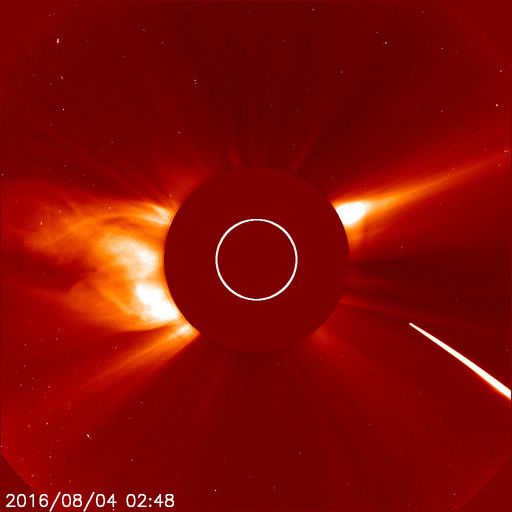 |  |
| Kreutz comet in SOHO LASCO C3 imager on 3 August at its brightest | Kreutz comet in SOHO C2 imager on 4 August. | Kreutz comet in STEREO COR2 imager on 4 August. |
 |  |  |
| Animation of Kreutz comet in SOHO LASCO C3 imager on 4 August. | Animation of Kreutz comet in SOHO C2 imager on 4 August. | Animation of Kreutz comet in STEREO COR2 imager on 4 August. |
On 31 July a small Kreutz comet entered the field of view of the SOHO C3 imager, Kreutz comets are sungrazing comets thought to be the remnants of a large comet which broke up several centuries ago. The comet rapidly brightened, causing Karl Battrams to suggest this is the brightest Kreutz for 21 years.
The comet came to perihelion on August 4 at around 05 UT, at around 1 solar diameter from the Sun. The even was captured by the SOHO C3 and C2 instruments and the STEREO COR2 and COR1 instruments.In the animations above you can see the comet going behind the occultation disks hiding the sun in all these instruments...and not coming out. The comet was vaporized by the intense heat of the sun.
Labels: comet, Kreutz, Soho, Stereo Satellite, sungrazer
Saturday, February 08, 2014
New Comet C/2014 C2 STEREO (congratulations Comet Al)
 |  |
| Comet C/2014 C2 in the STEREO H1 A instrument on 2/2/14, arrowed. The vertical lines are instrument artefacts. Click to embiggen | animation of 24 images from 2/2/14 to3/2/14 showing the rapid motion of the comet, click to embiggen. |

Unfortunately, the comet will now only be visible from the northern hemisphere, and will be very low above the horizon at astronomical twilight from around February 14. It will probably be very faint, around magnitude 13 or less. This makes it a very difficult target.
The comet was visible in the southern hemisphere in the evening, but was low on the horizon around astronomical twilight from January 1, and may have been too faint to observe. But Australian observers should check their images from this time.
MPEC one line Ephermeris
CK14C020 2014 02 18.6577 0.508074 1.000000 57.5181 283.3470 135.3097 18.5 8.0 C/2014 C2 (STEREO)
Orbital elements:
    C/2014 C2 (STEREO)
T 2014 Feb. 18.65769 TT                                 MPC
q   0.5080744            (2000.0)            P               Q
                   Peri.   57.51809     -0.45953242     -0.56620958
                   Node   283.34701     -0.84240966     +0.52195234
e   1.0            Incl.  135.30975     +0.28138215     +0.63794394
From 77 observations 2014 Feb. 1-4.
Labels: comet, Comet Al, iTelescope, Stereo Satellite
Friday, December 13, 2013
Earth will NOT be hit by a "Wave of Killer ISON Debris"
 |  |
| Chart showing the predicted position of ISON as seen from STEREO H1A on 1 December 00:09 UT (click to embiggen). The Pleaides is the cluster at centre left in both images. | Image showing the actual position of ISON as seen from STEREO H1A on 1 December 00:09 UT (click to embiggen). The STEREO image has Earth and Mercury in the centre, these are not plotted on the star chart. |
Now that Comet C/2012 S1 ISON has fallen apart into a sad pile of gravel and dust, the fear merchants are at it again. With headlines like "COMET ISON'S KILLER Debris Wave Heading for EARTH" (I'm not going to link to the various pages and give them the page views, but you can google it yourself if you want to kill a few brain cells) the fear merchants are trying to scare people into thinkg a massive strom of rocks is headed our way.
But it isn't.

ISON's predicted orbit takes it well away from us, the nearest the pile of gravel formerly known as ISON comes to us is 0.43 AU (64,000,000 km), that's a bit under half the distance form Earth to the Sun, or the distance from Earth to Venus's Orbit.
i.e. Nowhere near us. I have previously checked ISON's orbit as it came out from its close approach to the Sun in the SOHO LASCO C3 images, it was right on track. I've done it again for ISON is the high resolution STEREO H1A imager images. This is more tricky as STEREO-A does not have the same field of view as Earth, so I needed to make a special ephemeris using JPL horizons based on the STEREO-A spacecraft's position.
They match to within 8 arc seconds. This means that ISON is on track in it's predicted orbit, and will come no closer to Earth than 0.43 AU. The rather compact debris trail will be high above Earth's orbit heading out to space. Oh yes, and the leftover material will not be "city sized". ISON itself was less than 1 Km in diameter (more like 600 meters), the biggest bits in the leftover gravel will be meter sized, at the outside as big as the Chelyabinsk meteor. If the debris cloud did come near us, we would get a pretty meteor display, but nothing more.
But of course, they will not come anywhere near us.
Labels: C/2012 S1 ISON, Meteors, Pseudoscience, Stereo Satellite
Wednesday, December 04, 2013
A Bit of a Comet ISON Wrap-up.
 |  |
| Comet C/2012 S1 ISON (indicated) has survived its passage around the Sun. It is much faded, and is probably no more than a pile of rubble gently dissipating into space. image from 30 Nov 2013 | Animation of 20 images from 30 November to 1 December 2013 showing ISONs progressive fading |
Being off at a conference and away from my astronomy software I have not been able to blog ISONs going saga. After initially recovering from its beating as it passed perihelion, it has continued to fade as it passed from the LASCO C3 imager to the STEREO H1A imager.

While still visible in H1A up until the time it passed out of the H1A field of view, it is very much faded, and it is uncertain if the remnants will be visible in amateur instruments when it gets high enough in dark sky several days from now.
I've done a quick image and animation of the high resolution H1A images available now, this give a more realistic view than the medium resolution highly enhanced images that have been available until now.
Labels: C/2012 S1 ISON, Soho, Stereo Satellite
Friday, November 29, 2013
Comet ISON, It's Not Dead Yet! (it may go for a little walk)
 |  |
| Latest 12 images from the SOHO LASCO C3instrument animated. Comet ISON breaks up, but some comet-looking material comes out the other side. You can see the remnants of the old tail on the other side of the Sun. | Latest 30 low resolution beacon images from the STEREO COR2B instrument animated. As for LASCO C3 you can see a big bright blob of material coming out. |
C/2012 S1 ISON continues to amaze. After fizzing out, it seems to have turned on again. Whether this is just a bunch of gravel fizzing out or a fragment of nucleus turning on again, as happened with comet Lovejoy is not clear. Because of the orientation of the comet and it's orbit in COR2B it looks like it is spinning, but this is just a line of sight effect. However, looking carefully at the image it may be that we are seeing the beginning of new tail production. Only time will tell, so we need to keep on watching.
Monty Python: "I'm not dead yet!".
Labels: C/2012 S1 ISON, Soho, Stereo Satellite
Is Comet C/2012 ISON channelling comet Lovejoy? (post perihelion, 28 November 2013)
 |  |
| Latest 30 images from the SOHO LASCO C2 instrument animated. Comet ISON breaks up, but some material comes out the other side. | Latest 30 low resolution beacon images from the STEREO COR2A instrument animated. The Big blob is Venus. As for LASCO C2 you can see the breakup, but something continues on. |
C/2012 S1 ISON reached perihelion. And then broke up, and then something continues on. It might be just gravel and dust, or there might be a chunk big enough to be comet like. This is not unlike what happened to comet Lovejoy. Only time will tell if there is a chunk big enough to turn on again.
Insert favourite Monty Python or Princess Bride Quote here.
Labels: C/2012 S1 ISON, Soho, Stereo Satellite
Thursday, November 28, 2013
How Bright is ISON? Comparing Comet ISON to Lovejoy
 |  |
 |  |
How bright is comet C/2012 S1 ISON now? It's pretty hard to tell with the images we have, as we don't really have high resolution images with good comparison stars at the moment. So I've compared ISON as it looks now to C/2011 W3 Lovejoy as it looked when it just entered the SOHO LASCO C3 imager and STEREO COR2B imager.
Both comets look roughly the same in the SOHO images, but Lovejoy looks brighter in the COR2B images. Unfortunately I don't know where Lovejoy was with respect to COr2B, so I don't know if this is due to the comet being closer to the camera.ISON looks around the same brightness as
Still, overall it is looking similar to Lovejoy at the moment, perhaps it will perform like Lovejoy?
Labels: C/2012 S1 ISON, comet lovejoy, Soho, Stereo Satellite
Wednesday, November 27, 2013
Comet ISON Reaches Perihelion Tomorrow (28 November 2013)

At this time it is a mere degree (that's one fingerwith) form the Sun (see here for diagrams). If you are not an experienced solar observer DO NOT look for it in daylight, your eyes can be severely damaged by exposure to the Suns glare.
However, a bevy of spacecraft will be observing, and you can watch from the safety of your computer screens.
These times are taken from Karl Battams info sheet.
November 28, 0400UT: Enters STEREO/SECCHI COR-2A (15:00 AEDST)
November 28, 1300UT: Enters SOHO/LASCO C2 (24:00 AEDST)
November 28, use links above for everything except the SDO.
~1600 - 2300UT: Transits STEREO/SECCHI COR-1B (10:00 29th AEDST)
~1700 - 2200UT: Transits STEREO/SECCHI COR-1A (15:00 AEDST)
~1720 - 1920UT: Transits SOHO/SUMER (15:00 AEDST)
~1810 – 2010UT: Transits STEREO/SECCHI EUVI-B (15:00 AEDST)
~1820UT +/- ?? hr: Transits SDO/AIA! (15:00 AEDST)
Post-Perihelion: November 28 2300UT: Exits SOHO/LASCO C2 (10:00 29th AEDST)
November 29 1400UT: Exits STEREO/SECCHI COR-2A (01:00 30th AEDST)
November 29 2000UT: Exits STEREO/SECCHI COR-2B (07:00 30th AEDST)
November 30 2300UT: Exits SOHO/LASCO C3 (10:00 31st AEDST)
November 31 0000UT: Enters STEREO/SECCHI HI-1A (to Dec 7) (11:00 AEDST)
There is always some lag in transmission from the spacecraft to Earth, so you won't actually be watching live, but it will be pretty close.
Labels: C/2012 S1 ISON, Soho, Stereo Satellite
Comet C/2012 S1 ISON meets a Coronal Mass Ejection (or does It?) 27 November 2013
 |  |
| Comet C/2012 S1 ISON in the field of view of the STEREO COR2B imager (lower left). Jupiter is the bright dot center left. Animation of 30 STEREO images. Click to embiggen. | Comet C/2012 S1 ISON in the field of view of the SOHOLASCO C3 imager (lower left). Animation of 30 SOHO images. Click to embiggen. |
Comet ISON may not have reached unaided eye visibility, but it is certainly putting on a show in the bevy of spacecraft observing it. Today ISON entered the field of view of the STEREO COR2B imager and the SOHO LASCO C3 imager. We only have the low resolution images from the STEREO COR2B imager at the moment, but it appears to have caught a dramatic moment.
When a Coronal Mass Ejection blasts out of the Sun and slams into the comet, causing great disruption to the tail.

As you can see, at the time the time (around 4:40 UT) when the CME apparently slams into the comet in COR2B, it is nowhere near the comet in LASCO C3.
If you look at the image to the left, this is the NASA Goddard solar wind/CME model, you may need to click on it and embiggen to see in detail, but the CME blasts out bottom right and misses ISON (top right) by a great distance.
The apparent CME impact is just a line of sight effect.
As ISON makes its final plumet into the Sun tomorrow, it may encounter, or appear to encounter, other CME's. Interpreting these will require a good understanding of where the CME actually is, and avoid confounding by line of sight effects.
Labels: C/2012 S1 ISON, Soho, Solar flare, Stereo Satellite
Tuesday, November 26, 2013
Comet C/2012 S1 ISON in STEREO H1A (23 November 2013)
 |  |
| Comet C/2012 S1 ISON imaged in the STEREO satellites H1A instrument on 23 November. 2P/Enke is to the top right and ISON is the big bright thing to the centre. 13 images stacked in ImageJ and aligned then the images differenced to cancel out stars. The vertical lines are imaging artefacts from Earth being too bright (off screen).Click to embiggen | Comet C/2012 S1 ISON imaged in the STEREO satellites H1A instrument on 21 November. 2P/Enke is to the top right and ISON is the big bright thing to the bottom left. 26 Images stacked in ImageJ, then the images differenced to cancel out stars and assembled into an animation. The vertical lines are imaging artefacts from Earth being too bright (off screen).Click to embiggenYou will need to click on the image to embiggen it. |
Comparison of Comet ISON on the 21st and 23rd in high resolution stereo H1A fits images. While there is a lot of debate over ISON's fate, I think these images show the comet is still in play.
In the images above I have used Comet Al's ImageJ macro for using image differencing to really pull out the detail in the comet.
Although to the same scale comet ISON looks a trace dimmer on the 23rd vs the 21st, however this is basically image brightness scaling issues. You can see the comet apparently change significantly in brightness, but comet 2P Enke does the same in parallel. ISON has an extensive tail with what looks like knots of material moving down it, just as in the 21st.
In the images below I have taken a different approach, using a log transform to try and bring out some of the detail in the comets tail. It gives a somewhat different view of the knots moving down the tail, and extensive billows of material in the tail.
I have not had a chance to do calibrated estimates of the comets. However, I think the imminent demise of ISON is less likely from these images and the medium resolution images from the 25th.
 |  |
| Comet C/2012 S1 ISON imaged in the STEREO satellites H1A instrument on 23 November. 2P/Enke is to the right and ISON is the big bright thing in the centre. 13 images stacked in ImageJ and aligned then LOG processed to enhance dim details. Click to embiggen. Asteroid Kleopatra is towards the bottom of the image. | Comet C/2012 S1 ISON imaged in the STEREO satellites H1A instrument on 21 November. All 26 Images stacked in ImageJ, then the images LOGed to enhance detail and assembled into an animation. You will need to click on the image to embiggen it. |
Labels: 2P Encke, C/2012 S1 ISON, Stereo Satellite
Has Comet ISON disintedgrated? (or is it disintedgrating)
 |  |
| Comet C/2012 S1 ISON in the medium resolution PNG images from H1A on 23 November. If you click the image you can see a bright "knot" in the tail. | Comet C/2012 S1 ISON in the medium resolution PNG images from H1A on 25 November. The comet still apears to be healthy, but looks can be decieveing |
There has been a lot of buzz in the astronomy community over the last 8 hours of so over news that comet C/2012 S1 ISON may be breaking up/ has already broken up. There are several elements to this.
A CalTech team using the IRAM millimeter telescope in Spain has reported a 20 fold fall in molecular emission lines from 21 November to 25 November. They interpret this as a disintegration of the comet. The TRAPPIST team reports a fall in dust production rates by a factor of 3, AfRho measurements by the CARA team suggest nuclear erosion. Terry Lovejoy has measured strong non-gravitational forces which may suggest a breakup. Dan Fishers notes an alternate view of the CalTech results.
Against this the comet looks healthy and brightening in the STEREO images. This could be due to the comet being an expanding cloud of reflective dust though.
Labels: C/2012 S1 ISON, Stereo Satellite
Comet C/2012 S1 ISON, more tail action in H1A (23 November, 2013)
 |  |
| Comet C/2012 S1 ISON in medium resolution PNG images from STEREO H1A on 23 November. No processing. Click to embiggen | 25 images stacked and animated using ImageJ, no other processing. Click to embiggen (warning about 14 Mb file). If you look hard you can see 2P/Enke. |
Comet ISON in medium resolution PNG images from STEREO H1A,while more detailed than the beacon images, they are somewhat limited for analysis, using 38Ari, Lambda Ceti, Mu Ceti and Xi Tau (O Tau that I used for the images from the 21st is behind the label), the comet stars of around magnitude 2.7 (this is probably fainter than it actually is due to the CCD response of H1A and pixel saturation in the processed PNG), and the comet brightening by 0.5 magnitudes over the course of the day.
Labels: 2P Encke, C/2012 S1 ISON, Stereo Satellite
Monday, November 25, 2013
Comet C/2012 S1 ISON in STEREO H1A, great tail action (21 November 2013)
 | |
| Comet C/2012 S1 ISON imaged in the STEREO satellites H1A instrument on 21 November. 2P/Enke is to the top right and ISON is the big bright thing to the bottom left. Single frame of 26 images stacked in ImageJ and aligned then the images differenced to cancel out stars. The vertical lines are imaging artefacts from Earth being too bright (off screen).Click to embiggen | All 26 Images stacked in ImageJ, then the images differenced to cancel out stars and assembled into an animation. You will need to click on the image to embiggen it. |
Comet ISON has moved further into the field of view of the STEREO H1 inager, and it looks quite stunning.
In the images above I have used Comet Al's ImageJ macro for using image differencing to really pull out the detail in the comet. Comet ISON shows amazing detail in it's tail, there may be some tail rotation, and you can see knots of material moving down the comets tail. In contrast Enke's tail is quite thin, but whips around a fair bit.
In the images below I have taken a differnt approach, using a log transform to try and bring out some of the detail in the comets tail. It gives a somewhat differnt view of the knots moving down the tail.
It tried estimating the magnitude of the comet using the reference stars Rho Ari (5.56), 38 Ari (5.18), Lambda Ceti (4.69), Mu ceti (4.28) and O Tau (3.61). It get the comet starting at magnitude 5 at the begining of the day, and magnitude 4.5 by the end of the day. This is probably an underestimate due to the spectral response of the H1A CCD camera. My estimate of the magnitude of Enke was 5.5, a full magnitude less than predicted.
However, the key point is irrepective of the absolute magnitude, the comet is steadily brightening. An analysis of the brightening of images from the 23rd.
Certainly, whatever happens in the next few days, ISON is giving us a pretty good show.
 | |
| Comet C/2012 S1 ISON imaged in the STEREO satellites H1A instrument on 21 November. 2P/Enke is to the right and ISON is the big bright thing to the bottom left. Single frame of 26 images stacked in ImageJ and aligned then LOG processed to enhance dim details. Click to embiggen | All 26 Images stacked in ImageJ, then the images LOGed to enhance detail and assembled into an animation. You will need to click on the image to embiggen it. |
Labels: 2P Encke, C/2012 S1 ISON, Stereo Satellite
Sunday, November 24, 2013
Comet C/2012 S1 ISON enters STEREO H1A (20 November, 2013)
 |  |
| Comet C/2012 S1 ISON imaged in the STEREO satellites H1A instrument on 20 November. 2P/Enke is to the right and ISON is the big bright thing to the bottom left. 13 images stacked in ImageJ and aligned . Click to embiggen | 12 Images stacked in ImageJ, then the images differenced to cancel out stars and assembled into an animation. You will need to click on the image to embiggen it, The process crops out ISON, but you can see the movement of Enke's tail. |
Comets ISON has finally entered the field of view of the STEREO H1A instrument. The left-hand image was processed in ImageJ as usual, The right-hand image was processed using a difference macro in ImageJ which subtracts out non moving pixels to bring out more details with the comets. Enke and ISON have active tails (which you can't see for ISOn as it just enters in the last few frames), but you may wish to compare the 20th in H1A with the comets appearance on the 20th in H2A.
Labels: 2P Encke, C/2012 S1 ISON, Stereo Satellite
Saturday, November 23, 2013
Comet C/2012 S1 ISON, good tail action in STEREO (20 November, 2013)
 |  |
| Comet C/2012 S1 ISON imaged in the STEREO satellites H2A instrument on 20 November to 14 November. 3 comets, Mercury and the Pleiades are labelled so you know where to look in the animation. 12 images stacked in ImageJ, aligned then the imges differenced to cancel out stars. Click to embiggen | 12 Images stacked in ImageJ and assembled into an animation. You will need to click on the image to embiggen it, so that you can see ISON, Lovejoy and 2P/Enke and their tails at their best. |
The latest images of comets ISON, Lovejoy and Enke in the STEREO H2A instrument. The data was processed using a difference macro in ImageJ which subtracts out non moving pixels to bring out more details with the comets. Enke and ISON have active tails, and I may have caught the edge of a tail disconnection event with ISON.

You can clearly see the active tail now, and the brightness jump when the out burst occurs is still readily seen.
ISON is very obviously brighter on the 20th, have to do some astrometry to determine how bright.
I have lots of images to download and process, this may take a while. But clearly the plotting of tail and brigness evolution is well worth it.
Labels: 2P Encke, C/2012 S1 ISON, Stereo Satellite
Friday, November 22, 2013
Comet C/2012 S1 ISON in STEREO H1 A Beacon Images (20-22 November, 2013)
 |  |
| Comet C/2012 S1 ISON as seen in the low resolution beacon images from the H1A instrument form 20-22 November. Nice and bright with a good tail. The tow bright objects are Mercury and Earth, respectively. | Animated GIF of the 10 frames of ISON entering the H1A imager. Click to embiggen. Looks like there is some significant tail activity. |
Comet C/2012 S1 ISON continues to pass through the field of view of the STEREO H1A instrument. Even in the low resolution images at the momen it is looking good, much brighter than 2P/Enke was.It should be great when we get the high resolution images in a couple of days.
Labels: C/2012 S1 ISON, Stereo Satellite



 Click to read about or order
 Click to read about or order
 Click to read about or order
 Click to read about or order


