Thursday, October 03, 2019
iTelescope ALERT! comet C/2018 W2 (Africano) near Neptune (4 Oct UT)
 |  |
| C/2018 W2 (Africano) seen at Astronomical Twilight 0n the evening of 3 October (local time) from Mayhill, New Mexico. The comet is around 1 degree from Neptune. The large rectangle is the field of view of T14/T20 and the small that of T5Click to embiggen. | C/2018 W2 (Africano) seen at Astronomical Twilight on the evening from 3 October (local time)from from Siding Springs, Australia. The comet is close to Neptune on the 4th. The large rectangle is the field of view of T12. Click to embiggen. |

C/2018 W2 (Africano) has a close approach to the planet Neptune on the 4th of October UT. Both the Northern Hemisphere and Southern Hemisphere have good views at Astronomical twilight. In the Southern Hemisphere the pair get higher as the evening goes on, but the comet moves further away from Neptune.
The pair are closest at 4:25 UT on the 4th (UT). They are close to phi Aquarii, which makes a handy guide to find them. (H/T Dave Friend via comet images)
The MPC one line ephemeris is:
CK18W020 2019 09 05.7286 1.454687 1.000777 157.9721 181.8498 116.6157 20190825 9.5 4.0 C/2018 W2 (Africano)
Ephemeris of comet C/2018 W2 Africano from SSO on 4 October
Time     Geo R.A.       Geo Dec     Altitude
19:47:00 23h 07m 37.9s -06° 10' 03" +42° 24' 55"
20:47:00 23h 07m 22.9s -06° 16' 32" +52° 35' 05"
21:47:00 23h 07m 07.9s -06° 23' 01" +59° 42' 28"
22:47:00 23h 06m 52.9s -06° 29' 28" +61° 20' 04"
23:47:00 23h 06m 37.9s -06° 35' 55" +56° 38' 48"
00:47:00 23h 06m 23.0s -06° 42' 21" +47° 44' 12"
01:47:00 23h 06m 08.1s -06° 48' 45" +36° 45' 30"
02:47:00 23h 05m 53.2s -06° 55' 09" +24° 51' 30"
03:47:00 23h 05m 38.4s -07° 01' 32" +12° 37' 31"
04:47:00 23h 05m 23.6s -07° 07' 55" +00° 43' 12"
Ephemeris of comet C/2018 W2 Africano from Mayhill on 3 October (4 Oct UT)

Time      Geo R.A.      Geo Dec     Altitude
19:11:00 23h 09m 40.9s -05° 16' 58" +30° 51' 50"
20:11:00 23h 09m 25.6s -05° 23' 34" +40° 47' 52"
21:11:00 23h 09m 10.3s -05° 30' 09" +48° 10' 21"
22:11:00 23h 08m 55.1s -05° 36' 44" +51° 25' 54"
23:11:00 23h 08m 39.9s -05° 43' 18" +49° 32' 45"
00:11:00 23h 08m 24.7s -05° 49' 51" +43° 08' 12"
01:11:00 23h 08m 09.6s -05° 56' 23" +33° 45' 13"
02:11:00 23h 07m 54.5s -06° 02' 54" +22° 40' 19"
03:11:00 23h 07m 39.4s -06° 09' 24" +10° 40' 57"
04:11:00 23h 07m 24.4s -06° 15' 53" -01° 55' 44"
Labels: comet, Conjunction, iTelescope, Neptune, telescope

Wednesday, October 02, 2019
iTelescope ALERT! comet C/2018 W2 (Africano)
 |  |
| C/2018 W2 (Africano) seen at Astronomical Twilight in the evening from 2 October from Mayhill, New Mexico. The comet is in Piscies then moves through Aquarius towards Fomalhaut. Click to embiggen. | C/2018 W2 (Africano) seen at Astronomical Twilight in the evening from 2 October from from Siding Springs, Australia. The comet is in Piscies then moves through Aquarius towards Fomalhaut. Click to embiggen. |
C/2018 W2 (Africano) is currently magnitude 9 and is fading. However it is still an excellent imaging target. See the images here and here. The comet is currently Piscies then moves through Aquarius towards Fomalhaut.

C/2018 W2 (Africano) is visible from the Northern hemisphere and the Southern Hemisphere just after astronomical twilight in the evening. As October continues the Southern hemisphere will be favoured.
On the 11th the comet will be 31' from the Helix nebula (Mag 7). On the 14th it will be 33' from the Atom for Peace galaxy (Mag 11).
The MPC one line ephemeris is:
CK18W020 2019 09 05.7286 1.454687 1.000777 157.9721 181.8498 116.6157 20190825 9.5 4.0 C/2018 W2 (Africano)
Ephemeris of comet C/2018 W2 Africano SSO

Date         Ast Twi Rise     Top R.A.     Transit           Top Dec           Set      Ast Twi End
02 Oct 2019 19:27:25 16:38:54 +52° 59' 37" 22:39:34 23h 25m 54.9s +01° 45' 13" 04:47:18 04:19:50
03 Oct 2019 19:28:11 16:21:49 +54° 18' 25" 22:29:16 23h 19m 13.5s -01° 08' 33" 04:43:43 04:18:27
04 Oct 2019 19:28:57 16:05:15 +55° 13' 41" 22:19:16 23h 12m 49.1s -03° 55' 13" 04:40:09 04:17:04
05 Oct 2019 19:29:43 15:49:13 +55° 45' 57" 22:09:31 23h 06m 41.7s -06° 33' 59" 04:36:36 04:15:41
06 Oct 2019 19:30:30 15:33:43 +55° 56' 46" 22:00:04 23h 00m 51.3s -09° 04' 16" 04:33:05 04:14:18
07 Oct 2019 19:31:18 15:18:44 +55° 48' 32" 21:50:52 22h 55m 17.6s -11° 25' 49" 04:29:34 04:12:55
08 Oct 2019 19:32:07 15:04:15 +55° 24' 05" 21:41:56 22h 50m 00.3s -13° 38' 34" 04:26:05 04:11:32
09 Oct 2019 19:32:56 14:50:16 +54° 46' 23" 21:33:15 22h 44m 59.1s -15° 42' 39" 04:22:36 04:10:09
10 Oct 2019 19:33:46 14:36:45 +53° 58' 19" 21:24:50 22h 40m 13.4s -17° 38' 19" 04:19:08 04:08:46
11 Oct 2019 19:34:36 14:23:43 +53° 02' 24" 21:16:38 22h 35m 42.8s -19° 25' 56" 04:15:42 04:07:24
12 Oct 2019 19:35:28 14:11:07 +52° 00' 50" 21:08:41 22h 31m 26.7s -21° 05' 54" 04:12:16 04:06:02
13 Oct 2019 19:36:20 13:58:58 +50° 55' 23" 21:00:57 22h 27m 24.7s -22° 38' 42" 04:08:50 04:04:40
14 Oct 2019 19:37:12 13:47:13 +49° 47' 28" 20:53:25 22h 23m 36.1s -24° 04' 47" 04:05:26 04:03:18
15 Oct 2019 19:38:06 13:35:52 +48° 38' 12" 20:46:06 22h 20m 00.4s -25° 24' 37" 04:02:02 04:01:57
16 Oct 2019 19:39:00 13:24:54 +47° 28' 25" 20:38:58 22h 16m 37.0s -26° 38' 41" 03:58:39 04:00:36
17 Oct 2019 19:39:55 13:14:17 +46° 18' 45" 20:32:02 22h 13m 25.4s -27° 47' 24" 03:55:17 03:59:15
18 Oct 2019 19:40:51 13:04:01 +45° 09' 41" 20:25:16 22h 10m 25.0s -28° 51' 13" 03:51:55 03:57:55
19 Oct 2019 19:41:47 12:54:06 +44° 01' 32" 20:18:40 22h 07m 35.4s -29° 50' 29" 03:48:34 03:56:36
20 Oct 2019 19:42:44 12:44:29 +42° 54' 32" 20:12:14 22h 04m 56.0s -30° 45' 35" 03:45:14 03:55:16
21 Oct 2019 19:43:42 12:35:10 +41° 48' 51" 20:05:58 22h 02m 26.4s -31° 36' 52" 03:41:54 03:53:58
22 Oct 2019 19:44:41 12:26:08 +40° 44' 35" 19:59:50 22h 00m 06.0s -32° 24' 38" 03:38:35 03:52:40
23 Oct 2019 19:45:40 12:17:22 +39° 41' 46" 19:53:50 21h 57m 54.5s -33° 09' 09" 03:35:17 03:51:22
24 Oct 2019 19:46:40 12:08:52 +38° 40' 28" 19:47:59 21h 55m 51.4s -33° 50' 43" 03:31:59 03:50:06
25 Oct 2019 19:47:41 12:00:37 +37° 40' 39" 19:42:15 21h 53m 56.4s -34° 29' 32" 03:28:42 03:48:50
26 Oct 2019 19:48:43 11:52:36 +36° 42' 19" 19:36:38 21h 52m 09.0s -35° 05' 50" 03:25:25 03:47:34
27 Oct 2019 19:49:45 11:44:48 +35° 45' 25" 19:31:08 21h 50m 28.8s -35° 39' 49" 03:22:10 03:46:20
28 Oct 2019 19:50:48 11:37:13 +34° 49' 56" 19:25:45 21h 48m 55.7s -36° 11' 40" 03:18:54 03:45:06
29 Oct 2019 19:51:52 11:29:50 +33° 55' 50" 19:20:28 21h 47m 29.2s -36° 41' 33" 03:15:40 03:43:53
30 Oct 2019 19:52:56 11:22:39 +33° 03' 02" 19:15:18 21h 46m 08.9s -37° 09' 36" 03:12:26 03:42:41
31 Oct 2019 19:54:01 11:15:38 +32° 11' 31" 19:10:13 21h 44m 54.8s -37° 35' 59" 03:09:13 03:41:30


Ephemeris of comet C/2018 W2 Africano Mayhill
Date         Ast Twi Rise     Transit   Top R.A.     Top Dec      Set      Ast Twi End
02 Oct 2019 19:07:23 16:36:18 22:30:35 23h 21m 08.9s -00° 18' 51" 04:38:48 04:34:47
03 Oct 2019 19:06:03 16:33:10 22:20:29 23h 14m 39.5s -03° 07' 41" 04:21:24 04:35:29
04 Oct 2019 19:04:44 16:30:00 22:10:40 23h 08m 27.1s -05° 48' 49" 04:04:34 04:36:12
05 Oct 2019 19:03:26 16:26:50 22:01:08 23h 02m 31.8s -08° 21' 36" 03:48:17 04:36:54
06 Oct 2019 19:02:08 16:23:39 21:51:51 22h 56m 53.2s -10° 45' 42" 03:32:33 04:37:36
07 Oct 2019 19:00:51 16:20:28 21:42:51 22h 51m 31.2s -13° 01' 01" 03:17:22 04:38:19
08 Oct 2019 18:59:35 16:17:16 21:34:06 22h 46m 25.3s -15° 07' 35" 03:02:42 04:39:01
09 Oct 2019 18:58:20 16:14:04 21:25:36 22h 41m 35.1s -17° 05' 40" 02:48:33 04:39:43
10 Oct 2019 18:57:06 16:10:52 21:17:20 22h 37m 00.2s -18° 55' 35" 02:34:54 04:40:25
11 Oct 2019 18:55:53 16:07:40 21:09:19 22h 32m 40.0s -20° 37' 43" 02:21:43 04:41:07
12 Oct 2019 18:54:40 16:04:27 21:01:31 22h 28m 33.9s -22° 12' 33" 02:09:00 04:41:50
13 Oct 2019 18:53:29 16:01:15 20:53:56 22h 24m 41.4s -23° 40' 32" 01:56:44 04:42:32
14 Oct 2019 18:52:19 15:58:02 20:46:33 22h 21m 02.0s -25° 02' 08" 01:44:52 04:43:14
15 Oct 2019 18:51:09 15:54:50 20:39:22 22h 17m 35.1s -26° 17' 50" 01:33:26 04:43:56
16 Oct 2019 18:50:01 15:51:38 20:32:22 22h 14m 20.1s -27° 28' 04" 01:22:22 04:44:39
17 Oct 2019 18:48:54 15:48:25 20:25:33 22h 11m 16.5s -28° 33' 15" 01:11:40 04:45:21
18 Oct 2019 18:47:48 15:45:13 20:18:55 22h 08m 23.8s -29° 33' 48" 01:01:20 04:46:04
19 Oct 2019 18:46:43 15:42:01 20:12:26 22h 05m 41.5s -30° 30' 05" 00:51:20 04:46:47
20 Oct 2019 18:45:39 15:38:50 20:06:07 22h 03m 09.1s -31° 22' 26" 00:41:38 04:47:30
21 Oct 2019 18:44:37 15:35:38 19:59:56 22h 00m 46.0s -32° 11' 11" 00:32:15 04:48:13
22 Oct 2019 18:43:35 15:32:27 19:53:54 21h 58m 32.0s -32° 56' 37" 00:23:10 04:48:56
23 Oct 2019 18:42:35 15:29:16 19:48:00 21h 56m 26.5s -33° 39' 01" 00:14:21 04:49:39
24 Oct 2019 18:41:36 15:26:05 19:42:14 21h 54m 29.1s -34° 18' 36" 00:05:47 04:50:23
25 Oct 2019 18:40:39 15:22:55 19:36:35 21h 52m 39.5s -34° 55' 37" 23:49:25 04:51:07
26 Oct 2019 18:39:42 15:19:45 19:31:04 21h 50m 57.3s -35° 30' 15" 23:41:34 04:51:51
27 Oct 2019 18:38:47 15:16:36 19:25:39 21h 49m 22.2s -36° 02' 42" 23:33:56 04:52:35
28 Oct 2019 18:37:54 15:13:26 19:20:20 21h 47m 53.8s -36° 33' 08" 23:26:31 04:53:19
29 Oct 2019 18:37:01 15:10:18 19:15:08 21h 46m 31.7s -37° 01' 42" 23:19:17 04:54:03
30 Oct 2019 18:36:10 15:07:09 19:10:01 21h 45m 15.8s -37° 28' 33" 23:12:14 04:54:48
31 Oct 2019 18:35:21 15:04:01 19:05:00 21h 44m 05.7s -37° 53' 49" 23:05:21 04:55:33
Labels: comet, iTelescope
Wednesday, September 18, 2019
iTelescope ALERT! extrasolar comet C/2019 Q4 (Borisov)
 |  |
| C/2019 Q4 (Borisov) as seen at Astronomical Twilight in the morning on 19 September from Mayhill, New Mexico. The Comet is between iota Cancerii and Kappa Leo then moves towards Regulus. Click to embiggen. | C/2019 Q4 (Borisov) as seen at Nautical twilight in the morning on 19 September from Siding Springs, Australia. The Comet is between iota Cancerii and Kappa Leo then moves towards Regulus. Click to embiggen. |
Putative interstellar comet C/2019 Q4 (Borisov) unlike 'Oumuamua, was found well before it passed the sun, so there is an excellent opportunity to observe this fascinating comet. Also unlike 'Oumuamua there is clear signs of cometary activity, with a coma and tail already visible. We also have the first spectrum of our visitor, and it resembles solar system comets.
C/2019 Q4 (Borisov) is currently magnitude 18 but will brighten up to magnitude 15.6, a reasonable target for amateurs with serious equipment and long exposures. The comet is at perihelion on 7 December, 2019 and has its closest approach to the Earth on 29 December at around 2AU.The comet is currently in Cancer heading towards Leo.
C/2019 Q4 (Borisov) is visible from the Northern hemisphere just before astronomical twilight in the morning.In the Southern hemisphere it is too low above the horizon at nautical twilight to image. Soon it will be too close to the sun to image from any hemisphere This will change towards the end of October early December when the Southern hemisphere is favoured.
The MPC one line ephemeris is:
CK19Q040 2019 12 08.1199 2.024442 3.431584 208.7126 308.3073 43.8899 20190427 11.0 4.0 C/2019 Q4 (Borisov)
Ephemeris of comet C/2019 Q4 Borisov SSO

Date         Ast Twi Rise     Transit   Top R.A.     Top Dec      Set      Ast Twi End
19 Sep 2019 04:46:27 04:53:11 09:30:26 09h 04m 27.3s +27° 41' 20" 14:08:11 19:33:36
21 Sep 2019 04:43:27 04:46:25 09:26:16 09h 08m 09.8s +26° 59' 45" 14:06:36 19:35:12
23 Sep 2019 04:40:26 04:39:39 09:22:06 09h 11m 53.4s +26° 16' 57" 14:05:05 19:36:49
25 Sep 2019 04:37:22 04:32:51 09:17:57 09h 15m 36.9s +25° 33' 00" 14:03:35 19:38:29
27 Sep 2019 04:34:18 04:26:01 09:13:47 09h 19m 20.1s +24° 47' 53" 14:02:06 19:40:12
29 Sep 2019 04:31:13 04:19:09 09:09:37 09h 23m 02.9s +24° 01' 35" 14:00:39 19:41:57
01 Oct 2019 04:28:08 04:12:15 09:05:27 09h 26m 45.4s +23° 14' 02" 13:59:13 19:43:44
03 Oct 2019 04:25:01 04:05:19 09:01:16 09h 30m 27.6s +22° 25' 15" 13:57:48 19:45:35
05 Oct 2019 04:21:55 03:58:20 08:57:05 09h 34m 09.3s +21° 35' 10" 13:56:25 19:47:28
07 Oct 2019 04:18:48 03:51:20 08:52:54 09h 37m 50.6s +20° 43' 47" 13:55:04 19:49:24
09 Oct 2019 04:15:42 03:44:17 08:48:42 09h 41m 31.6s +19° 51' 04" 13:53:44 19:51:22
11 Oct 2019 04:12:36 03:37:12 08:44:30 09h 45m 12.0s +18° 56' 59" 13:52:25 19:53:24
13 Oct 2019 04:09:30 03:30:04 08:40:17 09h 48m 52.1s +18° 01' 31" 13:51:08 19:55:29
15 Oct 2019 04:06:26 03:22:53 08:36:04 09h 52m 31.7s +17° 04' 37" 13:49:53 19:57:36
17 Oct 2019 04:03:23 03:15:40 08:31:50 09h 56m 10.8s +16° 06' 17" 13:48:39 19:59:47
19 Oct 2019 04:00:21 03:08:25 08:27:36 09h 59m 49.5s +15° 06' 29" 13:47:28 20:02:02
21 Oct 2019 03:57:21 03:01:06 08:23:21 10h 03m 27.7s +14° 05' 12" 13:46:18 20:04:19
23 Oct 2019 03:54:24 02:53:44 08:19:06 10h 07m 05.4s +13° 02' 25" 13:45:10 20:06:40
25 Oct 2019 03:51:28 02:46:20 08:14:50 10h 10m 42.6s +11° 58' 08" 13:44:05 20:09:03
27 Oct 2019 03:48:36 02:38:52 08:10:34 10h 14m 19.2s +10° 52' 18" 13:43:01 20:11:30
29 Oct 2019 03:45:46 02:31:21 08:06:17 10h 17m 55.2s +09° 44' 57" 13:42:00 20:14:00
31 Oct 2019 03:43:00 02:23:46 08:02:00 10h 21m 30.5s +08° 36' 03" 13:41:00 20:16:32
02 Nov 2019 03:40:18 02:16:08 07:57:42 10h 25m 05.3s +07° 25' 37" 13:40:04 20:19:06
04 Nov 2019 03:37:39 02:08:26 07:53:23 10h 28m 39.4s +06° 13' 38" 13:39:09 20:21:43
06 Nov 2019 03:35:05 02:00:40 07:49:04 10h 32m 12.8s +05° 00' 08" 13:38:18 20:24:22
08 Nov 2019 03:32:36 01:52:50 07:44:44 10h 35m 45.6s +03° 45' 07" 13:37:29 20:27:02
10 Nov 2019 03:30:12 01:44:56 07:40:23 10h 39m 17.7s +02° 28' 37" 13:36:43 20:29:44
12 Nov 2019 03:27:53 01:36:58 07:36:01 10h 42m 49.1s +01° 10' 38" 13:36:00 20:32:26
14 Nov 2019 03:25:41 01:28:55 07:31:39 10h 46m 19.8s -00° 08' 46" 13:35:20 20:35:09
16 Nov 2019 03:23:34 01:20:47 07:27:17 10h 49m 49.8s -01° 29' 35" 13:34:44 20:37:53
Ephemeris of comet C/2019 Q4 Borisov Mayhill
Date         Ast Twi Rise     Transit   Top R.A.     Top Dec      Set      Ast Twi End
19 Sep 2019 04:25:21 01:54:21 09h 05m 44.2s +27° 27' 05" 09:15:25 16:35:43 19:25:37
21 Sep 2019 04:26:50 01:52:38 09h 09m 26.7s +26° 45' 07" 09:11:14 16:29:06 19:22:43
23 Sep 2019 04:28:18 01:50:57 09h 13m 10.3s +26° 01' 56" 09:07:05 16:22:28 19:19:51
25 Sep 2019 04:29:45 01:49:18 09h 16m 53.6s +25° 17' 35" 09:02:56 16:15:48 19:17:01
27 Sep 2019 04:31:12 01:47:40 09h 20m 36.7s +24° 32' 04" 08:58:46 16:09:06 19:14:13
29 Sep 2019 04:32:38 01:46:03 09h 24m 19.4s +23° 45' 20" 08:54:36 16:02:22 19:11:27
01 Oct 2019 04:34:04 01:44:28 09h 28m 01.8s +22° 57' 22" 08:50:25 15:55:37 19:08:44
03 Oct 2019 04:35:29 01:42:54 09h 31m 43.8s +22° 08' 08" 08:46:15 15:48:49 19:06:03
05 Oct 2019 04:36:54 01:41:21 09h 35m 25.4s +21° 17' 37" 08:42:03 15:42:00 19:03:26
07 Oct 2019 04:38:19 01:39:49 09h 39m 06.6s +20° 25' 46" 08:37:52 15:35:08 19:00:51
09 Oct 2019 04:39:43 01:38:19 09h 42m 47.4s +19° 32' 35" 08:33:40 15:28:14 18:58:20
11 Oct 2019 04:41:07 01:36:50 09h 46m 27.7s +18° 38' 01" 08:29:27 15:21:18 18:55:53
13 Oct 2019 04:42:32 01:35:22 09h 50m 07.6s +17° 42' 04" 08:25:14 15:14:19 18:53:29
15 Oct 2019 04:43:56 01:33:56 09h 53m 47.0s +16° 44' 40" 08:21:01 15:07:18 18:51:09
17 Oct 2019 04:45:21 01:32:31 09h 57m 26.0s +15° 45' 50" 08:16:47 15:00:15 18:48:54
19 Oct 2019 04:46:47 01:31:08 10h 01m 04.6s +14° 45' 32" 08:12:33 14:53:09 18:46:43
21 Oct 2019 04:48:13 01:29:47 10h 04m 42.6s +13° 43' 44" 08:08:18 14:46:00 18:44:37
23 Oct 2019 04:49:39 01:28:28 10h 08m 20.1s +12° 40' 26" 08:04:03 14:38:49 18:42:35
25 Oct 2019 04:51:07 01:27:10 10h 11m 57.1s +11° 35' 37" 07:59:47 14:31:35 18:40:39
27 Oct 2019 04:52:35 01:25:54 10h 15m 33.5s +10° 29' 16" 07:55:30 14:24:18 18:38:47
29 Oct 2019 04:54:03 01:24:40 10h 19m 09.3s +09° 21' 22" 07:51:13 14:16:58 18:37:01
31 Oct 2019 04:55:33 01:23:27 10h 22m 44.4s +08° 11' 57" 07:46:56 14:09:34 18:35:21
02 Nov 2019 04:57:02 01:22:17 10h 26m 19.0s +07° 00' 59" 07:42:37 14:02:08 18:33:46
04 Nov 2019 04:58:33 01:21:09 10h 29m 52.8s +05° 48' 29" 07:38:18 13:54:37 18:32:17
06 Nov 2019 05:00:04 01:20:03 10h 33m 26.0s +04° 34' 27" 07:33:59 13:47:04 18:30:54
08 Nov 2019 05:01:36 01:19:00 10h 36m 58.6s +03° 18' 55" 07:29:38 13:39:26 18:29:36
10 Nov 2019 05:03:08 01:17:58 10h 40m 30.4s +02° 01' 54" 07:25:18 13:31:45 18:28:26
12 Nov 2019 05:04:40 01:17:00 10h 44m 01.6s +00° 43' 26" 07:20:56 13:24:00 18:27:21
14 Nov 2019 05:06:13 01:16:04 10h 47m 32.1s -00° 36' 28" 07:16:34 13:16:11 18:26:23
16 Nov 2019 05:07:46 01:15:11 10h 51m 01.8s -01° 57' 45" 07:12:10 13:08:17 18:25:31
Labels: comet, iTelescope
Sunday, February 10, 2019
iTelescope ALERT! comet C/2018 Y1 Iwamoto at its brightest this week
 |  |
| Comet C/2018 Y1 Iwamoto as seen at 1:41 Local time on 11 Feb for Mayhill, NewMexico, when it is at transit. The Comet is near between 53 Leo and Regulus. the larger rectangle is the field of view of T14/20 medium rectangle is T5/T11 (Mayhill)Click to embiggen. | Comet C/2018 Y1 Iwamoto as seen at 3:00 Local time on 11 Feb for SSO, Siding Spring, when it is at transit (astronomical twilight starts at 5:09). The Comet is near 53 Leo . The large square is the field of View of T12 (SSO) the medium T30 (SSO) and the small that of T17 (SSO). Click to embiggen. |
Comet C/2018 Y1 ( Iwamoto ) will be at its brightest over the next few days, notionally peaking on the 12th. Australian observers are reporting that the comet is around magnitude 6.5, easily visible in binoculars, and long exposure astro-photographs are revealing a nice little tail. The comet is currently in Leo.
Comet C/2018 Y1 isin Leo and is visible from both Northern and Southern scopes from with transit around 1:30 am-midnight am (Northern scopes) and 3:00-2:30 am (Southern scopes). Currently The Southern scopes have the best view but after a week the Northern scopes have better views, however the moon will begin to interfere. Currently the Moon sets around midnight so imaging at transit will give the best shots.
Comet C/2018 Y1 is quite bright and moving fats, and will need short exposures with stacking on scopes with tracking for the best results.
iTelescope users have been getting nice shots of the comet.
The MPC one line ephemeris is:
CK18Y010 2019 02 07.0247 1.286916 0.989575 358.0526 147.4829 160.4008 20190427 11.5 4.0 C/2018 Y1 (Iwamoto)
Ephemeris of comet C/2018 Y1 Iwamoto from SSO
Date                Rise         Ast Twi E   Altitude    Transit      Set           Ast Twi B
10 Feb 2019 20:59:53 21:25:40 +33° 00' 07" 03:00:46 08:41:42 05:09:28
11 Feb 2019 20:42:49 21:24:33 +34° 45' 20" 02:35:53 08:07:30 05:10:37
12 Feb 2019 20:24:27 21:23:24 +35° 53' 27" 02:09:07 07:30:59 05:11:46
13 Feb 2019 20:04:55 21:22:14 +36° 13' 23" 01:40:46 06:52:45 05:12:54
14 Feb 2019 19:44:23 21:21:04 +35° 40' 13" 01:11:17 06:13:37 05:14:02
15 Feb 2019 19:23:10 21:19:53 +34° 17' 23" 00:41:18 05:34:35 05:15:09
16 Feb 2019 19:01:38 21:18:40 +32° 15' 22" 23:42:36 04:56:43 05:16:15
17 Feb 2019 18:40:10 21:17:27 +29° 47' 36" 23:15:00 04:20:54 05:17:21
18 Feb 2019 18:19:10 21:16:14 +27° 06' 44" 22:49:09 03:47:44 05:18:26
19 Feb 2019 17:58:56 21:14:59 +24° 22' 28" 22:25:16 03:17:34 05:19:30
Ephemeris of comet C/2018 Y1 Iwamoto from  Mayhill
Date                Rise         Ast Twi E   Altitude    Transit      Set           Ast Twi B
10 Feb 2019 18:51:22 19:06:17 +55° 24' 59" 01:41:43 08:01:37 05:26:45
11 Feb 2019 18:13:43 19:07:05 +62° 27' 12" 01:15:30 07:45:00 05:25:58
12 Feb 2019 17:34:26 19:07:53 +69° 28' 43" 00:47:35 07:27:10 05:25:10
13 Feb 2019 16:54:25 19:08:40 +75° 45' 56" 00:18:24 07:08:15 05:24:20
14 Feb 2019 16:14:43 19:09:28 +79° 30' 29" 23:18:26 06:48:24 05:23:28
15 Feb 2019 15:36:24 19:10:16 +78° 20' 11" 22:49:11 06:27:56 05:22:36
16 Feb 2019 15:00:20 19:11:03 +73° 48' 45" 22:21:10 06:07:09 05:21:42
17 Feb 2019 14:27:06 19:11:50 +68° 27' 04" 21:54:49 05:46:26 05:20:47
18 Feb 2019 13:57:02 19:12:37 +63° 10' 45" 21:30:22 05:26:07 05:19:50
19 Feb 2019 13:30:07 19:13:24 +58° 16' 09" 21:07:54 05:06:30 05:18:52
Example plan for following the comet, check filter availability.
; ; Single target image example, adjust filter as necessary for chosen scope (scopes 12,14 and 20 can’t track, the comet is moving so fast that untacted 60s exposures will trail).
;
#trackon
#count 15
#interval 60
#binning 2
#filter Red
CK18Y010 2019 02 07.0247 1.286916 0.989575 358.0526 147.4829 160.4008 20190427 11.5 4.0 C/2018 Y1 (Iwamoto)
#shutdown
Labels: comet, iTelescope
Wednesday, January 09, 2019
iTelescope ALERT! Asteroid (6478) Gault has a tail!
 |  |
| Asteroid (6478) Gault as seen at 3:36 Local time for Mayhill, New Mexico, when it is at transit. The Comet is near nu (ν) Hydrae not far from Crater . Click to embiggen. | Asteroid (6478) Gault as seen at 4:37 Local time for SSO, Siding Spring, when it is at transit (astronomical twilight starts at 4:33). The Comet is near nu (ν) Hydrae not far from Crater . Click to embiggen. |
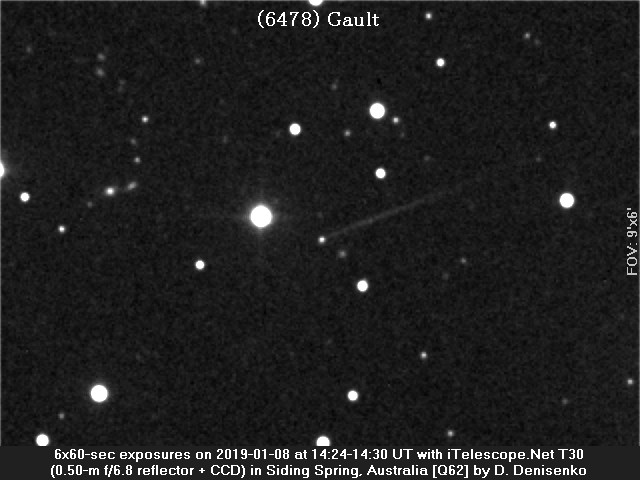
 Telescope view of Asteroid (6478) Gault. The large square is the field of View of T30 (SSO) and the small that of T17 (SSO) the medium rectangle is T5 (Mayhill). The orientation is upside down from the spotters maps.
 Asteroid (6478) Gault has been reported to have a comet like tail, from CBET 4594 “The tail/trail first appears in individual ATLAS exposures on 2018 Dec. 8, as identified by Denneau, with a median combined 120-s exposure showing a tail 30" long in p.a. 290 degrees. There is no evidence of a tail in previous ATLAS imaging in January 2018. An initial analysis using a cometary Finson-Probstein model (cf. website URL http://comet-toolbox.com/FP.html, as perJ.-B. Vincent) shows that both the Dec. 2018 and Jan. 2019 data are consistent with the ejection of material or commencement of activity in early Nov. 2018”. Previous images from ATLAS and PanSTARRS show no cometary-like activity back to 2010.
It has been suggested a collision or impact is responsible for the tail. Ongoing observation of the phenomenon should be undertaken to understand its nature.
Asteroid (6478) Gault is visible from both Northern and southern scopes from with transit around 3:30 am (northernscopes) and 4:30 am (Southern scopes), however, this is just past astronomical twilight at SSO, so imaging should begin before this. The Southern scopes have the best view with the asteroid potentially visible from 12:30 am local time.
Asteroid (6478) Gault is currently magnitude 18.7, and will need long exposures on narrow field scopes with tracking for the best results.

iTelescope users Ulrich Eberhard Stickel and Denis Denisenko have achieved images with T30 from SSO. Denis Denisenko's is at this link: http://scan.sai.msu.ru/~denis/Comet/6478-T30-20190108.jpg
The MPC one line ephemeris is:
06478 14.4 0.15 K194R 289.34905 83.26761 183.55769 22.81135 0.1935870 0.28161558 2.3051451 0 MPO435760 1093 19 1988-2018 0.44 M-v 38h MPC 0000 (6478) Gault 20180209
Example plan for following the asteroid, check filter availability.
;
; Single target image example, adjust filter as necessary for chosen scope.
;

#trackon
#count 3
#interval 300
#binning 2
#filter Red
06478   14.4   0.15 K194R 289.34905   83.26761  183.55769   22.81135  0.1935870  0.28161558   2.3051451  0 MPO435760  1093  19 1988-2018 0.44 M-v 38h MPC        0000   (6478) Gault              20180209
#shutdown
Labels: alert, asteroids, iTelescope
Friday, October 13, 2017
Near Earth Object 2012 TC4 Flys by (12 October 2017)
 |  |
| Asteroid 2012 TC4 imaged with iTelescope T20 on 11 October 2017. MAX stack of 8 x 60 second luminance images, stacked in ImageJ. Over enhanced to show the asteroid. Click to embiggen. | Animation of all 8 frames, made with ImageJ. CLick to embiggen. |
Five years ago to the day, NEO 2012 TC4 passed 0.2 Earth Moon distances away from us. This time the asteroid was even closer, at 0.13 Earth Moon distances (a mere 50,150 km) and hurtling though the sky at a blistering 13 arc minutes a second. At this speed the iTelescopes cannot track the asteroid. Even with a 60 second exposure the asteroid is a mere streak 45 minutes before closest approach.

The asteroid zipped across the field in a mere 12 minutes. The asteroid is a fast rotator, with a period of 12 minutes and 14 seconds, and the asteroid can be seen to dim midfield.
There are quite a few good images of the asteroid on the web, like this one from the SONEAR observatory.
Labels: 2012 TC4, iTelescope, NEO
Thursday, April 20, 2017
Asteroid 2014 JO25 recedes from view (20 April, 2017)
 |  |
| Asteroid 2014 JO25 ziping along with the scope tracking on the asteroid (the asteroid is the dot near the edge). 20 x 60 second luminance exposures with iTelescope T11 stacked and aligned in ImageJ. Imaging starts at 9:05 UT (3:05 am local time 20th) Click to embiggen. | Animation of the same 20 x 60 frames (click to embiggen for animated asteroidal goodness) |
As Asteroid 2014 JO25 recedes from earth I was able to get some more images and animations. By the time I took the above images with iTelescope T11 in New Mexico, it had moved far enough away that I could track on the asteroid. Still moving at a fair clip and the stars are trailed.
 |  |
| Asteroid 2014 JO25 zips along receding from Earth with added satellite trails (the asteroid is the dotted line through the centre). 20 x 60 second luminance exposures with iTelescope T14 stacked and aligned in ImageJ. Imaging starts at 3:05 UT (9:05 pm local time 19th) Click to embiggen. | Animation of the same 20 x 60 frames (click to embiggen for animated asteroidal goodness) |
Earlier in the UT day from T14, also New Mexico. Asteroid is moving too fast to track.
 |  |
| Asteroid 2014 JO25 near galaxy NGC 4710. 7 x 120 second luminance exposures with iTelescope T13 (Siding Spring Observaory) stacked and aligned in ImageJ. Imaging starts at 11:00 UT (9:05 pm local time 20th) Click to embiggen and see more galaxies. | Animation of the same 20 x 60 frames (click to embiggen for animated asteroidal goodness). Cloud comes over in the last frames. |
Finally an image from telescope T13 at Siding Spring Observatory in Australia, choosing to track on the galaxies rather than the asteroid for a prettier composition. Clouds have ruined any chance of me seeing the asteroid with my own instruments.
Labels: 2014 JO25, asteroids, iTelescope
Wednesday, April 19, 2017
Capturing asteroid 2014 JO25 (19 April 2017)
 |  |
| Asteroid 2014 JO25 zips past the magnitude 13.1 galaxy NGC 6248 while bracketed by satellite trails (the asteroid is the dotted line through the centre). 10 x 120 second luminance exposures with iTelescope T14 stacked and aligned in ImageJ. Imaging starts at 10:00 UT (4:00 am local time) Click to embiggen and see more galaxies. | Animation of the same 10 x 120 frames (click to embiggen for animated asteroidal goodness) |
Asteroid 2014 JO25 is, as I type, making its closest approach to Earth (12:24 UT 19 April). Zipping past at 4.6 Earth-Moon distances at closest approach, this asteroid was moving at a speedy 92.2 arc seconds per minute whin I was trying to image it, making imaging a tad challenging. However, using the remote telescopes of iTelescope in Mayhill New Mexico I succeeded (with a bit of bad luck with some cloud early on). With the wide-field T14 instrument I caught the asteroid zipping through a field of galaxies, looking rather nice.
 Asteroid 2014 JO25 also at 10:00 UT taken with iTelescope T5, moving so fast the tracker is just barely coping (hint the asteroid is the only thing that is not a streak).
Australia gets its chance tomorrow, when the asteroid zips through Virgo. It won't be as bright as at closest approach, but still within reach of modest amateur scopes.
This is the closest approach of asteroid 2015 JO25 for around 400 years, and it wont come this close again for another 500 years.
The asteroid turn out to be a very interesting object, images from the Arecibo radio telescope show that the asteroid is a contact binary, and about twice the size we though it was, one of the two lobes is around 620 meters in diameter, see here and here of radio telescope "images" and animations from the Goldstone and Arecibo radio telescopes.
Labels: 2014 JO25, asteroids, iTelescope
Wednesday, April 12, 2017
More comet C/2015 ER61 goodness (8 April 2017)
 |  |
| Comet C/2015 ER61 on APril 8 at 4:41 AEST. Image is a stack of 15 x 60s greyscale images from iTelescope T13 registered and stacked in comet mode of DeepSky Stacker. Click to embiggen | Same images registered and stacked in ImageJ, then a SUMMED Z projection applied. Click to embiggen |
Comet C/2015 ER61 is fading after its outburst, but I got some nice sequence of it via the remote iTelescopes (here it's been mostly clouded out). I've been playinng with DeepSKy stacker to see if I can better comet tail resolution than I can with ImageJ. My current attempts with both are pretty meh.
See my previous image here.
Labels: C/2015 ER61, comet, iTelescope
Saturday, April 08, 2017
My First Telescopic Image of Comet C/2015 ER61

Weather at the SSO finally cleared so I was able to get this image with the iTelescope T13 remote telescope.
The head is overexposed to show the tail more clearly. While not as impressive at this image (my image is rotated at 90's to this one, and is a much narrower field of view), it isn't too bad at all.
Labels: C/2015 ER61, comet, iTelescope
Thursday, October 20, 2016
Mars and M22 in Hydrogen Alpha Light (9 October 2016)

Labels: cluster, imageJ, iTelescope, Mars
Thursday, September 08, 2016
My Images of Mars close to M19 (7 September 2016)
 |  |
| Mars (Obvious overexposed blob) and M19 (labelled fuzzy patch) taken with the Canon IXUS 400 ASA, 3 x Zoom, 15 seconds exposure. Click to embiggen. | Mars (Obvious overexposed blob on far right) and M19 (obvious fuzzy patch) taken with the Canon IXUS mounted on 8" Newtonian inifinty ot infinity focus, 25 mm eyepiece. 800 ASA, 15 seconds exposure. Image rotated to match simple camera image Click to embiggen |
After a beautifully clear day it looked like cloud would ruin the close approach of Mars and M19. I got Don the 8"Newtonian out and assembled it anyway and cooled it down while organising tea.
After dinner I set up the camera on the scope, ran some test shots on the Moon, then a couple of test shots on Saturn (next time I check the focus properly) then finally went for Mars and M19.
I had to juggle the alignment to get both Mars and M19 in the picture (as you can see) and because I didn't get the camera-eyepeice alignment exactly right there is some weird brightness variations across the field of view, but otherwise it worked ot pretty well. Remember this is a simple point and shoot camera basically just stuck up to the lens of the telescope (with an adaptor to be sure, but nothing particularly fancy).
While taking images I alos checked out the view in binoculars, in 10x50 binoculars, with a waxing Moon in the sky M19 was clearly visible near Mars.
 M19 and Mars taken with iTelescope T12. M19 is at the top. Mars (near
the bottom) is grossly over exposed in this 10 second exposure. Click to
embiggen
M19 and Mars taken with iTelescope T12. M19 is at the top. Mars (near
the bottom) is grossly over exposed in this 10 second exposure. Click to
embiggenLabels: binocular, cluster, iTelescope, Mars, telescope
Wednesday, September 07, 2016
Mars close to globular cluster M19 (7 September 2016)
 |  |
| Mars as seen from Adelaide at 22:00 ACST on 7 September, simiar views will be seen elsewhere in Australia at the equivalent local time. Click to embiggen. | Simulated binocular view of M19 and Mars. you will need to click to embiggen to see M19. M19 is faint and fuzzy under suburban skies in binoculars, so this is an accurate simulation. |
 |  |
| Black and white printable chart suitable for use with binoculars or telescopes. The large circle is the field of view of 10x50 binoculars, the small circle the FOV of a 30 mm eyepiece with a 114mm reflector. Click to embiggen and print (use with redlight torches so as to not destroy your night vision) | M19 and Mars taken with iTelescope T12. M19 is at the top. Mars (near the bottom) is grossly over exposed in this 10 second exposure. Click to embiggen |
For the next seven days Mars will be within a binocular field of the magnitude 6.8 globular cluster M19. This will look rather nice, even tonight, under suburban skies struggling with cloud, M19 was clearly visible as a fuzzy patch in binoculars near Mars. Of course over the next few days the waxing moonlight will make it harder to see the globular cluster.
However, on the night of the 7th Mars and M19 will be less than a degree apart, an will fit easily into a low power eyepiece of a telescope. while they should be fine to the unaided eye, photographing them will be a bit of a juggling act as the brightness of Mars will overwhelm the dimmer globular cluster (see the itelescope image above).
Mars will be a little over 1 degree away on the 8th, but will still fit in many low power telescope eyepieces.Well worth having a look.
on the 11th and 12th Mars wil be around a degree from the yellow orange binary 36 Ophiuchi (36 on the black and white map) a rather nice view in small telescopes)
Labels: binocular, cluster, iTelescope, Mars, telescope
Monday, March 28, 2016
Comet 252P in the tail of the Scorpion (morning, 26 March 2016)
 |  |
| 252P/LINEAR taken at 5:00 am AEDST 26/3/16. The image is a stack of 15x 60 second luminance exposures from iTelescope T12 at Siding Spring Observatory. MEDIAN Z projection used on the stack. Click to embiggen. | Same as before but a MAX Z projection on 8 of the 15 frames used to show the track of the comet. Click to embiggen. |
Comet 252P remains elusive for me from my home. The morning of the 26th it was just near Lesath and Shalula, the two bright stars in the sting of the Scorpions tail (and the two bright stars in the images above). However it was raining here in Adelaide. Fortunately iTelescope at Siding Spring Observatory was clear, and I was able to get these shots of comet 252P.
I used a MEDIAN Z projection registered on the comet to bring the comet out from the background stars, and a MAXIUM Z projection with the images registered on the stars to show the movement of the comet.

Labels: 252P, comet, iTelescope
Comet 252P and the Butterfly Cluster (27 March 2016)
 |  |
| 252P/LINEAR taken at 4:50 am AEDST 27/3/16. The image is a stack of 6x 60 second luminance exposures from iTelescope T12 at Siding Spring Observatory. MAX Z projection used on the stack. Click to embiggen. | Same as before but the images are SUMMED in the Z projection. Click to embiggen. |
The weather has been cloudy here, and I only got a brief glimpse of the tail of Scorpius through the cloud at 5:00 am on Easter Sunday before it really socked in. Fortunately iTelescope at Siding Spring Observatory was clear, and I was able to get these shots of comet 252P near the Butterfly Cluster. 6 x 60 second images were stacked in ImageJ and then I experimented with different Z projections to bring out the nebula and dark globules around the Butterfly Cluster (M6). On I used MAX, maximum intensity for each image and the other I simply SUMMED the images. The comet is a bit overexposed, but the surrounding territory comes out quite nicely.

Labels: 252P, comet, iTelescope
Monday, March 14, 2016
My first shot of comet 252P/LINEAR

No idea how currently bright it is, cloud here keeps me from making visual observations. but from other observers it is now apparently between 6.5 and 7.0 so still brightening.
Labels: 252P, comet, iTelescope
Thursday, February 11, 2016
Supernova SN 2016adj in Centaurus A

I will have to take shorter exposures and stack them if I want to do photometery.
Labels: iTelescope, supernova
Monday, January 04, 2016
Comet C/2013 US10 Catalina 20 December and 31 December 2015
 |  |
| Comet C/2103 US10 imaged with iTelescope T20 on 20 December 2015. MEDIAN stack of 5x180 second luminance images, stacked in ImageJ. Click to embiggen to see the galaxies in the bottom right clearly. | Comet C/2103 US10 imaged with iTelescope T20 on 31 December 2015. MEDIAN stack of 5x180 second luminance images, stacked in ImageJ. Click to embiggen. The ginormous blob off to the right is the bright star Arcturus, making detail in the comet hard to see.. |
 |  |
| The image of Comet C/2103 US10 above cropped to show detail in the inner tail. Click to embiggen to see the fine structure more clearly. | Animation of each of the 5x180 second frames. |
I have been having extraordinary trouble seeing the bright(ish) comet C/2013 US10 Catalina (magnitude 6.4, just below unaided eye visibility), here in Australia it is very low on the horizon and clouds (and the occasional need for sleep) have frustrated me. My choice of timing for remote telescope runs has been pretty dismal too, I seem to pick all the stormy nights. However I have managed to get these two images, one from the 20th showing exquisite detail in the tail, and one from the 31st, when the comet was close to Arcturus. This was interesting but drowned any detail in the comet out.
The comet is still reasonably close to Arcturus, if you want to try an find it with your own scopes.
Labels: astrophotography, C/2013 US10, comet, iTelescope
Friday, April 17, 2015
My First Image of C/2015 G2 (MASTER) 15 April 2015

Nice long thin tail.
Labels: C/2015 G2, comet, iTelescope



 Click to read about or order
 Click to read about or order
 Click to read about or order
 Click to read about or order