Tuesday, January 19, 2016
The David Bowie Constellation in Stellarium
 |  |  |
| The David Bowie constellation, as illustrated in the memorial webpages | What the constellation will actually look like this morning at around 3 am AEDST looking east. Simulated in Stellarium, click to embiggen | What the constellation will look on 1 April in the morning at around 3 am AEDST looking south. Simulated in Stellarium, click to embiggen |
DDB Brussles report of this amazing tribute to David Bowie has been circulating around the world. The images of the "constellation" Belgian astronomers of the MIRA public observatory created has attracted attention (rather than the fact that the image is interactive and that clicking in the lightning flash plays Bowie songs).
But will the "constellation" actually look like that? The constellation was drawn on 2D maps of the sky, and there is likely some distortion. So I used the "sky cultures" feature of Stellarium to create the Bowie constellation, using the stars nominated by the Belgian astronomers. The results can be seen in the images above.
The "constellation" is only briefly visible before Sunrise in the southern hemisphere (and a large chunk of it is permanently below the horizon for the northern hemisphere) at the moment, and it is side on It won't be until April that it will be oriented more vertically. It is still a bit chunky, but not too bad a representation.
Of course, several of the stars are too faint to be easily seen, and the "constellation" ignores the obvious bright stars, but it does reasonably produce a lightning flash. And it is ephemeral, as it was produced to be "near Mars, but Mars will move away from the "constellation" over the year, and be far away by 2017.
Still, a nice idea. I you want to add this to stellarium yourself, in the skycultures folder create a folder called Bowie. The create the following files:
constellation_names.eng.fab, constellationship.fab, description.en.utf8, info.ini,
references.txt and star_names.fab
using the file contents below; constellationship.fab is the Hippicaros numbers of the stars involved (placed in line connection order). The star_names.fab doesn't work even though identically set up files work fine for my Boorong and Karuna sky cultures. I leave fixing this as an exercise to the reader. See the abbreviated rules here.
========constellation_names.eng.fab===========
001 "Ziggy Stardust" _("Ziggy Stardust")
002 "NTest" _("NTest")
=======constellationship.fab===============
001 7  65474 73714 73714 77952 77952 70069 70069 70638 70638 64003 64003 68002 68002 65474
=======description.en.utf8=============


David Bowie Tribute
Music legend David Bowie gets his own constellation, delineated by seven stars that shine in the iconic shape of a lightning bolt. A remarkable tribute by Belgian music station Studio Brussel and MIRA Public Observatory.
External links
- David Bowie Tribute: Starman Gets His Own Constellation.
Author
This sky culture was contributed by Stellarium user Ian Musgrave based on the work of Belgian music station Studio Brussel and MIRA Public Observatory. ==========info.ini========================= [info] name = Bowie ===========references.txt=================== Reference sources - http://ddbbrussels.prezly.com/belgians-give-starman-bowie-own-constellation# http://stardustforbowie.be/ =========star_names.fab================ 65474|_("Spica") 73714|_("sigma Librae") 77952|_("beta Triangulum") 70069|_("SAO 241641") 70638|_("beta Octanis") 64003|_("SAO 204132") 68002|_("zeta Centauri") 80112|_("Wife of Dujit") =========================================Labels: constellations, public outreach, stellarium

Thursday, July 02, 2015
What was the Conjunction like from Jupiter (and Callisto and Ceres)?
 |  |
| Venus and Earth seen from the cloud tops of Jupiter on July 1 simulated in Stellarium (click to embiggen). | Telescopic view of Venus and Earth seen from the cloud tops of Jupiter on July 1. |
 |  |
| Jupiter about to eclipse Venus and Earth as seen from Callisto on July 1 simulated in Stellarium (click to embiggen). | Jupiter about to eclipse Venus and Earth as seen from Callisto on July 1. |
A little while ago someone on Facebook (soory, I forgot who it was), said people on Jupiter and Venus would be wondering why we were making a fuss.
Well, Venus maybe, but from the cloud tops of Jupiter Venus and the Earth are even more spectacularly close. In a telescope (should you be in a convenient balloon, or be an inquisitive balloon organism) , the crescent Earth and the "last quarter" Venus look superb, with Earth's Moon nearby.
The most spectacular view is from Callisto though. You get to see Jupiter eclipse Venus, Earth and the Moon, and before that, you get to see the various Galilean moons dance towards and away from Venus and Earth.

I'm sure there is some space rock between Earth and Ceres that is in the right spot to have a spectacular triple conjunction. I leave that as an exercise for the reader.
Labels: Conjunction, Earth, Jupiter, stellarium, Venus
Sunday, July 06, 2014
Tonight's Conjunction As Seen From Mars
 |  |
| Earth as seen from Mars on the the night of the Moon, Mar, Spica conjunction. The Moon is too close to be seen separate from the Earth with the unaided eye. Earth is a morning object from Mars at the moment. Simulated in Stellarium | Looking back towards the Sun from behind Mars. Simulated in Celestia |
Someone was wondering what the Moon Spica and Mars conjunction would look like from Mars. Well, here are some simulated views for you. As Spica is "behind" Mars, we can see it in these views.
Labels: celestia, Conjunction, Mars, Moon, stellarium
Friday, July 05, 2013
Venus and Contrails in the Twilight (1 July, 2013)
 |  |
| Venus and contrail taken on 1 July at 18:19 ACST, 2013, Canon IXUS at ASA 400, 4 seconds exposure. Click to embiggen. | Almost equivalent view in Stellarium. I juggled the scale, but it still doesn't quite match the actual picture. I had to set the Light Pollution to 5 in View Sky (F4) to get the star intensities to mostly match (Venus and Procyon don't match still). Click to embiggen. |
Labels: astrophotography, stellarium, Venus
Thursday, May 23, 2013
The Planet Dance's Main Attraction Starts This Friday (24 May, 2013)
 |  |
| Western horizon as seen from Adelaide this Friday at 5:45 pm ACST on 24 May, when Venus and Mercury are closest. Similar views will be seen from the rest of the southern hemisphere at the equivalent local time. Click on any image to embiggen | Western horizon as seen from Adelaide at 5:45 pm ACST on Sunday 26 May, when all 3 planets are within a circle 3° across. |
 |  |
| Eastern horizon as seen from Adelaide at 5:45 am ACST on 20 April 2026, when Mercury, Saturn and Marsare within a circle less than 2° across. | Western horizon as seen from Adelaide at 6:23 pm ACST on 8 September 2040, showing all 5 bright planets and the crescent Moon.. |
The weather seems to be fining up, so there is a good chance we will see the main part of the planet dance under clear skies.
This Friday evening (24 May) Mercury and Venus are closest, then on Sunday evening and Monday evening (26 and 27 May respectively), Mercury Venus and Jupiter are are within a circle 3° across (that's the distance covered by three out-stretched fingers).
For more details, viewing hints and an animation, see my Planet Dance post.
The line-up is the best until 2026, when Mercury, Saturn and Mars are within a circle less than 2° across. Then in 2040, all 5 of the bright planest are close together in the evening twilight, with lots of close approachs of pairs of planets, a real planet dance to look forward to.
Labels: Conjunction, Jupiter, Mercury, stellarium, unaided eye observation, Venus
Thursday, February 28, 2013
Earth as seen from Mars on 19 October 2014, with Added Comet Siding Spring
 |  |
| Comet C/2012 A1 Siding Spring as seen from Mars on the 19th of October 2014, with the Moon Demios and Earth. Simulated in Stellarium. Click to embiggen | Comet C/2012 A1 Siding Spring as seen from Mars on the 20th of October 2014, if it hasn't impacted Mars it will be as bright as Venus. With the Moon Demios and the Southern Cross. |
Strangely, one of the top searches that brings people to my blog is "Earth from Mars", so I started to provide views of Earth from Mars simulated in Stellarium (see here and here for some previous examples I have provided) .
But seeing as the story of comet C/2013 A1 (Siding Spring) potentially impacting Mars has gone viral around the world (astroblog is currently number 2 when you Google "C/2013 A1" see my previous posts here and here, with Celestia script, my post also got mentioned in New Scientist too, WOOT, along with Universe Today) I thought I would give the Earth from Mars fans something special. Earth from Mars with comet C/2013 A1 in view.
On the 19th (Mars at Adelaide equivalent time, around 18th UT) Earth is low above the eastern Martian horizon pre-Dawn, and the comet is bright and near the Zenith. By the 20th (19th UT) comet Siding SPring has zipped over to the Southern skies, and is glowing at roughly magnitude -4, as bright as Venus is in Earths skies. This should be easy to image from the Mars orbiters and surface rovers.
There is no tail on the comet because predicting tail appearance is difficult, at Mars's distance the comet may have a rather short tail.
Labels: comet, Earth, Earth from Mars, Mars, stellarium
Thursday, September 13, 2012
Finding Near Earth Asteroid 2012 QG42
 |  |
| Location of NEO 2012 QG42 at 9 pm local time on 13 September as simulated in Stellarium | Location of NEO 2012 QG42 at 9 pm local time on 14 September |
375 metre diameter Near Earth Object 2012 QG42 will be 7.4 Earth-Moon distances from us at closest approach on September 14 at 05:08 UT (that 3 am AEST, but the asteroid will still be close after astronomical twilight in Australia).
At magnitude 14 or so (ignore the Stellarium magnitudes, they are too dim) it will not be visible in binoculars or small telescopes, you will need a 6" or more scope and dark skies to see this. However, you will be able to see the asteroid visibly move over a period of a few minutes, so it's worth a look.
In Australia it's not far from the bright star Altair in Aquila, and is a good distance above the horizon at 7:30 pm local time (around astronomical twilight), and is probably too low to image by 11 pm.
Because it so so close to earth parallax is a problem, and Stellarium positions will be out. Links to detailed ephemeris's can be found here. My previous images of the asteroid are here, here and here.
Labels: asteroids, NEO, stellarium
Tuesday, June 05, 2012
The Transit of Earth from Mars, November 10, 2084

The cool thing about transits of Earth from Mars is you also get to see the Moon as well. The image to the left is the Stellarium simulation of the transit of Earth on 2084.
The next transit of Venus to be seen from Mars is in 2030.
Labels: Mars, stellarium, transit, Venus
The 2012 Transit of Venus in Stellarium

Anyway, copy the following script to a file called venus_transit.ssc, put it in the scripts folder, then run it through the scripts tab in the configuration menu. Enjoy!
====================>8 cut here >8==================
//
// Name: Venus Transit
// License: Public Domain
// Author: Ian Musgrave
// Description: Simple script to demonstrate the transit of Venus from Adelaide.
//
core.wait(1);
core.clear("natural");
// Turn off constellation lines and labels if on, flag planets.
ConstellationMgr.setFlagLines(false);
ConstellationMgr.setFlagLabels(false);
SolarSystem.setFlagPlanets(true);
core.wait(1);
// OK, move to the proper location and date for the Transit, time is UT
// you can change this to your location in decimal Long lat
// note stellarium does Long Lat not lat long like everyone else
// Select the Sun and track it
core.setDate("2012:06:05T22:09:29");
core.setObserverLocation(138.59863, -34.92866, 10, 0, "Adelaide, Australia");
core.selectObjectByName("Sun", false);
StelMovementMgr.setFlagTracking(true);
core.wait(2);
// Zoom in on the Sun
StelMovementMgr.zoomTo(0.6, 2);
core.wait(2);
// Speed up the action
core.setTimeRate(250);
// When Transit over set to normal speed and zoom out
core.waitFor("2012:06:06T06:59:28");
core.setTimeRate(1);
StelMovementMgr.zoomTo(60, 2);
Labels: stellarium, Sun, transit, Venus
Thursday, March 22, 2012
Dance of the Planets II, Venus, Jupiter and the Crescent Moon 25-27 March
 |  |
 |
If you have been watching Venus and Jupiter over the past few weeks (see here, here and here), you will have seen them draw close together and then start moving apart. Starting Sunday 25th March the crescent Moon joins then for a rather beautiful line-up, which is best on Monday the 26th when the Moon is directly between Venus and Jupiter.
If you look to the west between half an hour and an hour after sunset you will have the best views, especially if you have a level, unobstructed western horizon.
Labels: Conjunction, Jupiter, Moon, stellarium, Venus
My First Image of Supernova 2012aw near M95
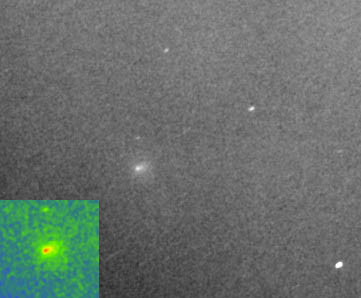
 This is my first image of the new supernova 2012aw in M95, taken with iTelescope T05 (5 x 120sec exposures stretched in FITS liberator and stacked in image J). Click to embiggen.
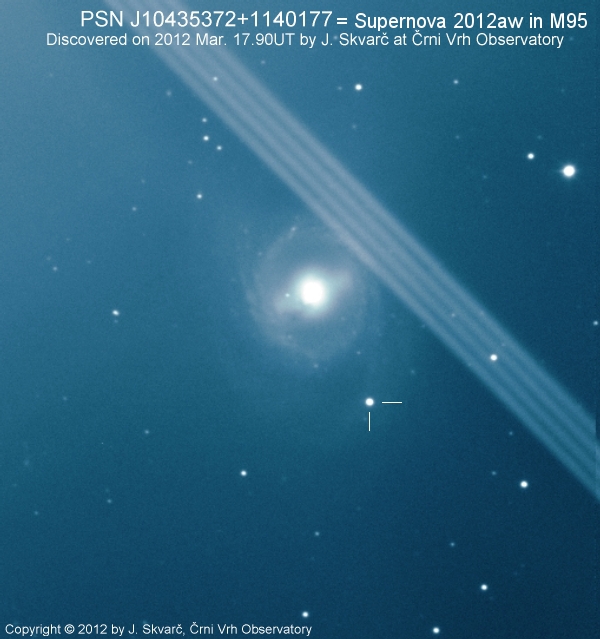
Compare this with the discovery image. There's a lot of light contamination because M95 is so close to Mars at the moment.
Of course, as nice as pretty pictures are, on going observations are needed to follow the brightness curve of this type IIp supernova. I'll do some magnitude estimates when I get the time.
You can get a Stellarium plugin with all the bright historical supernovas if you want (hat tip Ethan Siegel).
The Bad Astronomer has a great many image links and a video. And here's another iTelescope image from Francis Walsh.
Labels: iTelescope, stellarium, supernova
Wednesday, February 22, 2012
Dance of the Planets, February 24-27 2012
 |  |
 |  |
Between Thursday February 24, 2012 and Monday 27 February, the crescent Moon will come close to Venus and then Jupiter in a series of beautiful encounters as it climbs in the twilight sky. Venus and Jupiter come closer too. You will need a clear level horizon to see the lineups at their best, but even moderately cluttered horizons will show the the spectacle nicely. Start looking to the west from around half an hour after sunset.
Mercury is in the mix too, but unless you are looking out over ocean you wont have a chance to see it (and even if you do it will be hard to pick up)
Video of simulated Moon and plaentary encounters.
Labels: Jupiter, Moon, stellarium, Venus
Sunday, February 12, 2012
Earth from Mars, February 2012
 |  |
Left image: Earth as seen from Mars looking north-west in the twilight of February 12, 2012, shortly after Sunset, as visualised in Stellarium. The location is approximately the same latitude on Mars as Adelaide is on Earth. The right image is what Earth would look like through a telescope. Click on any image to embiggen. An earlier version from November 2011 is here.
The evening sky on Mars is quite lovely at the moment, with Earth, Venus and bright Jupiter all lined up. Earth will disappear from view very soon as Mars moves into opposition (where the earth is directly between Mars and the Sun. From our point of view, Mars will be at it biggest and brightest and visible all night long).
Once again one of the top search terms for people visiting my blog, is "Earth from Mars", probably in response to more publicity about the "John Carter on Mars" movie. So, once more, here it is for you searchers.
Labels: Earth, Mars, stellarium
Saturday, November 05, 2011
Earth from Mars, November 2011
 Earth as seen from Mars looking north-west in the late twilight of November 8, 2011 as visualised in Stellarium. The location is approximately the same latitude on Mars as Adelaide is on Earth.
For Some reason one of the top search terms for people visiting my blog, now that Elenin has gone, is "Earth from Mars". So, here it is for you searchers.
Labels: Earth, Mars, stellarium
Tuesday, August 02, 2011
Did Elenin/Nibiru tilt Saturn (or How do Bleeping Telescopes Work?)
 Stellarium vs telescopic view of Saturn as presented at http://www.scribd.com/fullscreen/60725711
There is a lot of silliness running about the intertubes at the moment about comet C/2010 X1 Elenin. I try to avoid the silliest, and talk about genuine confusions and misunderstandings, encouraging people to think critically and look at the sky.
But I have to respond to the latest silliness going around the intertubes, as it involves one of my favourite astronomy programs, Stellarium.
In a page hosted on scribd (see link above, it will be 10 minutes of your life you will never get back), amongst the usual claims (CW Leonis is Nibiru etc., see my FAQ and these posts to cover most of what is in this document) and some unusual claims (gravity doesn't exist) is the claim that Elenin/Nibiru has caused planet Saturn to change it's tilt.
The support for this claim is comparison between Stellarium predictions for the night skies appearance and actual telescopic images. It appears to have a lot of traction, given the emails I've been getting and the various discussion groups hosting these images (eg here).
Before discussing this, I'd like to get people to think about this claim though. Saturn is the iconic planet for amateur astronomers, thousands world wide will be watching it every
No, Saturn did
 not tilt.
Most solar system visualization programs show the planets as we would see them from Earth, but telescopes invert the image, either a simple flip or upside down-back to front, depending on the optics involved (see http://www.spaceref.com/telescopes/Image-Orientation-Why-Is-Everything-Upside-Down.html for more of an explanation and of course here with diagrams).
When you compare a visualisation image with a telescopic image, they will look tilted with respect to each other.
And you can demonstrate this with Stellarium itself. If you look at the image to the right, you will see a small telescope icon (boxed in the image). This will swap between the "no telescope" view and various telescopic views.
In the image below, I compare the Stellarium prediction for the unaided eye image for Saturn at 22:00 hr on 1 June 2011, as in the image from Scibd, and the Stellarium prediction for an equatorial mounted telescope (such as the one used to take the Saturn image seen in the Scibd document).
 |  |
Personally, I wouldn't take much stock in the writings of someone who doesn't realize telescope images are inverted.
At Christopher Go's astrophotography site you can see stunning images of Saturn going back to 2007. No Nibiru-induced tilt is seen.
Labels: Pseudoscience, stellarium
Wednesday, March 23, 2011
Review of Stellarium 0.10.6.1
 Comet 2010 X1 Elenin visualised after downloading orbital elements into Stellarium 10.6.1
Bottom line, if you do not already have Stellarium, or have not yet upgraded to Stellarium 10.6.1, go and download the upgrade now.
I’ve used the free planetarium program Stellarium since version 0.9, and it is no secret that it is my favourite planetarium program for unaided eye observation, and for illustrating aspects of the sky to school groups and the general public. With version 10.6.1 the Stellarium development team have produced a program that I truly love.
The first aspect is that Stellarium 10.6.1 (for windows, also versions for Linux and Mac) runs faster on my machine (a less than state of the art Dell Inspirion 1420 with Windows Vista) than the previous 10.5, and more stably. The old 10.5 would very rarely, but randomly, crash for no apparent reason. This version chugs along quite nicely under quite strenuous circumstances.
All the old features that make this an excellent planetarium program (photorealistic sky, customisable locations, zoomable objects, large star databases, easy navigation, switching between constellation shapes and plain view, satellite passes, night mode, multiple sky culture maps, ability to see the sky from other planets) are there. The search option is still very sluggish though. All my keyboard shortcuts work as they did before.
 And what’s more, it has added a feature that makes me almost delirious with joy. There is a plug-in that lets you download new solar system objects. Gone is the laborious hand editing of the system.ini file, you can download new comets and asteroids from online sources, or upload them from files on flash drives (if you are using a field laptop with no internet access.
To access the plug-in after downloading Stellarium 10.6.1, press F2 to enter the configuration files, click on the Plug-in tab, then choose solar system editor plugin, click on the load at startup checkbox, then restart Stellarium.
After restart, go back to the plugin tab and choose solar system editor, then click on configure. Choose the “solar system” tab and click on “import elements”. In the next screen choose the “lists” tab, then choose either comets or asteroids. If you are connected to the internet, click on “online list”, then either type a URL manually, or choose from the preconfigured drop box.


The next screen will ask you to choose an object from the list. You may have to wait a minute or so for the list to load, depending on internet connection and speed (slowish wireless broadband dongle in my case), but when the list comes up, choose the object you want, and click add objects. This takes you back to the download objects screen (this is initially confusing, but is actually handy if you want to load objects from a different catalogue), but as you work back through the screens, you will see your new objects in the list. Daggerstab, take a bow.
 There are quiet a lot of new features that I won't go into. Suffice it to say that Stellarium covers a wide range of utilities that an amateur astronomer, educator or just interested person would find handy, without being a clunking behemoth.
The other thing that I think is important is that the satellite plugin. They have updated the code and made it more accurate. They have also added satellite tracks. If you already had the satelliet plug-in installed in 10.5, when you install 10.6 it will automatically turn on the satellite tracks. I actually find this annoying, but it is dead easy to turn on or off in the confiuration menu (down the bottom), so you can have it on when you want.
I give it 4 out of 5 Cepheid variables. What lets it down in my opinion is they still haven't produced a scripting manual. I love the scripting capabilities of Stellarium, and the new scripting language looks really powerful, but working out how to use it is really hit and miss.
Still, that relatively minor quibble apart (I should get off my bottom and make my own guide) , Stellarium 10.6 is a fabulous program, go give it a try.
Labels: review, stellarium
Friday, March 18, 2011
Comet 2010 X1 Elenin for Celestia and Stellarium
 Comet 2010 X1 Elenin visualised in Stellarium on 16 October, 2010 (click to embiggen).
As a follow up to the previous posts on 2010 X1 Elenin, I present to you these data files for Celestia and Stellarium so you can simulate the comet in these programs.
For Celestia, copy the data between the lines into a file called 2010X1.ssc (or Elenin.ssc or whatever you like), and copy that file into the Celestia extras folder. The data for Elenin is fairly old in the Celestia file, obtained here. For some reason the newest data, that works perfectly in Stellarium, results in Elenin just sitting in front of the Beehive cluster.
======cut 8<==================2010X1.ssc========================
"Elenin:2010X1" "Sol"
{
Class "comet" # Just copying the data for Halley
Mesh "halley.cmod"
Texture "asteroid.jpg"
Radius 4 # best guess at maximum semi-axis
MeshCenter [ -0.338 1.303 0.230 ]
# No idea why any of this works.
# These are old orbital elements, but replacing them with
# more recent elements, the ones that work perfectly for Stellarium and
# SkyMap, causes the comet to sit in front of the Beehive cluster
# and not move. I’ve been driven to frustration by this
EllipticalOrbit
{
Epoch 2455578.5 #2011-Jan-17.0
Period 3457004.12
SemiMajorAxis 22862.71468671387
Eccentricity 0.9999788963233883
Inclination 1.840276249645969
AscendingNode 323.2462306600872
ArgOfPericenter 343.7899811826415
MeanAnomaly 359.9999325013102
}
#Again, this data is copied straight from the ssc files for Halleys’ Comet
# chaotic rotation, imperfectly defined:
# this version from "The New Solar System", 4th Edition; Eds.
# JK Beatty, CC Petersen, A Chaikin
PrecessingRotation
{
Period 170 # 7.1 day axial rotation period
Inclination 66
PrecessionPeriod 3457004.12 # 3.7 day precession period
}
Albedo 0.8
}
==========8<=====cut================================================
For Stellarium 0.10.5 and older, make a backup copy of your Stellarium.ini file, then add the following lines to the end of the INI file. The radius is wrong, but it’s the only way I know of to get the magnitude right (there is a way to specify magnitude in Stellarium, add these lines
absolute_magnitude = 8.0
slope_parameter = 4
but it makes the comet too dim)
Stellarium 0.10.6 has just been released, which has a plugin which will allow you to add comets and asteroids directly, but the above method will still work.
[Elenin]
name = 2010X1/Elenin
parent = Sun
radius = 24
oblateness = 0.0
halo = true
color = 1.0,1.0,1.0
tex_halo = star16x16.png
tex_map = nomap.png
coord_func = comet_orbit
orbit_TimeAtPericenter = 2455815.22816
orbit_PericenterDistance = 0.482473
orbit_Eccentricity = 1.000016
orbit_ArgOfPericenter = 343.8071
orbit_AscendingNode = 323.2259c
orbit_Inclination = 1.8392
lighting = false
albedo = 1
sidereal_period = 365.25
Labels: celestia, comets, stellarium
Friday, November 05, 2010
A "Bright" New Comet in Virgo
 Earth as seen from Comet C/2010 V1 (Ikeya-Murakami), visualized in Celestia (click to embiggen)
Congratulations to Kaoru Ikeya and Shigeki Murakami, two Japanese amateurs who have discovered a new comet by visual (telescopic) observation (Kaoru Ikeya has 7 comets to his name, so he's an experienced comet hunter).
The Comet, C/2010 V1 (Ikeya-Murakami), is in Virgo. At the moment it appears to be around 2 degrees from Saturn. According to some reports it’s between magnitude 8 and 9, which should be achievable in good binoculars. The best places to see the comet are sadly in the northern hemisphere. In the southern hemisphere it is too close to the horizon and the oncoming dawn to make out. Between the 25th and the 30th the comet is between Venus and Spica.
 Location of Comet C/2010 V1 (Ikeya-Murakami) as seen from the Northern Hemisphere on the morning of November 5, an hour before sunrise (click to embiggen).
An image taken by Francois Kugel is here, and an image by Josep M. Aymami is here.
Here is a stellarium file for the comet (add to the end of the ssystem.ini file)
[2010V1]
name = C/2010 V1 Ikeya-Murakami
parent = Sun
radius = 24
oblateness = 0.0
halo = true
color = 1.0,1.0,1.0
tex_halo = star16x16.png
tex_map = nomap.png
coord_func = comet_orbit
orbit_TimeAtPericenter = 2455488.31671
orbit_PericenterDistance = 1.71541
orbit_Eccentricity = 1.0
orbit_ArgOfPericenter = 155.076
orbit_AscendingNode = 5.844
orbit_Inclination = 8.913
lighting = false
albedo = 1
sidereal_period = 365.25
Here is the celestia file, but frustratingly it gives entirely the wrong position for the comet:
===============================================================
"Ikeya-Murakami:C/2010 V1" "Sol"
{
Class "comet"
Mesh "borrelly.cms"
Texture "asteroid.jpg"
Radius 2.2
#InfoURL "http://www.solarviews.com/eng/borrelly.htm"
EllipticalOrbit
{
#Epoch 2455505.5
Epoch 2455488.31671 # 2010 Oct. 18.817 UT
Period 5.49
SemiMajorAxis 3.11206192
Eccentricity 1.0
Inclination 8.913
AscendingNode 5.844
ArgOfPericenter 155.076
#MeanAnomaly 358.956091
}
UniformRotation
{
Period 25
Inclination 90
AscendingNode 315
}
Albedo 0.04
}
==================================================================================
 Black and White map suitable for printing, click to embiggen.
MPEC files and imaging maps are over at my GRAS blog.
Labels: celestia, comets, stellarium
Saturday, October 16, 2010
Comet 103P/Hartley Enters the Southen Skies
 Comet 103P Hartley above the northern horizon at 4:30 am ACDST (3:30 non-daylight saving time) as seen from Adelaide on October 18, similar views will be seen from other places at equivalent local time. For the next few days it will be easy to spot near the bright star Capella.
 Comet 103P Hartley 2 has now entered the southern skies. The comet has been reported by northern observers to be visible to the unaided eye as a faint fuzzy dot under dark sky conditions. In the southern hemisphere, with the comet closer to the horizon, it will be difficult to spot until later in the week (and of course the horrible weather means we have had little opportunity to see it).
Unfortunately you need to get up around 4 am (local daylight saving time, 3 am local standard time). Also unfortunately, Moonlight will begin to interfere by the end of the week.
The comet should become brighter, leading up to its closest approach on October 20, but will never get brighter than between magnitude 4-5.
Naturally the comet will be best seen from dark sky sites. It will be easily seen in binoculars, and it races through the sky through some pretty territory (lots of binocular friendly open clusters).
 Spotters map of 103P Hartley in black and white, suitable for printing out (you need to click to embiggen and print the embiggened map) .
Alternatively you can download this printable back and white PDF Map.
If you want to add 103P Hartley to Stellarium or Celestia, the elements for those programs are here.
Labels: celestia, comets, stellarium, unaided eye observation
Wednesday, October 13, 2010
Comet 103P in Stellarium, a cautionary tale


Left image, 103P as imaged with the GRAS 14 telescope in New Mexico; Right Image, predicted position of 103P as visualized in Stellarium at the same time.
Stellarium is a pretty handy program. Realistic planetary visualization, customizable, I can run as a planetarium as well as control telescopes, and above all, it's free! You can also add objects to it. However, a reader (Wojtec) has posted a problem with Stellarium's implementation of 103P Hartley.
UPDATE: Reader Dagger stab writes:
If you are using the MPC's Minor Planet & Comet Ephemeris Service as a source, there's an error in your Stellarium data: it should be "orbit_PericenterDistance = 1.058686". (There should be an 8 after the 5.) It's correct in the Celestia script. :)(Thanks RD. Strangely, I used both the JPL horizons data as well a the MPC data, why SkyMap gets it right with the MPC data is a mystery, I will check back)
UPDATED UPDATE: I ended up completely rebuilding the Hartley add-on with fresh MPES data to match SkyMap, and with the rebuilt add-on 103P is within 5' of the CCD position, good performance and about as accurate as SkyMap. I've posted the revised figures on the original post and at the end of this post. The JPL horizons data was older than the MPES data, so it gave wacky results. Makes sense that it was the add-on elements rather than Stellarium being weird.
Wojtec found the Stellarium position was off by over 20 minutes of arc, I've confirmed this, actually, I found a 37 minute of arc discrepancy, and that was using a 103P definition file with the latest MPC parameters. Now this isn't much, for visual location or using binoculars and low power telescopes it will be just fine. But if you are using CCD imaging, then this is a significant discrepancy, if say, you were using the GRAS G14 imager the comet would be significantly displaced (see above images, and the image below which makes it clearer), and with the GRAS G5 imager the comet could be out of frame.
 Stellarium location of 103P compared to the SkyMap prediction, and the actual measured position from the G14 CCD image (click to embiggen)
I've tired two separate definition files for 103P, and there is still the same discrepancy, in the image to the left I've used the same parameters for SkyMap and Stellarium. So it's not the values. I've also been careful to check that the times were correct (imaging run vs Stellarium prediction) so the apparent differences were not due to timing errors.
Curiously, it only is happening with 103p Hartley (and to some extent 2010 TD54). For Comet Enke, Comet 10P Temple, and Vesta the Stellarium prediction is within 5 minutes of arc of the actual object, which is quite tolerable. It can't be a topocentric vs geocentric problem, the discrepancy for 2010 TD54, which has a huge parallax, was only 18' compare to 103P's 37' difference (and with only a short observation time you would expect a large uncertainty in the 2010 TD54 position).
So, I'm baffled, I'll put up a query at the Stellarium forums [answered rapidly, see above, thanks DS], but for now, just be aware that if you are using Stellarium to guide your telescopic CCD imaging, 103P's position will be off. [Now Fixed, see below]
=======================================
[Hartley]
name = 103P/Hartley
parent = Sun
radius = 24
oblateness = 0.0
halo = true
color = 1.0,1.0,1.0
tex_halo = star16x16.png
tex_map = nomap.png
coord_func = comet_orbit
orbit_TimeAtPericenter = 2455497.76729
orbit_PericenterDistance = 1.058678
orbit_Eccentricity = 0.695113
orbit_ArgOfPericenter = 181.1969
orbit_AscendingNode = 219.7661
orbit_Inclination = 13.6168
lighting = false
albedo = 0.5
orbit_visualization_period = 365.25
===========================================
Labels: comets, stellarium



 Click to read about or order
 Click to read about or order
 Click to read about or order
 Click to read about or order