Thursday, February 11, 2016
Supernova SN 2016adj in Centaurus A

I will have to take shorter exposures and stack them if I want to do photometery.
Labels: iTelescope, supernova

Thursday, January 23, 2014
Bright Supernova 2014J in Galaxy M82!

A bright new Type 1a supernova has been discovered in the galaxy M82, it has now been given the permanent designation of SN 2014J. Currently around magnitude 11 (I get it a little bit brighter), it is expected to brighten over the coming days, and may reach the binocular visible level of magnitude 8.
The supernova was discovered by accident, during a workshop on CCD imaging techniques. It is one of the closest supernova to us in recent decades.

Unfortunately it is only visible from the northern hemisphere, in the Constellation of Ursa Major, not far from the brightest star in Ursa Major, Dubhe. The Galaxy M82 is reasonably bright, at magnitude 8.6, and the brightening supernova can be picked up with relatively short exposures. At the moment the best time to image the supernova is between 12:00 am and 2:000 am, when it is high in the sky.
There is a nice animation here. Some confirmation images from the Remanzacco Observatory are here, and Peter Lake gives a nice overview of supernova hunting.
Labels: iTelescope, supernova
Monday, March 25, 2013
Supernova in M65, 24-03-13 and 23-03-13
 |  |
| Supernova in the Galaxy M65 on 23 March, image taken with iTelescope T04, 5x120 second exposures stacked and registered in ImageJ then a SUM Z-project applied, followed by contrast adjustment and colour inversion. Supernova indicated by black bars (click to embiggen). | A day later (24 March), same conditions but more affected by Moonlight. I'll have to do some astrometry to see if it has got brighter. Supernova indicated by black bars (click to embiggen). |
Labels: supernova
Sunday, March 24, 2013
Supernova in M65, 23-03-13

Here's a better image from Rolando Ligustri.
The supernova is reported to be still brightening, increasing from magnitude 16.4 to 15.8. It is located at RA 11 18 56.95 DEC +13 03 49.4
Labels: imageJ, iTelescope, supernova
Thursday, March 22, 2012
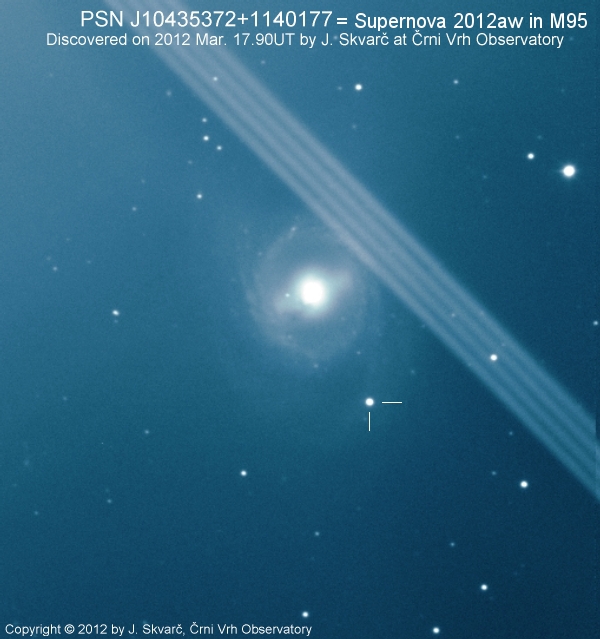
My First Image of Supernova 2012aw near M95
 This is my first image of the new supernova 2012aw in M95, taken with iTelescope T05 (5 x 120sec exposures stretched in FITS liberator and stacked in image J). Click to embiggen.
Compare this with the discovery image. There's a lot of light contamination because M95 is so close to Mars at the moment.
Of course, as nice as pretty pictures are, on going observations are needed to follow the brightness curve of this type IIp supernova. I'll do some magnitude estimates when I get the time.
You can get a Stellarium plugin with all the bright historical supernovas if you want (hat tip Ethan Siegel).
The Bad Astronomer has a great many image links and a video. And here's another iTelescope image from Francis Walsh.
Labels: iTelescope, stellarium, supernova
Wednesday, January 11, 2012
Possible Supernova in NGC 3239 in Leo
 My image of the possible supernova in NGC 3239 in Leo taken with iTelescope T05 (3x120 seconds, stacked in ImageJ). Compare this to the discovery image (more details at the link as well) and an image taken before the supernova (tip of the hat to Charles Bell).
The image is very badly affected by the Moonlight, with the Moon only 30 degrees away, and it will only get worse over the next few days. Not sure how I'll get any good magnitude estimates out of this.
Labels: supernova
Tuesday, December 13, 2011
Supernova 2011iv in NGC 1404 on Dec 11
 Supernova 2011iv in NGC 1404 taken with GRAS-12 on December 11 2011, 5x60 second luminance exposures stacked and summed using ImageJ. Compare with images here and here. I'll have do do some astrometry, but it looks brighter than in Leonids images (click to embiggen).
Labels: Global Rent-a-Scope, supernova
Friday, December 09, 2011
Bright New Supernova in NGC 1404
Monday, September 12, 2011
Finding the bright Supernova 2011fe in M101
 North-western sky as seen form around latitude 30 deg north at astronomical twilight (an hour and a half after sunset). M101, which hosts the supernova is above the handle of the big dipper.
With Supernova 2011fe being exclusively a northern hemisphere object, I have neglected the basic "look here" type posts I normally do.
However, despite this blog being largely about observing from the southern hemisphere, with added exoplanets, most of my readers are from the US (thank you, comet Elenin), so I'm doing a finding the supernova post just for you.
Now Supernova 2011fe is the brightest supernova in the past 20 years, however it's currently around magnitude 10, which makes it very faint from our pespective (the limit anyone can see under dark skies with ideal eyesight is magnitude 6.5). You will need a small telescope or dark skies and good, tripod mounted binoculars to see it.
 Approximate binocular view of M101 (Click to embiggen).
A big problem at the moment is Moonlight, for the next day or so bright Moonlight will mean that the supernova (and its host galaxy M101) will be effectively invisible in binoculars and small telescopes. You will have to wait until the Moon is below the horizon (September 15) to see them.
The other problem is that M101 sets not too long after twilight, so you have about 2 hours where it is high enough above the murk around the horizon to see.

M101 is a faint patch of light in binoculars, despite its listed brightness of magnitude 7.7, it is a diffuse object, so rather dim, it may look like no more than a fuzzy dot. It will look better in a smal telescope, but will still be a fuzzy patch.
Once you have it, the star within the fuzzy dot is the supernova. Happy supernova hunting!
Labels: supernova
Thursday, September 08, 2011
Supernova 2011fe in M101 Nearing or at Maximum Brightness
Supernova 2011fe imaged using Global-ret-a-scope GRAS_05 on August 30 (click to embiggen)Supernova 2011fe in M101 has been brightening considerably, and is nearing, or may be already at, it’s maximum brightness. If you have M101 reasonably high in your night sky, you should be able to see the supernova in binoculars. Sadly, this supernova can't be seen from most of Australia.
Labels: Global Rent-a-Scope, supernova
Tuesday, June 14, 2011
Supernova sn2011dh in M51 is brightening!
 Supernova sn2011dh in M51 imaged with the GRAS-05 instrument. Left image 4 June, right image 10 June. Both are 120 sec exposures using the luminance filter. The 10 June supernova image is visibly brighter than the June 4 image (click to embiggen).
Most of you following this blog, or astronomy news in general, will be aware of the “bright” supernova in the Whirlpool Galaxy (M51).
I’ve been following the supernova over the past week (and encouraging others who are doing this to submit their images for crowd sourcing). After the first two images I tried my hand at photometry, to estimate the brightness of the supernova.
 My estimated supernova magnitudes, with 95% confidence intervals.
My first two images were from 4 June and 6 June (due to this thing called weather). I used spot densities from the calibrated (but otherwise untouched) FITS files derived using ImageJ. I used the densities from the supernova and 6 reference stars spanning the range of M13 to M15.1.
To my surprise, the supernova hadn't faded according to my data, but actually brightened. Given the accuracy of my measurements though, it could have just not have dimmed much.
So when I looked at my next image from the 8th, it looked as bright as the nearby reference star, and my photometry confirmed this.
 Then the image of the 10th the supernova was definitely brighter than the reference star (see image above). My photometry showed it to be M12.7.
So how good was my photometry. I didn't have many reference stars between M14 and M13 (mostly because when I designated my reference stars I was expecting the supernova to dim, and partly because they
 were what I had magnitudes for) and I'm using spot densities rather than areas as is standard.
I was only moderately confident in the accuracy of the magnitudes. So I checked the sn2011dh webpage, and to my surprise found that my magnitudes fitted very closely with the magnitudes reported by others. The supernova's magnitude has now plateaued around M 12.8 (which is pretty typical of Type II-P supernova, although how typical the upward bump is I don't know).
This is definitely a supernova worth continued following (now I find I should have been doing exposures with BVR filters). Again I urge people to submit their images (details here). Calibrated but otherwise unmodifed FITS images are best, but all images are welcome. Of course, with the Moon almsot full imaging will have to take a break for a while, but when we have some less Moon-haunted skies it will be interesting to see what this supernova will be doing.
Labels: Global Rent-a-Scope, supernova
Sunday, June 05, 2011
Crowdsourcing the M51 Supernova (and My Images)

 The supernova in M51, Left; The discovery image (from here) on 2 June, Right; Pete Polous's GRAS-07 image of June 3.
 My images of M51. Left image: M51 imaged with GRAS-07 on 04-06-11 at 02:36 UT (300 seconds Luminance). Right image: M51 imaged with GRAS-05 (120 seconds Luminance).
Images optimized (Arcsinx) with FITS liberator, then scaled and despeckled with ImageJ.
The supernova is still, bright, but I'll have to do some photometry to see if it is fading.
This is an excellent opportunity to use crowd sourcing as a way of following the supernova. I've already asked the GRAS users to upload there images to the GRAS users page. However, I'd like everyone with images of M51 from May 28 on to submit them to the Flikr group astrometry, which automatically performs astrometry on the images, and will allow us to follow the supernova.
Labels: astrophotography, supernova
Friday, June 03, 2011
Supernova in M51
 Image via Digital Sky via Stuarts tweet
French amateurs have reported a supernova in M51 (2 June 2011 at 00:52 UTC). Details (in French) and images here.
It's a Type II supernova, more details here. Sadly, all the GRAS telescopes are offline at the moment (curse you daylight).

Update: The Sun has set in Spain and Pete Poulous Sends this image of M51 taken with GRAS-07 using a a 300 sec luminance exposure.
Labels: supernova
Saturday, December 06, 2008
Echos of Anchient Light - Tycho Brahe's Supernova revelaed
This supernova was classified as a type Ia. However, there has been some doubt about this classification, as naturally enough astronomers were not able to directly measure the Supernovas spectrum. Now, over 400 years later, astronomers have been able to measure this spectrum from light echoes reflected from dust clouds and confirm it was a type Ia supernova.
Once the light of the supernova swept past earth back in 1572, it kept going. When it hit dust or gas, some of this light was reflected back to us. These (very) dim reflections are a sort of time machine that allow us to "watch" the supernova as it happened all those centuries ago and measure its spectrum.
Light echoes have been used before to identify supernova (see here and here for more detailed explanations and videos. But this is the first time such a historic supernova has been seen.
This research is reported in the current issue of Nature 2008,Volume 456 Number 7222 pp545-674, Tycho Brahe's 1572 supernova as a standard type?Ia as revealed by its light-echo spectrum p617
This study reports an optical spectrum of Tycho Brahe's supernova near maximum brightness, obtained from a scattered-light echo more than four centuries after the direct light of the explosion swept past Earth. It is found that SN 1572 belongs to the majority class of normal type Ia supernovae.
Oliver Krause et al. doi:10.1038/nature07608 (you will need a subscription to read this)
Labels: peer-reviewed research, supernova



 Click to read about or order
 Click to read about or order
 Click to read about or order
 Click to read about or order