Sunday, August 28, 2016
Proxima Centauri b, The Exoplanet Next Door

When I was in high school (mumble) years ago, our zoology teacher was a bit of a science fiction buff, which gave her extra credit points in the eyes of a science fiction loving teenager. She set us one assignment to write about organisms on a tidally locked world. A key intersection of my twin loves of biology and astronomy, I turned in a fairly ummm...average assignment none the less, about burrowing animals on the dessert like sunny side of the world (I didn't think much about the atmospherics and hot pole/cold pole heat transfer).
This was all brought back by the announcement of a planet orbiting Proxima Centauri. Proxima Centauri is part of the triple star system Alpha Centauri. Alpha A and B are orange sun-like stars, but Proxima is a red dwarf orbiting somewhat distant from the other two.
 |  |
| The sky as seen from the southern hemisphere and hour and a half after sunset. Proxima Centauri is almost mid way between Riget Kent (alpha Centauri) and the dim star alpha Circinus off to the left. Click to embiggen | A binocular field view of the location of Proxima Centauri. Proxima is too dim (magnitude 11) to be seen in binoculars, but is visible intelescopes and long duration exposures. But is hard to tell from the other stars. Click to embiggen. |
The planet around Proxima is both "earth-like" and in the habitable zone. This is particularly exciting. Proxima is only 4.26 light years away, so in principle future instruments might be able to resolve it. If we are really lucky, the planet will transit its sun, so we can get some ideas about its diameter and atmosphere without new instruments.
As well, Proxima Centauri is the closest star to us, only a hop skip and a jump galactically speaking. To be sure, the technical challenge is enormous. Our current speediest spacecraft, Voyager 1 and New Horizons, woul take on the order of 8,000 years to get there. These craft travel at only around 0.005% of the speed of light, a recent proposal for a fleet of "starchips"; postage sized spacecraft carried on light salis, could reach 20% of light speed and get to Proxima b in a lifetime (including development).
The challenges of such a spacecraft are enormous, but not insurmountable. It will be very interesting to see what the next decade brings.
"Earth like" merely means it is small and rocky, "habitable zone measn nothing more than it is in the region around the star that liquid water can possibly exist on. But as a reminder, both Venus (searing hell) and Mars (frozen wasteland) are also (just) in the Sun's habitable zone. Whether liquid water exists on the world depends on if it has an atmosphere, and how dense it is. The occasional flares from the star, more powerful than our solar flares, will be a challenge to atmospheric stability, let alone life.
I have as usual made a Celestia file for the system. Original paper here. Copy the data here to a plain text file (Proximab.ssc) and copy the file to the Celestia extras folder.
=======================================8<==cut===8<===Proximab.ssc=======================================================
"b" "Proxima"

# Earth-like world that orbits the red dwarf star Proxima Centauri, the closest star to the Solar system
# Nature 536, 437–440 (25 August 2016) doi:10.1038/nature19106
# http://www.nature.com/nature/journal/v536/n7617/full/nature19106.html

{
Texture "venussurface.*"
# Using Venus as it is close to the leading edge of the habitable zone.

Mass 1.27     # M.sin(i) = 1.27 (1.10-1.46)
Radius 6300     # 1.27 Earth Mass radius a guess

#InfoURL "http://en.wikipedia.org/wiki/Alpha_Centauri_Bb"

EllipticalOrbit {
Period 0.0306251
SemiMajorAxis 0.0485
Eccentricity 0.0 #fixed
ArgOfPericenter 310 #from paper
Inclination 90.0322 #guess
#MeanAnomaly 271
}

# likely to be in captured synchronous rotation
}

AltSurface "limit of knowledge" "Proxima/b"
{
Texture "venussurface.*"
OverlayTexture "ganymede-lok-mask.png"
}

}

===================================8<==cut===8<===================================================================
Labels: celestia, exoplanet, extrasolar planet

Friday, December 25, 2015
The Christmas Eve Asteroid 2003 SD220 is Not Nibiru (and will not cause Earthqaukes)
 |  |
| Location of asteroid 2003 SD220 at 5:00 am ACDST on Christmas morning as seen from Adelaide Australia, just after it's closest approach. Click to embiggen. | The Earth and Moon as seen from 2003 SD220 as simulated in stellarium. |
Asteroid 2003 SD220, also known as the Christmas eve asteroid, will come close to Earth on 13:08 UT 24 December (that is 00:08 am AEDST in Australia) at distance of 0.073 AU. Visible only in high powered telescopes at closest approach, it has gained unwarranted attention from breathless articles in the tabloid press claiming that it could cause earthquakes (it won't, just like the other asteroids didn't). Various fringe sites have suggested it is, or is linked to, an imaginary planet called Nibiru (it''s not).
To put this in perspective, at its closest 2003 SD220 is around 28.4 Earth-Moon distances away this time. Yes, that is over 28 times the distance from the Earth to Moon (recall that the Apollo missions took 3 days to get to the Moon). As you can see from the image above, 2003 SD220 will only see the Earth and Moon as faint dots.
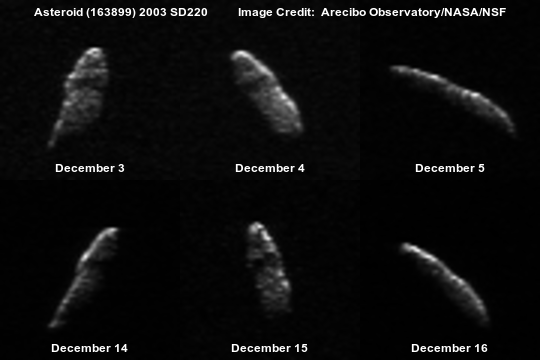
As well, other large asteroids are being ignored favour of 2003 SD220. What about 2008 CM, a 1.5 km wide asteroid that will pass us by at 22 Earth-Moon distances on December 29. No one is claiming IT will cause earthquakes of is Nibiru.
So bottom line, 2003 SD220 will pass us by harmlessly, like all the other large asteroids we have been following.
For those of uswho just want to play around with the asteroid orbit, or who want to argue with people who claim this asteroid will hit us (it won't) I've made Celestia files for 2003 SD220. As usual, copy the data here to a plain text file (2003SD220.ssc) and copy the file to the Celestia extras folder.
========= >8 cut =============2003SD220.ssc=======>8; cut =====================
"2003 SD220" "Sol"

#Data from MPC http://cfa-www.harvard.edu/iau/MPEph/MPEph.html
#Epoch 2016 Jan. 13.0 TT = JDT 2457400.5  (M-h)          MPC
#M 257.16312              (2000.0)            P               Q
#n   1.30903706     Peri.  326.44287     -0.48635381     +0.86135024             T = 2457479.05918 JDT
#a   0.8276272      Node   274.06174     -0.76583262     -0.50108247             q =     0.6533014
#e   0.2106332      Incl.    8.46007     -0.42066657     -0.08361889    Earth MOID = 0.01840 AU
#P   0.75           H   17.0           G   0.15           U   2
#From 217 observations at 8 oppositions, 2000-2015, mean residual 0".46.

{
    Class "asteroid"
    Mesh   "ky26.cmod"
    Texture "asteroid.jpg"
    Radius  1.0 # maximum semi-axis
    MeshCenter [ -0.000718 -0.000099 0.000556 ]

    EllipticalOrbit
    {
    Epoch                         2457400.5       # Epoch 2016 Jan. 13.0 TT = JDT 2457400.5
    Period                             0.893737187           # P
    SemiMajorAxis          0.8276272      # a
    Eccentricity                0.2106332      # e
    Inclination                  8.46007          # Incl.
    AscendingNode          274.06174       # Node
    ArgOfPericenter       326.44287       # Peri
    PericenterDistance      0.6533014     # q
    MeanAnomaly          257.16312       # M
    }

    RotationPeriod 11 #Measured

    Albedo 0.15        #Based on typical Stony asteroids, rotation periods vary from one hour to one day

}
========= >8 cut =============2003SD220.ssc======= >8 cut===================== Labels: asteroids, celestia, earthquakes, Pseudoscience, public outreach
Sunday, October 18, 2015
Celestia files for Near Earth Asteroid 2015 TB145
 |  |
| Near Earth Asteroid 2015 TB145 at closest approach to Earth as visualised in Celestia. Click to embiggen. | Orbits of Earth, Moon and Near Earth Asteroid 2015 TB145 at closest approach to Earth as visualised in Celestia. Click to embiggen. |
Asteroid 2015 TB145 will come within 1.3 Earth Moon distances of Earth on October 31. Despite being somewhere between 280–620 meters in diameter, it will be visible in small amateur instruments at closest approach, although North America will have the best view. The asteroid is a target for mapping with radar.
For those of us not in North America (or who just want to play around with the asteroid orbit, or who want to argue with people who claim this asteroid will hit us (it won't)) I've made Celestia files for 2015 TB145. As usual, copy the data here to a plain text file (2015TB145.ssc) and copy the file to the Celestia extras folder.
========= 8< cut =============2015TB145.ssc======= 8< cut =====================
"2015 TB145" "Sol"

#Data from MPC http://cfa-www.harvard.edu/iau/MPEph/MPEph.html
#Epoch 2016 Jan. 13.0 TT = JDT 2457400.5                 MPC
#M  10.48189              (2000.0)            P               Q
#n   0.32423068     Peri.  121.69708     -0.81665165     -0.42486171             T = 2457368.17150 JDT
#a   2.0984565      Node    37.76023     -0.03578994     -0.63822119             q =     0.2938239
#e   0.8599809      Incl.   39.63322     +0.57602011     -0.64200175    Earth MOID = 0.00157 AU
#P   3.04           H   19.8           G   0.15           U   8
#From 62 observations 2015 Oct. 10-15, mean residual 0".36.

{
    Class "asteroid"
    Mesh   "ky26.cmod"
    Texture "asteroid.jpg"
    Radius  0.15 # maximum semi-axis
    MeshCenter [ -0.000718 -0.000099 0.000556 ]

    EllipticalOrbit
    {
    Epoch                         2457400.5      # Epoch 2016 Jan. 13.0 TT = JDT 2457400.5
    Period                             3.04           # P
    SemiMajorAxis          2.0984565      # a
    Eccentricity                0.8599809      # e
    Inclination                  39.63322          # Incl.
    AscendingNode          37.76023       # Node
    ArgOfPericenter       121.69708       # Peri
    PericenterDistance      0.2938239     # q
    MeanAnomaly          10.48189       # M
    }

    RotationPeriod 0.9 #Guess

    Albedo 0.15        #Based on typical Stony asteroids, rotation periods vary from one hour to one day

}
================================8< cut 8<=====================================
Labels: asteroids, celestia, NEO
Sunday, August 02, 2015
Charon Surface Texture for Celestia

The Charon Global Map has just been released to complement the Pluto Global Map, so I resized it (1024x512) and converted it to a 72 DPI png to use as a texture for Celestia.
You need to copy the texture file Charon.png to the textures/medres folder in the Celestia directory, then edit the solarsys.ssc file in the data folder (make a backup copy first) to replace the texture name in the Pluto definition section with that of the new texture, save it and you are good to go (just as you did for Pluto).
"Charon:Pluto I:134340 Pluto I:1978 P 1" "Sol/Pluto"
{
    Texture "Charon.*"
    SpecularTexture "charon-lok-spec.*"
    SpecularColor            [ 0.135 0.12 0.08 ]
    SpecularPower             9.5
Now I have to learn how to do XYZ or SPICE orbits to add in the New Horizons flyby. And also fix the north polar alignments.
Labels: celestia, Dwarf Planet, Pluto
Wednesday, July 29, 2015
Pluto Surface Texture for Celestia

The Pluto Global Map has just been released, so I resized it (1024x512) and conveyed it to a 71 DPI png to use as a texture for Celestia.
You need to copy the texture file pluto_surface1.png to the textures/medres folder in the Celestia directory, then edit the solarsys.ssc file in the data folder (make a backup copy first) to replace the texture name in the Pluto definition section with that of the new texture, save it and you are good to go.
"Pluto:134340 Pluto" "Sol"
{
    Class "dwarfplanet"
    Texture "pluto_surface1.*"
    SpecularTexture "pluto-lok-spec.*"
    SpecularColor            [ 0.135 0.12 0.08 ]
    SpecularPower             9.5
Now waiting for the Charon map. Then I have to learn how to do XYZ or SPICE orbits to add in the New Horizons flyby.
Labels: celestia, Dwarf Planet, Pluto
Sunday, July 26, 2015
Celestia Files for Kepler 452b (the "so called" Earth 2.0)

Friday's announcement from the Kepler mission of the discovery of Kepler 452b had the media galvanised, with some calling it "Earth 2.0".
Kepler 452b is earth-like, and in a habitable zone, but that doesn't meant that it is Earth's twin. Similarly, not being Earth's twin does not make it disappointing.
Kepler-452b is in the habitable zone of it's star, with a radius 1.6 times that of Earth (technically making it a super Earth). While there is a lot of to-do about habitable zones, it simply means the zone where liquid water can exists on a planets surface. Other factors may be involved in habitability too. Mars is in our habitable zone, but was too small to hold on to a substantial atmosphere, and is now a freezing desert.
As of this discovery there are 13 earth-like worlds orbiting stars in their habitable zomes, and Kepler-186f is one that is closer in size to Earth than Kepler 452b. However, all but Kepler-452b orbit smaller, cooler stars and most are tidally locked to their sun (Kepler-186f orbits roughly where Mercury would be in our solar system, but because its sun is a cool red dwarf, it is not baking hot).
Kepler-452b orbits a sun-like G2 star, and has a year of 385 days, failry similar to our 365 days (all the others are much shorter, as they are closer in).
We don't know if Kepler-452b is a rocky world like our own, or a water world, however, it is the first time we have found an earth-like world around a sun that is the near twin of our own. Technically, it is quite difficult for find these kinds of planets (finding planets that have short years around dim cool stars is much easier) and gives us hope that we can find more of them in the near future.
Once again I've made Celestia files for the system. One for the star (which isn't in the default files) and one for the planet.
As usual, copy the data here to plain text files (Kepler452.stc and Kepler452b.ssc), copy both of the files to the Celestia extras folder. The star is around 1400 lightyears away in Cygnus, so in the Celestia star browser, you will have to show around 500 stars to see Kepler-452 in the list. You can find the paper from which I took the data here.
===============Kepler452.stc===============================
#Kepler survey DISCOVERY AND VALIDATION OF Kepler-452b
# The Astronomical Journal 150 (2): 56. doi:10.1088/0004-6256/150/2/56
"Kepler-452:2MASS 19440088+4416392:2KOI-7016.01:KIC 8311864"
{
RA 296.0042
Dec 44.2775556
Distance 1400 # light years from published data
SpectralType "G2"
AppMag 13.4
Radius 772005 # in km, 1.11 Sun radii
}
========================================================
===============Kepler452b.ssc=========================================
"b" "Kepler-452"
# earth like, possibly water world
{
Texture "exo-class4.*"
NightTexture "exo-class4night.*"
Mass 5 # M.sin(i) = 5 Earth, from paper
Radius 10400 # 1.63 Earth radi, from paper
#InfoURL "http://en.wikipedia.org/wiki/Kepler-452b"
# The Astronomical Journal 150 (2): 56. doi:10.1088/0004-6256/150/2/56
EllipticalOrbit {
Period 1.054364
SemiMajorAxis 1.046
Eccentricity 0.02
ArgOfPericenter 267 #guess
Inclination 89.806
#MeanAnomaly 271
}
}
AltSurface "limit of knowledge" "Kepler-452/b"
{
Texture "venussurface.*"
OverlayTexture "ganymede-lok-mask.png"
}
================================================================
Labels: celestia, exoplanet, extrasolar planet
Thursday, July 23, 2015
New Ceres and Vesta textures for Celestia
 |  |
| Ceres simulated in Celestia with a surface map taken from the Dawn spacecraft (click to embiggen) | Vesta simulated in Celestia with a surface map taken from the Dawn spacecraft (click to embiggen) |
Celestia is an amazing 3Dspace simulation program. It is expandable, you can add comets, asteroids, exoplanets and more (see some examples here). I use a simulation of the STEREO spacecraft to helpd identify comets in the STEREO images.
Celestia also has a wonderful online community building a variety of different worlds. They have taken the latest surface maps from the Dawn orbiter of Ceres and Vesta and made them into textures for the respective asteroids simulated in Celestia. The Vesta and Ceres packs are here (scroll down the lists of asteroids till you come to them).
There are actually quite comprehensive and use advanced techniques. Being simple minded I just copied the texture files into the /texture/medres folder, then edited the asteroids.ssc file (after making a backup first).
"1 Ceres:Ceres:A899 OF" "Sol"
{
 Class "dwarfplanet"
 Texture "ceres.0center1.png"

 Color [ 0.800 0.745 0.681 ]
As an example this is the edited bit of the Ceres entery in asteroids.ssc
Anyway, download the asteroid packs, add the textures, and you can zoom to the realistic versions of Vesta andd Ceres now.
Wednesday, November 12, 2014
Comet 67P/Churyumov–Gerasimenko in Celestia

As usual, I have been trying to make a Celestia file for comet 67P.
And failing miserably. I tried to convert the ESA public shape model to celestia 3Ds format and failed miserably. So I ended up using Jack Selden's Rosetta files, with a surface map taken from this thread on the Celestia. The Celestia comet looks nothing like the rubber duck shape of 67P, but until some kind person points me to a pubic Celestia shape model that is what I am stuck with.
I utterly failed to make any of the XYZ orbital files work for me, so I just copied the orbit of Dactyl around Ida. Yes, that's cheating, but after days of frustration I wanted something that works. If you want a stunning Celestia simulation, go here.
As usual, copy the code below and save as it as a text file 67P.ssc in the Celestia extras folder.
==========================67P.ssc=======================================
# Taken from Jack Seldens 67P ssc file
# Created By Ian Shazell, Spacecraft Analyst for Rosetta
# On Behalf of the European space Agency, www.esa.int
# Comet 67P Churyumov-Gerasimenko, Celestia SSC file. www.shatters.net/celestia
#
#
"Churyumov-Gerasimenko" "Sol"
{
Class "comet"
Mesh "asteroid.cms"
Texture "67p720x361.png" # texture from the Celestia forum from John Van Vliet
Radius 1.98 # http://forum.celestialmatters.org/viewtopic.php?f=4&t=690
EllipticalOrbit
{
Period 6.4451441700205338809034907597536
PericenterDistance 1.2431213
SemiMajorAxis 3.4632382
Eccentricity 0.6410523343769
Inclination 7.04073996
AscendingNode 50.150595169
ArgOfPericenter 12.77512076
MeanAnomaly -71.72623185
Epoch 2456778.5
}
Albedo 0.2
}
"Rosetta" "Sol/Churyumov-Gerasimenko"
{
Class "spacecraft"
Mesh "rosetta.3ds" # rosetta model http://homepage.eircom.net/~jackcelestia/files/rosetta.zip
Radius 0.005
EllipticalOrbit
{
Epoch 2449228.2028 # Using orbit of Dactyl around Ida
Period 0.96534 #
SemiMajorAxis 25.0 # Why? I can't make anything else work
Eccentricity 0.13 #
LongOfPericenter 310 #
AscendingNode 90 #
#
Inclination 8 #
}
Albedo 0.5
}
======================end 67P.ssc==========================
Sunday, July 06, 2014
Tonight's Conjunction As Seen From Mars
 |  |
| Earth as seen from Mars on the the night of the Moon, Mar, Spica conjunction. The Moon is too close to be seen separate from the Earth with the unaided eye. Earth is a morning object from Mars at the moment. Simulated in Stellarium | Looking back towards the Sun from behind Mars. Simulated in Celestia |
Someone was wondering what the Moon Spica and Mars conjunction would look like from Mars. Well, here are some simulated views for you. As Spica is "behind" Mars, we can see it in these views.
Labels: celestia, Conjunction, Mars, Moon, stellarium
Sunday, April 06, 2014
Celestia Files of the recent Dwarf Planet finds
 |  |
| Close up view of the outer solar system showing the two new objects 2013 FY27 and 2013 FZ27, the orbit of Pluto is highlighted for comparison. Click to embiggen | More distant view of the outer solar system showing 2012 VP113, its is highlighted. The orbit of Sedna does not fit even at this scae.Click to embiggen, |
In quick succession the team of Scott Sheppard and Chad Trujillo at the Cerro Tololo Inter-American Observatory have announced 3 new Dwarf planets. 2012 VP113 has an enormous 4000 year long orbit, and represent an object from the inner edge. The two others 2013 FY27 and 2013 FZ27 are more "traditional" Scattered disk objects (that seems ironic now).
Once again I have made a Celestia file, three files actually. In the clestia download I use, Sedna was ilsted as an Asterid, bot a dwarf planet, so if its orbot doesn't turn up when you enable Dwarf Planets in Render | View Otions, but does when you turn on Asteroids, go to the data folder, find outersys.ssc (save a cpopy just in case), open and scroll down to Sedna and replace Class "asteroid" with Class "dwarfplanet".
As usual, copy the data here to a plain text file ( 2012VP113.ssc etc.) and copy the file to the Celestia extras folder.
========================2012VP113.ssc==================================
"2012 VP113" "Sol"

#Sedna like inner Oort cloud object
#Data from MPC http://cfa-www.harvard.edu/iau/MPEph/MPEph.html
#Epoch 2014 May 23.0 TT = JDT 2456800.5                  MPC
#M   3.06601              (2000.0)            P               Q
#n   0.00021494     Peri.  291.14923     +0.84619626     -0.34404613             T = 2442536.18257 JDT
#a 276.0078196      Node    90.89192     +0.49413218     +0.79246630             q =    79.8521916
#e   0.7106887      Incl.   24.01461     -0.19946247     +0.50361634
#P4585              H    4.1           G   0.15           U   6
#From 24 observations at 2 oppositions, 2012-2013, mean residual 0".24.

{
    Class "dwarfplanet"
    Texture "pluto-lok.*"
    SpecularTexture "pluto-lok-spec.*"
    SpecularColor            [ 0.135 0.12 0.08 ]
    SpecularPower             9.5
    Radius  500 # maximum semi-axis


	InfoURL "http://en.wikipedia.org/wiki/2012_VP113"

	EllipticalOrbit
	{
	Epoch                  2456800.5      # Epoch 2014 May 23.0 TT = JDT 2456800.5
	Period                 4585           # P
	SemiMajorAxis          276.0078196    # a
	Eccentricity           0.7106887      # e
	Inclination            24.01461       # Incl.
	AscendingNode          90.89192       # Node
	ArgOfPericenter       291.14923       # Peri
        PericenterDistance      79.8521916    # q
        MeanAnomaly              3.06601      # M
	}

	RotationPeriod 0.9 #Guess

	Albedo 0.4        #Based on Sedna

}

==========================================================
=======================2013FY27.ssc===================================
"2013 FY27" "Sol"

#Eris-like scattered disk object
#Data from MPC http://cfa-www.harvard.edu/iau/MPEph/MPEph.html
#Epoch 2014 May 23.0 TT = JDT 2456800.5                  MPC
#M 214.46118              (2000.0)            P               Q
#n   0.00216253     Peri.  136.72941     +0.79347223     +0.60486455             T = 2524100.74140 JDT
#a  59.2235677      Node   187.09259     -0.58925583     +0.79121780             q =    35.8742198
#e   0.3942577      Incl.   33.07550     +0.15224777     -0.09007372
#P 456              H    3.0           G   0.15           U   8
#From 12 observations at 2 oppositions, 2013-2014, mean residual 0".27.

{
    Class "dwarfplanet"
    Texture "pluto-lok.*"
    SpecularTexture "pluto-lok-spec.*"
    SpecularColor            [ 0.135 0.12 0.08 ]
    SpecularPower             9.5
    Radius  500 # maximum semi-axis


	InfoURL "http://en.wikipedia.org/wiki/2013_FY27"

	EllipticalOrbit
	{
	Epoch                  2456800.5      # Epoch 2014 May 23.0 TT = JDT 2456800.5
	Period                 456            # P
	SemiMajorAxis          59.2235677     # a
	Eccentricity            0.3942577     # e
	Inclination            33.07550       # Incl.
	AscendingNode         187.09259       # Node
	ArgOfPericenter       136.72941       # Peri
        PericenterDistance     35.8742198     # q
        MeanAnomaly           214.46118       # M
	}

	RotationPeriod 0.9 #Guess

	Albedo 0.14        #Theortically expected

}

==========================================================
======================2013FZ27.ssc====================================
"2013 FZ27" "Sol"

#Eris-like scattered disk object
#Data from MPC http://cfa-www.harvard.edu/iau/MPEph/MPEph.html
#Epoch 2014 May 23.0 TT = JDT 2456800.5                  MPC
#M 277.75427              (2000.0)            P               Q
#n   0.00293700     Peri.  341.17225     -0.05888594     +0.97046090             T = 2484803.84051 JDT
#a  48.2910933      Node   284.91917     -0.88199787     -0.16035023             q =    38.0092953
#e   0.2129129      Incl.   14.01192     -0.46755985     +0.18025938
#P 336              H    4.4           G   0.15           U   6
#From 17 observations at 2 oppositions, 2013-2014, mean residual 0".42.

{
    Class "dwarfplanet"
    Texture "pluto-lok.*"
    SpecularTexture "pluto-lok-spec.*"
    SpecularColor            [ 0.135 0.12 0.08 ]
    SpecularPower             9.5
    Radius  500 # maximum semi-axis


	InfoURL "http://en.wikipedia.org/wiki/2013_FZ27"

	EllipticalOrbit
	{
	Epoch                  2456800.5      # Epoch 2014 May 23.0 TT = JDT 2456800.5
	Period                 336            # P
	SemiMajorAxis          48.2910933     # a
	Eccentricity            0.2129129     # e
	Inclination            14.01192       # Incl.
	AscendingNode         284.91917       # Node
	ArgOfPericenter       341.17225       # Peri
        PericenterDistance     38.0092953     # q
        MeanAnomaly           277.75427       # M
	}

	RotationPeriod 0.9 #Guess

	Albedo 0.14        #Theortically expected

}

==========================================================
Labels: celestia, Dwarf Planet, Eris, Pluto
Friday, April 04, 2014
South African Astronomers! A Chance to Catch the Ringed Asteroid Chariklo with an Occultation (and a Celestia File!)

The ring system was discovered when the asteroid occulted (passed in front of) a star, dips in the stars light before and after the asteroid itself dimmed the star revealed their presence. This was how the rings of Uranus were discovered in 1997.

Chart of the occulation path of asteroid Chariklo
On 29th of April Chariklo will again occult a star, this time a 12th magnitude star. This will be seen from South Africa at 23h13min UTC.
This will be an excellent opportunity for amateur and professional observers to study this astonishing ring system.
Full observing instruction, observing charts and more can be found at the special IOTA Chariklo observing site.
In honour of this special occasion I have made a Celestia file of Chariklo, I've added rings, based on Saturn's rings (using Uranus's rings makes it too dim). As usual, copy the data here to a plain text file (10199Chariklo.ssc) and copy the file to the Celestia extras folder.
============================10199Chariklo.ssc=============================
"10199 Chariklo:Chariklo:1997 CU26" "Sol"
#Asteroid with rings http://www.eso.org/public/archives/releases/sciencepapers/eso1410/eso1410a.pdf
#Data from MPC http://cfa-www.harvard.edu/iau/MPEph/MPEph.html
#Epoch 2014 May 23.0 TT = JDT 2456800.5 MPC
#M 60.13106 (2000.0) P Q
#n 0.01576192 Peri. 241.60043 -0.93692798 +0.06833546 T = 2452985.54248 JDT
#a 15.7542102 Node 300.37989 +0.14092715 -0.82359414 q = 13.0508682
#e 0.1715949 Incl. 23.41167 -0.31985232 -0.56304792
#P 62.5 H 6.6 G 0.15 U 0
#From 533 observations at 16 oppositions, 1988-2009, mean residual 0".46.
{
Class "asteroid"
Mesh "ky26.cmod"
Texture "asteroid.jpg"
Radius 129.6 # maximum semi-axis
MeshCenter [ -0.000718 -0.000099 0.000556 ]
InfoURL "http://en.wikipedia.org/wiki/10199_Chariklo"
EllipticalOrbit
{
Epoch 2456800.5 # Epoch 2014 May 23.0 TT = JDT 2456800.5
Period 62.5 # P
SemiMajorAxis 15.7542102 # a
Eccentricity 0.1715949 # e
Inclination 23.41167 # Incl.
AscendingNode 300.37989 # Node
ArgOfPericenter 241.60043 # Peri
PericenterDistance 13.0508682 # q
MeanAnomaly 60.13106 # M
}
RotationPeriod 0.9 #Guess
Albedo 0.048 #Based on Chiron
Rings {
Inner 400
Outer 450
Texture "saturn-rings.png"
}
}======================================================

Labels: asteroids, celestia, Occultation
Sunday, September 15, 2013
Comet C/2012 S1 ISON in Celestia

I can't believe this, but it seems that I have not previously posted a Celestia file for comet C/2012 S1 ISON. I remedy this oversight now.
Unfortunately, comet C/2012 S1 ISON has a hyperbolic orbit, and Celestia doesn't like those. The comet's orbit and name won't turn up when you turn on the comet attributes, or when you select the comet by clicking on it. As usual, copy the code below and save as it as a text file 2012S1.ssc in the Celestia extras folder.
======================2012S1.ssc=============================
"C2012S1:ISON" "Sol"
{
Class "comet" # Just copying the data for Halley
Mesh "halley.cmod"
Texture "asteroid.jpg"
Radius 5 # best guess at maximum semi-axis
MeshCenter [ -0.338 1.303 0.230 ]
# Data from latest JPL Horizons orbit as of 15 Sep 2013
# Comet has a hyperbolic orbit, so Celestia will not show an orbit track
#
EllipticalOrbit
{
Epoch 2456625.280420214468 # 2013-Nov-28.78042021 TT
Period 165849.9873 # (q/(e-1))^1.5 hyperbolic orbit
SemiMajorAxis -3018.632859 #Hyperbolic orbit
PericenterDistance 0.01249597828341519
Eccentricity 1.000004139615141
Inclination 61.91714591634256
AscendingNode 295.7273670259968
ArgOfPericenter 345.5153902820819
MeanAnomaly 0.0
}
# Again, this data is copied straight from the ssc files for Halleys’ Comet
# chaotic rotation, imperfectly defined:
# this version from "The New Solar System", 4th Edition; Eds.
# JK Beatty, CC Petersen, A Chaikin
PrecessingRotation
{
Period 170 # 7.1 day axial rotation period
Inclination 66
PrecessionPeriod 3457004.12 # 3.7 day precession period
}
Albedo 0.8
}
=======================================================
Labels: C/2012 S1 ISON, celestia
Wednesday, July 17, 2013
Neptunes New Moon in Celestia
 |  |
| The view towards Neptune from S/2004 N1, with the Moons Galetea, Proteus and Triton visible. Simulated in Celestia. | Orbit of the new Moon simulated in Celestia. |
Hard on the heels of Pluto's new Moons, a new Moon of Neptune has been discovered in archival pictures taken of Neptune by the Hubble space telescope.The new Moon, S/2004 N1, is the 14th Moon of Neptune, orbiting between the Moons Larissa and Proteus. At 20 Km across, it is the smallest Moon of Neptune (but by no means the smallest Solar System Moon), and appallingly dim.
Once again I've made a Celestia file for the new Moon.
As usual, copy the data here to a plain text file (newneptunemoon.ssc), copy the file to the Celestia extras folder. Once more I have to update my Celestia Moon tour.
===============newneptunemoon.ssc======================================
"Neptune XIV:S/2004 N 1" "Sol/Neptune"
{
Class "minormoon"
Texture "asteroid.jpg"
SemiAxes [ 8 10 10 ]
EllipticalOrbit
{
Period 0.9362
SemiMajorAxis 104200
Eccentricity 0.0000
Inclination 0.0000 # Using Galatea
AscendingNode 327.929 # Using Galatea
ArgOfPericenter 89.060 # J2000.0
MeanAnomaly 2.357 # Using Galatea
}
RotationOffset 233.6 #Using Galatea
Albedo 0.063 #Using Galatea
}
========================================================================
Saturday, July 06, 2013
Asteroid 5099 Iainbanks (with Celestia add-on)
 |  |
| Asteroid 5009 Iainbanks taken with iTelescope T9 at 9 pm on Friday July 5. 5 x 3 inute exposures were stacked using ImageJ and SUMMED. | Animated GIF of 5009 Iainbanks from two sequences shot an hour apart. The other moving things are all artifacts. |
 |  |
| Celestia simulation showing the orbit of 5099 Iainbanks. | The view towards Earth from Iainbanks, simulated in Celestia. |
Iain Banks, a prolific and celebrated writer, died on 9 June 2013. He wrote both conventional and science fiction, publishing his science fiction works as Iain M Banks. He was one of my favourite novelists, his Culture novels works of soaring imagination, operating over huge swaths of the galaxy and of time. The solar system spanning artefacts his Culture dwellers created/inhabited put Larrry Niven's Ringworld Engineers to shame (Okay, okay, so the Orbitals were mini-Ringworlds, but he made a lot more of them, and other solar system wide structures).
On June 23rd the IAU named asteroid 5099 as iainbanks, a fitting tribute to a much loved science fiction author. I didn't hear of it until yesterday, so I took the opportunity to take some shots of the asteroid with iTelescopes T9 instrument. At magnitude 17 it's quite a bit dimmer than my usual quarry, and moving sufficiently slowly that I had to do two imaging runs an hour apart to see it move.
One thing puzzles me though, the article states of Iain Banks's Culture that
"Thanks to their technology they are able to hollow out asteroids and use them as ships capable of faster-than-light travel while providing a living habitat with centrifugally-generated gravity for their thousands of denizens."I don't actually remember that in his novels (some of the ships are gigantic, but I though they were made de novo by the Minds). Still the only more fitting memorial would be an asteroid on a hyperbolic orbit.
Of course I've made Celestia files for 5009 Iainbanks. As usual, copy the data here to a plain text file (5099iainbanks.ssc) and copy the file to the Celestia extras folder. Sadly, there are no Culture add-ons in the Celestia Science Fiction section, but there is a Ringworld add-on.
===============5099iainbanks.ssc======================================
"5099 Iainbanks" "Sol"
#Data from MPC http://cfa-www.harvard.edu/iau/MPEph/MPEph.html
#Epoch 2013 Apr. 18.0 TT = JDT 2456400.5 MPC
#M 224.98550 (2000.0) P Q
#n 0.25162303 Peri. 288.09916 +0.98702989 -0.15923578 T = 2456937.07449 JDT
#a 2.4848630 Node 81.06718 +0.15399094 +0.90320511 q = 2.3556400
#e 0.0520041 Incl. 1.18300 +0.04537395 +0.39857809
#P 3.92 H 13.1 G 0.15 U 0
#From 1286 observations at 20 oppositions, 1954-2013, mean residual 0".51.
{
Class "asteroid"
Mesh "ky26.cmod"
Texture "asteroid.jpg"
Radius 3.05 # maximum semi-axis
MeshCenter [ -0.000718 -0.000099 0.000556 ]
InfoURL "http://en.wikipedia.org/wiki/%285099%29_Iainbanks"
EllipticalOrbit
{
Epoch 2456400.5 # Epoch 2013 Apr. 18.0 TT = JDT 2456400.5
Period 3.92 # P
SemiMajorAxis 2.4848630 # a
Eccentricity 0.0520041 # e
Inclination 1.18300 # Incl.
AscendingNode 81.06718 # Node
ArgOfPericenter 288.09916 # Peri
PericenterDistance 2.3556400 # q
MeanAnomaly 224.98550 # M
}
RotationPeriod 0.9 #Guess
Albedo 0.15 #Based on typical Stony asteroids, rotation periods vary from one hour to one day
}
======================================================================
Labels: asteroids, celestia, iTelescope, miscellaneous
Sunday, June 30, 2013
Three Exoplanets in a Habitable Zone? The Gliese 667 C System in Celestia
 |  |
| Gliese 667 C f (Exoplanet names in triple star systems are confusing) looking back towards it's primary (Gliese 667 C) and the binary it orbits (Cliese 667 A and B). Also visible are several of the other planets in the system. Visualised in Celestia. Click to embiggen. | The Gliese 667 C system. I have tilted the orbital plane sightly so that all three stars in the triple star system can be seen. |
Our search for extrasolar planets keeps turning up science-fiction worlds! The latest is a planetery system around one star in a triple star system that hosts not one, but three planets in its habitable zone (c, f [illustrated above] and e).

We already knew that there were three planets around Gliese 667, but longer data collection and reanalysis found more of them.
While there is a lot of to-do about habitable zones, it simply means the zone where liquid water can exists on a planets surface. Other factors may be involved in habitability too. Mars is in our habitable zone, but was too small to hold on to a substantial atmosphere, and is now a freezing desert. The M star these planets revolve around is potentially a flare star, with powerful solar eruptions that may make life difficult on these planets. We also don't know if they are rocky worlds of water worlds.
Still, the growing inventory of stars with terrestrial style planets in their habitable zones suggests that the possibility of life on other worlds is not remote.
The ESO press release is here, and nice backgrounders from the Universe Today and Space.com. Once again I've made Celestia files for the system.
As usual, copy the data here to a plain text file (GJ667.ssc), copy the file to the Celestia extras folder. Celestia already has Gliese 667 triple star system, so you don't need to have a star definition file. The images you get from Celestia look a bit different to the artists interpretations in the press release, in part because of the way the stars and planets are rendered in Celestia, and in part because of how the stars orbit is defined. But it will still give you a good feel fro the system.
I'll have to update my Celestia Exoplanet Tour as well.
===============GJ1667.stc======================================
"b" "Gliese 667 C"
# Neptune like world
# All data from original paper http://www.eso.org/public/archives/releases/sciencepapers/eso1328/eso1328a.pdf
{
Texture "exo-class4.*"
NightTexture "exo-class4night.*"
Mass 5.94 # M.sin(i) = 5.94 Earth
Radius 12181.98 # 1.91 Earth radii, guess
#InfoURL "https://en.wikipedia.org/wiki/Gliese_667_Cb"
EllipticalOrbit {
Period 0.019713845
SemiMajorAxis 0.050432
Eccentricity 0.112
ArgOfPericenter 267 #guess
Inclination 30 #greater than 30 actually, but no clear figure
#MeanAnomaly 271
}
# likely to be in captured synchronous rotation
}
AltSurface "limit of knowledge" "Gliese 667 C/b"
{
Texture "extrasolar-lok.*"
}
"c" "Gliese 667 C"
# Venus-like world maybe, on edge of habitable zone
{
Texture "venussurface.*"
# Using venus although it may be a water world
Mass 3.9 # M.sin(i) = 3.9 Earth
Radius 11480.4 # 1.8 Earth radi, from paper
#InfoURL "https://en.wikipedia.org/wiki/Gliese_667_Cc"
EllipticalOrbit {
Period 0.076995587
SemiMajorAxis 0.12507
Eccentricity 0.001
ArgOfPericenter 267 #guess
Inclination 30
#MeanAnomaly 271
}
}
AltSurface "limit of knowledge" "Gliese 667 C/c"
{
Texture "extrasolar-lok.*"
}
"d" "Gliese 667 C"
# Neptune like world
{
Texture "exo-class4.*"
NightTexture "exo-class4night.*"
Mass 10.4 # M.sin(i) = 10.4 Earth
Radius 17539.5 # 2.75 Earth radii, guess
#InfoURL "https://en.wikipedia.org/wiki/Gliese_667_Cd"
EllipticalOrbit {
Period 0.252131656
SemiMajorAxis 0.2758
Eccentricity 0.19
ArgOfPericenter 267 #guess
Inclination 30
#MeanAnomaly 271
}
# likely to be in captured synchronous rotation
}
AltSurface "limit of knowledge" "Gliese 667 C/d"
{
Texture "extrasolar-lok.*"
}
"e" "Gliese 667 C"
# earth like world
{
Texture "venussurface.*"
# Using venus although it may be a perfectly earth-like world
Mass 2.68 # M.sin(i) = 2.68 Earth, upper limit of theoretical range
Radius 9567 # 1.5 Earth radii,
#InfoURL "https://en.wikipedia.org/wiki/Gliese_667_Ce"
EllipticalOrbit {
Period 0.170471395
SemiMajorAxis 0.212
Eccentricity 0.001
ArgOfPericenter 267 #guess
Inclination 30
#MeanAnomaly 271
}
}
AltSurface "limit of knowledge" "Gliese 667 C/e"
{
Texture "venussurface.*"
OverlayTexture "ganymede-lok-mask.png"
}
"f" "Gliese 667 C"
# earth like world
{
Texture "ganymede.*"
# Using Ganymede as it may be giant water world
# NightTexture "gasgiantnight.jpg"
Mass 1.94 # M.sin(i) = 1.94 Earth theoretical maximum
Radius 9567 # 1.5 Earth radii,
#InfoURL "https://en.wikipedia.org/wiki/Gliese_667_Cf"
EllipticalOrbit {
Period 0.106998653
SemiMajorAxis 0.15575
Eccentricity 0.001
ArgOfPericenter 267 #guess
Inclination 30
#MeanAnomaly 271
}
}
AltSurface "limit of knowledge" "Gliese 667 C/f"
{
Texture "ganymede.*"
OverlayTexture "ganymede-lok-mask.png"
}
"g" "Gliese 667 C"
# Neptune like world
# All data from original paper
{
Texture "exo-class4.*"
NightTexture "exo-class4night.*"
Mass 4.41 # M.sin(i) = 4.41 Earth
Radius 12181.98 # 1.91 Earth radii, guess
#InfoURL "https://en.wikipedia.org/wiki/Gliese_667_Cg"
EllipticalOrbit {
Period 0.68861018
SemiMajorAxis 0.5389
Eccentricity 0.107
ArgOfPericenter 267 #guess
Inclination 30 #greater than 30 actually, but no clear figure
#MeanAnomaly 271
}
# likely to be in captured synchronous rotation
}
AltSurface "limit of knowledge" "Gliese 667 C/g"
{
Texture "extrasolar-lok.*"
}
============================end========================
Labels: celestia, exoplanet, extrasolar planet
Saturday, June 01, 2013
1998 QE2 in Celestia
 |  |
| Orbit of 1998 QE2 simulated in Celestia at closest approach on May 31 20:59 UT (click to embiggen) | 1998 QE2 simulated in Celestia at closest approach on May 31, it looks more dramatic in the illustrations to various news stories, but they are all artistic versions that exaggerate the size of Earth. (click to embiggen) |
If like I am, you are clouded out of your view of Near Earth Asteroid 285263 1998 QE2 then why not try a Celestia simulation? You could also go to astroweb TV to see the live webcast of the flyby at the Virtual Telescope at 31 May, starting at 20:30 UT (that's 6:30 am AEST).
For Celestia, copy the section below to a file names 1998QE2.ssc and place it in the extras folder.
===========1998QE2.ssc=======================
"1998 QE2" "Sol"
{
Class "asteroid"
Mesh "ky26.cmod"
Texture "asteroid.jpg"
Radius 1.35 # maximum semi-axis
MeshCenter [ -0.000718 -0.000099 0.000556 ]
#InfoURL "http://en.wikipedia.org/wiki/%28285263%29_1998_QE2"
EllipticalOrbit
{
Epoch 2456432.586820592895 #(2013-May-20.08682059)
Period 3.77
SemiMajorAxis 2.421509211736214
Eccentricity 0.5710446435571564
Inclination 12.854229843842
AscendingNode 250.1715449355728
ArgOfPericenter 345.61224799
MeanAnomaly 351.607302468126
}
RotationPeriod 0.4
Albedo 0.15
}
===================================================
Labels: asteroids, celestia, NEO
Saturday, April 20, 2013
Kepler-62 and Kepler-69, a Bonanza of Exoplanets in the Habitable Zone.
 |  |
| The Kepler-62 system, simulated in Celestia, click to embiggen. | The view looking from the Super-Earth Kepler-62e, looking to the Inner solar system and the Water World 62f, the smallest world currently known in a habitable zone, beyond. Simulated in Celestia, click to embiggen. |
The plethora of exoplanets pouring out of the Kepler mission keeps amazing me. As you know, I'm quite an exoplanet fan, but I just can't keep up with the discoveries. As of today there are 866 confirmed exoplanets, and Kepler has 2,740 (yes, you read that right) planetary candidates that need to be worked through and confirmed.
The latest batch are the systems Kepler-62 and Kepler -69. Kepler-62 hosts 5 planets, and Kepler-69 two. Gone are the days when exoplanets were all Super-Jupiters or Jupiter sized, we are picking up lots of Terrestrial sized planets now (even if they are mostly Super-Earths).
Importantly, both these systems host planets in their respective habitable zones. Kepler-62 has two planets in its habitable zone and Kepler-69 has one. Kepler 62-f is the smallest known world in a habitable zone, and Kepler 69-c is the smallest planet in the habitable zone of a sun-like star (Kepler 62 is substantially smaller and cooler than the Sun).
While these worlds are similar in size to Earth (although bigger), it looks like the Kepler 62 planets are Water Worlds, occupied by a global ocean rather than having continents like Earth.
As well, Kepler-62-c is the smallest exoplanet found yet, about the size of Mars (but much hotter).
For more detailed discussion of the meaning of these exoplanets see the Kepler press release (with link to the published paper) and this Australian ABC report. Nancy Atkinson at Universe today has a nice image and animation roundup of the new systems.
Me, what can I contribute? As usual I've made Celestia files. I've just done the Kepler-62 system, I'll do Kepler-69 later. One for the star (which isn't in the default files) and one for the planet.
Copy the data here to plain text files (Kepler62.stc and Kepler62Planets.ssc), copy both of the files to the Celestia extras folder. The star is around 1200 lightyears away in Lyra, so in the Celestia star browser, you will have to show around 500 stars to see Kepler-62 in the list.
I'll have to update my Celestia Exoplanet Tour as well.
===============Kepler62.stc======================================
#Kepler survey
"Kepler-62:2MASS J18525105+4520595:KIC 9002278"
{
RA 283.2125
Dec 45.3497
Distance 1200 # light years from published data
SpectralType "K2V"
AppMag 14.0
}
=======================================================
==================Kepler62Planets.ssc============================
"b" "Kepler-62"
# Neptune like world?
{
Texture "exo-class4.*"
NightTexture "exo-class4night.*"
Mass 9 # M.sin(i) = 9 Earth
Radius 8355.18 # 1.31 Earth radi, from paper
#InfoURL "http://en.wikipedia.org/wiki/Kepler-62b"
EllipticalOrbit {
Period 0.015646374
SemiMajorAxis 0.0553
Eccentricity 0
ArgOfPericenter 267 #guess
Inclination 89.2
#MeanAnomaly 271
}
# likely to be in captured synchronous rotation
}
AltSurface "limit of knowledge" "Kepler-62/b"
{
Texture "extrasolar-lok.*"
}
"c" "Kepler-62"
# Mercury-Like world
{
Texture "mercury.*"
Mass 4 # M.sin(i) = 4 Earth
Radius 3444.12 # 0.54 Earth radi, from paper
#InfoURL "http://en.wikipedia.org/wiki/Kepler-62c"
EllipticalOrbit {
Period 0.034062959
SemiMajorAxis 0.0929
Eccentricity 0.0
ArgOfPericenter 267 #guess
Inclination 89.7
#MeanAnomaly 271
}
# likely to be in captured synchronous rotation
}
AltSurface "limit of knowledge" "Kepler-62/c"
{
Texture "extrasolar-lok.*"
}
"d" "Kepler-62"
# Neptune like world
{
Texture "exo-class4.*"
NightTexture "exo-class4night.*"
Mass 14 # M.sin(i) = 14 Earth
Radius 12437.1 # 1.95 Earth radi, from paper
#InfoURL "http://en.wikipedia.org/wiki/Kepler-62d"
EllipticalOrbit {
Period 0.049729669
SemiMajorAxis 0.120
Eccentricity 0.0
ArgOfPericenter 267 #guess
Inclination 89.7
#MeanAnomaly 271
}
# likely to be in captured synchronous rotation
}
AltSurface "limit of knowledge" "Kepler-62/d"
{
Texture "extrasolar-lok.*"
}
"e" "Kepler-62"
# earth like, possibly water world
{
Texture "exo-class4.*"
NightTexture "exo-class4night.*"
Mass 36 # M.sin(i) = 36 Earth, upper limit of theoretical range
Radius 10268.58 # 1.61 Earth radi, from paper
#InfoURL "http://en.wikipedia.org/wiki/Kepler-62e"
EllipticalOrbit {
Period 0.335072935
SemiMajorAxis 0.427
Eccentricity 0.0
ArgOfPericenter 267 #guess
Inclination 89.98
#MeanAnomaly 271
}
# likely to be in captured synchronous rotation
}
AltSurface "limit of knowledge" "Kepler-62/e"
{
Texture "venussurface.*"
OverlayTexture "ganymede-lok-mask.png"
}
"f" "Kepler-62"
# earth like world
{
Texture "ganymede.*"
# Using Ganymede as it may be giant ice world
# NightTexture "gasgiantnight.jpg"
Mass 35 # M.sin(i) = 35 Earth theoretical maximum
Radius 8992.98 # 1.41 Earth radi, from paper
#InfoURL "http://en.wikipedia.org/wiki/Kepler-62f"
EllipticalOrbit {
Period 0.731790854
SemiMajorAxis 0.718
Eccentricity 0.0
ArgOfPericenter 267 #guess
Inclination 89.9
#MeanAnomaly 271
}
# likely to be in captured synchronous rotation
}
AltSurface "limit of knowledge" "Kepler-62/f"
{
Texture "ganymede.*"
OverlayTexture "ganymede-lok-mask.png"
}
==============================================================
Labels: celestia, exoplanet, extrasolar planet
Monday, April 08, 2013
Meteor Showers from Comet ISON? Not likely

There's been some speculation on the web that a) we will cross comet C/2012 S1 ISON's tail, and b) we will get meteor showers from it.
Now, on the face of it this is not unreasonable. After all, all bar one of our current meteor showers are due to Earth intersecting the debris trails of comets. The Leonid meteor shower, for example, is due to us intersecting debris from the comet 55P/Temple Tuttle.
But there's the rub, Earth actually has to intersect a debris trail.
To start off with Earth doesn't actually cross comet ISON's tail, it's a bit hard to tell here, as you lose the third dimension (but you can try fooling around with the JPL orbit diagram for ISON, needs JAVA), but if you look carefully at the embiggened diagram above you can see that Earth is nowhere near comet ISON's tail.
Comet tails point way from the Sun, due to the solar wind blowing the dust and gas away. The larger particles form a slowly expanding cloud which follows the orbit of the parent comet.It's a little difficult to make out, but the comet starts out well above the plane of Earth,s orbit, the dips below, all while the Earth is over 1 Astronomical Unit (the distance of the Earth to the Sun) away.
As the comet nears the Sun, the tail is angled away from Earth's orbit, it may briefly flick over Earth's orbit as the comet rounds the Sun (assuming the comet doesn't disintegrate) and the tail is long enough, but it will be a bit over 6 months before Earth reaches that spot. All comet particulates will be long gone by then.
We've looked in vain for meteor outburst from the comets, C/2006 P1 (McNaught), C/2006 T1 (Levy) but none have appeared, there may be shower in 2022 from the dust cloud associated with comet 73P fragmenting in 1995 (like Comet Biela in the 19th century).
However, in general one pass comets do not produce meteor showers, their transient dust trains do not intersect Earth's orbit. The dust trains we do intersect to produce meteors from known comets (Like 55P/ temple Tuttle and the Leonids, the Perseids and 109P\Swift-Tuttle) have been ejected decades to centuries before.
So, meteors from comet C/2012 S1 ISON? Not likely. Here's an animation.
Labels: celestia, comet, Meteors
Friday, March 29, 2013
More News on Comet 2013 A1 (Siding Spring), A Mars Impact Less Likley)
 Simulation of the close approach of C/2013 A1 to Mars in Celestia using the latest JPL elements (click to embiggen)
After obtaining more positions for comet C/2013 A1 Siding Spring (141 positions over a orbital arc of 171 days using pre-discovery images), we have a better idea of the comets encounter with Mars.
The nominal close approach is now 0.0008 AU. This is a bit further out than the previous 0.0007 AU (see my previous posts here and here), and still further out than the 0.00023 AU close approach of 2012 DA14, which missed us by two Earth diameters. To put this is still more perspective, the Martian Moon Demios is 0.00016 AU from Mars, so the nominal solution for the comet is nearly 4 times further from Mars then its outmost Moon.
Despite the improved orbital measurements, the error associated with this estimate still includes an impact though (and a maximum miss of 0.0022 AU), so although the orbit is more tightly constrained, an impact still can't be ruled out at this stage.
However, orbital simulations from Leonid Elenin suggest that an impact is very unlikely. Probably in the range of 0.08% or less.
We still need more observations to pin down the orbit more tightly and get a better idea of whether it will impact, but the trend of the recent observations suggets a close approach .
Even if it doesn't impact it will look pretty good from Earth, and spectacular from Mars (revised orbit gives a magnitude -8 comet as seen from Mars's surface), which might be observed by the flotilla of orbiting spacecraft and the rovers. But it's not as simple as it seems, power issues and the ability to point cameras in the right direction all must be addressed. This NASA article outlines the issues with getting them to do the imaging. Sadly, it seems the MAVEN atmospheric sampler will not be ready, even though it arrives a few weeks beforehand.
A collision would also be spectacular, but the rovers may not fare so well as debris rains down over the planet.

Importing the latest elements into SkyMap or Stellarium suggests that from Earth we will still see the comet and Mars less than a minute of arc from each other, which will look quite nice in telescope eye pieces (but hard to image as the comet will be a dim magnitude 8.5 form Earth and Mars bright).
Yet again I've updated the Celestia file I made for you. Unfortunately, the new solution is a hyperbolic orbit, and Celestia doesn't like those, the comet's orbit and name won't turn up when you turn on the comet attributes, or when you select the comet by clicking on it. As usual, copy the code below and save as it as a text file 2013A1.ssc in the Celestia extras folder.
======================2013A1.ssc=============================
""C2013 A1" "Sol"
{
#Close approach to Mars
#Latest JPL Elements from 24 March 2013
#Close approach 0.00079898 AU
Class "comet" # Just copying the data for Halley
Mesh "halley.cmod"
Texture "asteroid.jpg"
Radius 3 # best guess at maximum semi-axis
MeshCenter [ -0.338 1.303 0.230 ]
EllipticalOrbit
{
Epoch 2456956.048701312819 #2014 Oct 25.54870131
Period 238217.8007 # (q/(e-1))^1.5 hyperbolic orbit
SemiMajorAxis -3842.814969515329
PericenterDistance 1.399570869178647
Eccentricity 1.000364204594882
Inclination 129.0223419222239
AscendingNode 300.9648682319892
ArgOfPericenter 2.430759318651679
MeanAnomaly 0.0
}
# Again, this data is copied straight from the ssc files for Halleys’ Comet
# chaotic rotation, imperfectly defined:
# this version from "The New Solar System", 4th Edition; Eds.
# JK Beatty, CC Petersen, A Chaikin
PrecessingRotation
{
Period 170 # 7.1 day axial rotation period
Inclination 66
PrecessionPeriod 3457004.12 # 3.7 day precession period
}
Albedo 0.8
}
===========================================================
Labels: C/2013 A1, celestia, comet, comets, Mars



 Click to read about or order
 Click to read about or order
 Click to read about or order
 Click to read about or order


