Tuesday, April 18, 2023
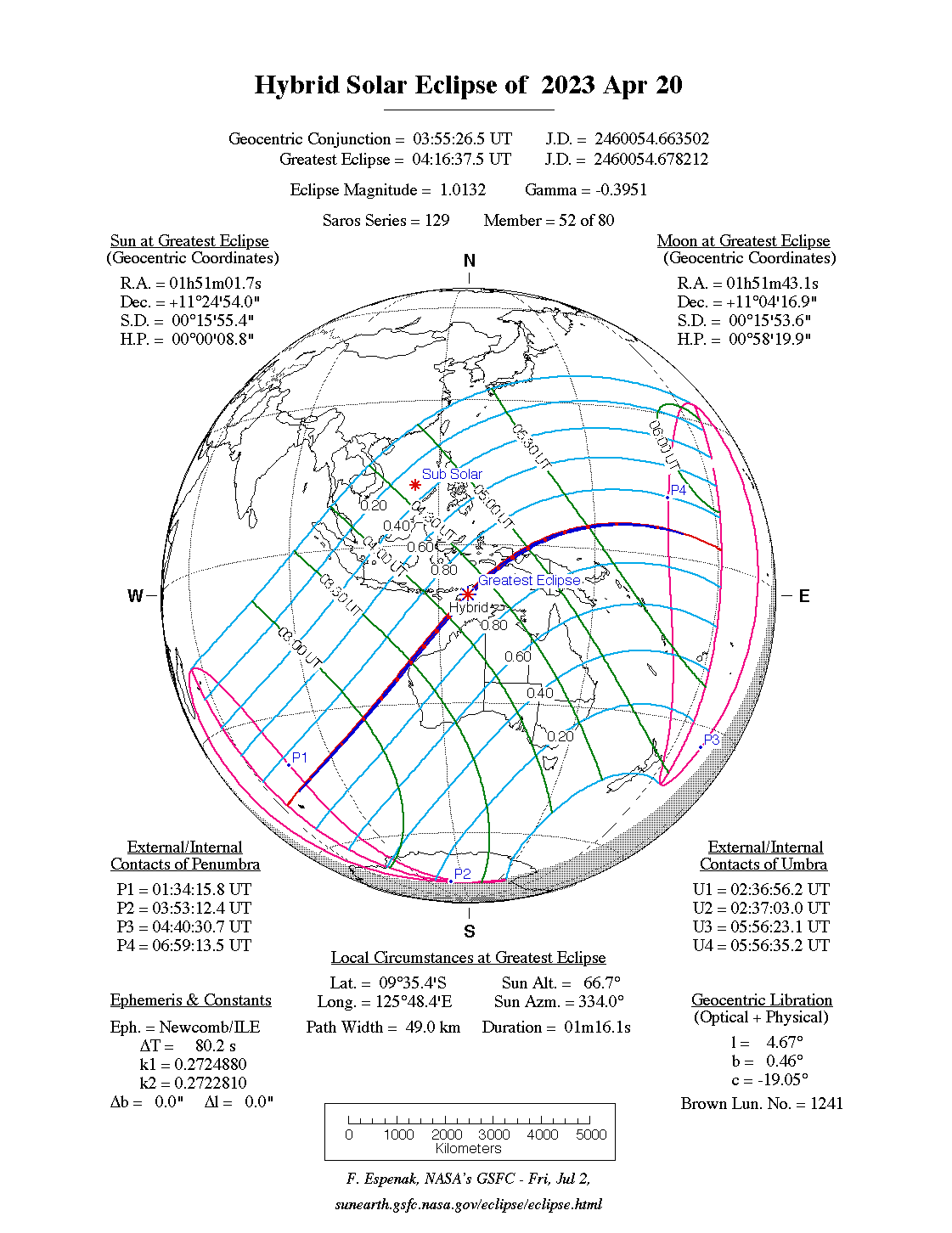
Livestreams for the Hybrid Solar Eclipse April 20, 2023

If you can't be at Northwest cape for the April 20, Hybrid Solar eclipse, then you can watch it on several live streams set up for the purpose.
The live streams should start around 10:00 am AWST (11:30 am ACST, 12:00 AEST, 0136 UT) Totality is 11:29 AWST (13:30 ACST, 14:00 AEST)
Perth Observatory: https://perthobservatory.com.au/astronomy/solar-eclipse-live-stream
Time and date: https://www.timeanddate.com/live/eclipse-solar-2023-april-20
Gravity discovery Center: https://www.youtube.com/watch?v=IWEv1DWel3Y
For a guide to the partial eclipse seen from the rest of Australia See my eclipse page (don't forget do NOT look directly at the Sun! and use safe solar observing techniques):
http://astroblogger.blogspot.com/2023/04/hybrid-solar-eclipse-april-20-2023.html
Labels: eclipse, solar, solar eclipse, Sun

Tuesday, April 11, 2023
Hybrid Solar Eclipse, April 20, 2023


On 20th April the Sun will be eclipsed at the very edge of Australia, the path of totality will pass over the northwest cape in WA, being visible from Exmouth and Learmonth. If you haven’t already booked your campsite or hotel, it is too late, it was all booked out months ago. This is a hybrid eclipse, which annular in some parts of its path and total in others.

The rest of Australia sees a partial eclipse, with WA having the best view, Broome and Geraldton see >80% of the Sun covered: Darwin 80%, Perth 71%, Cairns 50%, Townsville 36% and Adelaide 21%. the partial eclipse begins around 10 am local time WA, 12 pm central states and 1 pm Eastern states (see table below for detailed times and eclipse coverage for selected cities, for places in between these cities the coverage will be about midway and the times similar).
A map showing eclipse times in Universal Time is here.
Do NOT look directly at the Sun! Do not use so called filters. Over exposed film, smoked glass, CD's, chip packets etc. used as filters are NOT, repeat NOT safe. Only special solar-rated viewing spectacles from astronomical suppliers should be used (for one example see here), they may cost a bit, but your eyesight is without price. Never
use eyepiece filters for telescopes. These can crack at inopportune
times and destroy your eyesight. In the annular eclipse path, as there
is always some of the solar disk visible, at no time is it safe to view the eclipse with the unaided eye.
The easiest and cheapest way to observe this event is by making a
pinhole in a stiff square of cardboard and projecting the image of the
Sun onto a flat surface. You are basically making a simple pinhole
camera, which will reveal the changes to the Suns outline quite
satisfactorily. A card with a 1 mm hole should be projected onto a
surface (eg white paper, or a white wall) about 20 cm away, a 5 mm hole
should be projected onto a surface 1 to 1.5 meters away.
You need to create a reasonable sized image, so you need a fair distance
between the pinhole and the surface you project the image on. This will
mean the image is going to be fairly dim, so you also need some sort of
sun shield to keep in image in shadow. I use the longest available
postpac postal tube, with alfoil over the top (and the pinhole in the
alfoil), and wide ring of stiff cardboard to ensure that the image of
the sun is projected into a dark area. This link will show you several
methods to make pinhole projection systems.
You are not limited to holes in cardboard, I have used Water crackers and colanders and gaps between leaves as projection systems.
You can also use binocular and telescopic projection systems. This link will show you how to make safe solar viewing and telescope projection systems. Here is my step by step guide to making a binocular projection system, and a guide to aiming your binoculars or telescope when you can't actually look at the Sun. And this is the projection system I use with my refractor telescope.
Remember, do NOT look directly at the Sun, as irreparable eye damage or blindness can occur (see this video for a graphic demonstration).
| City | Eclipse Start | Mid Eclipse | Eclipse End | % Sun covered |
| Adelaide (ACST) | 12:22 | 13:29 | 14:34 | 21 |
| Alice Springs (ACST) | 12:13 | 13:37 | 15:01 | 48 |
| Brisbane (AEST) | 13:44 | 14:45 | 15:42 | 16 |
| Broome (AWST) | 10:22 am | 11:53 am | 13:27 | 89 |
| Cairns (AEST) | 13:25 | 14:49 | 16:05 | 42 |
| Canberra (AEST) | 13:28 | 14:21 | 15:11 | 10 |
| Darwin (ACST) | 12:18 | 13:52 | 15:25 | 81 |
| Geraldton (AWST) | 09:59 am | 11:22 am | 12:50 | 82 |
| Hobart (AEST) | 13:25 | 14:06 | 14:47 | 5 |
| Melbourne (AEST) | 13:15 | 14:09 | 15:01 | 11 |
| Perth (AWST) | 10:00 am | 11:21 am | 12:47 am | 71 |
| Sydney (AEST) | 13:37 | 14:29 | 15:19 | 10 |
| Townsville (AEST) | 13:27 | 14:47 | 16:00 | 36 |
Cloud cover predictions can be found at SkippySky.
Here is the near-real time satellite view of the clouds (day and night) http://satview.bom.gov.au/
Labels: eclipse, solar eclipse, Sun
Tuesday, March 19, 2019
Adelaide Henge 2019
 |  |
| Rundle Mall looking west | Hindeley street looking west |
The equinox is on the 21st, where the Sun rises due east and sets due west and day and night are equal length. Aside from the marking of the passing of summer to Autumn, it is also a chance to see "city henge", in this case Adelaide henge.
Unlike the famous Stonehenge, whose stones are aligned to catch the summer and winter solstices. City henges are found in cities with a regular grid of east-west streets, where the rising and setting sun can shine through these human-made canyons at various times of the year. The most famous is Manhattan henge, where the skyscrapers of New York provide dramatic chasms for the setting sun to illuminate.
Less well known but still dramatic is Melbourne Henge. Where great views are to be had down Collins Street and Bourke street amongst others as the setting sun washes the streets in golden glow.
And the phenomenon can be seen in Adelaide too. We lack the skyscraper canyons, but our CBD east-west streets can still be illuminated with a golden glow.
Did I say east-west? while our CBD streets are nominally east west, they are infcat slightly out of alignment with true east (the streets of Melbourne are even more out of true being angled at 250 degrees west, which is why Melbourne Henge for the setting sun is 7 February and 4 November, not on the days of the equinox).
As our street are closer to East-west (North terrace being 87 degrees east and 263 degrees west as measured by my trusty compass) Adelaide henge is closer to the equinox. Sadly our best time to observe the sun setting through the city has passed. This was on the 16th at 19:33, when the sun was setting at 263 degrees. However, the sun moves slowly from this ideal alignment and our streets are broad, so good sunsets almost aligned with the streets such as North terrace, Rundle Mall and Hindle street should be available over the next few days.
In contrast, best theoretical sunrise is not until 28 March, when the sun is 87 degrees from East and rising at 7:25. However, to the east is the Adelaide hills, and by the time the sun rises above then it will have moved off the direct line. Ironically the best time for the sunrise to shine down the street is on the 21st, at 7:36, as the sun just clears the Adelaide hills.
Again, those are the best times, but a few days either side of those it will still be good. So get up early or stay in the city for sunset, and you might see something wonderful.
Labels: equinox, public outreach., Sun
Monday, April 18, 2016
Sunspot 2529 visible with safe viewing techniques

The sunspot is the large dark spot (click to embiggen) and the other dark stuff is junk on the CCD chip.
Sunspot 2529 is big enough to be visible with use safe solar viewing techniques. It will rotate off the sun in a the next two days, but is worthwhile looking at.
Wednesday, November 25, 2015
ISS Crosses Suns Disk Adelaide 26 November 2015

The ISS will cross the Sun's disk as seen from a very narrow path as it crosses over Adelaide.
This is much more difficult than a Moon crossing, as this is telescope only, and you have to use special solar filters and use EXTEREME CAUTION not to damage your eyes.
Do NOT attempt this AT ALL unless you are a VERY experienced solar astrophotographer.
However, the path of the ISS is still evolving, and the centre line may change further before Thursday. Use your exact location (or choose a location close to the centre line as defined above) in either CalSky or Heavens Above (both have drag and drop maps if you don't know your exact longitude, but it may take a while to navigate the layers) to see if the pass occurs where you are, or if you have to hike a bit to see it.
Labels: astrophotography, ISS, Sun
Saturday, October 25, 2014
Giant Sunspot AR2192, Easy Viewing Target, Unleashes X class Flare
 |  |
| Sunspot AR 2192 imaged using my Canon IXUS (400 ASA) and 4" Newtonian (infinity to infinity focussing with a 25 mm eyepiece), there are multiple sunspots, AR 2192 is the large obvious complex to the right of centre. Click to embiggen | 3x Zoom under the same conditions as the previous image. Still blurred a bit with 1/640 second exposure. Sun drift and atmospheric turbulence. Click to embiggen |
Giant Sunspot AR 2192 is big enough to be seen without magnification, just using eclipse viewing glasses. I could easily see it this afternoon with just eclipse glasses over the past few days. I did get the scope out today as well, as you can see above (EldestOne's High School graduation activities took priority over solar imaging I'm afraid).
Sunspot AR 2192 is readily visible in other safe solar projection systems. The following link will show you several methods to make pinhole projection systems.
You can also use binocular and telescopic projection systems. This link will show you how to make safe solar viewing and telescope projection systems. Here is my step by step guide to making a binocular projection system, and a guide to aiming your binoculars or telescope when you can't actually look at the Sun. And this is the projection system I use with my refractor telescope.
Sunspot AR 2192 unleashed an X3.1 flare this morning, but sadly there was no coronal mass-ejection with it, so auroral displays are unlikely. As big as Jupiter, this is the biggest sunspot of this current solar cycle, and the largest since sunspot 486 11 years ago.
The is still a chance that this massive sunspot will produce an auroral-effective flare before it rotates away, but don't get your hopes up.
Labels: aurora, Solar flare, Sun
Sunday, February 02, 2014
Giant Sunspot AR1944 Returns (as AR 1967)
The sunspot is still active, and may yet hurl some geoeffective coronal mass ejections towards us.
Labels: Solar flare, Sun, sunspot
Friday, March 15, 2013
Geomagnetic Storm Warning (15-16 March)
 The Australian IPS has issued an active alert, with the possibility of minor
geomagnetic storms in the next 24 hours from a Coronal Mass Ejection that will
just brush past us.
The Australian IPS has issued an active alert, with the possibility of minor
geomagnetic storms in the next 24 hours from a Coronal Mass Ejection that will
just brush past us.A second M class flare has just occurred, but it is unclear if this has resulted in an Earth-Directed CME (UPDATE: yes, it has, should hit in 2-3 days).
People in Tasmania and Southern New Zealand should be on the alert for aurora from after astronomical twilight (about 1 and a a half hours after sunset) until the early morning of the 16th.
It is possible that Southern Victoria and Northern New Zealand will see aurora, but far less likely. Look to the south for unusual shifting glows.
And it is entirely possible than nothing at all will happen. Have a look for comet Lemmon low in the southern sky, while you are looking for aurora (comet PanSTARRS is long gone).
http://astroblogger.blogspot.com.au/2013/03/comets-c2011-l4-panstarrs-and-c2012-f6.html
Thursday, November 29, 2012
Still More Solar Eclipse Images (Port Douglas Edition)
 |  |
 |  |
 |  |
For these shots Cynthia used a Panasonic Lumix DC with Baader solar film. Terrific results with a really simple setup.
Labels: Cynthia Ma, eclipse, solar, Sun
Sunday, November 25, 2012
More Solar Eclipse Goodness
Labels: Comet Al, eclipse, solar, Sun
Saturday, November 24, 2012
Planetary Alignments and X-Class Solar Flares, Just by Chance

Hot on the heels of claims about alignments and earthquakes, comes the notion that planetary alignments are associated with solar flares. A recent video points out that the Carrington event, the most massive solar flare ever recorded, occurred during an "alignment" (see also here). It then goes on to draw a very long bow to try and associate solar flares with planetary alignments.
Again, people apparently think that because planets are large, they will have significant gravitational/tidal effects that might affect the Sun, but as we have previously seen, these effects fall off rapidly with distance, with Venus having less than a millionth of the tidal force of the Moon, for example.
The problem is that, during a solar maximum, there are a lot of flares. There are also a lot of alignments (depending on how you define alignment, well get to that later). By chance alone you would expect to see flares and alignments overlap occasionally.

How frequent are flares? Well, it depends on the size of the flare and the time. The rarest and most powerful events are the X-class flares (the Carrington Event was a super X flare), and we have the most of these during solar maximum.
According to this document, there is an average of one X-class flare a month during solar maximum (which would mean that alignments and flares would pretty well occur often by chance alone). M and C class flares are even more common, the amount of data makes it hard to work with.
Of course, the flares are not evenly distributed, with far more occurring during the peak years than the start years.
I've approached the issue of alignments and flares in two ways.
- I've taken the list of most powerful X class flares since 1976 and looked at whether there were alignments close to or during these times.
- I've looked at all alignments during the 2001-2003 solar maximum, when there were the most X-class flares, and looked to see if they are significantly associated with flares.
 For example, for the alignment on the "Night of the Smiley Face Fritz", Venus, Jupiter and the crescent Moon were all together within 3º of each other. On the same night, Mars, Mercury and the Sun were all within 3º of each other (there weren't any X-class flares though).
 The "alignment" at the time of the Carrington Event had Mercury, Venus, Mars and Saturn strung out in a line that covered 12º, with Venus 7 º from the Sun. This is pretty marginal as alignments go.
For example, much tighter and closer alignments have not produced any significant solar flares. Like the 17 June 1872 conjunction when Venus, Mars and Mercury were all within 1º of each other and 7º from the Sun, nothing happened, or 22 August 1891, when Mars and Venus were 0.01º from each other and 7º from the Sun, or 19 June 1904 when Mars and Venus were 0.3º from each other and 5º from the Sun.
Or 24 August 1987, when Venus and Mars were lees than 30' (arc seconds) apart, 1º from the Sun, the Moon 3º away and Mercury 4º away, Zilch (solar flare wise).
But these are isolated examples, to get an unbiased picture of what is going on, we need to look at statistically valid samples of flares and alignments.
Which brings us back to what an alignment is.
For the purposes of this exercise, for a single planet to be aligned with the Sun, it has to be within 5º of it. For multiple planets, I've allowed that two planets must be within at last 10º of each other and at least one member of the group within 15º of the Sun.
So with those definitions, what does the flare/alignment profile look like.
Table 1. The most powerful X class flares since 1976 and their association with alignments. Alignments found using the events tool in SkyMap. Alignments defined as described above.
| ------- | ------------------------------- | -------- | |
| Ranking | Day/Month/Year | ||
| ------- | ------------------------------- | X-Ray Class | Alignment Present? |
| 1 | 4/11/2003 | X28+ | No |
| 2 | 2/04/2001 | X20.0 | No |
| 2 | 16/08/1989 | X20.0 | No |
| 3 | 28/10/2003 | X17.2 | Mercury 2 degrees from Sun |
| 4 | 7/09/2005 | X17 | Venus and Moon close, but 40 degrees from Sun |
| 5 | 6/03/1989 | X15.0 | No |
| 5 | 11/07/1978 | X15.0 | Jupiter 25' from Sun |
| 6 | 15/04/2001 | X14.4 | No |
| 7 | 24/04/1984 | X13.0 | Mercury 3 degrees from Sun |
| 7 | 19/10/1989 | X13.0 | No |
| 8 | 15/12/1982 | X12.9 | Moon 4 degrees away |
| 9 | 6/06/1982 | X12.0 | No |
| 9 | 1/06/1991 | X12.0 | No |
| 9 | 4/06/1991 | X12.0 | No |
| 9 | 6/06/1991 | X12.0 | No |
| 9 | 11/06/1991 | X12.0 | No |
| 9 | 15/06/1991 | X12.0 | Mercury 3 degrees from Sun |
| 10 | 17/12/1982 | X10.1 | Mercury, Venus 2 degrees from each other, 7 degrees from Sun |
| 10 | 20/05/1984 | X10.1 | No |
| 11 | 29/10/2003 | X10 | Mercury 2 degrees from Sun |
| 11 | 25/01/1991 | X10.0 | No |
| 11 | 9/06/1991 | X10.0 | No |
| 12 | 9/07/1982 | X 9.8 | No |
| 12 | 29/09/1989 | X 9.8 | Mars 1 degree from Sun, Mercury and Moon 2 degrees appart 10 degress from Sun |
| 13 | 22/03/1991 | X 9.4 | No |
| 13 | 6/11/1997 | X 9.4 | No |
| 14 | 24/05/1990 | X 9.3 | Moon 8 degrees away |
| 15 | 5/12/2006 | X 9.0 | Mars, Mercury, Jupiter within 6 degrees of each other, Jupiter 10 degrees from Sun |
| 15 | 6/11/1980 | X 9.0 | No |
| 15 | 2/11/1992 | X 9.0 | No |

As you can see, there were no alignments during the most powerful X-class flare recorded since 1976, and neither was there an alignment during the 1989 flare that blacked out Canada. Mercury comes close to the Sun (in the absence of other planets nearby) during a few flares, but as Mercury comes close to the Sun often that is expected by chance alone.
So far not looking good for alignments and flares.
So lets look at alignments during the 2001-2003 peak of the last solar maximum.
Table 2. Planetary alignments during the last solar Maximum (2001-2003) and their association with X class flares. These are the dates when Venus and the Moon were aligned (minimum separation distance of 5º between Venus and the Moon, and maximum distance of 15º from the Sun). Other planets identified as being within either 5º of Venus or the Moon. Alignments identified using the events tool in SkyMap. Flare list from NASA, a flare occurring in the same month as any alignment was counted as positive.
| Date of Alignment | X-Class Flares? | Other Planet? |
| 25 Mar 2001 | Yes | No |
| 14 Nov 2001 | Yes | No |
| 14 Dec 2001 | Yes | No |
| 13 Jan 2002 | No | Mercury |
| 12 Feb 2002 | No | No |
| 15 May 2002 | No | No |
| 04 Nov 2002 | No | Mercury |
| 28 Jun 2003 | Yes | No |
| 28 Jul 2003 | No | Saturn |
| 27 Aug 2003 | No | Jupiter |
| 26 Sep 2003 | No | Mercury |
Again, not looking good for flares and alignments. While there were other occasions when planets were close together they all occur too far away from the Sun (>20º) to be meaningful in the solar flare context. Also, in quiet years alignments go on quite happily, without any flares (I leave this as an exercise for the reader).
Everything we have seen is entirely consistent with chance association with flares and alignments.
The video does give some predictions, but they are very fuzzy "may result in exaggerated solar activity" this could mean anything from mere M class flares to high rating X class flares. Certainly The two X class flares we have had since July (13 July X1.4 and 23 October X1.6), were not predicted. The predicted dates of August 22 and September 21 (and the days either side) are devoid of flare activity greater than C8. October 3 and October 14 (and the days either side) miss out on anything and October 21 has an M class flare.
Hardly an encouraging hit rate, given that since July we have had roughly a C8 or larger flare roughly every 4 days. You could do better by flipping a coin.
Planetary alignments and solar flares? Just say no!
Labels: alignment, Moon, Pseudoscience, Solar flare, Sun
Friday, November 23, 2012
Will the Alignments of November 28 Cause Earthquakes? (No, but you knew that)

On November 28 there will be a penumbral eclipse of the Moon. At this time Mars will be "close" to Pluto (over 4 degrees, the width of 4 fingers when you arm is outstretched, or 10 lunar diameters away from each other) and Venus and Saturn will be a much more impressive half a degree away (although that is in daylight on the 27th).
The Saturn-Venus alignments will be attractive (but difficult to see in the twilight), while Mars-Pluto will be invisible to all but serious telescopes (although Mars will be very close to the attractive globular cluster M22, a worthwhile binocular or small telescope sight).
 Inner Solar system on November 28 (Pluto is too far away to fit in, click to embiggen).
 And wouldn't you know, someone is claiming that these alignments will cause a magnitude 7.8 or so earthquake.
Yeah, alignments, I'm not sure why people seem to think planetary alignments are causing earthquakes. Maybe because planets are big and there's this gravity thing and uuumm, they're ALIGNMENTS man!
And there is the tide.
Now, the Moon raises not only tides in the ocean, but also tides in the crust of the Earth. Small to be sure, around 30 cm. However, you can imagine that the flexing of the Earth as the lithosphere tide passes through the Earth might set off an earthquake that was already “ready to blow” as it were. Indeed, there is a weak correlation between the lithospheric tides associated with Full/New Moon and a subclass of shallow earthquakes (increasing the probability of this subclass of earthquakes by less than 1%).
So if the Moon raises a tide, why can't the planets? And why can not the sum of the planets tidal force be big enough during an alignment to have an effect.
Now, I'm going to repeat a famous Douglas Adams line.
"Space is big. You just won't believe how vastly, hugely, mind-bogglingly big it is. I mean, you may think it's a long way down the road to the chemist's, but that's just peanuts to space."Sure planets are big, but space is bigger. Gravity holds it all together, but gravitational tidal force falls off rapidly with distance (as the cube of the distance, this is what we call "a lot" in technical terms) .

Now, ever since this bloke called Newton got gravities measure we can actually do the calculations to work out what the tidal force between the various planets and Earth is.
There are a number of versions of the tidal force equations, and I've used a couple of them, they give much the same answers.
However, the respective Mars-Pluto and Saturn-Venus alignments are around 30 degrees from the Moon-Sun axis (see the figure above).
If you remember your tides, tidal heights are lower when the Moon and Sun are not directly aligned, so if anything, the tidal hight of ocean and earth tides will be LOWER and the risk of earthquakes less due to the Mars-Pluto, Saturn-Venus alignments.
So when I calculated the tidal forces I used a version of the equations that take the angles into account.
Tidal Force = 3/2 x GmM x (r/R3) x sin 2Theta, where G is the gravitational constant, m is the mass of earth, M is the mass of the tidally interacting body, r is the radius of Earth, R is the separation between earth and the the object and Theta is than angle between the object and the Earth-Sun axis. The spreadsheet is here so you can do your own calculations.
In the figure above, I've expressed the figures as µg and rounded up (1.72 x 10⁻⁷ g is 0.2 µg on the figure).
An analytical solution to the tidal forces shows that the tidal force due to the Earth-Moon-Sun line-up on November 28 is 1.72230242 x 10⁻⁷ g (where g is the force of gravity at Earths' Surface, yes the tidal force is rather weak, that's why tides aren't huge), adding in the tidal forces of Mars-Pluto and Venus Saturn line-ups give us 1.72230248 x 10⁻⁷ g.
That is the Mars-Pluto, Saturn-Venus line-ups add 0.00000006 x 10⁻⁷ g force to the G force produced by the Sun and Moon.
This is 106 times smaller than the variation in gravitational force due to variations in the Moons orbit (which, as we know, has virtually no effect on earthquakes). You can check this yourself via the spreadsheet.
So tremble in fear, not.
I've dealt with earthquakes and planetary and lunar alignments extensively, especially frequency and probability issues, see the lists of posts here.
David Greg has a series of videos on the various problems with prediction earthquakes from alignments (and why these predictions fail), see here and especially here.
Labels: earthquakes, Mars, Moon, Pluto, Pseudoscience, Saturn, Sun, tide, Venus
Thursday, November 22, 2012
More Eclipse Images (From NewZealand)
.jpg)
The clouds give it a nice atmospheric effect, and the sunspots are crisp and clear.
Labels: eclipse, solar, Sun, Tony Travaglia
Wednesday, November 21, 2012
Images from the November 14, 2012 Total Eclipse (part 2)
On the down side the wind and occasional patches of rain messed up my mounting, so the projection was sometimes a little wonky. But I was still able to catch parts of the eclipse that I missed due to the Olympus deciding that focussing was for other cameras.
On the day, you could see the Sunspots quite clearly, but focusing the Canon IXUS on the projected image was difficult. Still, I have a nice progression of images to complement my images taken with the solar filter.
 |  |
| My binocular projection setup (with my special iTelescope astronomy hat). | Crescent Shadows of leaves on the wall near my set-up. Click on the image to embigggen |
 |  |
| The cresent begins to come back (I was too busy snapping shots with the Olympus to do the early exit with the projection system) | The crescent gets fatter (the image is inverted compared to the shots taken with the Olympus) |
 |  |
| More cresecent | More |
 |  |
| The moon is almost off the Sun (look closely and you can see some blurry sunspots) | And it's almost farewell to the Moon. |
Monday, November 19, 2012
Images from the November 14, 2012 Total Eclipse (part 1)
Here's the (mostly) Olympus images. The commentary that goes with these images is here. Click on any image to embiggen.
 |  |
| Shortly after Sunrise from the top of Yorkeys Knob. The clouds looked so innocent then. | The Yorkeys Knob Crew, they gave a big cheer during my telephone interview with 891 ABC radio. |
 |  |
| The Eclipse begins, and the clouds start in earnest | Going ... |
 |  |
| Going... | Going... |
 |  |
| Moments before totality, a big cloud had come and squatted toad like on the Sun. Note the streamers of light from behind the cloud, and the patch of Sun underneath... | .. . which disappear when totality hits. The scene was much darker than this, the Olympus auto adjusts the exposure with no manual override. It was supposed to go eerily quite, but every one was cheering and going WOW! |
 |  |
| Is that the Diamond Ring effect or just varying cloud thickness? | A wire thin crescent Sun returns. |
 |  |
| Coming back... | Coming Back.. (and here is where the Olympus decided to lose focus for about half an hour [Frustration]) |
 |  |
| Coming back... | Almost at the end (the Olympus again decides that focussing is for wimps) |
So, despite the cloud it was pretty amazing. Not just the images (made more dramatic by the tension surrounding the cloud), but also the camaraderie of the folks on the hill. I'll post the projection images later.



 Click to read about or order
 Click to read about or order
 Click to read about or order
 Click to read about or order