Saturday, October 25, 2014
Giant Sunspot AR2192, Easy Viewing Target, Unleashes X class Flare
 |  |
| Sunspot AR 2192 imaged using my Canon IXUS (400 ASA) and 4" Newtonian (infinity to infinity focussing with a 25 mm eyepiece), there are multiple sunspots, AR 2192 is the large obvious complex to the right of centre. Click to embiggen | 3x Zoom under the same conditions as the previous image. Still blurred a bit with 1/640 second exposure. Sun drift and atmospheric turbulence. Click to embiggen |
Giant Sunspot AR 2192 is big enough to be seen without magnification, just using eclipse viewing glasses. I could easily see it this afternoon with just eclipse glasses over the past few days. I did get the scope out today as well, as you can see above (EldestOne's High School graduation activities took priority over solar imaging I'm afraid).
Sunspot AR 2192 is readily visible in other safe solar projection systems. The following link will show you several methods to make pinhole projection systems.
You can also use binocular and telescopic projection systems. This link will show you how to make safe solar viewing and telescope projection systems. Here is my step by step guide to making a binocular projection system, and a guide to aiming your binoculars or telescope when you can't actually look at the Sun. And this is the projection system I use with my refractor telescope.
Sunspot AR 2192 unleashed an X3.1 flare this morning, but sadly there was no coronal mass-ejection with it, so auroral displays are unlikely. As big as Jupiter, this is the biggest sunspot of this current solar cycle, and the largest since sunspot 486 11 years ago.
The is still a chance that this massive sunspot will produce an auroral-effective flare before it rotates away, but don't get your hopes up.
Labels: aurora, Solar flare, Sun

Sunday, February 02, 2014
Giant Sunspot AR1944 Returns (as AR 1967)
Giant sunspot AR1944 has rotated back onto the face of the Sun, and has been renamed AR1967. It is still big enough to be seen with simple eclipse glasses and no magnification (no pictures, at 43 degrees C I'm not going to get my scope out).
The sunspot is still active, and may yet hurl some geoeffective coronal mass ejections towards us.
The sunspot is still active, and may yet hurl some geoeffective coronal mass ejections towards us.
Labels: Solar flare, Sun, sunspot
Wednesday, January 08, 2014
Aurora Alert, January 9-10 2014

Remember giant sunspot AR1944? Well it let off an X class flare which produced an Earth-directed Coronal Mass Ejection.
This is anticipated to arrive at Earth on January 9 (Thursday) around 08:00 UT (which is 19:00 AEDST) +/- 7 hours! (so it could arrive as early as midday or as late as 2 am on the morning of the 10th).
NOAA predicts G2 and G1 class geomagnetic storms, which have the potential to produce aurora in Tasmania, Southern Victoria, Possibly Southern WA and South Island New Zealand. The Australian IPS has an anodyne prediction of "active".
The Moon is at First Quarter, so will not interfere much, and will be low in the late evening if the storm arrives later. As always, look to the south and look for shifting glows (greenish red for Tassie and NZ, red for Victoria and WA), dark sky sites are best. Some idea of the sorts of things it might be possible to see is http://astroblogger.blogspot.com.au/2013/07/images-from-saturday-nights-aurora.html
NOAA predictions
http://www.swpc.noaa.gov/wsa-enlil/
http://www.swpc.noaa.gov/ftpdir/forecasts/three_day/01080030three_day_forecast.txt
Labels: aurora, Solar flare, sunspot
Wednesday, November 27, 2013
Comet C/2012 S1 ISON meets a Coronal Mass Ejection (or does It?) 27 November 2013
 |  |
| Comet C/2012 S1 ISON in the field of view of the STEREO COR2B imager (lower left). Jupiter is the bright dot center left. Animation of 30 STEREO images. Click to embiggen. | Comet C/2012 S1 ISON in the field of view of the SOHOLASCO C3 imager (lower left). Animation of 30 SOHO images. Click to embiggen. |
Comet ISON may not have reached unaided eye visibility, but it is certainly putting on a show in the bevy of spacecraft observing it. Today ISON entered the field of view of the STEREO COR2B imager and the SOHO LASCO C3 imager. We only have the low resolution images from the STEREO COR2B imager at the moment, but it appears to have caught a dramatic moment.
When a Coronal Mass Ejection blasts out of the Sun and slams into the comet, causing great disruption to the tail.

As you can see, at the time the time (around 4:40 UT) when the CME apparently slams into the comet in COR2B, it is nowhere near the comet in LASCO C3.
If you look at the image to the left, this is the NASA Goddard solar wind/CME model, you may need to click on it and embiggen to see in detail, but the CME blasts out bottom right and misses ISON (top right) by a great distance.
The apparent CME impact is just a line of sight effect.
As ISON makes its final plumet into the Sun tomorrow, it may encounter, or appear to encounter, other CME's. Interpreting these will require a good understanding of where the CME actually is, and avoid confounding by line of sight effects.
Labels: C/2012 S1 ISON, Soho, Solar flare, Stereo Satellite
Saturday, November 24, 2012
Planetary Alignments and X-Class Solar Flares, Just by Chance

Hot on the heels of claims about alignments and earthquakes, comes the notion that planetary alignments are associated with solar flares. A recent video points out that the Carrington event, the most massive solar flare ever recorded, occurred during an "alignment" (see also here). It then goes on to draw a very long bow to try and associate solar flares with planetary alignments.
Again, people apparently think that because planets are large, they will have significant gravitational/tidal effects that might affect the Sun, but as we have previously seen, these effects fall off rapidly with distance, with Venus having less than a millionth of the tidal force of the Moon, for example.
The problem is that, during a solar maximum, there are a lot of flares. There are also a lot of alignments (depending on how you define alignment, well get to that later). By chance alone you would expect to see flares and alignments overlap occasionally.

How frequent are flares? Well, it depends on the size of the flare and the time. The rarest and most powerful events are the X-class flares (the Carrington Event was a super X flare), and we have the most of these during solar maximum.
According to this document, there is an average of one X-class flare a month during solar maximum (which would mean that alignments and flares would pretty well occur often by chance alone). M and C class flares are even more common, the amount of data makes it hard to work with.
Of course, the flares are not evenly distributed, with far more occurring during the peak years than the start years.
I've approached the issue of alignments and flares in two ways.
- I've taken the list of most powerful X class flares since 1976 and looked at whether there were alignments close to or during these times.
- I've looked at all alignments during the 2001-2003 solar maximum, when there were the most X-class flares, and looked to see if they are significantly associated with flares.
 For example, for the alignment on the "Night of the Smiley Face Fritz", Venus, Jupiter and the crescent Moon were all together within 3º of each other. On the same night, Mars, Mercury and the Sun were all within 3º of each other (there weren't any X-class flares though).
 The "alignment" at the time of the Carrington Event had Mercury, Venus, Mars and Saturn strung out in a line that covered 12º, with Venus 7 º from the Sun. This is pretty marginal as alignments go.
For example, much tighter and closer alignments have not produced any significant solar flares. Like the 17 June 1872 conjunction when Venus, Mars and Mercury were all within 1º of each other and 7º from the Sun, nothing happened, or 22 August 1891, when Mars and Venus were 0.01º from each other and 7º from the Sun, or 19 June 1904 when Mars and Venus were 0.3º from each other and 5º from the Sun.
Or 24 August 1987, when Venus and Mars were lees than 30' (arc seconds) apart, 1º from the Sun, the Moon 3º away and Mercury 4º away, Zilch (solar flare wise).
But these are isolated examples, to get an unbiased picture of what is going on, we need to look at statistically valid samples of flares and alignments.
Which brings us back to what an alignment is.
For the purposes of this exercise, for a single planet to be aligned with the Sun, it has to be within 5º of it. For multiple planets, I've allowed that two planets must be within at last 10º of each other and at least one member of the group within 15º of the Sun.
So with those definitions, what does the flare/alignment profile look like.
Table 1. The most powerful X class flares since 1976 and their association with alignments. Alignments found using the events tool in SkyMap. Alignments defined as described above.
| ------- | ------------------------------- | -------- | |
| Ranking | Day/Month/Year | ||
| ------- | ------------------------------- | X-Ray Class | Alignment Present? |
| 1 | 4/11/2003 | X28+ | No |
| 2 | 2/04/2001 | X20.0 | No |
| 2 | 16/08/1989 | X20.0 | No |
| 3 | 28/10/2003 | X17.2 | Mercury 2 degrees from Sun |
| 4 | 7/09/2005 | X17 | Venus and Moon close, but 40 degrees from Sun |
| 5 | 6/03/1989 | X15.0 | No |
| 5 | 11/07/1978 | X15.0 | Jupiter 25' from Sun |
| 6 | 15/04/2001 | X14.4 | No |
| 7 | 24/04/1984 | X13.0 | Mercury 3 degrees from Sun |
| 7 | 19/10/1989 | X13.0 | No |
| 8 | 15/12/1982 | X12.9 | Moon 4 degrees away |
| 9 | 6/06/1982 | X12.0 | No |
| 9 | 1/06/1991 | X12.0 | No |
| 9 | 4/06/1991 | X12.0 | No |
| 9 | 6/06/1991 | X12.0 | No |
| 9 | 11/06/1991 | X12.0 | No |
| 9 | 15/06/1991 | X12.0 | Mercury 3 degrees from Sun |
| 10 | 17/12/1982 | X10.1 | Mercury, Venus 2 degrees from each other, 7 degrees from Sun |
| 10 | 20/05/1984 | X10.1 | No |
| 11 | 29/10/2003 | X10 | Mercury 2 degrees from Sun |
| 11 | 25/01/1991 | X10.0 | No |
| 11 | 9/06/1991 | X10.0 | No |
| 12 | 9/07/1982 | X 9.8 | No |
| 12 | 29/09/1989 | X 9.8 | Mars 1 degree from Sun, Mercury and Moon 2 degrees appart 10 degress from Sun |
| 13 | 22/03/1991 | X 9.4 | No |
| 13 | 6/11/1997 | X 9.4 | No |
| 14 | 24/05/1990 | X 9.3 | Moon 8 degrees away |
| 15 | 5/12/2006 | X 9.0 | Mars, Mercury, Jupiter within 6 degrees of each other, Jupiter 10 degrees from Sun |
| 15 | 6/11/1980 | X 9.0 | No |
| 15 | 2/11/1992 | X 9.0 | No |

As you can see, there were no alignments during the most powerful X-class flare recorded since 1976, and neither was there an alignment during the 1989 flare that blacked out Canada. Mercury comes close to the Sun (in the absence of other planets nearby) during a few flares, but as Mercury comes close to the Sun often that is expected by chance alone.
So far not looking good for alignments and flares.
So lets look at alignments during the 2001-2003 peak of the last solar maximum.
Table 2. Planetary alignments during the last solar Maximum (2001-2003) and their association with X class flares. These are the dates when Venus and the Moon were aligned (minimum separation distance of 5º between Venus and the Moon, and maximum distance of 15º from the Sun). Other planets identified as being within either 5º of Venus or the Moon. Alignments identified using the events tool in SkyMap. Flare list from NASA, a flare occurring in the same month as any alignment was counted as positive.
| Date of Alignment | X-Class Flares? | Other Planet? |
| 25 Mar 2001 | Yes | No |
| 14 Nov 2001 | Yes | No |
| 14 Dec 2001 | Yes | No |
| 13 Jan 2002 | No | Mercury |
| 12 Feb 2002 | No | No |
| 15 May 2002 | No | No |
| 04 Nov 2002 | No | Mercury |
| 28 Jun 2003 | Yes | No |
| 28 Jul 2003 | No | Saturn |
| 27 Aug 2003 | No | Jupiter |
| 26 Sep 2003 | No | Mercury |
Again, not looking good for flares and alignments. While there were other occasions when planets were close together they all occur too far away from the Sun (>20º) to be meaningful in the solar flare context. Also, in quiet years alignments go on quite happily, without any flares (I leave this as an exercise for the reader).
Everything we have seen is entirely consistent with chance association with flares and alignments.
The video does give some predictions, but they are very fuzzy "may result in exaggerated solar activity" this could mean anything from mere M class flares to high rating X class flares. Certainly The two X class flares we have had since July (13 July X1.4 and 23 October X1.6), were not predicted. The predicted dates of August 22 and September 21 (and the days either side) are devoid of flare activity greater than C8. October 3 and October 14 (and the days either side) miss out on anything and October 21 has an M class flare.
Hardly an encouraging hit rate, given that since July we have had roughly a C8 or larger flare roughly every 4 days. You could do better by flipping a coin.
Planetary alignments and solar flares? Just say no!
Labels: alignment, Moon, Pseudoscience, Solar flare, Sun
Thursday, May 10, 2012
More Flares Incoming! Aurora Possibilities Ahead.

In addition to the flares I reported earlier, there was a M5.8 event around 2:30 pm. Looks like we could be in for some aurora one way of the other. Spaceweather gives a 50% chance of geomagnetic storms in high latitudes in the next 24-48 hours.
In regard to the May 7 flares, solar storm watch says the May 7 CME's will miss us http://
Labels: aurora, Solar flare, Sun, sunspot
More Flares from the Sun
In the past 24 hours we have had an M5 and M4 class solar flare, as well as several smaller ones. It is possibly that Tasmania and Southern New Zealand will see aurora in the next 24-48 hours
Labels: animation, aurora, Solar flare
Monday, May 07, 2012
Prepare for Flares, Active Sunspot 1467 Arrives with a Bang (and a possible geomagnetic storm)!

On Sunday and this morning my mailbox got hit with news of several M class flares. These all emanated from the Sunspot region 1467, which had just rotated onto the face of the Sun (big group just on the left of the image).
Sunspot region 1467 is massive, one of the biggest sunspot groups in years, and should be easily observable with safe solar projection.
None of the flares that crackeled off are headed in our direction, but it is very likely the a couple will fire off when the Sunspot group is more or less facing us.
But we might get to see aurora before then, there is a geomagnetic alert for 9 and 10 May, with the possibility of isolated minor storms. So Tasmania and Southern New Zealand might have a chance of aurora.
Labels: aurora, Solar flare, Sun, sunspot
Friday, March 30, 2012
The Return of Sunspot 1429
Sunspot 1429, which produced several strong flares and was responsible for some nice aurora, is rotating back onto the face of the Sun we see. It is still active, and we might have a chance of aurora (although by the time it is facing us directly, strong Moonlight will interfere). See more here.
Labels: Solar flare, sunspot
Wednesday, March 14, 2012
Comet SWAN enters SOHO Lasco C3 (and a solar storm)
 The new Kreutz Sungrazer comet SWAN, has entered the SOHO lasco C3 imager.
It's reasonably bright and beautifully formed. It is heading straight in for the Sun, and may turn up in the C2 imager tomorrow. I'll also have a look at the STEREO C2 beacon images, but they are pretty low resolution.
Tomorrow the high resolution STEREO images from H1B should be available. I suppose I also should try estimating magnitudes and such.
(UPDATE: Comet Al has made a great animation from H1B on the 11th here)
I made another animation, you can see the comet fly into the solar storm produced by the recent M7.9 flare.
Labels: comet, Kreutz, Soho, Solar flare, sungrazer
Saturday, March 10, 2012
Typical Really .. (Auroras 9 March and possibly 11 March)
While I was at WOMADelaide watching the Master Drummers of Burundi, the IPS sent out an aurora alert, while I was watching an iridium flare over The Picture Box Orchestra, the Kp Index went to 7.6, and while I was tucking SmallestOne in to bed the first aurora were being reported from Tasmania.
In the end, faint aurora were reported as far away as Perth, although Moonlight and cloud interfered from most locations. To compensate for my lack of warning here's some Aurora photo-albums:
Shevil Mathers, Tasmania:
https://plus.google.com/photos/109921669020426367250/albums/5717880870845033025?banner=pwa
Russell Cockman, Bayside Melbourne:
http://www.russellsastronomy.com/aurora/09032012.htm
A video of aurora from Ian Stewart of Tasmania
http://vimeo.com/38224262
Roger Groom, Perth:
http://www.rogergroom.com/items/aurora_australis_march_2012_perth
And SpaceWeather has lots of images:
http://www.spaceweather.com/
As well, Sunspot 1429 fired off a strong M6 class eruption, while not as strong as the X5, this one is aimed directly at us, so this could also fire off aurora, with the Moon waning we should have a better chance of seeing aurora. The coronal mass ejection should hit us March 11 at 0649 UT (+/- 7 hr), for Australia this is anywhere between 11 am AEDST the 11th to 1 am the 12.
The IPS has forecast storms for the 11th, so keep an eye on the Kp index over that the IPS solar weather site: http://www.ips.gov.au/Space_Weather
In the end, faint aurora were reported as far away as Perth, although Moonlight and cloud interfered from most locations. To compensate for my lack of warning here's some Aurora photo-albums:
Shevil Mathers, Tasmania:
https://plus.google.com/photos/109921669020426367250/albums/5717880870845033025?banner=pwa
Russell Cockman, Bayside Melbourne:
http://www.russellsastronomy.com/aurora/09032012.htm
A video of aurora from Ian Stewart of Tasmania
http://vimeo.com/38224262
Roger Groom, Perth:
http://www.rogergroom.com/items/aurora_australis_march_2012_perth
And SpaceWeather has lots of images:
http://www.spaceweather.com/
As well, Sunspot 1429 fired off a strong M6 class eruption, while not as strong as the X5, this one is aimed directly at us, so this could also fire off aurora, with the Moon waning we should have a better chance of seeing aurora. The coronal mass ejection should hit us March 11 at 0649 UT (+/- 7 hr), for Australia this is anywhere between 11 am AEDST the 11th to 1 am the 12.
The IPS has forecast storms for the 11th, so keep an eye on the Kp index over that the IPS solar weather site: http://www.ips.gov.au/Space_Weather
Labels: astrophotography, aurora, Solar flare
Thursday, March 08, 2012
The Coronal Mass Ejection has Hit!
 The coronal mass ejection from yesterdays X5 flare hit at 1100 UT March 8 (thats 22:00 AEDST). In the Southern Hemisphere, Kp is currently 5.
A minor geomagnetic storm is currently in progress, it may intensify or fizzle out. Tasmanians and New Zealanders should keep an eye out to the south for aurora, just in case
Labels: aurora, Solar flare
Coronal Mass Ejection to hit Tonight (March 8), Possibility of Mid latitude Aurora
The coronal mass ejection (CME) blasted toward Earth by yesterday's X5-class solar flare is expected to reach our planet on March 8th at 06:25 UT (+/-7 hours). For Australians, that's anywhere between 10:25 am AEDST to 00:25 am on the morning of the 9th (AEDST). Those are pretty broad limits. The IPS http://www.ips.gov.au/Space_Weather has not yet issues an aurora alert, and the Kp index is currently 1, so the storm hasn't reached us yet.
There is a good possibility of mid latitude auroras, in the past they have even reached northern New South Wales. But as always, there is equally the possibility that the event will be a squib from the Southern Hemisphere. The Full Moon's light will not help either.
Look to the South, and as always, dark sky sites away from the suburbs will have the best views, should aurora come to pass.
The CME track http://iswa.gsfc.nasa.gov/downloads/20120307_014400_anim.tim-den.gif
The flare as seen through HelioViewer http://helioviewer.org/?movieId=KPP15 hat tip to CometAl for the heads up. http://cometal-comets.blogspot.com/
There is a good possibility of mid latitude auroras, in the past they have even reached northern New South Wales. But as always, there is equally the possibility that the event will be a squib from the Southern Hemisphere. The Full Moon's light will not help either.
Look to the South, and as always, dark sky sites away from the suburbs will have the best views, should aurora come to pass.
The CME track http://iswa.gsfc.nasa.gov/downloads/20120307_014400_anim.tim-den.gif
The flare as seen through HelioViewer http://helioviewer.org/?movieId=KPP15 hat tip to CometAl for the heads up. http://cometal-comets.blogspot.com/
Labels: aurora, Solar flare
Wednesday, March 07, 2012
Sunspot Group 1429 blasts out an X5 Flare
 |  |
UPDATE 8:47 ACDST, Kp just hit 5 for Tasmania and southern Victoria, minor geomagnetic storm in progress according to the IPS
http://www.ips.gov.au/Geophysical/1/3/1
Sunspot group 1429 has done it again! After the X1 flare of a couple of days ago, a huge X5 class solar flare blasted out at around 11:15 AEDST (around 00:23 UT) with accompanying radio blackouts. There was a coronal mass ejection (CME) as well. This burst is more geoeffective that the last flare, although still not pointed directly at the Earth, so there is a possibility of aurora at mid-latitudes. Even now it is still firing off smaller flares.
The CME should reach us in 24-48 hours, Australians/New Zealanders should keep an eye on the IPS space weather page http://www.ips.gov.au/Space_Weather when the K-index is 5 or over, there is the possibility of aurora. Aurora can strike anytime, so Australians/New Zealanders should look to the south about and hour and a half after sunset, although quite often aurora occur after midnight. Naturally people in dark sky locations will have a better chance of seeing anything than people in the suburbs, and the further south you are the better too.
Northern Hemispherians should look at either Space Weather or the NOAA space weather page.
However, this is close to the full Moon, so the aurora might be drowned out from all but southern Tasmania and New Zealand if they do occur (even a massive CME will not guarantee aurora at our latitudes).
If you are up and about looking for aurora, then on the 8th the Moon is close to Mars, and on the 11th the Moon, Spica and Saturn make an attractive triangle. After sunset, you can watch Venus and Jupiter coming closer together above the western horizon, being closest on the 14th. More details here.
Labels: aurora, Solar flare, Sun
Sunday, November 06, 2011
Sunspot 1339 Bubbles with Flares
 Sunspot Group 1339 (that's the rally big group to the left of Centre). Image credit SOHO/NASA.
Sunspot Group 1339 has been firing off M class flares nearly continuously. My email in-box is groaning under their weight. The orientation of the sunspot group is not quite good enough for there to be a good chance of auroras, but the possibility is there, so keep an eye out over the next few days.
Also, if it keeps up firing off M class flares the chances of seeing aurora are higher.
This sunspot group is big enough to seen with safe solar projection techniques.
Labels: Solar flare, sunspot
Wednesday, June 08, 2011
M 2.5 Solar Flare and Coronal Mass Ejection, Possible Aurora
On June 6 at 4:00 pm local time there was an M2.5 solar flare and a spectacular associated coronal mass ejection. The video below is from the Solar Dynamics Observer, via Helioviewer (tip of the hat to the Bad Astronomer for putting me on to it.)
The CME was not aimed directly at the Earth, there is the possibility that the CME will brush past Earth, so people should be alert for aurora in Tasmania and Southern New Zealand late tonight (8th, around midnight or so), early morning of the 9th and the evening of the 9th. Australians should keep an eye on the IPS Space Weather page, (as opposed to Spaceweather, which is northern hemisphere specific). More nice images and videos at Spaceweather, Universe Today and the Bad Astronomer.
The CME was not aimed directly at the Earth, there is the possibility that the CME will brush past Earth, so people should be alert for aurora in Tasmania and Southern New Zealand late tonight (8th, around midnight or so), early morning of the 9th and the evening of the 9th. Australians should keep an eye on the IPS Space Weather page, (as opposed to Spaceweather, which is northern hemisphere specific). More nice images and videos at Spaceweather, Universe Today and the Bad Astronomer.
Labels: aurora, Solar flare
Thursday, March 24, 2011
Solar Activity vs Earthquakes
 For the benefit of those claiming that solar flares and solar activity affect earthquakes, I have create these two graphs. The first is a graph of earthquake frequency and magnitude for all earthquakes of magnitude 6 and above (otherwise we would drowning in noise from magnitude 5 quakes) plotted against sunspot number from 1979 to 2010. Click on the image to embiggen.
I’ve use a 4 point smoothing to make the data more legible (which is why some Mag 8 earthquakes don’t appear). Data for earthquakes is from here, and sunspot data is from here.
As you can immediately see, earthquake number and intensity is basically random. There is no correlation with sunspot number, which is a proxy for solar activity and flare numbers. You can play around with the raw data and plot it in a variety of ways (binning earthquakes by month etc.) but the answer is the same. No relationship.
 To get a better handle on this, I’ve also plotted all earthquakes for 2010 magnitude 5 and greater against all solar flares magnitude C1 and greater (C is weakest, M more intense and X very intense). Flare data is from the Australian IPS. Coronal mass ejections (when Earth directed) tend to hit 48 hours after the solar flare (click image to embiggen).
Again, as you can see there is no correlation between solar flares and earthquake number or magnitude.
Labels: scepticism, Solar flare, Sun
Thursday, March 10, 2011
Sunspot 1166 Launches a Massive Flare
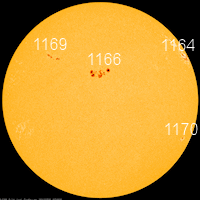 Sunspot group 1166 was the site of an X1.6 class flare about an hour ago (12:00 pm). This is a pretty significant flare, and should be sufficiently aligned with Earth to have a good chance of producing aurora. Currently the only warning from the Australian IPS is for a chance of activity today from the flares of yesterday from Sunspot Group 1164. See also Spaceweather.
We will have to wait a little while to see if this flare will have the potential for aurora.
UPDATE via Spaceweather:
Newly-arriving coronagraph data from the Solar and Heliospheric Observatory show no bright CME emerging from this eruption. Some material was surely hurled in our direction, but probably not enough for significant Earth-effects.
Labels: aurora, Solar flare, sunspot
Wednesday, March 09, 2011
The Firecracker Sun
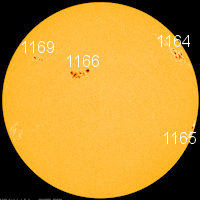 My inbox is being over-run by automatic notification of solar flares of M-class intensity. Sunspot1164 seems to be responsible for them, and while it is not in a favorable position being on the edge of the solar disk, at least one may have an Earth-directed component (see this movie here).
So high latitude observers should keep an eye out for aurora, around midnight or early tomorrow morning.
Labels: aurora, Solar flare
Tuesday, July 10, 2007
Sunspot 963 looks good
 Sunspot 963, image Credit SOHO/NASA
Sunspot 963 has just rotated onto the face of the Sun. It has a beta type magnetic field, and has produced a lot of C class flares. It has to potential to produce geoeffective solar flares capable of generating aurora. Of course, on the track record of past sunspots, its just as likely to go quiet.
Space Weather has lots of great images and links, like the shots of the ISS going past sunspot 963, and of the sunspot itself as well as a great movie of the spot flaring.
Labels: Soho, Solar flare, sunspot



 Click to read about or order
 Click to read about or order
 Click to read about or order
 Click to read about or order


.gif)