Tuesday, December 23, 2025
Coming Events: A Year of Southern Astronomy for 2026

The table below shows significant astronomical events that can be seen with the unaided eye or minimal equipment in 2026 in Australia (and to some degree elsewhere in the Southern Hemisphere, occultations and eclipses are very region specific).
This year we get a good Total Lunar eclipse visible Australia wide and at a good time in the evening so all can watch. There are good oppositions of Jupiter and Saturn and a daytime occultation of Jupiter and some nice occultations of Antares.
As well we have some fantastic parings and lineups and good meteor showers.
Close pairings of the Moon and bright planets are given special attention as not only is the Moon a ready guide to locating the planets if you are not familiar with them, these massings are rather beautiful.
Special events are bolded. T indicates a telescope only event. As well as apogee and perigee moons I have also included times when the Lunar X is visible at First Quarter.
| Date | Event |
| January | |
| 03 January 2026 | Full Moon |
| 04 January 2026 | Earth at Perihelion. |
| 04 January 2026 | Moon close to Jupiter in the morning |
| 07 January 2026 | Moon close to Regulus in the morning. |
| 10 January 2026 | Jupiter at opposition, when it is biggest and brightest as seen from Earth |
| 11 January 2026 | Moon close to Spica |
| 15 January 2026 | Moon close to Antares in the morning (occultation 4:37 AEDST, 18:00–19:22 UT 14th) |
| 23 January 2026 | Saturn near crescent Moon in evening (4° apart) |
| 26 January 2026 | First Quarter |
| 28 January 2026 | Moon near Pleiades |
| 30 January 2026 | Moon at perigee. |
| 31 January 2026 | Moon close to Jupiter |
| February | |
| 01 February 2026 | Moon near Beehive cluster (1.3° apart) |
| 02 February 2026 | Full Moon Moon near Regulus |
| 11 February 2026 | Moon near Antares |
| 020 February 2026 | Moon near Saturn in evening twilight (5° apart) |
| 24 February 2026 | Moon near Pleiades |
| 24 February 2026 | waxing Moon near Jupiter in the evening (4° apart) |
| 24 February 2026 | "Lunar X" visible in telescopes at twilight (from 07:31 UT on for ~ 4 hours) T (perigee First Quarter) |
| 27 February 2026 | Moon close to Jupiter (4° apart) |
| March | |
| 2 March 2026 | Moon Near Regulus (0.4° apart) |
| 3 March 2026 | Full Moon, Total Lunar Eclipse early evening |
| 10 March 2026 | Moon near Antares |
| 16 March 2026 | Mercury and Mars close in the morning twilight (4° apart) |
| 21 March 2026 | Earth at Equinox |
| 26 March 2026 | Moon close to Jupiter (4° apart) |
| 29 March 2026 | Moon close to Regulus (closest early morning 30th) |
| April | |
| 02 April 2026 | Full Moon |
| 07 April 2026 | Moon close to Antares (0.7° apart) |
| 15-16 April 2026 | Thin crescent Moon forms lineup with Mercury, Mars and Saturn in the Morning twilight. Mars around 4° from thin crescent Moon on the 16th |
| 19 April 2026 | Venus near to thin crescent moon in evening twilight (4.7° apart) |
| 19 -22 April 2026 | Mercury, Mars and Saturn form a triangle in the morning twilight. Mercury and Saturn closest on the 20th. |
| 23 April 2026 | Waxing Moon close to Jupiter (3.6° apart) in the evening |
| 24 April 2026 | "Lunar X" visible from 10:50 UT T |
| 26 April 2026 | Waxing moon close to Regulus in early evening |
| May | |
| 02 May 2026 | Full Moon |
| 02 May 2026 | Venus close to the Red star Aldebaran in the evening twilight |
| 04 May 2026 | Moon close to Antares in the morning twilight |
| 6-7 May 2026 | Eta Aquariid meteor shower |
| 14 May 2026 | Crescent Moon near Saturn in the morning twilight (3°) |
| 15 May 2026 | Crescent Moon near Mars in the morning twilight (3°) |
| 19 May 2026 | Crescent Moon near Venus in the evening twilight (3°) |
| 20 May 2026 | Crescent Moon near Jupiter in the evening twilight (3°) |
| 23 May 2026 | Moon close to Regulus in the evening sky |
| 31 May 2026 | Full Moon (Blue Moon and apogee Moon, apogee June 1 ). Occultation of Antares in early evening twilight. |
| June | |
| 08 June 2026 | Venus near to Pollux in the evening twilight (5°) |
| 10 June 2026 | Venus close to Jupiter in the evening twilight (2°) with Mercury below |
| 17 June 2026 | Crescent Moon close to Jupiter in the evening twilight, with Mercury below and Venus above forming a kite pattern |
| 18 June 2026 | Waxing Moon close to Venus in evening twilight (0.3°) |
| 21 June 2026 | Earth at solstice |
| 22 June 2026 | First Quarter, Lunar X visible at 0941 UT T |
| 25 June 2026 | Mercury and Jupiter close in the evening twilight forming a line with Venus |
| 29 June 2026 | Mars near the Pleiades |
| July | |
| 04 July 2026 | Mars close to Uranus (0.5°) between Pleiades and Hyades, Binocular or Telescope. |
| 07 July 2026 | Earth at aphelion |
| 10 July | Venus and the bright star Regulus close. |
| 12 July 2026 | Mars near bright red star Aldebaran (5° apart) |
| 17 July 2026 | Crescent Moon in between Regulus and Venus in the evening twilight |
| 21 July 2026 | Moon near Spica |
| 25 July | Moon near Antares, closest in morning sky |
| 29-30 July 2026 | Southern Delta Aquarids meteor shower in morning |
| 30 July 2026 | Full Moon |
| August | |
| 07 August 2026 | Moon close to the Pleiades. |
| 09 August 2026 | Moon close to Mars: 4.4° S, Occultation of Elnath (Beta Tauri) in the early morning ~ 4-5 am AEST) |
| 15 August 2026 | Venus, crescent Moon and Spica form a line in evening sky |
| 16 August 2025 | Venus near to the crescent Moon (2°) in the evening sky |
| 17 August 2026 | Moon near Spica (3° apart) in the evening sky |
| 20 August 2026 | Lunar X visible 06:30 UT T, First Quarter Moon |
| 21 August 2026 | Moon close to Antares: 0.7° |
| 28 August 2026 | Full Moon, partial Lunar eclipse not visible from Australia |
| September | |
| 01 September 2026 | Venus close to Spica: 1.4° in the evening sky |
| 07 September 2026 | Moon close to Mars: 3° in the morning sky |
| 09 September 2026 | Moon close to Jupiter: 0.8° in the morning twilight. |
| 14 September 2026 | Venus close to crescent Moon (0.6° apart) with Spica and Mercury below in the evening. |
| 17 September 2026 | Moon close to Antares in the evening sky. Occultation in south-eastern states and South Australia around midnight. |
| 19 September 2026 | Apogee First Quarter Moon |
| 23 September 2026 | Earth at Equinox |
| 26 September 2026 | Mercury very close to Spica: 0.9° in the evening twilight. With Venus above. |
| 27 September 2026 | Full Moon. |
| October | |
| 04 October 2026 | Saturn Opposition |
| 05 October 2026 | Moon near Mars: 1.2° in the morning |
| 06 October 2026 | Moon close to Jupiter in the morning |
| 07 October 2026 | Mercury near Venus: 5° in the evening twilight. |
| 12 October 2026 | Mars in the heart of the Beehive cluster |
| 12 October 2026 | Moon near Venus 3.3° in the evening twilight with Mercury above |
| 13 October 2026 | Moon near Mercury 2.3° in the evening twilight with Venus below. Asteroid 4 Vesta at opposition (Magnitude 6.5, binoculars or telescope) |
| 21-22 October 2026 | Orionid meteor shower |
| 28 October 2026 | Moon close to the Pleiades: 1° |
| November | |
| 2 November 2026 | Waning Moon near near Mars (1° apart) in the late morning sky |
| 3 November 2026 | Waning Moon very near Jupiter (0.5° apart) in the morning sky, daytime occultation. Visible from most of Australia except NE QLD. T |
| 7 November 2026 | Thin crescent moon close to Venus, with Spica nearby, in the morning twilight. |
| 10 November 2026 | Venus close to Spica in morning twilight sky |
| 16 November 2026 | Mars close to Jupiter in the morning twilight, forming a triangle with Regulus. |
| 18/19 November 2026 | Leonid Meteor Shower |
| 25 November 2026 | Full Moon (almost perigee Moon), Mars close to Regulus, forming a triangle with Jupiter, in the morning twilight. |
| 26 November 2026 | Opposition of Uranus (not far from Pleiades, easy binocular target, possible unaided eye) |
| 28 November 2026 | Jupiter, Mars and Regulus form a triangle |
| December | |
| 1 December 2026 | Waning Moon close to Mars, forming an attractive grouping with Jupiter and Regulus |
| 13 December 2026 | Jupiter closest to Regulus (2° apart) in morning sky, forming a shallow triangle with Mars. |
| 14/15 December 2026 | Geminid Meteor shower in the morning. No moon interference this year. |
| 17 December 2026 | First Quarter Moon, Luna X visible 09:35 UT T |
| 22 December 2026 | Earth at solstice |
| 24 December 2025 | Perigee Full Moon (“Super Moon”) |
| 28 December 2025 | Jupiter close to the waning Moon in the morning twilight, forming a triangle with Regulus and with Mars nearby. |
Labels: Asteroid, Conjunction, eclipse, Jupiter, Mars, Moon, Opposition, Saturn, unaided eye, Venus, Yearly Sky Events

Friday, April 25, 2025
Seeing Vesta at Opposition (2 May 2025)
 |  |
| Evening sky on Friday, May 2 as seen from Adelaide at 23:00 ACST. Asteroid Vesta is at apposition in Libra. The inset is the binocular view of Vesta at this time. At magnitude 5.7 it will be an easy binocular object near clear guide stars. Similar views will be seen elsewhere in Australia at the equivalent local time. | The approximate wide field binocular view of Vesta and the guide stars at 23:00 ACST from Friday, April 25 on with the track of Vesta shown (click to embiggen, similar views will be seen elsewhere at the equivalent local time). |
 |  |
| Black and white horizon chart facing North suitable for printing showing the guide objects of 4 Vesta, Antares, 𝛃 Librae (Zubeneschamali), μ Virginis (Rijl Al Awwa, unlabeled in this view) and Arcturus as seen from Adelaide at 23:00 ACST at Saturday 25 April. Similar views will be seen elsewhere in Australia at the equivalent local time. Use the charts above to orient yourself to get to the guide stars. | Black and white binocular chart suitable for printing showing the movement of 4 Vesta over April-May. The large circle represents the field of view of 10x50 binoculars. Click to embiggen and print. Use the horizon chart to the left for orientation first. |
The Asteroid 4 Vesta is one of the iconic minor planets, and
one of two orbited by the Dawn spacecraft. At favorable
oppositions Vesta is bright enough to be seen with the unaided eye under dark
sky conditions. This year it gets to magnitude 5.7 just over unaided eye visibility at dark sky sites. Not really visible from suburban skies, but it will be easily visible in binoculars and small telescopes.
This year Friday, May 2 is a good opposition of Vesta, when it will
reach a magnitude of 5.7 at its brightest with reasonable guide stars and no Moon interference.
The waxing Moon will interfere later in the month, but now there is no Moon interference up to opposition allowing Vesta and its guide stars to be easily seen.
Labels: 4 Vesta, Asteroid, binocular
Friday, January 10, 2025
Coming Events: A Year of Southern Astronomy for 2025

The table below shows significant astronomical events that can be seen with the unaided eye or minimal equipment in 2025 in Australia (and to some degree elsewhere in the Southern Hemisphere, ocultations and eclipses are very region specific).
This year we get a good Total Lunar eclipse visible Australia wide. We get multiple occultations of the bright star Antares. There are good oppositions of Mars and Saturn. Comet C/20024 G3 ATLAS may be visible low in the evening twilight at the end of January, if it survives its passage around the Sun.
As well we have some fantastic parings and lineups and good meteor showers (although the moon is a pest).
Close pairings of the Moon and bright planets are given special attention as not only is the Moon a ready guide to locating the planets if you are not familiar with them, these massings are rather beautiful.
Special events are bolded. T indicates a telescope only event. As well as apogee and perigee moons I have also included times when the Lunar X is visible at First Quarter.
| Date | Event |
| January | |
| 03 January 2025 | Crescent Moon near Venus in evening twilight. |
| 04 January 2025 | Earth at Perihelion, Crescent Moon close to Saturn in evening twilight. |
| 07 January 2025 | First Quarter perigee moon |
| 10 January 2025 | Moon near Jupiter in evening. |
| 14 January 2025 | Moon near Mars in evening. |
| 16 January 2025 | Mars at opposition, when it is biggest and brightest as seen from Earth |
| 18 January 2025 | Venus and Saturn at their closest (2° apart) |
| 16-25 January 2025 | Comet C/20024 G3 ATLAS may be visible low in the evening twilight. |
| February | |
| 01 February 2025 | Saturn near crescent Moon in evening (4° apart) |
| 02 February 2025 | Venus near crescent Moon in evening (~6° apart) |
| 05 February 2025 | "Lunar X" visible in telescopes at twilght (from 0813 UT on for ~ 4 hours) T |
| 07 February 2025 | waxing Moon near Jupiter in the evening (4° apart) |
| 09 February 2025 | waxing Moon near Mars in the evening (5° apart) |
| 15 February 2025 | Venus at maximum brilliance |
| March | |
| 1 March 2025 | Saturn and Mercury near to thin crescent Moon (2° apart for Mercury) very low in evening twilight, will require binoculars. |
| 2 March 2025 | Crescent Moon near Venus in evening twilight (5°) |
| 6 March 2025 | Waxing Moon near Jupiter in evening twilight (6°) |
| 09 March 2025 | Waxing Moon near Mars in evening sky (6°), Moon close to Pollux |
| 14 March 2025 | Occultation of bright star Beta Virginis around midnight |
| 20 March 2025 | Earth at Equinox |
| 21 March 2025 | Occultation of bright star Antares just after midnight |
| April | |
| 03 April 2025 | Crescent Moon near Jupiter in Evening twilight. |
| 05 April 2025 | "Lunar X" visible from 12:43 UT T |
| 05-06 April 2025 | Mars around 5° from waxing Moon |
| 13 April 2025 | Apogee Full Moon |
| 25 April 2025 | Saturn and Venus close in the morning twilight forming a triangle with the thin crescent Moon |
| 26 April 2025 | Crescent Moon close to Mercury in the morning twilight |
| May | |
| 01-10 May 2025 | Asteroid 4 Vesta at opposition in the evening, potentially visible to the unaided eye. |
| 01 May 2025 | Saturn and Venus close in the morning twilight (3°) |
| 01 May 2025 | Jupiter near the thin crescent moon in the evening twilight |
| 04 May 2025 | First Quarter Moon close to Mars (4° apart) in the evening. |
| 6-7 May 2025 | Eta Aquariid meteor shower |
| 23 May 2025 | Crescent Moon near Saturn in the morning twilight (4°) |
| 24 May 2025 | Crescent Moon near Saturn in the morning twilight (4°) |
| 28 May 2025 | Crescent Moon near Jupiter in the evening twilight (7°) will require binoculars |
| June | |
| 01 June 2025 | Mars near to thin crescent Moon (3° apart) in evening sky. |
| 03 June 2025 | |
| 10 June 2025 | Occultation of Antares in early evening sky |
| 19 June 2025 | Waning Moon close to Saturn in morning skies |
| 21 June 2025 | Earth at solstice |
| 22 June 2023 | Crescent Moon near Venus in morning skies |
| 27 June 2025 | Thin crescent Moon close to Mercury in evening twilight |
| 30 June 2025 | Mars close to crescent Moon in evening sky. |
| July | |
| 04 July 2025 | Earth at aphelion, Venus close to Uranus (2°) |
| 08 July 2025 | Occultation of Antares in late morning sky |
| 12-14 July | Venus close to Aldebaran, making a second "eye" for Taurus the Bull. |
| 8 July 2025 | Thin crescent moon near Mercury (6° apart) low in evening twilight |
| 16-17 July 2025 | Saturn near waning Moon (6° apart) in the evening sky |
| 22 July 2025 | Venus near the crescent Moon in morning sky |
| 23 July | Jupiter near the thin crescent Moon in morning sky |
| 29-30 July 2025 | Southern Delta Aquarids meteor shower in morning |
| 1-31 July 2025 | Saturn close to Neptune (2-1°) in morning sky |
| August | |
| 01-31 August 2025 | Saturn close to Neptune (1-2°) in morning sky |
| 01 August 2025 | Lunar X visible 10:47 UT T, apogee First Quarter Moon |
| 3-4 August 2025 | Venus close to star Propus (𝝶 Geminorum, 1°) |
| 12-13 August 2025 | Jupiter and Venus close (1°) the morning sky |
| 12 August 2025 | Saturn near the waning Moon (4° apart) in the evening sky |
| 20 August 2025 | Jupiter near crescent Moon (6° apart) in morning sky |
| 21 August 2025 | Venus near thin crescent Moon (7° apart) in morning sky |
| 26 August 2025 | Mars near to thin crescent Moon (4° apart) in evening sky. |
| September | |
| 4-10 September 2025 | Jupiter close (0.5° apart) to Wassat (Delta Geminorum) closest on 7th |
| 08 September 2025 | Total eclipse of the moon (around midnight, 7th in WA) |
| 08 September 2025 | Saturn close to the Full Moon (4° apart) in evening sky (alos close dring the Lunar eclipse in the early hours of the morning. |
| 17 September 2025 | Jupiter near crescent Moon (6° apart) in morning sky |
| 21 September 2025 | Saturn at Opposition |
| 22 September 2025 | Earth at Equinox |
| 20 September 2025 | Venus very close to Regulus in the morning twilight (0.5° apart) and close to the thin resent Moon (4° apart). Will need binoculars and a level horizon |
| 24 September 2025 | Thin crescent Moon near Mars (4° apart) in evening twilight |
| 29 September 2025 | Lunar X visible 08:46 UT T |
| October | |
| 03 October 2025 | Asteroid Ceres at opposition binocular visible |
| 06 October 2025 | Moon near Saturn (9° apart) in the evening sky |
| 07 October 2025 | Jupiter in the heart of NGC 2420 T |
| 14 October 2025 | Jupiter near Last Quarter Moon (6° apart) in morning sky |
| 19 October 2025 | Mercury near Mars (2° apart) in evening twilight |
| 21-22 October 2025 | Orionid meteor shower |
| 23 October 2025 | Thin crescent Moon near Mars (4° apart) in evening twilight, forming a triangle with Mercury |
| November | |
| 2 November 2025 | Moon |
| 5 November 2025 | Perigee Full Moon ("super" Moon) |
| 11 November 2025 | Jupiter near waning Moon (6° apart) in morning sky |
| 13 November 2025 | Mercury near Mars (2° apart) low in the evening twilight |
| 21 November 2025 | Thin crescent Moon, Antares and Mars form a triangle low in the evening twilight |
| 18/19 November 2025 | Leonid Meteor Shower |
| 21 November 2025 | Opposition of Uranus (not far from Pleiades, easy binocular target, possible unaided eye) |
| 27 November 2025 | Lunar X visible 10:47 UT T |
| 29 November 2025 | Waxing Moon near near Saturn (4° apart) in the evening sky |
| December | |
| 5 December 2025 | Perigee Full Moon ("super" Moon) |
| 7 December 2025 | Jupiter near waning Moon (4° apart) in morning sky, forming a line with the bright star Pollux. |
| 14/15 December 2025 | Geminid Meteor shower in the morning, some Moon interference |
| 19 December 2023 | Mercury, the thin Crescent Moon and the bright star Antares from a triangle low in the morning twilight, might need binoculars |
| 21 December 2025 | Earth is at Solstice |
| 27 December 2025 | Neraly First Quarter Moon near near Saturn (4° apart) in the early evening sky |
Labels: Asteroid, Conjunction, eclipse, Jupiter, Mars, Moon, Opposition, Saturn, unaided eye, Venus, Yearly Sky Events
Thursday, March 14, 2024
Follow-up to the Imaging Vesta Challenge, March 2024
 |  |
| Black and White printable map for locating Vesta at s asimilar scale to the images. Elnath and zeta Tau (Tianguan) are fairly obvious and Vesta is near 121 Tau. Click to embiggen | Photorealistic map for locating Vesta (and in conjunction with the printable map). Elnath and zeta Tau (Tianguan) are fairly obvious and Vesta is near 121 Tau. Click to embiggen. |
 |  |
| Stack of 30x 1 second exposures at ISO 3200 with my canon IXUS "point and shoot" on 8 March. Click to embiggen. | Labelled Stack of 30x 1 second exposures at ISO 3200 with my canon IXUS "point and shoot" on 8 March. Click to embiggen. |
 |  |
| Stack of 10x 4 second exposures at ISO 3200 with my Samsung S24 on 8 March. Click to embiggen. | Labelled stack of 10x 4 second expsures at ISO 3200 with my Samsung S24 on 8 March. Click to embiggen. |
So how did my asteroid 4 Vesta imaging challenge go? Remember my original attempt didn't go too well, despite my confidence.
I had a second opportunity on the 8th. The sky clarity was better, I could actually see Tianguan (zeta tau) and Elnath on the back of the camera/phone screen in test shots (there was a lot of groobling around on the ground setting up the shots and several test exposures to get the right patch zoomed in. My Knees do not like me as I did this on the gravel bike path near the beach.
But eventually I got Tianguan (zeta tau) and Elnath framed at a good zoom level (don't ask me what the Zoom is, the Canon IXUS just gives a zoom bar and the Samsung S24 give a zoom level but I forgot to record it. Both the IXUS and Samsung were on a tripod (I have a special adapter to pones for my tripod).
For the point and shoot IXUS I took 30 x 1 second frames at ISO 3200 (f/5.6), as the IXUS doesn't take exposures longer than 1 second (well it does, but defaults to ISO 50!). I traded noise for sensitivity. I also took a dark frame (exposure exactly the same as the main images but with the lens blocked to account for noise. The frames were then stacked in Deep Sky Stacker, the stacked output saved (a TIFF file), then exposure adjusted in The GIMP and the TIFF converted to JPG.
Unlike last time 4 Vesta was clearly (if faintly visible). You should embiggen the images above to see Vesta clearly.
For the Samsung S24 I took 10 x 4 second frames at ISO 3200, f/3.4no dark frame though. The frames were then processed as for the IXUS (stacked in Deepsky Stacker, the stacked output saved (a TIFF file), then exposure adjusted in The GIMP and the TIFF converted to JPG). The result is much better than the single 10 second exposure.
The Samsung S24 is cheating though, few cameras/phones have a 200 megapixel camera. They will be closer to the 20 megapixel IXUS. But the point is that even with an ordinary camera phone and stacking you can take effective astrophotos down to at least magnitude 8. This opens up a world of sky imaging you didn't think you could access with simple equipment.
How did others go, Well Brendan got Vesta on the 9th,

Vesta is seen faintly above121 tau and has clearly moved since my images on the 8th.
If anyone else has images and wants to submit them, let me know.
 |  |
| Single 10 second second exposure at ISO 3200 with my Samsung S24 on 3 March, Vesta is just visible. | Labelled stack of 10x 4 second expsures at ISO 3200 with my Samsung S24 on 8 March. Click to embiggen. |
In these images from 3 and 8 mrach you can clearly see the movement of Vesta.
Labels: 4 Vesta, Asteroid, astrophotography, gimp
Thursday, March 07, 2024
Imaging Vesta Challenge, March 2024
 |  |
| Black and White printable Black and White printable Northern horizon map for locating Vesta. Map
is set at astronomical twilight, 21:12 ACDST, 90 minutes after sunset.
Elnath and zeta Tau (Tianguan) are fairly obvious below Orion. Click to
embiggen and print.and print. | Black and White printable map for locating Vesta suitable for binoculars. Elnath and zeta Tau (Tianguan) are fairly obvious and Vesta is near 121 Tau. The circle is the approximate field of view of 10x50 binoculars. Click to embiggen and print. |
 |  |
| Photrealistic Northern horizon map for locating Vesta (and in conjunction with the printable map). The mMap is set at astronomical twilight, 21:12 ACDST, 90 minutes after sunset. Elnath and zeta Tau (Tianguan) are fairly obvious below Orion. Click to embiggen . | Photrealistic map for locating Vesta suitable for binoculars (and in conjunction with the printable map). Elnath and zeta Tau (Tianguan) are fairly obvious and Vesta is near 121 Tau. Click to embiggen. |
 |  |
| Stack of 10x 1 second exposures at ISO 3200 with my canon IXUS "point and shoot" on 3 March, Vesta is not readily visible. | Single 10 second second exposure at ISO 3200 with my Samsung S24 on 3 March, Vesta is just visible. |
So, for this months Astrophotography challenge I set "imaging the Asteroid 4 Vesta". Now vesta is magnitude 8 at the moment, a bit dim, but visible in binoculars and potentially image-able with fairly ordinary cameras using stacking, a powerful software technique where multiple images and be combinted to enhance dim objects.
The biggest challenge is actually aiming your camera, even though the horns of the bull, Elnath and zeta Tau (Tianguan) are fairly obvious, they did not really show up well in the back of my canon IXUS not the mobile phone. So I had to do a bit of guess work in aiming and do a number of test shots to get Elnath and zeta Tau in view.
For the Canon IXUS "point and shoot" camera I took 10 x 1 second exposures at ISO 3200 and stacked them in Deep Sky Stacker, This wasa simple "drag and drop" procedure. I was limited to 1 second exposures because Canon messed up their long duration exposures (anything over 1 second defaults to 50 ISO, which is useless). The stack revealed several of the expected guide stars (and a couple of satellites) but no unambiguous Vesta. I'll try again with a deeper stack (20 + images, and some dark frames for noise reduction if the weather clears up before the Moon comes out again (around the 12-13th).
For the Samsung s24 I took a single 10 second shot at ISO 3200, this *just* revealed Vesta (see image above), so if the clouds go away I will try stacking multiple shots with the S24.
Free Stacking software includes Deep Sky Stacker and Autostakkert for Windows, and StarStaX for macOS.
Labels: 4 Vesta, Asteroid, astrophotography
Saturday, January 06, 2024
Coming Events: A Year of Southern Astronomy for 2024

The table below shows significant astronomical events that can be seen with the unaided eye or minimal equipment in 2024 in Australia (and to some degree elsewhere in the Southern Hemisphere, ocultations and eclipses are very region specific).
This year we get a Penumbral Lunar eclipse best visible from eastern Australia. We get multiple occultations of Saturn (some daylight only). A couple of occultations of the Pleiades, and an occultation of the bright star Antares (only visible western and central Australia). There are good oppositions of Jupiter and Saturn. Mars is at opposition in January 2025 but we get a good run up to it. We also get a comet in September/October, C/2023 A3 Tsuchinshan-ATLAS, which may be a fizzer but just might be spectacular.
As well we have some fantastic parings and lineups and good meteor showers.
Close pairings of the Moon and bright planets are given special
attention as not only is the Moon a ready guide to locating the planets
if you are not familiar with them, these massings are rather beautiful.
Special events are bolded.
| Date | Event |
| January | |
| 03 January 2024 | Earth at Perihelion |
| 09 January 2024 | Crescent Moon near Venus in morning twilight. |
| 10 January 2024 | Crescent Moon near Mercury in morning twilight. |
| 14 January 2024 | Crescent Moon close to Saturn in evening twilight. |
| 18 January 2024 | First Quarter Moon near Jupiter in evening. |
| 20 January 2024 | Occultation of the Pleiades (Perth best from 21:14 AWST, also Adelaide, Darwin good, just 17 Tau, Brisbane, Hobart, Sydney) |
| 28 January 2024 | Mars and Mercury very close (0.2° apart) |
| February | |
| 08 February 2024 | Venus near crescent Moon in morning (5° apart) |
| 9 February 2024 | Mercury near crescent Moon in morning (~5° apart) |
| 11 February 2024 | Thin Crescent Moon and Saturn close low in the evening twilight (5° apart) |
| 15 February 2024 | waxing Moon near Jupiter in the evening (4° apart) |
| 21-24 February 2024 | Venus and Mars around 1° apart in the morning twilight. |
| 25 February 2024 | Apogee (mini) Full Moon |
| March | |
| 9 March 2024 | Venus close to thin crescent Moon (3° apart) low in morning twilight |
| 1-9 March 2024 | Mercury within 5° or Venus in morning twilight |
| 13-14 March 2024 | Crescent Moon near Jupiter in evening twilight |
| 20 March 2024 | Earth at Equinox |
| 22 March 2024 | Saturn very close to Venus (0.6° apart), very difficult low in the morning twilight |
| 25 March 2024 | Apogee (mini) Full Moon |
| 25 March 2024 | Penumbral Lunar Eclipse |
| April | |
| 6-7 April 2024 | Crescent Moon brackets Mars and Saturn in the morning twilight. |
| 8 April 2024 | Crescent Moon and Venus close low in the morning twilight |
| 11 April 2024 | Saturn and Mars spectacularly close (0.4° apart) in morning sky. |
| 10-11 April 2024 | Crescent Moon near Jupiter in the evening twilight |
| 19 April 2024 | Mercury and Venus close low in the morning twilight (difficult, requires binoculars and a level horizon) |
| May | |
| 04 May 2024 | Daytime occultation of Saturn (east coast from around 9 am) |
| 05 May 2024 | Early Morning occultation of Neptune (east coast from around 4 am) |
| 05 May 2024 | Crescent Moon very close to Mars (0.3° apart) in morning twilight. |
| 6-7 May 2024 | Eta Aquariid meteor shower |
| 06 May 2024 | Crescent Moon near Mercury in the morning twilight |
| June | |
| 03 June 2024 | Mars near to thin crescent Moon (3° apart) in morning sky. |
| 4-5 June 2024 | Jupiter and Mercury close (3° apart) low in morning twilight (binocular event) |
| 21 June 2024 | Earth at solstice |
| 27 June 2023 | Saturn is occulted by the moon just after 23:00, low on the eastern horizon (eastern states and SA) |
| July | |
| 2 July 2024 | Mars near crescent Moon (5° apart) in morning sky. |
| 3 July 2024 | Jupiter near crescent moon in the morning sky, at this time Jupiter forms a second eye for Taurus the Bull being 6° from the other eye, bright red Aldebaran) |
| 5 July 2024 | Earth at aphelion, waning Moon near Saturn in the morning sky. |
| 8 July 2024 | Thin crescent moon near Mercury (6° apart) low in evening twilight |
| 16 July 2024 | Mars and Uranus very close (0.5° apart) in the morning sky. |
| 24 July 2024 | Saturn near waning Moon (5° apart) in the evening sky |
| 25 July 2024 | Mercury near Regulus (6° apart) in the evening twilight. |
| 29-30 July 2024 | Southern Delta Aquarids meteor shower in morning |
| 30 July 2024 | Occultation of Pleiades (from around 5 am local time on). |
| 31 July 2024 | Jupiter near crescent moon (6° apart) in morning sky. |
| August | |
| 06 August 2024 | Mercury, Venus and crescent Moon form a triangle to the evening twilight |
| 15 August 2024 | Jupiter and Mars very close (0.3° apart) in morning sky |
| 20-21 August 2024 | The Moon brackets Saturn. |
| 28 August 2024 | Jupiter, Mars, the waning Moon and the bright Star Elnath form a triangle in the morning sky |
| September | |
| 05 September 2024 | Venus close (1° apart) to thin crescent Moon in the evening sky at the end of twilight |
| 08 September 2024 | Saturn at Opposition |
| 09 September 2024 | Mars close (1° apart) to open cluster M35 |
| 10 September 2024 | Occultation of bright star Antares, west, central North (Perth, Darwin, Alice Springs) everywhere else sees a close approach or graze low to the horizon |
| 17 September 2024 | Perigee ("super") Moon near Saturn, occultation in Northern Australia in late twilight (Brisbane, Alice Springs Darwin), close everywhere else. |
| 18 September 2024 | Venus close (3° apart) to the bright star Spica |
| 22 September 2024 | Earth at Equinox |
| 24 September 2024 | Moon near Jupiter in morning sky |
| 26 September 2024 | Moon near Mars in morning sky |
| 09-27 September 2024 | C/2023 A3 Tsuchinshan-ATLAS may be visible low in the morning twilight, if it hasn't broken up, it may be quite bright. |
| October | |
| 5-62 October 2024 | Venus bracketed by thin crescent Moon |
| 13 October on 2024 | C/2023 A3 Tsuchinshan-ATLAS may be visible low in the evening twilight, rapidly rising higher in the evening sky, if it hasn't broken up, it may be quite bright, even visible to the unaided eye. Venus keeps pace with the comet. |
| 14 October 2024 | Saturn close (5° apart) to the Moon in the evening sky. |
| 21-22 October 2024 | Moon brackets Jupiter in the morning sky. |
| 21-22 October 2024 | Orionid meteor shower, last quarter Moon interferes. |
| 25 October 2024 | Crescent Moon near Mars (5° apart), Moon very close to bight star Pollux in morning sky |
| 26-27 October 2024 | Venus close to the bright red star Antares in evening sky. |
| November | |
| 3 November 2024 | Mercury close to thin crescent Moon (2° apart) in evening sky |
| 5 November 2024 | Crescent Moon near Venus (2° apart) in evening sky sky |
| 10 November 2024 | Mercury close to bright red star Antares (2° apart) in evening sky |
| 11 November 2024 | Waxing Moon near Saturn (5° apart) in the evening sky |
| 14 November 2024 | Possible early burst of Leonid meteors, moonlight interference |
| 17 November 2024 | Waxing Moon near Jupiter in the evening sky |
| 18/19 November 2024 | Leonid Meteor Shower, significant Moon interference. |
| 17 November 2024 | Waxing Moon near Jupiter in the evening sky, opposition of Uranus |
| 21 November 2024 | Waxing Moon near Mars (5° apart) in the evening sky |
| 30 November 2024 | Mars close to Beehive cluster (2° apart) in the evening sky. |
| December | |
| 5 December 2024 | Venus near crescent Moon (5° apart) in the evening sky |
| 8 December 2024 | Saturn very close to waxing Moon, daytime occultation in Northern Australia (5:30 pm Darwin) |
| 8 December 2024 | Opposition of Jupiter |
| 14/15 December 2024 | Geminid Meteor shower in the morning, significant Moon interference |
| 14 December 2023 | Waxing Moon near Jupiter (5° apart) in the evening sky |
| 18 December 2024 | Mars near waning Moon in the evening sky |
| 21 December 2023 | Earth is at Solstice |
| 29 December 2024 | Mercury near Moon (6° apart) low in the twilight morning sky |
Labels: Asteroid, Conjunction, eclipse, Jupiter, Mars, Moon, Opposition, Saturn, unaided eye, Venus, Yearly Sky Events
Thursday, December 21, 2023
Seeing Vesta at Opposition (22 December 2023)
 |  |
| Evening sky on Friday, December 22 as seen from Adelaide at 22:16 ACDST (90 minutes after sunset). Asteroid Vesta is at apposition in Orion. The inset is the binocular view of Vesta at this time. At magnitude 6.6 it will be an easy binocular object near clear guide stars. Similar views will be seen elsewhere in Australia at the equivalent local time. | The approximate binocular view of Vesta and the guide stars at on from Thursday, December 23 on. with the track of Vesta shown (click to embiggen, similar views will be seen elsewhere at the equivalent local time). |
 |  |
| Black and white horizon chart facing east suitable for printing showing the guide objects of 4 Vesta Elnath, Propus and Chi orionus as seen from Adelaide at 22:16 ACDST. Similar views will be seen elsewhere in Australia at the equivalent local time. Use the charts above to orient yourself to get to the guide stars. | Black and white binocular chart suitable for printing showing the movement of 4 Vesta over December. The large circle represents the field of view of 10x50 binoculars. Click to embiggen and print. Use the horizon chart to the left for orientation first. |
The Asteroid 4 Vesta is one of the iconic minor planets, and
one of two orbited by the Dawn spacecraft. At favorable
oppositions Vesta is bright enough to be seen with the unaided eye under dark
sky conditions. This year it gets to magnitude 5.8 just over unaided eye visibility at dark sky sites. Not really visible from suburban skies, but it will be easily visible in binoculars and small telescopes.
This year on Friday, December 22 is a so-so opposition of Vesta, when it will
reach a magnitude of 6.4 at its brightest with reasonable guide stars and some Moon interference. The next bright opposition is May 2025 it will reach magnitude 5.6 with good guide stars.
The waxing Moon will interfere later in the month, but now the waxing Moon should allow Vesta to be easily seen.
Labels: 4 Vesta, Asteroid, binocular
Wednesday, January 11, 2023
Coming Events: A Year of Southern Astronomy for 2023

The table below shows significant astronomical events that can be seen with the unaided eye or minimal equipment in 2023 in Australia (and to some degree elsewhere in the Southern Hemisphere, ocultations and eclipses are very region specific).
This year we get a Partial Lunar eclipse best visible from western Australia. A Total Solar eclipse is visible from the tip of Western Australia and everywhere else sees a partial eclipse (best from WA and central north). There are good oppositions of Jupiter and Saturn. We also get an occultation of the Pleiades and a binocular comet.
As well we have some fantastic parings and lineups and good meteor showers.
Close pairings of the Moon and bright planets are given special
attention as not only is the Moon a ready guide to locating the planets
if you are not familiar with them, these massings are rather beautiful.
Special events are bolded.
| Date | Event |
| January | |
| 3 January 2023 | Moon between Mars and Pleiades |
| 5 January 2023 | Earth at Perihelion |
| 21 January 2023 | Crescent Moon near Mercury in morning twilight. |
| 23 January 2023 | Saturn, Venus and Crescent Moon close in the evening twilight |
| 26 January 2023 | Crescent Moon close to Jupiter |
| February | |
| 4 February 2023 | Comet C/2022 E3 visible above northern horizon (binocular) |
| 11-13 February 2023 | Comet C/2033 E3 comes close to Mars the enters the Hyades (binocular) |
| 19 February 2023 | Crescent Moon and Mercury close in the morning twilight |
| 22 February 2023 | Crescent Moon near Venus in evening twilight |
| 23 February 2023 | Crescent Moon close to Jupiter. |
| 28 February 2023 | Waning Moon close to Mars |
| 26-30 February 2023 | Venus and Jupiter come close together ahead of a spectacular conjunction in March |
| March | |
| 2 March 2023 | Venus and Jupiter in a spectacular close approach (0.5 degrees) in evening twilight |
| 3 March 2023 | Mercury very close (1 degrees) to Saturn deep in morning twilight |
| 20 March 2023 | Crescent Moon and Saturn close in early morning twilight |
| 21 March 2023 | Earth at Equinox |
| 24 March 2023 | Crescent Moon and Venus close in evening twilight |
| 28 March 2023 | Waning Moon close to Mars. |
| April | |
| 12 April 2023 | Venus near the Pleiades. |
| 16 April 2023 | Saturn and crescent Moon close in morning sky. |
| 20April 2023 | Total Solar Eclipse; Exmouth WA (partial in the rest of Australia) |
| 23April 2023 | Crescent Moon close to Venus in evening sky |
| 26 April 2023 | Waxing Moon close to Mars in evening sky |
| May | |
| 5/6 May 2023 | Penumbral eclipse of the Moon |
| 6-7 May 2023 | Eta Aquariid meteor shower |
| 14 May 2023 | Waning Moon close to Saturn in the morning sky |
| 18 May 2023 | Mercury, Jupiter and crescent Moon form a triangle in morning twilight |
| 23 May 2023 | Crescent Moon below Venus in the evening sky |
| 24-25 May 2023 | Mars with waxing Moon nearby |
| June | |
| 3 June 2023 | Mars in heart of Beehive cluster (M44), Venus forms line with Castor and Pollux |
| 10 June 2023 | Saturn near waning Moon in morning sky |
| 14 June 2023 | Crescent Moon near Jupiter in morning sky, Venus near Beehive cluster in evening sky |
| 17 June 2023 | Thin Crescent Moon, Mercury and red star Aldebaran form a line low in the morning twilight |
| 22 June 2023 | Earth at solstice |
| 22 June 2023 | Crescent Moon forms triangle with Mars and Venus in evening sky |
| July | |
| 7 July 2023 | Earth at aphelion, waning Moon near Saturn in the morning sky. |
| 8 July 2023 | Venus at greatest brilliance |
| 10 July 2023 | Venus, Mars and the bright star Regulus form a triangle in the evening twilight |
| 12 July 2023 | Crescent Moon close to Jupiter in the morning sky |
| 19 July 2023 | Thin Crescent Moon close to Mercury low in evening twilight |
| 20 July 2023 | Crescent Moon, Venus and bright star Regulus for a triangle in the evening twilight |
| 21 July 2023 | Mars near crescent Moon in the morning twilight |
| 26 July 2023 | Venus, Mercury and Regulus form a triangle |
| 30 July 2023 | Mercury Very close (0.5 degrees) to Regulus, Venus close by |
| 29-30 July 2023 | Southern Delta Aquarids meteor shower |
| August | |
| 2 August 2023 | Perigee Full Moon (“super” Moon) |
| 3 August 2023 | Saturn close (2 degrees) to Moon in evening sky |
| 8-9 August 2023 | Jupiter near waning Moon |
| 18 August 2023 | Thin crescent Moon forms triangle with Mercury and Mars in evening twilight |
| 19 August 2023 | Thin crescent Moon forms line with Mercury and Mars in evening twilight |
| 27 August 2023 | Saturn at opposition |
| 30 August 2023 | Saturn near waxing Moon in evening |
| 31 August 2023 | Perigee Full Moon (“Super” Moon) also Blue Moon |
| September | |
| 4 September 2023 | Jupiter close to waning Moon in evening sky |
| 12 September 2023 | Thin crescent Moon close to Venus in dawn sky |
| 16-17 September 2023 | Crescent Moon near Mars |
| 23 September 2023 | Earth at Equinox |
| 27 September 2023 | Saturn close to the waxing Moon |
| October | |
| 1-2 October 2023 | Jupiter and waning Moon near in evening sky |
| 11 October 2023 | Venus and crescent Moon close in morning sky |
| 24 October 2023 | Saturn and the waxing Moon close in evening sky |
| 21-22 October 2023 | Orionid meteor shower |
| 28 October 2023 | Twilight partial eclipse of the Moon (best from WA) |
| 29 October 2023 | Jupiter and the Full Moon close in evening sky |
| 30-31 October 2023 | Ocultation of the Pleiades (before midnight 30th to early morning 31st) |
| November | |
| 3 November 2023 | Opposition of Jupiter |
| 10 November 2023 | Crescent Moon near Venus in morning sky |
| 14 November 2023 | Opposition of Uranus |
| 18 November 2023 | Leonid Meteor Shower |
| 20 November 2023 | Waxing Moon near Saturn in the evening sky |
| 25 November 2023 | Waxing Moon near Jupiter in Evening sky |
| 29 November 2023 | Occultation of bright star Beta Tauri in morning sky |
| December | |
| 10 December 2023 | Venus and crescent Moon close |
| 14 December 2023 | Geminid Meteor shower in the morning |
| 14 December 2023 | Mercury near thin crescent Moon low in the twilight |
| 17-18 December 2023 | Waxing Moon near Saturn in the evening |
| 22 December 2023 | Earth is at Solstice |
| 22 December 2023 | Jupiter near waxing Moon in the evening |
| 23 December 2023 | Asteroid Vesta at opposition |
| 31 December 2023 | Venus, Mercury and Mars form a triangle low the twilight morning sky |
Labels: Asteroid, Conjunction, eclipse, Jupiter, Mars, Mercury, Moon, Opposition, Saturn, unaided eye, Venus, Yearly Sky Events
Wednesday, August 17, 2022
Seeing Vesta at Opposition (23 August 2022)
 |  |
| The North-east horizon as seen from Adelaide at 20:00 ACST (8:00 pm) showing the location of Vesta (click to embiggen) on Tuesday, August 23, when Vesta is at opposition and at its brightest.Similar views will be seen elsewhere in Australia at the equivalent local time. | The approximate binocular view of Vesta and the four guide stars at 20:00 ACST (8:00 pm) on Tuesday, August 23. The helix nebula is shown but will not be visible in binoculars(click to embiggen, similar views will be seen elsewhere at the equivalent local time). |
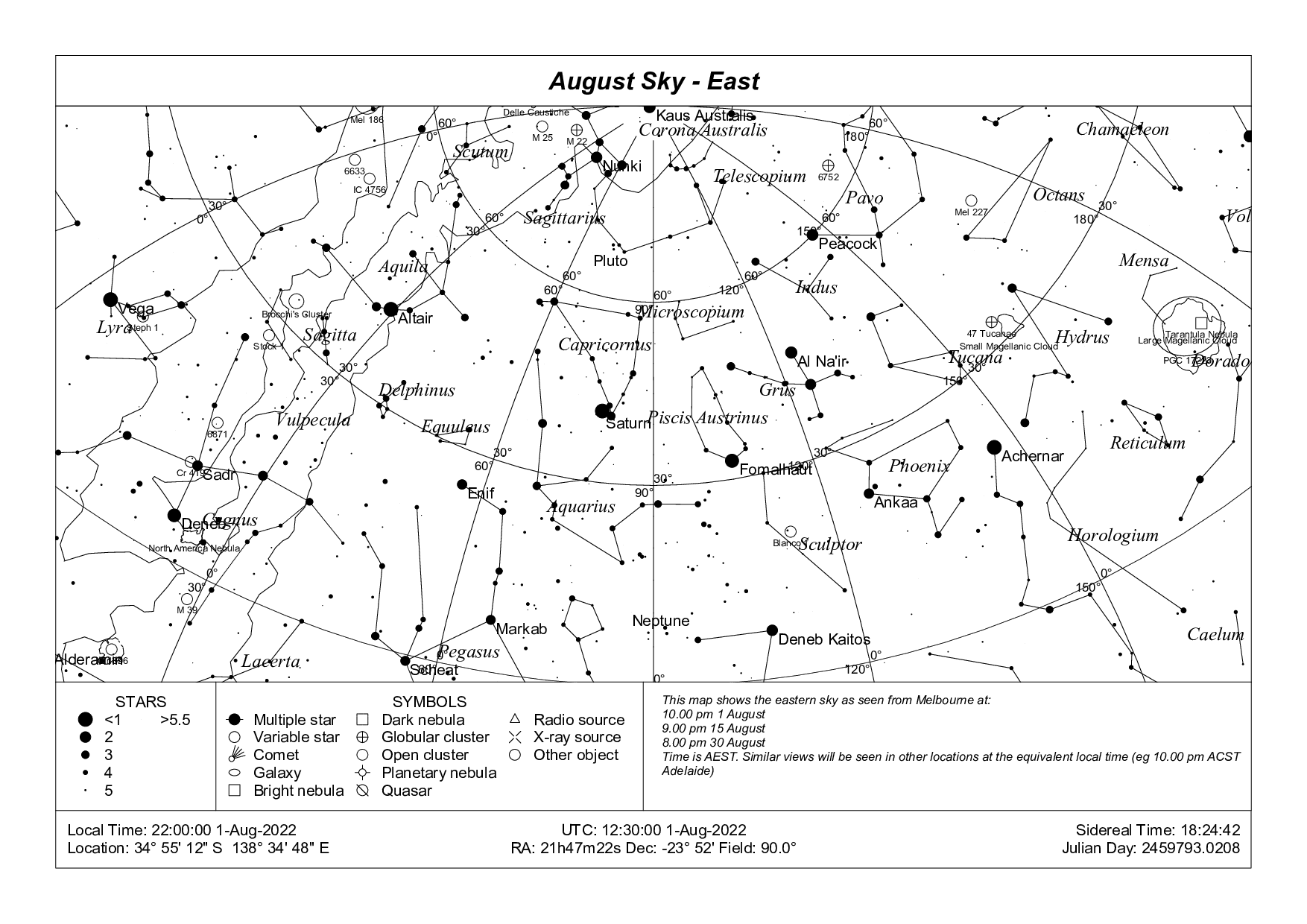 | 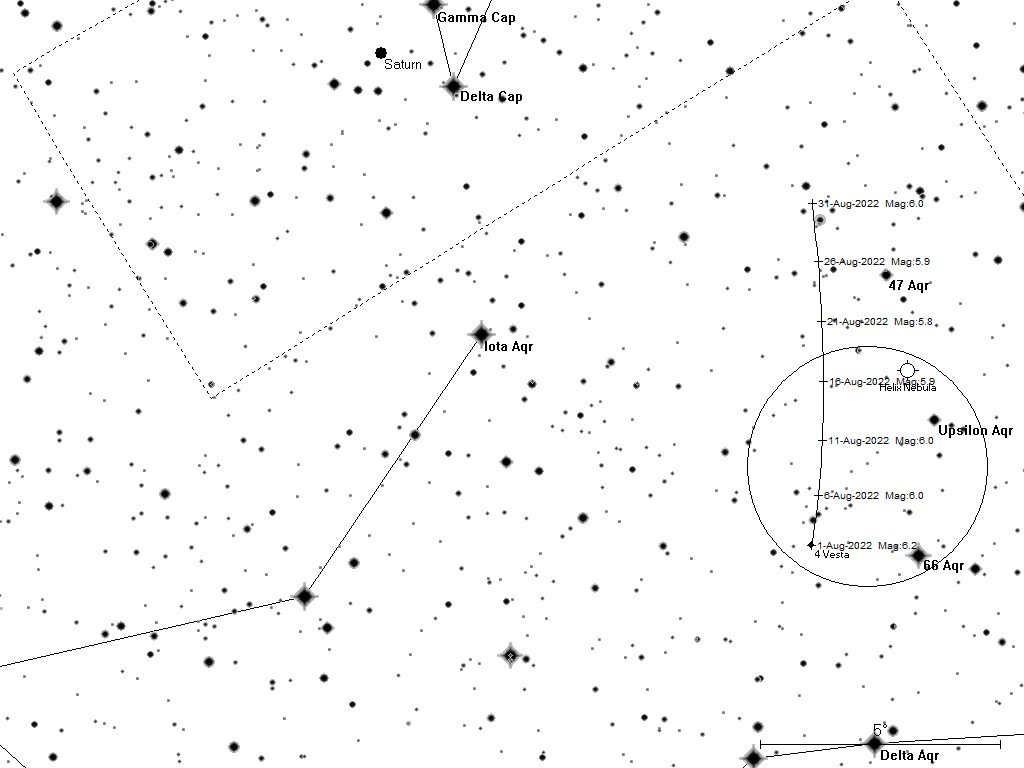 |
| Black and white horizon chart facing east suitable for printing showing the guide objects of 4 Vesta Saturn and Fomalhaut as seen from Adelaide at 22:00 ACDST. Similar views will be seen elsewhere in Australia at the equivalent local time. Use the charts above to orient yourself to get to the guide stars. | Black and white binocular chart suitable for printing showing the movement of 4 Vesta over August. The large circle represents the field of view of 10x50 binoculars. Click to embiggen and print. Use the horizon chart to the left for orientation first. |
The Asteroid 4 Vesta is one of the iconic minor planets, and
one of two orbited by the Dawn spacecraft. At favorable
oppositions Vesta is bright enough to be seen with the unaided eye under dark
sky conditions. This year it gets to magnitude 5.8 just over unaided eye visibility at dark sky sites. Not really visible from suburban skies, but it will be easily visible in binoculars and small telescopes.
This year on Tuesday, August 23 is a okay opposition of Vesta, when it will
reach a magnitude of 5.8 at its brightest with reasonable guide stars. The next bright opposition is May 2025 it will reach magnitude 5.6 with good guide stars.
The Full Moon interfered significantly early on earlier in the month, but now the skies are free from interference. Just before opposition, at opposition and several days after opposition Vesta is bright and easily seen. 17 August to 4 September may be best.
Labels: 4 Vesta, Asteroid, binocular, unaided eye
Monday, January 31, 2022
Coming Events: A Year of Southern Astronomy for 2022
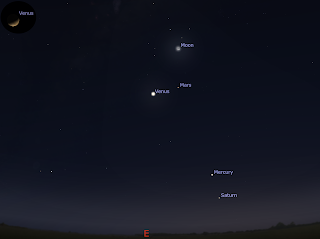
The table below shows significant astronomical events that can be seen with the unaided eye or minimal equipment in 2022 in Australia (and to some degree elsewhere in the Southern Hemisphere, ocultations and eclipses are very region specific).
This year we get a good Total Lunar eclipse. There are good oppositions of Mars, Jupiter and Saturn. Mars skims past the Pleiades and Hydaes clusters.
As well we have some fantastic parings and lineups and good meteor showers.
Close pairings of the Moon and bright planets are given special
attention as not only is the Moon a ready guide to locating the planets
if you are not familiar with them, these massings are rather beautiful.
Special events are bolded.
| Date | Event | |
| January | ||
| 1 January 2022 | Occultation of Mars | |
| 4 January 2022 | Earth at Perihelion | |
| 4 January 2022 | Crescent Moon, Mercury, and Saturn close low in the evening twilight | |
| 6 January 2022 | Jupiter and Crescent Moon close | |
| 30 January 2022 | Crescent Moon forms a triangle with Mars and Venus | |
| February | ||
| 2 February 2022 | Mars close to M28 | |
| 3 February 2022 | Jupiter close to the thin crescent Moon low in the twilight | |
| 6 February 2022 | Mars near globular cluster M22 | |
| 13 February 2022 | Mercury, Mars and Venus form a triangle in the morning sky. | |
| 27-28 February 2022 | Crescent Moon, Mars and Venus form a triangle in the morning sky. | |
| March | ||
| 1 March 2022 | Mercury, Saturn and thin crescent Moon form a triangle in the morning twilight | |
| 3 March 2022 | Mercury very close (0.6 degrees) from Saturn in morning twilight | |
| 21 March 2022 | Earth at Equinox, Five bright planets visible in the morning twilight, Jupiter and Mercury close in the morning twilight. | |
| 28 March 2022 | Crescent Moon, Saturn, Venus and Mars from a close massing in the morning twilight with the Moon above | |
| 29 March 2022 | Crescent Moon, Saturn, Venus and Mars from a close massing in the morning twilight with the Moon below | |
| 31 March 2022 | Thin crescent Moon close to Jupiter low in the morning twilight | |
| April | ||
| All April 2022 | Four bright planets in the morning sky Moon in the morning sky | |
| 5 April 2022 | Saturn and Mars very close (0.3 degrees apart) in the morning sky | |
| 13 April 2022 | Jupiter close to Neptune in the morning sky | |
| 26 April 2022 | Mars close to the crescent Moon in the morning sky | |
| 27-28 April 2022 | Crescent Moon close to Venus and Jupiter in the morning sky | |
| 28 April 2022 | Venus and Neptune in close conjunction (< 30 arc minutes) in the morning sky | |
| May | ||
| 1 May 2022 | Venus and Jupiter very close in the morning sky (0.2 degrees apart) | |
| 6-7 May 2022 | Eta Aquariid meteor shower | |
| 22 May 2022 | Waning Moon above Saturn | |
| 25 May 2022 | Mars, Jupiter and waning Moon form a triangle in morning sky | |
| 27 May 2022 | Crescent Moon above Venus | |
| 30 May 2022 | Mars and Jupiter very close in the morning sky (0.6 degrees apart) | |
| June | ||
| 1 June 2022 | Mars and Jupiter very close in the morning sky (1.0 degrees apart) | |
| 18 June 2022 | Saturn near waning Moon low in the late evening sky | |
| 14 June 2022 | Perigee Full Moon ("super Moon") | |
| 21 June 2022 | Earth at solstice | |
| 22 June 2022 | Mercury in head of Hyades near Aldebaran in morning sky, waning Moon near Jupiter | |
| 26 June 2022 | Crescent Moon between Venus and Pleiades in the morning sky | |
| 27 June 2022 | Crescent Moon near Mercury in the morning sky | |
| July | ||
| 1 July 2022 | Venus close to Aldebaran in the morning, forming a second eye for Taurus the Bull | |
| 4 July 2022 | Earth at aphelion | |
| 14 July 2022 | Syzygy Perigee full moon ("super Moon") closest of year | |
| 15 July 2022 | Moon close to Saturn | |
| 19 July | Moon close to Jupiter | |
| 22 July 2022 | Waning crescent Moon close to Mars (within binocular field) | |
| 27 July 2022 | Venus near crescent Moon in the morning twilight | |
| 29-30 July 2022 | Southern Delta Aquarids meteor shower | |
| 30 July 2022 | Mercury close to crescent moon in western evening twilight | |
| 31 July | Mars and Uranus 2 degrees apart (in same binocular filed) | |
| August | ||
| 1-3 August 2022 | Mars and Uranus less than 2 degrees apart (in same binocular filed) | |
| 4 August 2022 | Mercury very close to Regulus (0.7 degrees) in the evening twilight | |
| 12 August 2022 | Saturn close to Full Moon (perigee "super" Moon) | |
| 15 August 2022 | Saturn at opposition | |
| 15 August 2022 | Jupiter close to Waning Moon (1 degree) | |
| 20 August 2022 | Mars near Moon in Morning | |
| 22 August 2022 | Jupiter near Moon | |
| 29 August 2022 | Mercury near thin crescent Moon in evening sky, Mars between Pleiades and Hyades in the morning sky | |
| September | ||
| 3 September 2022 | Mars forms second "eye" in Taurus the Bull with Aldebaran in morning sky | |
| 8 September 2022 | Waxing moon close to Saturn in evening sky | |
| 11 September 2022 | Waning Moon close to Jupiter in evening sky | |
| 23 September 2022 | Earth at Equinox | |
| 27 September 2022 | Jupiter at Opposition | |
| October | ||
| 5 October 2022 | Saturn and waxing Moon close in evening sky | |
| 8 October 2022 | Jupiter and waxing Moon close in evening sky | |
| 14 October 2022 | Mars and the waxing Moon close in evening sky | |
| 21-22 October 2022 | Orionid meteor shower | |
| November | ||
| 2 November 2022 | Waxing Moon near Saturn in evening sky | |
| 4-5 November 2022 | Waxing Moon near Jupiter in evening sky | |
| 8 November 2022 | Total Lunar Eclipse | |
| 11 November 2022 | Waxing Moon near Mars in evening sky | |
| 18 November 2022 | Leonid Meteor Shower | |
| December | ||
| 2 December 2022 | Jupiter and waxing Moon close | |
| 8 December 2022 | Mars at opposition and close to Full Moon | |
| 14 December 2022 |
| |
| 22 December 2022 | Earth is at Solstice | |
| 24 December 2022 | Venus and Mercury and thin crescent Moon are close in evening twilight. | |
| 26 December | Saturn near crescent Moon | |
| 28-30 December 2022 | Venus and Mercury at their closest in evening twilight. | |
| 29 December 2022 | Jupiter close (1 degree) from the waning Moon in evening |
Labels: Asteroid, Conjunction, eclipse, Jupiter, Mars, Mercury, Moon, Opposition, Saturn, unaided eye, Venus, Yearly Sky Events



 Click to read about or order
 Click to read about or order
 Click to read about or order
 Click to read about or order


