Tuesday, June 06, 2023
No, Garlic will not Cure COVID.
Rouf R, Uddin SJ, Sarker DK, Islam MT, Ali ES, Shilpi JA, Nahar L, Tiralongo E, Sarker SD. Antiviral potential of garlic (Allium sativum) and its organosulfur compounds: A systematic update of pre-clinical and clinical data. Trends Food Sci Technol. 2020 Oct;104:219-234. doi: 10.1016/j.tifs.2020.08.006. Epub 2020 Aug 19. PMID: 32836826; PMCID: PMC7434784.
Labels: COVID-19, Science Blogging, science matters

Tuesday, February 15, 2022
No, a recent report has NOT found Graphene in COVID vaccines
The idea that COVID vaccines contain the nano-particle material graphene is a particular myth that refuses to go away. While graphene has a number of desirable properties in biomedical applications, it is not yet used in vaccines.
However, a new "report" claims that they have found "graphene" in vials of Pfizer, Moderna and Astra-Zenia COVID vaccines. TL;DR this is nonsense on stilts. Why? let me explain.
As a bit of background, I am a biomedical scientist. I have a lot of expertise in optical microscopy (bright field, fluorescence) and some expertise in electron microscopy. I also have expertise in UV-visible spectroscopy and experience with Nuclear magnetic Resonance and Mass Spectroscopy (although the latter is usually me nodding at my collaborators spectra trying to look intelligent).
With that background, let look at the "report", "Qualitative Evaluation of Inclusions In Moderna, AstraZeneca and Pfizer Covid-19 vaccines.". It uses two techniques to find "graphene" in the vaccines, optical microscopy and Raman spectroscopy.
Optical microscopy:
The problem with optical microscopy is that nano-materials are, well, nano, with sizes typically below the resolution threshold of optical instruments. The "report" says that aliquots of vaccine were placed on "clean" slides, dried, then cover slips placed on them. No details are given on how the slides were cleaned, if the cover-slips were cleaned, and what mounting medium was used.
Looking at the images I see the typical junk that ends up on slides (even cleaned ones and we use acid washing with ethanol rinses on the slides and cover-slips). Stray fibers and the agglomerations you get from drying complex solutions (particularly with lipids, the lipid nano-particles will aggregate as they dry into little blobs of fat). The "carbon nano-ribbons" (Figure 3.1) are not nano (approximately 7 µm in diameter), and the images in 3.2 are definitely not nano (15 µm across) and are the typical junk that accumulates of slides and cover-slips.
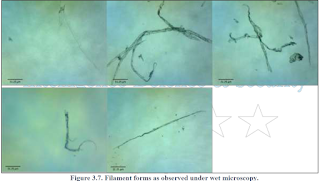
These random blobs and fibers are all (aside for some described as calcite) described as graphene with out any good evidence. Which brings me to Raman spectroscopy.
Raman Spectroscopy:
Spectroscopy of any sort of complex mixtures, like vaccines, is fraught with difficulties. Multiple components can interfere with each other and you can find peaks where you don't expect peaks. The "report" shows numerous Raman spectra, but they are all uniformly awful.
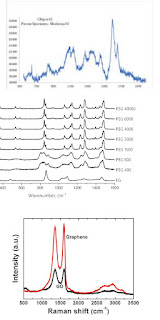
in this image (click to embiggen) I have posted the best spectrum from figure 3.11 (labelled "graphene with polyethylene glycol") above the spectra for polyethylene glycol (the PEG used in vaccines is PEG2000) and Graphene and graphene oxide (GO). The scales for the Raman shift are different in all the images, I can't do much about that. But the main thing is too look at the patterns.
The reports figure is very poor quality, so being sure of the peak locations is difficult but there are peaks around 800, 1100 and 1400 Raman shifts (cm-1) the may correspond to the 830, 1108 and 1470 peaks for PEG. There are a bunch of other peaks that don't quite fit with PEG (eg the peak around 1700 cm-1).
Graphene and Graphene oxide (GO) have distinct peaks at 1354 and 1591 (cm-1). There is a peak in the mess that is around 1600 cm-1 but the 1354 peak is missing.
So, no graphene.
Summary:
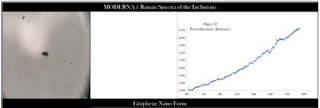
The "evidence" for graphene in the vaccines is random fibers and blobs which are not nano-scale, and poor resolution Rama spectra which don't show the spectral signature of graphene.
So no graphene in vaccines.
Given the poor image resolution the amateurish backgrounds and the obvious artefacts, the heading of "Global Humanitarian Crisis Prevention and Response Unit" on every page with a terrible graphic logo, I can't help but wonder if this is some sort of joke.
EDIT:
Labels: Pseudoscience, public outreach, science matters, vaccines
Thursday, November 18, 2021
No, you can't "Detox" from the COVID vaccines (or any other vaccine)
You may have heard of people offering "Detoxes" to"remove" the COVID vaccines. These range from "Detox" baths of Epsom salts and/or Borax, to snake venom removal kits, to the ancient technique of cupping.
None work, some are dangerous and all are based on a complete misunderstanding of how vaccines work.
The currently available vaccines are mRNA vaccines (Pfizer, Moderna), and adenovirus vector vaccines (AstraZeneca, Jannsen). In the first two, the mRNA from the spike protein is encapsulated in a lipid shell, in the latter two this is carried in a viral particle.Labels: science matters, vaccines
Wednesday, February 13, 2013
New Posts on Asteroid 2012 DA14

And I've just published an article in The Conversation about the loss of asteroid hunter Rob McNaught's funding and what it means for detecting potentially hazardous objects using 2012 DA14 as an example.
Labels: asteroids, Science Blogging, science communicators, science matters
Friday, December 07, 2012
December 11, Alternative Medicine versus Science: Winners and Losers (ASCSA Public Event)

The presentations will examine Pseudoscience, particularly in the context of Medicine. Our distinguished panel comprises real scientists and science communicators, all with a healthy disrespect for those who would tout snake oil. It promises to be a cracking good night.
I'm one of the presenters, and I'll be giving you a small dose of homoeopathy. The others are:
Professor Rob Morrison (Science Communicator): What and why about Friends of Science in medicine; why pseudosciences are not science
Tory Shepherd (Journalist, The Advertiser): Pseudoscience and the public, the media angle
Professor Marcello Costa (Prof of Neurophysiology, School of Medicine, Flinders University): Moving science into the medical arena
Professor Alastair MacLennan (Professor of Obstetrics and Gynaecology, Faculty of Health Sciences, University of Adelaide): In depth case studies for medical impact on women/children’s health
Location:
The Science Exchange
55 Exchange Pl Adelaide, SA 5000 Australia
Tuesday, December 11, 2012 from 6:00 PM to 7:30 PM (CST)
Book via EventBrite here: http://ascsapseudoscience.eventbrite.com.au
Cost:
ASC members & RiAus members: Free
Non-members: $5
Labels: Pseudoscience, science communicators, science matters
Thursday, August 09, 2012
A Plea for Sky Literacy


Labels: light pollution, Pseudoscience, science communicators, science matters
Wednesday, December 14, 2011
I'm on Today Tonight, umm Thursday Night Tonight
UPDATE to UPDATE: The video should be on the website http://au.news.yahoo.com/today-tonight/ the day after, and will be up for about a week.
those of you who are in South Australia, I will be on a Today Tonight segment (Channel 7) tonight (Wednesday December 14), briefly looking silly while peering at tins.
This will be eventually repeated on the East coast. And I'll be on again in one to two weeks time in a different story.
Labels: miscelaneous, science communicators, science matters
Friday, December 09, 2011
In Which I am a Media Star Again

Friday, July 22, 2011
Now THAT'S the Way to Test a Theory (Yes, Elenin Really is Small)
Except a commenter called Astronut, who did something unthinkable, rather than endlessly nattering he actually tested the hypothesis that Elenin was big.
He bought time on a remote telescope (one of the Slooh scopes) in the Canary Islands, and measured the position of asteroid (74732) 1999 RQ176 twenty -four hours after it's close encounter with comet Elenein on May 20.
And it was exactly where it was predicted to be (see also Leonid Elenins images of the asteroid post encounter).
Now, this pass was very close, at it's closest 1999 RQ176 was 225,830 km from Elenin (around 0.002 AU), which is 0.59 of the average distance between the Earth and Moon. If Elenin was as massive as Jupiter, it would have substantially altered the asteroids location. And I mean substantially, not just a few arc minutes off, more like being degrees off, the asteroid sling-shotted off into deep space.
Actually, if Elenin was a Brown Dwarf, with a radius of 4 times that of Jupiter (285 968 Km), at closest approach the asteroid would have been deep inside the Brown Dwarfs photosphere, and wouldn't have come out again.
The very fact that we could see 1999 RQ176 at all, means that Elenin is not a Brown Dwarf.
Science is at its heart a practical enterprise, we test things, and Astronut has shown that citizen scientists can make significant contributions, all props to you Astronut.
UPDATE: Astronut follows up the observations here.
PS, if Astronut or one of Astronut's friends reads this, could he/she get in contact with me, Global Rent-a-Scope has an offer for you.
Labels: comet, Pseudoscience, scepticism, science matters
Tuesday, July 19, 2011
If You are Looking For "Comet Elenin a FAQ for the worried"...
http://astroblogger.blogspot.
http://astroblogger.blogspot.
http://astroblogger.blogspot.
are not available.
Labels: comets, Pseudoscience, science matters
Sunday, December 19, 2010
Citizen Science - You Too Can Hunt for Exoplanets
 From the folk who bought you the citizen-participation astronomy projects Galaxy Zoo, Moon Zoo and the Milky Way project comes Planet Hunters. You can help find extrasolar planets for the Kepler Space telescope team.
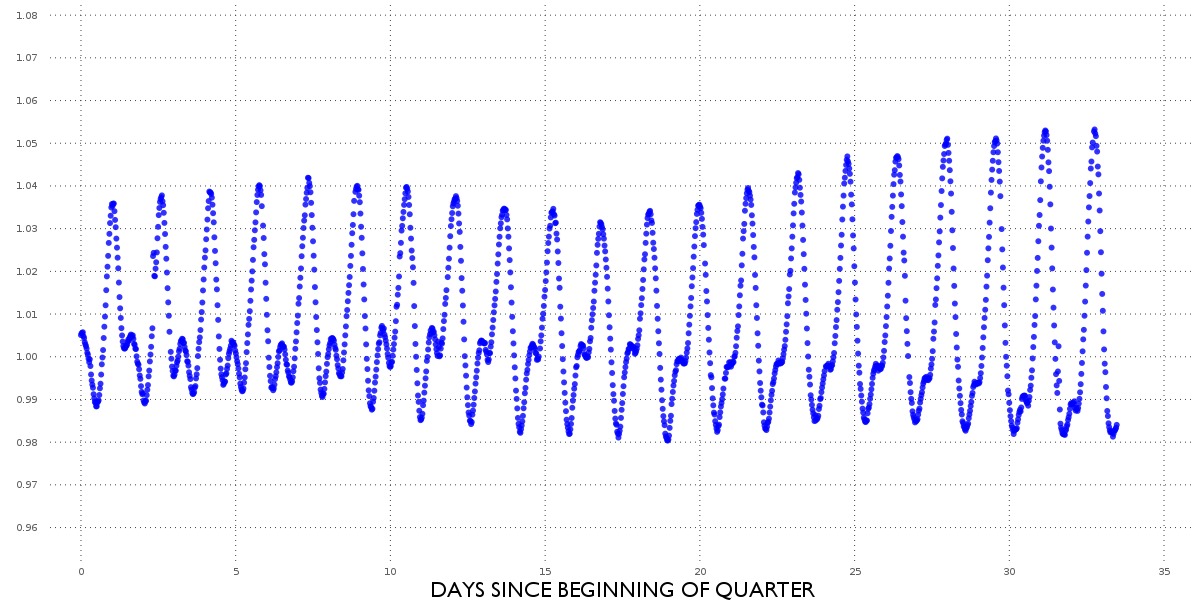
At planet hunters you scan star-intensity traces from the Kepler Space Telescope looking for the characteristic dips in a stars intensity caused by a planet transiting in front of of the star.
The Kepler folks have computer programs to do this, but people tend to be better at finding the patterns of transits than computers. So this is you chance to aid sicence, and mybe find another world out there. I'm enrolled, but so far I've only found variable stars (see image above). You will need a fair bit of patience as your sort through the traces.
But still, finding another world! Imagine that!
(Tip of the hat to the Bad Astronomer)
Labels: exoplanet, extrasolar planet, science matters
Sunday, November 14, 2010
Geo-xcentricities part 2; the view from Mars.
 Einstein rings, a spectacular prediction of relativity, taken from Hubble (Image credit Hubble/NASA)
You may remember a little while back I wrote about a conference of modern Geocentrism (Galileo was Wrong). Geocentrism is the belief that Earth is the centre of the Solar system, nay the entire Universe and everything revolves around it.
Todd Wood attended the conference, and you can read the about his growing sense of incredulity in his posts (part 1, part 2, part 3, part 4, part 5).
It turns out that these folks are relativity deniers.
 Image of the crescent Earth and Moon on October 3, 2007, taken by the HiRISE instrument of the NASA’s Mars Reconnaissance Orbiter.
Which is pretty strange, the usual tack is to argue for Geocentrism based of relativistic frame equivalence. Arguing against relativity is pretty hard, as it is one of the best confirmed theories of physics we have. From gravitational lensing (see images above) to frame dragging, relativity has passed increasingly stringent tests with flying colours.
These geocentricists apparently need relativity disconfirmed so the the Michelson-Morely experiment proves the Earth at rest.
Now there is a lot of problems with this (not the least because they need a non-moving ether to explain the M-M experiment, then a moving ether to explain Foucault's Pendulum) and other geocentrist positions. Some of the problems can be demonstrated with intensive mathematics, some with not so much maths (like the claim that GPS doesn't use relativistic corrections, which is untrue.)
 Earth as seen from Mars taken by the Spirit rovers' panoramic camera in 2004.
 However, in the spirit of my first post on this conference, where I tried to get people to do observations themselves that disproved first the Ptolemaic then the Tychonian systems, I want to get people to do something much simpler, related to observational astronomy.
Also in the spirit of Einstein, who tried to imagine what the word would look like if you were travelling on a photon, I want you to imagine your are standing on Mars.
 The evening sky on Mars on April 29, 2005 as simulated by Stellarium (the location isn't at the same latitude and longitude as opportunity, so the view is slightly different from the rover).
 What would you see from the surface of Mars that would be different in a Tychonian system (the system favoured by our modern geocentricists) versus a heliocentric system system?
As the Tychonican system is an inverted Copernican system, things like the phases of the Earth would be identical (see this JAVAscript model, advance the time to October 3, 2007 to match the image of crescent Earth and Moon above, and flip between the Tychonian and Heliocentric models to see what I mean).
 Earth imaged by the panoramic camera of Opportunity an hour after Sunset on April 29, 2005 (Image Credit NASA/JPL).
There is a big difference that would be immediately apparent. Whether in the Tychonian or Heliocentric systems, from the point of view from Mars, Earth would appear to be a morning or evening star that appeared to revolve around the Sun.
However, the geocentricists are using a geostationary model, where the 24 hour day is produced by the Sun rotating about the Earth. So in a period of 24 hours, an observer on Mars (armed with an occultation disk) would see Earth rise from the sun, then fall back, then reappear on the other side of the sun and repeat the process again.
During the period that the Mars rovers took images of the Earth, at maximum elongation Earth was 42-47 degrees from the Sun as seen from Mars. For the Earth to move from maximum elongation to inferior or superior conjunction (at least, as it would appear from Mars, because in the Tychonian system Earth can't have conjunctions) takes 6 hours (in a 24 hour day there will be four 6 hour segments as the Earth goes out, comes back, goes out and comes back again from the solar disk).
So the Earth will appear to move 42 degrees (taking the lowest figure) in 6 hours, or 7 degrees per hour against the background stars (approximately, it's slightly more complicated than this, but rough figures are all we need). That's 14 Lunar diameters per hour! Earth is fairly hooting along compared to the background stars. In one minute Earth would move 1/4 of a Lunar diameter which is quite noticeable.
Now look at the image above. It is a composite of 3 x 15 second images taken with the panoramic camera, you can see the image of Earth is slightly elongated. However, remember that Mars rotates, and any 15 second exposure will cause slight star trailing due to its rotation. The trail we see of Earth is nothing like what we would expect if it was moving to a 24 hour rhythm, as it hares along the sky (roughly 1/5th of a Lunar diameter). Still, for confirmation we have to check Earth's movement against that of the background stars.
Fortunately, in the original image there is a background star just above Earth (it's best seen in the TIF file). It has the same degree of elongation that the Earth does. This falsifies the Tychonian system, thus the solar system is heliocentric.
So "Eppur si muove" because it um, doesn't move (with respect to the background stars as seen from Mars).
Labels: Galileo, science, Science Blogging, science matters
Thursday, September 23, 2010
Me, Mercury and the European Planetary Science Congress
 This is an image of Mercury's tail obtained from combining a full day of data from a camera aboard the STEREO-A spacecraft. The reflected sunlight off the planet's surface results in a type of over-exposure that causes Mercury to appear much larger than its actual size. The tail-like structure extending anti-sunward from the planet is visible over several days and spans an angular size exceeding that of a full Moon in the night sky.(Credit: Image courtesy of Boston University’s Center for Space Physics)
Back in 2008 Comet Al and I were trying to confirm a comet position in images from STEREO A. I pointed out the nice bright comet moving across the STEREO image field and Comet Al said, "That's not a comet, that's Mercury!". We exchanged the internet equivalent of startled looks.
The feeling on the Stereohunter list was that it was an artefact, but I remembered an article on sodium emission from Mercury, and went to track down the group and ask them what they though our tail might be.
So began a saga that cumulated in the paper "Observations of Mercury’s Escaping Sodium Atmosphere by the STEREO Spacecraft" by Carl Schmidt, Jeffrey Baumgardner, Michael Mendillo, Christopher Davis and Ian Musgrave being read at the European Planetary Science Congress today. This paper was the subject of a press release, and has spread wide into the internet (Science Daily, Space.com, and SpaceInfo are just a few examples).
I must say I'm mildly chuffed to be mentioned in press releases, I'm more chuffed that I was included in the paper. I've got 40 peer-reviewed papers of my own in the field of biomedical science (ask me about Maitotoxin!), some of which I am very proud of, so I'm no stranger to being published.
But this is the first time my amateur efforts have made a contribution to advancing astronomical research, my beloved hobby. Of course, the others did all the really hard work of ground observations and calibrating the Stereo images, so my contribution needs to be put into perspective, but still.... ther's that warm inner glow that in a small way I made a difference.
My blog posts on the tails (with nice images and animations and a bit more background), can be found here.
Labels: Mercury, Science Blogging, science matters, Stereo Satellite
Thursday, September 16, 2010
Geo-xcentricities; you too can be Galileo with just a pair of binoculars (and gaffer tape)
 There’s been a lot of blank disbelief on the blogosphere of late, due to the announcement of a conference on Geocentrism (Galileo was Wrong). Geocentrism is the belief that Earth is the centre of the Universe and everything revolves around it. You would think that, 400+ years after Galileo, people would have cottoned on the the idea that the Earth orbits the sun, the sun orbits the galactic centre and the Milky Way galaxy does … well …complicated stuff with other galaxies, but basically we worked out long ago that the Earth is not the centre of the solar system, let alone the Universe.
Other people, especially Ethan at Starts with a Bang and the Bad Astronomer, have dealt with the technical details (and I have an earlier discussion here and here). My goal is to get you, the ordinary person on the Clapham omnibus (or in my case, the Outer Harbour train, where I am writing this), to try and demonstrate the Earth is heliocentric for yourself and to do so with common household materials. After all, science is at heart a practical endeavour, and non-professionals should be able to find the evidence for themselves.
So for this journey into the starry spheres, we will need a pair of binoculars, a camera tripod, some cardboard and alfoil, and lots of gaffer tape. We also have some luck, as the sky is currently cooperating in the Geocentrism debunking stakes.
First we have to ask ourselves, which “geocentric” theory are we disproving. The classic geocentric theory is that of Ptolemy, in which the planets, Moon and the Sun all orbit the Earth. The most famous variant of this is Tycho Brahe’s helio-geocentric system, where the Sun and Moon orbits the earth and everything else orbits the Sun. There are important differences in the systems which we will explore later.
 First off, let’s look at the phases of Venus. For this you will need binoculars and the camera tripod. You will also need a way of attaching the binoculars to the tripod. These days I use a special attachment (but this requires modern binoculars that have a screw thread on the body), but in the past I have used gaffer tape to good effect. Why attach the binoculars to the tripod? Because otherwise there will be too much shaking for you to see the image properly.
The image to the left is the setup I use for observing Sunspots (we come to that later), showing the binoculars gaffer taped to the tripod.
At the moment, Venus is prominent above the western horizon. Point your binocular lash-up at Venus, in my 10x50 binoculars Venus is very small but is a disk which has a distinct “half –Moon” shape. If your binoculars don’t have decent anti-glare coatings, you may have to observe in the early twilight in order to see Venus’s shape without internal reflections from the binocular lenses getting in the way.
 As you watch over the coming weeks, you will see Venus expand in size and become more crescent- shaped. Sketch the shape so you can follow its progress. This is so fast you should see a visible change in just one week. By mid-October Venus will be a thin crescent almost 2/3rds bigger than when you started observing. By late October Venus has nearly doubled in size and is a thin, glistening wire. Then Venus vanishes into the Suns glare and reappears in the morning. Over the next few months you can watch Venus shrink and become a tiny disk.
And now you have demolished the Ptolemaic geocentric system. Venus does have phases in this system, but quite unlike what you see here (I leave it too the reader to work out what a Ptolemaic systems Venus phases would look like, you can see a model of Ptolemaic Mercury here, which will give you a good idea). And you have only taken almost 6 months to do it (what, you thought it would be easy). As a reward, here's an animation of the Phases of Venus.


Left image Jupiter above the eastern horizon, Right Image, Venus above the western horizon, both at the same time in the evening (around 8pm ish in mid September 2010).
 Jupiter and three of its moons imaged with a mobile phone.
 But Ah! The Medicean Stars, now known as the Galilean Moons, they will shuttle backwards and forwards during the nights as you watch. The realisation that these “stars” were Moons of Jupiter were not a blow to any form of geocentrism per se, although they were the second of a series of powerful blows against the Aristotelian physics that underpinned Ptolemy’s system, which aided its demise. Determining that these specks actually orbited Jupiter, and were not just accidentally there, took a lot of effort.
Try keeping track of these sparks, and without reference to an almanac, try and determine their orbits (heck, try and keep track of which near identical points of light are which). It may take a while, you will need to keep careful sketches, and track the Moons and Jupiter with respect to the stars as Jupiter moves through the heavens, but a) You are sketching Venus anyway and b) it will be well worth it (hey, you proving things for yourself!).
 The next bit is more demanding. The Phases of Venus demolished the Ptolemaic Geocentric system, but the Tychonian- Geo-heliocentric system had Venus phases just like a pure heliocentric system (which is not surprising, as Tycho’s system is an inverted Copernican system). To eliminate the Tychonian system, we need to observe sunspots.
Luckily the Sun is coming out of its quiet phase, so you will have some to record. For this you will need to set up a safe binocular projection system (as shown above), where the image of the Sun is projected onto a surface so you can record the Sunspots. NEVER LOOK DIRECTLY AT THE SUN WITH BINOCULARS AS SEVERE EYE DAMAGE WILL RESULT.
Anyway, while you are recording the Phases of Venus and the orbits of Jupiters’ Moons, record the passage of Sunspots over the Suns face, over the 5-6 months you are recording the susposts, you will notice the path taken by the sunspots moves up and down. This is due to the Earths orbit not being exactly in the plane of the Suns rotation. In a geocentric system, with the Sun orbiting the earth once a day, this variation would show up on a daily basis, but what you observe can only be seen in a heliocentric system.
So, congratulations, you have just demonstrated that geocentric models don’t describe the solar system we see using very simple tools. It took a while, and was hard work, but you have demonstrated it yourself, and all the blovation of geocentricists won’t take that away (yes, Stellar parallax gets all the glory, but annual Sunspot variation was a powerful blow to Tychonian geocentric models). If you want to, you can take this further by making your own Foucault's Pendulum.
Labels: Copernicus, Galileo, Science Blogging, science matters
Thursday, September 02, 2010
See Baroness Greenfield at the Florey Lecture (Friday September 3)
This year the Scientist is Baroness Susan Greenfield, a renowned scientist and top notch communicator, I can promise that her talk will be fascinating. This year it's on how technology may be rewiring our brains.
The lecture is 5:30-7:30 pm Bonython Hall,University of AdelaideNorth Terrace, Adelaide
South Australia (L11 on this printable Map). Entrance is by gold coin donation, and you can register for entry here.
Labels: science, science communicators, science matters
Saturday, August 14, 2010
Ask The Naked Scientist! - National Science Week 16 August
This is an audience-interactive science question and answer show. Taking questions from the public on any science-related topic, Dr Chris Smith of Cambridge University responds in innovative, informative – and sometimes hilarious – ways.
A medical doctor and clinical lecturer in virology at Cambridge University, Chris Smith founded The Naked Scientists, an award-winning radio program on the BBC (and one of the world’s most down-loaded podcasts) that aims to strip science down to its bare essentials. Chris is one of the international guests touring the country in National Science Week.
Held in conjunction with Australian Science Communicators SA.
Labels: science, science communicators, science matters, science week
Monday, August 09, 2010
A Paper on Fructose and Cancer, it doesn't mean what you think it means
First, a little background. Sugar to most people is sucrose, or cane sugar. But actually "sugar" covers a large number of similar chemical compounds. Ones commonly encountered apart from sucrose include glucose and fructose (also known as fruit sugar as it is found in high concentrations in fruit, it is also found in honey). Indeed sucrose is glucose and fructose linked by a chemical bond. When you eat sucrose, enzymes in your gastrointestinal tract break it down into glucose and fructose, which are then absorbed (your body can absorb intact sucrose).
There is some concern that consumption of high levels of fructose may have negative health consequences above that of simply consuming more calories. People in the United States are particularly concerned as many of their soft drinks and foods are sweetened with High Fructose Corn Syrup (HFCS), as opposed to sucrose in most of the rest of the world (like Australia, where sugar cane fields are part of the national psyche). It should be pointed out that the proportion of fructose in honey is about the same as that in HFCS and some fruits (eg apples and pears) have significantly more. However, the large amount of extra sugar added to processed foods and soft drinks means we are be exposed to much higher concentrations of fructose (and glucose) than we would eating a diet of fresh fruit and vegetables.
In the study Orac talks about (Cancer Res; 70(15) August 1, 2010) the researchers were looking at whether fructose could support cancer cell growth.
Now in the paper there are two sets of results, one set on cancer cell proliferation, and one set on metabolism (seeing whether metabolic pathways involved in cancer growth were selectively activated by fructose). The authors show reasonably convincingly that fructose is preferentially metabolised to nucleic acids in pancreatic cancer cells, pancreatic cell models and hepatic cancer cells (with some caveats I will cover later[1]). However, what they say about the rate of cancer proliferation is almost, but not completely, dead wrong.
Press release:
"These findings show that cancer cells can readily metabolize fructose to increase proliferation," Dr. Anthony Heaney of UCLA's Jonsson Cancer Center and colleagues wrote.Abstract:
These findings show that cancer cellsIf you have access to the paper, look at Figure 1. If not, I've abstracted some of the key results in Figure 1 below, and added a line showing the control level of proliferation for clarity.
can readily metabolize fructose to increase proliferation.


Figure 1, panels A, B, C, D and F from
Cancer Res; 70(15) August 1, 2010
The first important thing to note is that when they did the proliferation assays, they compared the results to cells cultured in 10% Foetal Bovine Serum alone - which contained *0.4 mmol/L glucose*[2] (FBS in the figure, open bar, the black bar is complete medium with 10% FCS and 18mmol/L gulcose) . This means at the lowest concentrations of additional sugar, they are comparing 400µM glucose + 5.5µM fructose vs 405.5µM glucose. Which kind of messes up their interpretation.
Looking at the graph (note the red line showing basal growth, and the error bars) Generally, glucose and fructose are the same...they don't do anything above and beyond the Foetal Bovine Serum control. Only in MiaPaCa-2's, HPAF and, possibly, HPDR6 do you see proliferation which MAY be statistically significant from the baseline proliferation at the highest concentrations used (400µM glucose + 5500µM fructose vs 5900µM glucose, they look higher, but the error bars are significantly bigger too). An important caveat is that for the MiaPaCa-2 cells, when proliferation was remeasured using a different assay (BrDU incorporation), fructose basically did nothing. So any apparent increase in proliferation may just be assay variation.
It's a bit hard to clearly work out what data points are statistically significant, if any, as their statistics are borked, badly borked. The legend to Figure 1 says "P = not significant, fructose versus glucose or normal medium (NM)." Which if correct, means that the proliferation rates at 5.5µM added sugar (glucose of fructose) is no different from the 18 mM glucose normal medium values, which makes their data uninterpretable (see Figure 1B and C particularly). No other stats tests on the proliferation data are presented anywhere.
So we should reformulate the statement of the abstract as "In some cancer cell line, 5 mM fructose and 5mM glucose might cause the same amount of proliferation above that found with 0.4 mmol/L glucose, if we could statistically distinguish them from the control" (actually, the best interpretation is that fructose and glucose did nothing to proliferation, if their presentation of the statistics is correct).
Now, the kicker, what is the plasma concentration of fructose in most people? It's 8 µM, even in diabetics it's only 12 µM, while plasma glucose in normal people is around 5000µM (doi: 10.2337/diacare.25.2.353 Diabetes Care February 2002 vol. 25 no. 2 353-357, other papers have found diabetics in ketoacidosis to have levels of around 88µM, which dropped to 11µM when their diabetes was controlled [Clin Biochem. 2010 Jan;43(1-2):198-207. Epub 2009 Sep 8.]).
This is probably due to fructose being mainly taken up and metabolised in the liver, but the bottom line is that pancreatic tissue will never see any more than micromolar concentrations of fructose. Even if plasma levels of fructose from dietary sources reached 55 µM (which would be insanely unlikely), it would, on the basis of the results presented in the article (Cancer Res; 70(15) August 1, 2010) do absolutely nothing to cell proliferation (see Fig 1 again). The authors report that pancreatic cancer patients have 2.5 times the plasma levels of fructose of non-cancer patients, but that is still is 100 times less than the 5mM needed to see any difference in proliferation rate (assuming that the results are statistically significant, which they may not be).
There is one tissue that could be exposed to high levels of fructose, and that is the liver, which receives blood flow direct from the gut. However, even high levels of fructose ingestion (4g/kg; about 10 times what you would get from a can of soft drink) produce concentrations of fructose of no more than 1-2 mM in the portal blood (J Am Coll Nutr. 1986;5(5):443-50., Nutr Metab 1971;13:331-338 (DOI: 10.1159/000175352)), still well below the levels where we see some increase in proliferation of pancreatic cancer cells (well, assuming the results were statistically significant, which they may not be; the hepatic cancer cells were not examined for proliferation effects). Even then, the cells exposure at these high levels is brief, at most 2 hours, whereas in the experiments the cells were exposed for 48 hours. So even if you do drink 10 cans of soft drink at one sitting, your liver cells will be unlikely to be exposed to the proliferative levels of fructose.
Put simply, their results do not support their conclusions on prliferation.
1. While the data on metabolism is clear, again these results are in cells exposed to unphysiological concentrations of fructose for 72 hours. This is completely different from what the cells in your body would be exposed to.
2. It is very hard to get rid of glucose from FCS, and if you did the cells wouldn't grow (and actually die at 0 glucose). And you can't get rid of the FCS, for it contains growth factors the cells need to grow as well. Well, there are serum-free media with added growth factors, but they have their own problems. So there are limitations in how they can study this question. Most of my work is done in cancer cell lines (PC-12 and SHY-5Y amongst others, so I am acutely aware of both the strengths and limitations of tissue culture.
Labels: science, science matters
Thursday, August 05, 2010
National Science Week 14-22 August
Labels: science communicators, science matters, science week
Thursday, July 01, 2010
Anti-Science Bullies at it Again
Labels: miscelaneous, scepticism, Science Blogging, science matters
Friday, April 16, 2010
Woo Hoo!! Simon Singh Wins!
“It still staggers me that the British Chiropractic Association and half the chiropractors in the UK were making unsubstantiated claims. It still baffles me that the BCA then dared to sue me for libel and put me through two years of hell before I was vindicated. And it still makes me angry that our libel laws not only tolerate but also encourage such ludicrous libel suits. English libel law is so intimidating, so expensive, so hostile to serious journalists that it has a chilling effect on all areas of debate, silencing scientists, journalists, bloggers, human rights activists and everyone else who dares to tackle serious matters of public interest. In the area of medicine alone, fear of libel means that good research is not always published because those with vested interests might sue, and bad research that should be withdrawn is not pulled because the authors might sue the journal, and in both cases it is the public that loses out because the truth is never exposed. My victory does not mean that our libel laws are okay, because I won despite the libel laws - we still have the most notoriously anti-free speech libel laws in the free world.”
Read more here, and see the commentaries by Bad Science, Respectful Insolence and Pharyngula.
If you want to help in the campaign against the flagrant misuse of libel laws to silence critics go to Keep Libel Laws Out of Science.

Labels: Science Blogging, science matters



 Click to read about or order
 Click to read about or order
 Click to read about or order
 Click to read about or order


