Friday, December 25, 2015
The Christmas Eve Asteroid 2003 SD220 is Not Nibiru (and will not cause Earthqaukes)
 |  |
| Location of asteroid 2003 SD220 at 5:00 am ACDST on Christmas morning as seen from Adelaide Australia, just after it's closest approach. Click to embiggen. | The Earth and Moon as seen from 2003 SD220 as simulated in stellarium. |
Asteroid 2003 SD220, also known as the Christmas eve asteroid, will come close to Earth on 13:08 UT 24 December (that is 00:08 am AEDST in Australia) at distance of 0.073 AU. Visible only in high powered telescopes at closest approach, it has gained unwarranted attention from breathless articles in the tabloid press claiming that it could cause earthquakes (it won't, just like the other asteroids didn't). Various fringe sites have suggested it is, or is linked to, an imaginary planet called Nibiru (it''s not).
To put this in perspective, at its closest 2003 SD220 is around 28.4 Earth-Moon distances away this time. Yes, that is over 28 times the distance from the Earth to Moon (recall that the Apollo missions took 3 days to get to the Moon). As you can see from the image above, 2003 SD220 will only see the Earth and Moon as faint dots.
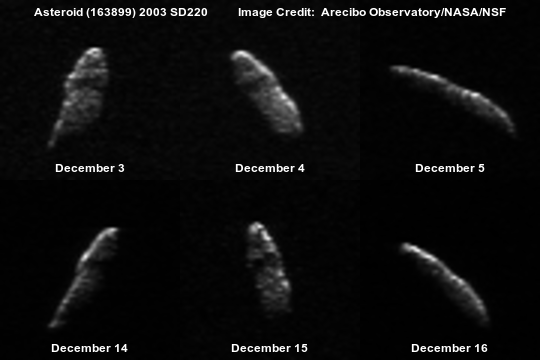
As well, other large asteroids are being ignored favour of 2003 SD220. What about 2008 CM, a 1.5 km wide asteroid that will pass us by at 22 Earth-Moon distances on December 29. No one is claiming IT will cause earthquakes of is Nibiru.
So bottom line, 2003 SD220 will pass us by harmlessly, like all the other large asteroids we have been following.
For those of uswho just want to play around with the asteroid orbit, or who want to argue with people who claim this asteroid will hit us (it won't) I've made Celestia files for 2003 SD220. As usual, copy the data here to a plain text file (2003SD220.ssc) and copy the file to the Celestia extras folder.
========= >8 cut =============2003SD220.ssc=======>8; cut =====================
"2003 SD220" "Sol"

#Data from MPC http://cfa-www.harvard.edu/iau/MPEph/MPEph.html
#Epoch 2016 Jan. 13.0 TT = JDT 2457400.5  (M-h)          MPC
#M 257.16312              (2000.0)            P               Q
#n   1.30903706     Peri.  326.44287     -0.48635381     +0.86135024             T = 2457479.05918 JDT
#a   0.8276272      Node   274.06174     -0.76583262     -0.50108247             q =     0.6533014
#e   0.2106332      Incl.    8.46007     -0.42066657     -0.08361889    Earth MOID = 0.01840 AU
#P   0.75           H   17.0           G   0.15           U   2
#From 217 observations at 8 oppositions, 2000-2015, mean residual 0".46.

{
    Class "asteroid"
    Mesh   "ky26.cmod"
    Texture "asteroid.jpg"
    Radius  1.0 # maximum semi-axis
    MeshCenter [ -0.000718 -0.000099 0.000556 ]

    EllipticalOrbit
    {
    Epoch                         2457400.5       # Epoch 2016 Jan. 13.0 TT = JDT 2457400.5
    Period                             0.893737187           # P
    SemiMajorAxis          0.8276272      # a
    Eccentricity                0.2106332      # e
    Inclination                  8.46007          # Incl.
    AscendingNode          274.06174       # Node
    ArgOfPericenter       326.44287       # Peri
    PericenterDistance      0.6533014     # q
    MeanAnomaly          257.16312       # M
    }

    RotationPeriod 11 #Measured

    Albedo 0.15        #Based on typical Stony asteroids, rotation periods vary from one hour to one day

}
========= >8 cut =============2003SD220.ssc======= >8 cut===================== Labels: asteroids, celestia, earthquakes, Pseudoscience, public outreach

Thursday, September 19, 2013
Earthquakes and Planetary Alignments, Yet Again.
 |  |
| Saturn-Earth "Alignment" on September the 18th, Venus is off the alignment axis. As this "alignment" doesn't actually pass through the Earth-Moon-Sun axis it actually decreases the tidal force, reducing the likelihood of Earthquakes. Click to embiggen. | Venus near Saturn. Apparently this is a close alignment. |
As I write it is the waning hours of September 19. Why does this matter? Because the Barcarroler had predicted a 6.6 magnitude quake on the 18th.
The Barcarroler predicts earthquakes based on a combination of planetary alignments and astrology. I've written about alignments and earthquakes before (See here, here and here). Basically, while it is plausible that crustal tides might set off earthquakes lunar alignments have no significant effect. The tidal effects of distant planets, millions to billions of times weaker than the Moon, can have no effect.
None the less, this does not deter the Barcarroler. Over the past 12 months (2012, 2013 predictions) he has made 15 predictions for earthquakes of magnitude 7 or over, how has that panned out?
| Predicted date | Predicted Magnitude | Quake Occurred |
| Aug 14, 2012 | 7.2 | No |
| Oct 26, 2012 | 7.2 | No |
| Nov 14, 2012 | 7.2 | No |
| Dec 17-18, 2012 | 7.5 | No |
| Dec 21-22, 2012 | 8.0 | No |
| Jan 18-19 | 7.0 | No |
| Jan 28-29 | 7.5 | No |
| Mar 27-28 | 8.0 | No |
| April 5-6 | 7.5 Black Sea region | 7.0 Indonesia, April 6 |
| April 28-29 | 7.8 | No |
| May 10-11 | 7.5 | No |
| May 25-26 | 7.7 Peru, NI New Zealand | Earthquakes on 24th, Tonga/Russia |
| June 19-20 | 8.3 | No |
| July 20-30 | 7.5-7.8 | No |
| Aug 25-26 | 7.8 | No |
| Sept 18 | 6.6 | No |
Actual earthquake dates and magnitudes from Geosciences Australia. Of the 15 Earthquakes predicted in the 12 months since August 2012, one fell within the prediction interval (the magnitude was out as was the location, but we will accept this one) and one fell just outside the predicted time (and in completely different spots).
If we include the near miss this represents an 87% failure rate. If we look at the 18 earthquakes of M7+ that did occur, this represents an 89% failure rate. This is just slightly worse than what could have been achieved by guessing randomly (you would have expected to get 3 earthquakes right just from random guessing allowing +/- one day either side of the guessed range). So, we can conclude that the Barcarroler's prediction success is worse than just guessing.
Oh, and has a magnitude 6+ quake occurred? No, another Barcarroler's prediction failed. As there is a magnitude 6-6.9 quake every 2.7 days on average, missing this is pretty sad for his method, as if a 87% failure rate wasn't bad enough.
A good video on why the Barcarroler's alignments are not valid is here. My extensive list of postings on astronomical phenomena and earthquakes is here.
Labels: Conjunction, earthquakes, Pseudoscience
Tuesday, June 18, 2013
The "Super Moon" of June 23, 2013
The Full Moon is Sunday June 23 in Australia. At this time the Moon will be at perigee, when it is closest to the Earth. This is the closest perigee
for 2013 at 356989 km. A full Moon at perigee has been called a
"Super Moon", this is not an astronomical term, but an astrological one (see also here).
While the Moon is close, it will have no real effect (or be
distinguishable without a telescope and a good memory).
 The Moon at Perigee and apogee as seen through a
telescope. With the unaided eye, the Moon only appears half a
finger-width wide, so the difference is much harder to see.
The Moon at Perigee and apogee as seen through a
telescope. With the unaided eye, the Moon only appears half a
finger-width wide, so the difference is much harder to see.
This months Full Moon could appear up to 14% bigger and 30% brighter in the sky than average. But will you actually notice if it is different to the last Full Moon?
The limit of distances that someone with good vision can distinguish between is 1 minute of arc (about the width of a human hair). So, for the vast majority of people any difference smaller than 1 minute of arc cannot be seen.
The Moon this Full Moon will be 33'57" wide (just a touch over half a degree, around half a finger-width wide), last months Full Moon (358374 km) was 33'47" wide. Without a telescope and careful astrophotography you will not notice the difference. For a list of full/new Moons and the dates of apogee/perigee see here.
If you can wait until January the 16th 2014, when the Full Moon is at Apogee, then it’s diameter will be 29'32" , and you could notice a difference if you have a good memory, but it won’t be spectacular. The illustration above is from November 28, 2012, when the Moon was at apogee and 29'33" wide when it was 406364 km from Earth.
However, while the "SuperMoon" will not be spectacular, it is still pretty and will be a good photo opportunity. If you have a decent zoom on your camera, after taking a photo of the Moon on June 23 and then again on January 16 2014 you will see a decent difference (you need to use exactly the same zoom enlargement, see Inconstant Moon for instructions).
And, no, we will not get earthquakes from the "Super Moon".
This months Full Moon could appear up to 14% bigger and 30% brighter in the sky than average. But will you actually notice if it is different to the last Full Moon?
The limit of distances that someone with good vision can distinguish between is 1 minute of arc (about the width of a human hair). So, for the vast majority of people any difference smaller than 1 minute of arc cannot be seen.
The Moon this Full Moon will be 33'57" wide (just a touch over half a degree, around half a finger-width wide), last months Full Moon (358374 km) was 33'47" wide. Without a telescope and careful astrophotography you will not notice the difference. For a list of full/new Moons and the dates of apogee/perigee see here.
If you can wait until January the 16th 2014, when the Full Moon is at Apogee, then it’s diameter will be 29'32" , and you could notice a difference if you have a good memory, but it won’t be spectacular. The illustration above is from November 28, 2012, when the Moon was at apogee and 29'33" wide when it was 406364 km from Earth.
However, while the "SuperMoon" will not be spectacular, it is still pretty and will be a good photo opportunity. If you have a decent zoom on your camera, after taking a photo of the Moon on June 23 and then again on January 16 2014 you will see a decent difference (you need to use exactly the same zoom enlargement, see Inconstant Moon for instructions).
And, no, we will not get earthquakes from the "Super Moon".
Labels: earthquakes, Moon, unaided eye
Friday, November 23, 2012
Will the Alignments of November 28 Cause Earthquakes? (No, but you knew that)

On November 28 there will be a penumbral eclipse of the Moon. At this time Mars will be "close" to Pluto (over 4 degrees, the width of 4 fingers when you arm is outstretched, or 10 lunar diameters away from each other) and Venus and Saturn will be a much more impressive half a degree away (although that is in daylight on the 27th).
The Saturn-Venus alignments will be attractive (but difficult to see in the twilight), while Mars-Pluto will be invisible to all but serious telescopes (although Mars will be very close to the attractive globular cluster M22, a worthwhile binocular or small telescope sight).
 Inner Solar system on November 28 (Pluto is too far away to fit in, click to embiggen).
 And wouldn't you know, someone is claiming that these alignments will cause a magnitude 7.8 or so earthquake.
Yeah, alignments, I'm not sure why people seem to think planetary alignments are causing earthquakes. Maybe because planets are big and there's this gravity thing and uuumm, they're ALIGNMENTS man!
And there is the tide.
Now, the Moon raises not only tides in the ocean, but also tides in the crust of the Earth. Small to be sure, around 30 cm. However, you can imagine that the flexing of the Earth as the lithosphere tide passes through the Earth might set off an earthquake that was already “ready to blow” as it were. Indeed, there is a weak correlation between the lithospheric tides associated with Full/New Moon and a subclass of shallow earthquakes (increasing the probability of this subclass of earthquakes by less than 1%).
So if the Moon raises a tide, why can't the planets? And why can not the sum of the planets tidal force be big enough during an alignment to have an effect.
Now, I'm going to repeat a famous Douglas Adams line.
"Space is big. You just won't believe how vastly, hugely, mind-bogglingly big it is. I mean, you may think it's a long way down the road to the chemist's, but that's just peanuts to space."Sure planets are big, but space is bigger. Gravity holds it all together, but gravitational tidal force falls off rapidly with distance (as the cube of the distance, this is what we call "a lot" in technical terms) .

Now, ever since this bloke called Newton got gravities measure we can actually do the calculations to work out what the tidal force between the various planets and Earth is.
There are a number of versions of the tidal force equations, and I've used a couple of them, they give much the same answers.
However, the respective Mars-Pluto and Saturn-Venus alignments are around 30 degrees from the Moon-Sun axis (see the figure above).
If you remember your tides, tidal heights are lower when the Moon and Sun are not directly aligned, so if anything, the tidal hight of ocean and earth tides will be LOWER and the risk of earthquakes less due to the Mars-Pluto, Saturn-Venus alignments.
So when I calculated the tidal forces I used a version of the equations that take the angles into account.
Tidal Force = 3/2 x GmM x (r/R3) x sin 2Theta, where G is the gravitational constant, m is the mass of earth, M is the mass of the tidally interacting body, r is the radius of Earth, R is the separation between earth and the the object and Theta is than angle between the object and the Earth-Sun axis. The spreadsheet is here so you can do your own calculations.
In the figure above, I've expressed the figures as µg and rounded up (1.72 x 10⁻⁷ g is 0.2 µg on the figure).
An analytical solution to the tidal forces shows that the tidal force due to the Earth-Moon-Sun line-up on November 28 is 1.72230242 x 10⁻⁷ g (where g is the force of gravity at Earths' Surface, yes the tidal force is rather weak, that's why tides aren't huge), adding in the tidal forces of Mars-Pluto and Venus Saturn line-ups give us 1.72230248 x 10⁻⁷ g.
That is the Mars-Pluto, Saturn-Venus line-ups add 0.00000006 x 10⁻⁷ g force to the G force produced by the Sun and Moon.
This is 106 times smaller than the variation in gravitational force due to variations in the Moons orbit (which, as we know, has virtually no effect on earthquakes). You can check this yourself via the spreadsheet.
So tremble in fear, not.
I've dealt with earthquakes and planetary and lunar alignments extensively, especially frequency and probability issues, see the lists of posts here.
David Greg has a series of videos on the various problems with prediction earthquakes from alignments (and why these predictions fail), see here and especially here.
Labels: earthquakes, Mars, Moon, Pluto, Pseudoscience, Saturn, Sun, tide, Venus
Thursday, August 16, 2012
Earthquakes and Alignments Again
On August 14 a magnitude 7.7 earthquake occurred of
the coast of Japan. A prediction had been posted that the planetary alignment
of August 14 would produce significant earthquakes. Did the Japan earthquake fulfil the prediction?
 This, allegedly, is an earthquake producing alignment, despite everything being all over the place. The Venus Moon alignment is at a significant angle to the Earth-Sun axis. Jupiter is way off (click to embiggen).
 June 4, 2 days before the transit of Venus. Full Moon lined up with Venus 3 degrees from the Sun, Mercury and Jupiter within 15 degrees of the Sun. Altogether a much more favourable line-up for earthquakes - yet nothing happened.
Next you have to consider all the alignments that didn't have a 7+ earthquake associated with them. 51 of 53 alignments had no 7+ earthquake associated with them, that's an impressive miss rate.
Particularly if we consider the alignments of 4 June, 18 June and 15 July. On 4 June, two days before the transit of Venus, The Sun and full Moon were aligned and Venus was within 3 degrees of the Sun. Jupiter and Mercury were within 15 degrees of the Sun.

The following table shows the tidal forces of the Sun, the Moon, and the
planets compared to that of the Sun (set at 1).
Alignments are lovely to watch. But that is the sole extent of their influence of Earth.
Short answer: no.
 This, allegedly, is an earthquake producing alignment, despite everything being all over the place. The Venus Moon alignment is at a significant angle to the Earth-Sun axis. Jupiter is way off (click to embiggen).
To explain why, we need to briefly consider
statistics. In any given year there are, on average 26338 earthquakes, and 16
of these are magnitude 7 and above. In general, earthquakes occur at random
[1], so what is the probability that a 7+ earthquake would occur on the date of
the alignment by chance alone?
The probability that a 7+ earthquake will occur on any specified day in a year is 1/24. This is hardly wildly improbable, and it is plausible this alignment and the quake are coincident by chance alone.
The probability that a 7+ earthquake will occur on any specified day in a year is 1/24. This is hardly wildly improbable, and it is plausible this alignment and the quake are coincident by chance alone.
But in fact the probability the August 14 event is by
chance alone is much more likely, because you need to consider all
alignments in a given 365 day span.
If we take "alignment" to mean when a
minimum of two planetary bodies are within 5 degrees of each other, or 5 degrees
from directly opposite each other (like full Moons/new Moons and the Sun), then
in the 365 day period since 14 August 2011, there were 53 alignments
of the bright planets Venus, Mars, Jupiter, Saturn and the Moon [2]. Thus, by
chance alone we should see two planetary alignments occurring on the
same day as a 7+ magnitude earthquake in this time period.
The August 14 quake scrapes in as the Venus-Moon
alignment was on the 13th, and the Mars-Saturn alignment was on the 15th. So
the likelihood that we have seen this result by chance alone is pretty much a
certainty.
 June 4, 2 days before the transit of Venus. Full Moon lined up with Venus 3 degrees from the Sun, Mercury and Jupiter within 15 degrees of the Sun. Altogether a much more favourable line-up for earthquakes - yet nothing happened.
 Next you have to consider all the alignments that didn't have a 7+ earthquake associated with them. 51 of 53 alignments had no 7+ earthquake associated with them, that's an impressive miss rate.
Particularly if we consider the alignments of 4 June, 18 June and 15 July. On 4 June, two days before the transit of Venus, The Sun and full Moon were aligned and Venus was within 3 degrees of the Sun. Jupiter and Mercury were within 15 degrees of the Sun.
If we were going to see 7+
earthquakes this alignment should do it. But it didn't. The alignments of 18
June and 15 July were very similar to that of 13 August, but were devoid of 7+
quakes (indeed, June and July were the quietest months for earthquakes since 14
August 2011). The results are entirely consistent with chance.

Now let's consider plausibility. It is plausible that
tidal forces could increase earthquakes, after all, the tidal force of the Moon
causes the crust of the earth to flex by as much as 30 cm, it's possible this flexing
could set off a quake that is close happening spontaneously.
However, earthquakes in general are not more common at the times of full or new Moon, when the tidal forces of the Sun and Moon are aligned and tides are at their highest.
However, earthquakes in general are not more common at the times of full or new Moon, when the tidal forces of the Sun and Moon are aligned and tides are at their highest.
Maybe the addition of extra planetary tidal forces
could do the trick?
No
Tidal force drops off as the cube of the distance, the
tidal force of Jupiter is 0.000033 that of the Moon. Also, for the effects
to truly add up, the Sun, Moon and planets have to be precisely aligned.
The alignments favoured by the various websites around the 'net have alignments that are completely ineffective, being more than 25 degrees away from the Solar new/full Moon axis. Remember that the highest tides (of both water and the Earth's crust) occur at Full and New Moon, when the Sun and Moon are aligned, the lowest tides are at last quarter Moon, when the Moon is at 90 degrees to the Sun-Earth axis.
The alignments favoured by the various websites around the 'net have alignments that are completely ineffective, being more than 25 degrees away from the Solar new/full Moon axis. Remember that the highest tides (of both water and the Earth's crust) occur at Full and New Moon, when the Sun and Moon are aligned, the lowest tides are at last quarter Moon, when the Moon is at 90 degrees to the Sun-Earth axis.
| Sun | 1 |
| Moon | 2.14 |
| Mercury | 0.000,000,15 |
| Venus | 0.000,0017 |
| Mars | 0.000,000,066 |
| Jupiter | 0.000,066 |
| Saturn | 0.000,000,33 |
| Uranus | 0.000,000,0062 |
| Neptune | 0.000,000,0019 |
| Pluto | 0.000,000,000,0061 |
Indeed, the Venus-Moon alignment of August 14 is opposed by the
Mars-Saturn alignment. So we would expect a lower chance of a planet-induced
earthquake (if not for the fact the tidal forces is so insanely tiny).
What about the idea that the planetary alignments are causing
resonances, amplifying the lunar tidal effects? Mensur Omerbashich uses the metaphor of soldiers marching in lock-step, where the repeated simultaneous foot falls of
the soldiers set up a bridge destroying resonance. However, in this case we
have one soldier (the Moon), whose footfalls occur with a 14 day rthym, next to
him a grass hopper (Jupiter) who jumps before the soldiers boot strikes the
bridge, and an ant (Venus) who also jumps before the soldiers boot falls, but
at a different time from the grasshopper. As well, the timing of the jumps of
the grasshopper and ant changes from footfall to footfall, so there is no
regular pattern to them.
Nope, not resonance.[3]
The August 14 quake is exactly what we would expect from
a earthquake and aligment occuring together by chance. This is re-enforced by
the large number of alignments which fail to produce alignments, and a lack of
a plausible mechanism for alignments to cause earthquakes.
Alignments are lovely to watch. But that is the sole extent of their influence of Earth.
[1] There are occasional earthquake clusters in an
active zone, and aftershocks in a major earthquake, but for 7+ magnitude quakes
they are close enough to being randomly distributed for our purposes.
[2] This is much more restrictive than the alignment earthquake
predictors, who add in Mercury, Uranus and Neptune to the mix, regardless of
their miniscule tidal effects, and separations of up to 15 degrees. Also, they
tend to include the days either side of the alignment which increases the
probability you will see alignment just by chance.
[3] I am well aware of the limitations of the
metaphor, but the point is that you need some consistent peiodicity, and decent
mass, for resonance systems to work. Planetary alignments just don't fit the
bill.
[4] More information on earthquakes and astronomical phenomena here.
[4] More information on earthquakes and astronomical phenomena here.
Labels: Conjunction, earthquakes, Mars, Pseudoscience, Saturn, Venus
Friday, May 04, 2012
The "Super Moon" of Sunday May 6, What Can You See?
Illustration of the orbit of the Moon around the Earth. Distances for apogee and perigee are given for the 2011 Full Moons because I was lazy and didn't want to redraw the diagram. The Full Moon of this Sunday May 6 (in Australian time zones anyway, it's 3:34 May 6 UT, which is 13:34 May 6 AEST), occurs at perigee.
Some folks have started to call perigean Full Moons "Super Moons" for reasons that, to my mind, are not entirely justified.
Still, we have the name, let's move on. What will you see, and what are the implications of this coming "Super Moon".
The Moon has an elliptical orbit around the Earth (greatly exaggerated for illustrative purposes in the diagram above). When the Moon is closest to Earth, it is at perigee, and furthest, at apogee. The orbit of the Moon precesses around the Earth, so that sometimes perigee occurs at full Moon, sometimes at new Moon, and every time in between. Also for a variety of reasons the distances of closest and furthest approach can vary by up to almost 1,000 Km.
Perigeee Full Moons ("super moons") are closer and brighter than other full Moons.
So, what can you see?
Without a telescope, and a near photographic memory, not much. The Moon is closer at perigee than at apogee and this years perigee full Moon could appear up around 12% bigger and a bit under 30% brighter in the sky than this years apogee Moon.However, the full Moon is only around half a finger-width wide in the sky, 14% of half a finger-width is not very much.
Technically the Moon is around 33 arc minutes wide. The limit of distances that someone with good vision can distinguish between is 1 minute of arc (about the width of a human hair). So, for the vast majority of people any difference smaller than 1 minute of arc cannot be seen.
 Perigee
and apogee as seen through a telescope. With the unaided eye, the Moon
only appears half a finger-width wide, so the difference is much harder
to see.
Perigee
and apogee as seen through a telescope. With the unaided eye, the Moon
only appears half a finger-width wide, so the difference is much harder
to see. This full Moon (May 6) will be 33.3 arc minutes in diameter, last months full Moon was 33.2 arc minutes in diameter, so even if you remember the last full Moon, you won’t notice any difference. If you wait for next months full Moon, that will also be 33.2 arc minutes in diameter, so you won’t notice any difference either.
If you can wait until November the 28th. when the Full Moon is at Apogee, then it’s diameter will be 29.1 arc minutes, and you could notice a difference if you have a good memory and good eyesight , but it won’t be spectacular.
However, it will be a good photo opportunity, if you have a decent zoom on your camera, taking a photo of the Moon on May 6 and then again on November the 28th you will see a decent difference (you need to use exactly the same zoom enlargement, see Inconstant Moon for instructions).
What will Happen?
The Moon will be bright and lovely, if lucky you may see a satellite pass or a meteor (sadly, there appear to be no International Space Station passes or Iridium flares at this time). Maybe you may see a Moon Bow. But nothing else will happen.One of the reasons why I am annoyed with the term "super moon" is that it was coined by astrologer Richard Nolle. While I am all for getting people excited about going out an seeing the sky for whatever reason, Mr. Nolle promoted the idea that "super moons" are linked with earthquakes, the the name "super moon" almost always pulls up this spurious idea..
They are not. And the "super moon of March 2011, which was much closer than this one, didn't result in any unforeseen earthquake activity.
Table of closest perigees for each year since 1991,
Date           Time   Distance           Moon Phase      Year
Mar 8          8:36   356529 km ++       F- 1h          1993
Jan 19        22:13   356548 km ++       F+ 0h          1992
Dec 12        21:38   356567 km ++       F+ 4h          2008
Mar 19        19:10   356577 km ++       F+ 0h          2011
Jan 30         9:04   356592 km ++       F+ 2h          2010
Nov 4          0:42   356614 km ++       F- 4h          1998
Dec 22        11:01   356654 km ++       F- 6h          2001
Dec 22        11:01   356654 km ++       F- 6h          1999
Oct 26        11:52   356754 km ++       F+ 6h          2007
Feb 7         22:20   356852 km ++       F- 8h          2002
Apr 25        17:18   356925 km ++       F- 2h          1994
Jul 30         7:37   356948 km ++       F- 2h          1996
May 6 3:34 356953 km ++ F- 0h 2012**
Sep 16        15:25   356965 km +        F- 3h          1997
Jun 13         1:06   357006 km +        F- 2h          1995
Apr 17         4:59   357157 km +        F+ 9h          2003
Jul 21        19:46   357159 km          F+ 8h          2005
Sep 8          3:08   357174 km +        F+ 8h          2006
Jun 3         13:11   357248 km ++       F+ 8h          2004
Jan 10        10:53   357500 km +        F- 16h         2009
Dec 22         9:29   358353 km          F+ 23h         1991
Nov 14        22:59   366050 km          F+3d 1h        2000
This years "super moon" is indicated with asterisk**. It's not particularly super, being quite a bit further away from us than the March "super moon" of 2011.
So, go out and enjoy this weekends "super moon" free from fear. If possible, try and photograph it and the November 28 apogee Moon (what do we call them? "underachieveing moon"?).
Here's the Bad Astronomers take on the "super moon", and this link is to a great "super moon" cartoon.
Labels: astrophotography, earthquakes, Moon, Pseudoscience
Tuesday, March 27, 2012
March 22 has Come and Gone...
...and Terral's prediction of "...one of the strongest earthquake events in Earth history" has not come to pass. We didn't even get a measly magnitude 8+ quake. But then, we knew that (see here and here). The Heavy Mass Object remains invisible, despite thousands of amateurs scanning Leo for the M95 supernova.
Labels: earthquakes, Pseudoscience
Wednesday, March 21, 2012
Earthquake in Oaxaca and Heavy Mass Objects
My article on Earthquakes and the recent prediction of a magnitude 9 earthquake on March 22 by Terral03 has had a sudden spike in hits in the wake of the magnitude 7.4 earthquake in Oaxaca.
But remember, we have on average 15 earthquakes of magnitude 7-8 every year, the probability of an earthquake of magnitude 7-8 on any given day of the month is 1 in 24. the probability that an earthquake of magnitude 7-8 will fall within +/- 2 days of a given day is 1 in 5.
So, no a magnitude 7.4 earthquake in on March 20 does not validate Terrals' prediction.
But remember, we have on average 15 earthquakes of magnitude 7-8 every year, the probability of an earthquake of magnitude 7-8 on any given day of the month is 1 in 24. the probability that an earthquake of magnitude 7-8 will fall within +/- 2 days of a given day is 1 in 5.
So, no a magnitude 7.4 earthquake in on March 20 does not validate Terrals' prediction.
Labels: earthquakes, miscelaneous



 Click to read about or order
 Click to read about or order
 Click to read about or order
 Click to read about or order


