Friday, January 08, 2021
Coming Events: A Year of Southern Astronomy for 2021

The table below shows significant astronomical events that can be seen with the unaided eye or minimal equipment in 2021 in Australia (and to some degree elsewhere in the Southern Hemisphere, ocultations and eclipses are very region specific).
This year we get a good Total Lunar eclipse during a perigee "super" Full Moon and a partial lunar eclipse under very poor conditions. There is a good opposition of Jupiter and Saturn. Mars skims past the Pleiades and Beehive cluster. Venus too skims past the Beehive. There is also a good opposition of Vesta.
While we don't have a spectacular conjunction of Jupiter and Saturn this year, we have some fantastic parings and lineups and good meteor showers.
Close pairings of the Moon and bright planets are given special
attention as not only is the Moon a ready guide to locating the planets
if you are not familiar with them, these massings are rather beautiful.
Special events are bolded.
| Date | Event |
| January | |
| 2 January 2021 | Earth at Perihelion |
| 12 January 2021 | Crescent Moon and Venus close low in the morning twilight |
| 14 January 2021 | Crescent Moon, Mercury and Jupiter close low in the evening twilight |
| 21 January 2021 | Mars and waxing Moon close |
| 21 January 2021 | Uranus between Mars and the waxing Moon |
| February | |
| 6-7 February 2021 | Venus close to Saturn low in the twilight |
| 11 February 2021 | Venus close to Jupiter and the crescent moon low in the twilight |
| 19 February 2021 | Mars near first Quarter Moon |
| 20-28 February 2021 | Mercury between Jupiter and Saturn in the twilight |
| 28 February 2021 | Mars within binocular distance of the Pleiades cluster |
| March | |
| 1-9 March 2021 | Mars within binocular distance of the Pleiades cluster, closest on the 2nd |
| 4 March 2021 | Asteroid Vesta at opposition, just visible to the unaided eye, best in binoculars |
| 5 March 2021 | Mercury very close to Jupiter below Saturn in the morning |
| 10 March 2021 | Saturn close to the crescent Moon in the morning |
| 11 March 2021 | Mercury close to Jupiter and the crescent Moon in the morning |
| 19 March 2021 | Mars near waxing Moon |
| 20 March 2021 | Earth at Equinox |
| April | |
| 7 April 2021 | Saturn near to the waning Moon in the morning sky |
| 8 April 2021 | Jupiter near to the crescent Moon in the morning sky |
| 11 April 2021 | Mercury close to the crescent Moon in the morning twilight |
| 17 April 2021 | Mars close to the crescent Moon |
| 27 April 2021 | Mars on outskirts of open cluster M35 (binoculars best) |
| 28 April 2021 | Perigee Full Moon ("super" Moon), 1:00 am |
| May | |
| 4 May 2021 | Saturn close to waning Moon in the morning sky |
| 5 May 2021 | Jupiter near to the waning Moon in the morning sky |
| 6-7 May 2021 | Eta Aquariid meteor shower |
| 14 May 2021 | Thin crescent Moon above Mercury in morning sky |
| 26 May 2021 | Total eclipse Perigee Full Moon ("super" Moon), 12:00 pm (eclipse from 8 pm) |
| 29 May 2021 | Mercury and Venus close low in the twilight (binoculars best) |
| June | |
| 1 June 2021 | waning Moon near Jupiter |
| 12 June 2021 | Venus near thin crescent Moon low in the evening sky |
| 14 June 2021 | Waxing crescent Moon and Mars near in evening sky |
| 21 June 2021 | Earth at solstice |
| 23-24 June 2021 | Mars crosses beehive cluster (binoculars best) |
| 27 June 2021 | Waning Moon close to Saturn |
| 28 June 2021 | waning Moon near Jupiter |
| July | |
| 3 July 2021 | Venus at the edge of the beehive cluster, best in binoculars |
| 6 July 2021 | Earth at aphelion |
| 8 July 2021 | Mercury close to the thin crescent Moon in the morning |
| 12 July 2021 | Crescent Moon, Venus and Mars close in the evening |
| 13 July 2021 | Venus and Mars very close in the evening sky |
| 22 July 2021 | Venus very close to bright star Regulus |
| 24 July 2021 | Saturn near Moon |
| 26 July 2021 | Jupiter near Moon |
| 29-30 July 2021 | Southern Delta Aquarids meteor shower |
| 30 July 2021 | Mars very close to Regulus |
| August | |
| 2 August 2021 | Saturn at opposition |
| 10 August 2021 | Mars near thin crescent Moon |
| 11 August 2021 | Venus close to crescent Moon |
| 18 August 2021 | Variable star Mira predicted to peak in brightness |
| 19 August 2021 | Jupiter at opposition |
| 17-21 August 2021 | Mercury close to Mars, closest on the 19th |
| 20 August 20 | Saturn near Moon |
| 22 August 2021 | Jupiter near Moon |
| September | |
| 6 September 2021 | Venus close to bright star Spica |
| 9 September 2021 | Mercury and crescent Moon close in the evening sky |
| 10 September 2021 | Crescent Moon and Venus nearby forming triangle with Spica |
| 17 September 2021 | Waxing Moon near Saturn |
| 18 September 2021 | Waxing Moon near Jupiter |
| 23 September 2021 | Earth at Equinox |
| 21 September 2021 | Mercury close to bright star Spica |
| 24 September 2021 | Venus close to moderately bright star alpha2 Librae, below Scorpius and above the pair of Mercury and Spica |
| October | |
| 1 October 2021 | Mercury and bright star Spica still close |
| 10 October 2021 | Venus, the crescent Moon and the bright star Antares form a triangle |
| 14 October 2021 | Saturn and the waxing Moon close |
| 15 October 2021 | Jupiter and the waxing Moon close |
| 17 October 2021 | Venus and the bright star Antares at their closest |
| 21-22 October 2021 | Orionid meteor shower |
| 23-24 October 2021 | Venus close to globular cluster M19 (binocular or telescope) |
| November | |
| 4 November 2021 | Thin crescent Moon close to Mercury low in the twilight |
| 8 November 2021 | Venus close to thin crescent Moon below the teapot of Sagittarius |
| 8-24 November 2021 | Venus crosses the teapot of Sagittarius |
| 10-11 November 2021 | Waxing Moon near Saturn |
| 11-12 November 2021 | Waxing Moon near Saturn |
| 18 November 2021 | Leonid Meteor Shower |
| 19 November 2021 | Partial Lunar eclipse, difficult with mid eclipse in the twilight |
| December | |
| 3 December 2021 | Mars and thin crescent Moon close low in the morning twilight |
| 7-10 December 2021 | Three bright planets form a line in the evening with the thin crescent. moon joining them, Venus and Moon close on the 7th |
| 8 December 2021 | Saturn and crescent Moon close |
| 10 December 2021 | Jupiter and crescent Moon close |
| 14 December 2021 | Geminid Meteor shower in the morning (waxing Moon sets before best rates) |
| 18 December 2021 | Apogee Full Moon (12:00 pm) |
| 21 December 2021 | Earth is at Solstice |
| 23-30 December 2021 | four bight planets, Mercury, Venus, Saturn and Jupiter line up in the evening twilight, on the 29th Venus and Mercury are at their closest. |
| 1 January 2022 | Thin crescent Moon very close to Mars low in the morning sky. Occultation seen in south eastern and south central Australia |
Labels: asteroids, Conjunction, eclipse, Jupiter, Mars, Mercury, Meteors, Opposition, Saturn, unaided eye, Venus, Yearly Sky Events

Thursday, January 09, 2020
Coming Events: A Year of Southern Astronomy for 2020

The table below shows significant astronomical events that can be seen with the unaided eye or minimal equipment in 2020 in Australia (and to some degree elsewhere in the Southern Hemisphere, ocultations and eclipses are very region specific). This year we only get penumbral Lunar eclipses under very poor conditions. There is a very good opposition of Mars though, and a spectacular Jupiter and Saturn conjunction. Venus travels through the Pleiades and displays its crescent form.
Close pairings of the Moon and bright planets are given special attention as not only is the Moon a ready guide to locating the planets if you are not familiar with them, these massings are rather beautiful.
Special events are bolded.
| Date | Event |
| January | |
| 11 January 2020 | Penumbral lunar eclipse in the morning, close to dawn. |
| 21 January 2020 | Crescent Moon and Mars close in the morning |
| 23 January 2020 | Crescent Moon and Jupiter close in the morning |
| 27 January 2020 | Venus and Neptune close |
| 26 January 2020 | Mercury close to the crescent moon in the evening twilight |
| 28 January 2020 | Venus close to the crescent moon in the evening |
| February | |
| 18 February 2020 | Mars passes between the triffid and Lagoon Nebulae |
| 19 February 2020 | Waxing Moon close to Mars in the morning |
| 20 February 2020 | Waxing Moon extremely close to Jupiter in the morning |
| 21 February 2020 | Waxing Moon close to Saturn in the morning |
| 27 February 2020 | Waning Crescent Moon close to Venus |
| 29 February 2020 | Mars close to Globular cluster M22 |
| March | |
| 1 March 2020 | Mars still close to Globular cluster M22 |
| 8-9 March 2020 | Venus close to Uranus (binocular only) |
| 18 March 2020 | Waning Crescent Moon forms a line with Mars, Jupiter and Saturn in the morning sky |
| 19 March 2020 | Crescent Moon between Mars and Jupiter and Saturn |
| 20 March 2020 | Earth at Equinox |
| 21 March 2020 | Mars very close to Jupiter |
| 22 March 2020 | Mercury close to the crescent Moon in the morning |
| 29March 2020 | Venus close to the crescent Moon in the evening |
| April | |
| 1 April 2020 | Saturn close to Mars in the morning sky |
| 3-4 April 2020 | Venus passes through the Pleiades cluster |
| 4 April 2020 | Mercury close to Neptune |
| 8 April 2020 | Perigee Full Moon ("super" Moon), 3:10 am |
| 15 April 2020 | waning Moon close to Jupiter in the morning sky |
| 16 April 2020 | waning Moon close to Saturn in the morning sky |
| 22 April 2020 | Crescent Moon close to Mercury in the morning sky |
| 26-27 April 2020 | Crescent Moon near Venus in the evening sky |
| May | |
| 5 May 2020 | Eta Aquariid meteor shower |
| 12 May 2020 | Moon between Jupiter and Saturn in evening sky |
| 15-16 May 2020 | Mars near the waning Moon |
| 22 May 2020 | Mercury and Venus close |
| 24 May 2020 | Thin crescent Moon near Venus |
| June | |
| 6 June 2020 | Penumbral lunar eclipse early morning near dawn |
| 8 June 2020 | Moon and Jupiter close in evening |
| 9 June 2020 | waning Moon and Saturn close in evening |
| 13 June 2020 | Moon and Mars close in morning |
| 19 June 2020 | Thin crescent Moon and Venus close in the morning twilight |
| July | |
| 5 July 2020 | Jupiter close to the moon |
| 6 July 2020 | Moon and Saturn close |
| 11 July 2020 | Moon and Mars close in evening |
| 12 July 2020 | Venus close to bright star Aldebaran |
| 14 July 2020 | Jupiter at Opposition |
| 17 July 2020 | Thin crescent Moon near Venus in the morning |
| 21 July 2020 | Saturn at Opposition |
| 29 July 2020 | Southern Delta Aquarids meteor shower |
| August | |
| 2 August 2020 | Moon between Jupiter and Saturn |
| 9 August 2020 | Moon close to Mars |
| 15-16 August 2020 | Crescent Moon close to Venus |
| 28 August 20 | Asteroid Ceres at opposition (binoculars only) |
| 29 August 2020 | Moon between Jupiter and Saturn again |
| September | |
| 5-6 September 2020 | Mars close to the Moon |
| 14 September 2020 | Venus and crescent Moon close in morning sky |
| 19 September 2020 | Crescent Moon and Mercury close forming triangle with Spica |
| 24 September 2020 | Variable star Mira at its brightest |
| 22 September 2020 | Mercury and bright star Spica very close |
| 22 September 2020 | Earth at Equinox |
| 25 September 2020 | Waxing Moon, Jupiter form a triangle with Saturn |
| 30 September 2020 | Venus close to bright star Regulus |
| October | |
| 2-3 October 2020 | Mars and waning Moon close |
| 3 October 2020 | Venus and the bright star Regulus very close |
| 14 October 2020 | Venus and the crescent Moon close |
| 14 October 2020 | Mars at opposition |
| 18 October 2020 | Mercury and thin crescent Moon closeish in the evening twilight |
| 21 October 2020 | Orionid meteor shower |
| 22 October 2020 | Jupiter and waning Moon close |
| 23 October 2020 | Saturn and waning Moon close |
| 31 October 2020 | Blue Moon in WA. |
| November | |
| 1 November 2020 | Apogee Full Moon (mini-Moon). In WA full Moon occurs before midnight but for all states apogee is on the early morning of the 1st. |
| 13 November 2020 | Thin crescent Moon close to Venus |
| 14 November 2020 | Thin crescent Moon close to Mercury |
| 18 November 2020 | Leonid Meteor Shower |
| 19 November 2020 | Crescent Moon and Jupiter close forming triangle with Saturn |
| 24-25 November 2020 | Waxing Moon close to Mars |
| 30 November 2020 | Penumbral Lunar eclipse, only seen from eastern states. Blue Moon of all states except WA. (see above) |
| December | |
| 13 December 2020 | Venus and thin crescent Moon close |
| 14 December 2020 | Geminid Meteor shower (New Moon, good rates) |
| 17 December 2020 | Jupiter and Saturn spectacularly close with the thin crescent Moon close too. |
| 21 December 2020 | Jupiter and Saturn even more spectacularly close in a conjunction that will not be repeated for over a decade. The pair will easily be visible together in telescope eye pieces. |
| 21 December 2020 | Earth is at Solstice |
| 23-24 December 2020 | Waxing Moon close to Mars |
Labels: asteroids, Conjunction, eclipse, Jupiter, Mars, Mercury, Meteors, Opposition, Saturn, unaided eye, Venus, Yearly Sky Events
Thursday, August 15, 2019
Bennu Mappers needs you!
Labels: asteroids, public outreach
Friday, May 24, 2019
Opposition of Ceres, 29 May 2019
 |  |
| Sky at 22:00 ACST on Saturday, May 25 looking east as seen from Adelaide. Similar views will be seen esewhere in Australia at and equivalent local time (click to embiggen). Ceres is below Antares and bright enough to be easily seen in binoculars. Jupiter is high above the eastern horizon with Saturn below. The left upper insert inset shows the telescopic view of Jupiter at this time, the left lower insert that of Saturn. | Black and white binocular chart suitable for printing (click to embiggen
and print). The large circle represents the field of view of 10x50 binoculars. The small that of a 4" Newtonian telescope with a 24 mm eyepiece. Use the horizon charts for orientation first. |
Ceres is at Opposition on the 29th of May. Currently around magnitude 7, it is readily visible in binoculars. Ceres is relatively easy to find, below below and to the north of Antares and above Jupiter. Ceres can be seen to move from night to night, brightening gradually.
Ceres is easy to spot with a bit of start hopping. Over the next few days it is between Chi (ꭕ) and Phi (ᶲ) Ophiuchi. While close to Antares, it is better to locate Acrab (ß1 Scorpii) the second brightest star just up from Antares, which forms a distinctive triangle with the close pair Omega (⍵) Scorpii and Jabbah (𝜈 Scorpii).
If you fool the line formed by Acab and Jabbah, the next bright star you come to is Chi (ꭕ) Ophiuchi, with Phi (ᶲ) Ophiuchi below that. Ceres is brightest object between the pair, and can be seen to move over the coming days.
 |  |
| Sky at 22:00 ACST on Saturday, May 25 looking east as seen from Adelaide. This is a higer magnification spotters map to find the dwarf planet Ceres. | Sky at 22:00 ACST on Saturday, May 29 looking east as seen from Adelaide. This is a higer magnification spotters map to find the dwarf planet Ceres. |
Labels: asteroids, binocular, Ceres
Wednesday, January 09, 2019
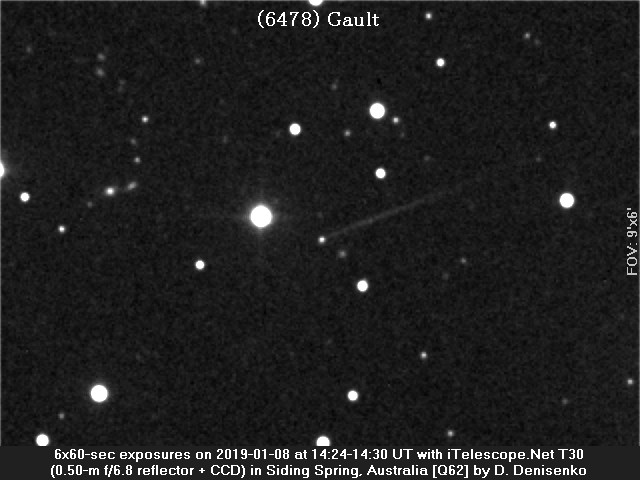
iTelescope ALERT! Asteroid (6478) Gault has a tail!
 |  |
| Asteroid (6478) Gault as seen at 3:36 Local time for Mayhill, New Mexico, when it is at transit. The Comet is near nu (ν) Hydrae not far from Crater . Click to embiggen. | Asteroid (6478) Gault as seen at 4:37 Local time for SSO, Siding Spring, when it is at transit (astronomical twilight starts at 4:33). The Comet is near nu (ν) Hydrae not far from Crater . Click to embiggen. |
 Telescope view of Asteroid (6478) Gault. The large square is the field of View of T30 (SSO) and the small that of T17 (SSO) the medium rectangle is T5 (Mayhill). The orientation is upside down from the spotters maps.
 Asteroid (6478) Gault has been reported to have a comet like tail, from CBET 4594 “The tail/trail first appears in individual ATLAS exposures on 2018 Dec. 8, as identified by Denneau, with a median combined 120-s exposure showing a tail 30" long in p.a. 290 degrees. There is no evidence of a tail in previous ATLAS imaging in January 2018. An initial analysis using a cometary Finson-Probstein model (cf. website URL http://comet-toolbox.com/FP.html, as perJ.-B. Vincent) shows that both the Dec. 2018 and Jan. 2019 data are consistent with the ejection of material or commencement of activity in early Nov. 2018”. Previous images from ATLAS and PanSTARRS show no cometary-like activity back to 2010.
It has been suggested a collision or impact is responsible for the tail. Ongoing observation of the phenomenon should be undertaken to understand its nature.
Asteroid (6478) Gault is visible from both Northern and southern scopes from with transit around 3:30 am (northernscopes) and 4:30 am (Southern scopes), however, this is just past astronomical twilight at SSO, so imaging should begin before this. The Southern scopes have the best view with the asteroid potentially visible from 12:30 am local time.
Asteroid (6478) Gault is currently magnitude 18.7, and will need long exposures on narrow field scopes with tracking for the best results.

iTelescope users Ulrich Eberhard Stickel and Denis Denisenko have achieved images with T30 from SSO. Denis Denisenko's is at this link: http://scan.sai.msu.ru/~denis/Comet/6478-T30-20190108.jpg
The MPC one line ephemeris is:
06478 14.4 0.15 K194R 289.34905 83.26761 183.55769 22.81135 0.1935870 0.28161558 2.3051451 0 MPO435760 1093 19 1988-2018 0.44 M-v 38h MPC 0000 (6478) Gault 20180209
Example plan for following the asteroid, check filter availability.
;
; Single target image example, adjust filter as necessary for chosen scope.
;

#trackon
#count 3
#interval 300
#binning 2
#filter Red
06478   14.4   0.15 K194R 289.34905   83.26761  183.55769   22.81135  0.1935870  0.28161558   2.3051451  0 MPO435760  1093  19 1988-2018 0.44 M-v 38h MPC        0000   (6478) Gault              20180209
#shutdown
Labels: alert, asteroids, iTelescope
Thursday, December 20, 2018
Coming Events: A Year of Southern Astronomy for 2019

The table below shows significant astronomical events that can be seen with the unaided eye or minimal equipment in 2019 in Australia (and to some degree elsewhere in the Southern Hemisphere, ocultations and eclipses are very region specific).
Close pairings of the Moon and bright planets are given special attention as not only is the Moon a ready guide to locating the planets if you are not familiar with them, these massings are rather beautiful.
Special events are bolded.
Sadly, the partial solar eclipse is just visible from parts of northern Australia, and the partial lunar eclipse is somewhat sad, but we have three occultations of Saturn and a number of beautiful planetary events to keep us occupied. The asteroid Vesta should be (just) visible to the unaided eye too.
| Date | Event |
| 2 January 2019 | Venus close to crescent Moon in morning |
| 3-4 January 2019 | Crescent Moon and Jupiter close |
| 4 January 2019 | Crescent Moon near Mercury |
| 12-13 January 2019 | waxing Moon and Mars close |
| 14 January 2019 | Mercury a bit over a finger-width from Saturn low in the morning twilight |
| 21 January 2019 | Perigee Full Moon ("super" Moon, strictly at its biggest on the morning of the 22nd) |
| 23 January 2019 | Venus and Jupiter close in the morning |
| 31 January 2019 | Crescent Moon and Jupiter close again |
| 1 February 2019 | Crescent Moon close to Venus in the morning sky |
| 2-3 February 2019 | Crescent Moon close to Saturn in the morning |
| 10 February 2019 | Waxing Moon close to Mars |
| 12-13 February 2019 | Uranus close to Mars (binocular viewing) |
| 20 February 2019 | Perigee Full Moon ("super" Moon, strictly at its biggest on the evening of the 19th) |
| 28 February 2019 | Waning Moon close to Jupiter |
| 2 March 2019 | Crescent Moon close to Saturn in the morning |
| 3 March 2019 | Crescent Moon close to Venus in the morning sky |
| 11 March 2019 | Crescent Moon close to Mars |
| 30 March 2019 | Waning Moon close to Saturn |
| 2-3 April 2019 | Crescent Moon close to Venus in the morning sky |
| 3 April 2019 | Crescent Moon close to Mercury in the morning sky |
| 9 April 2019 | Moon close to Mars in evening sky |
| 23 April 2019 | waning Moon close to Jupiter in the evening sky |
| 25 April 2019 | Occultation of Saturn by the Moon, very low on horizon |
| 4-25 May 2019 | Asteroid Ceres visible in binoculars (opposition on 28th) |
| 3 May 2019 | Crescent Moon close to Venus in the morning sky |
| 6 May 2019 | Eta Aquariid meteor shower. |
| 8 May 2019 | Crescent Moon close to Mars |
| 19 May 2019 | Venus and Uranus a finger-width apart in the morning twilight (binoculars) |
| 20 May 2019 | Jupiter near waning Moon |
| 22 May 2019 | Waning Moon close to Saturn |
| 1-29 June 2019 | Asteroid Ceres visible in binoculars |
| 2 June 2019 | Crescent Moon and Venus close in twilight |
| 4 June 2019 | Crescent Moon and Mercury close |
| 5 June 2019 | Crescent Moon and Mars close |
| 11 June 2019 | Jupiter at Opposition |
| 16 June 2019 | Jupiter and Full Moon close |
| 19 June 2019 | Moon and Saturn close |
| 4 July 2019 | Mercury close to Crescent Moon and Mars in the twilight |
| 10 July 2019 | Saturn at Opposition |
| 13-14 July 2019 | Moon and Jupiter close |
| 16 July 2019 | Moon and Saturn close |
| 16-17 July 2019 | Partial Lunar Eclipse, early morning, really only visible from WA and a bit in the Central states |
| 30 July 2019 | Southern Delta Aquarids meteor shower |
| 10 August 2019 | Moon close to Jupiter |
| 12 August 2019 | Moon close to Saturn, Occultation seen on East coast only |
| 6 September 2019 | Waxing Moon and Jupiter close |
| 8-9 September 2019 | Saturn close to Moon, Occultation in northern and Western Australia |
| 13 September 2019 | Apogee Full Moon (mini-Moon) |
| 29 September 2019 | Mercury close to bright star Spica |
| 30 September 2019 | Crescent Moon close to Spica and Mercury with Venus below |
| 3-5 October 2019 | Venus and the bright star Spica close |
| 4 October 2019 | Jupiter and waxing Moon close |
| 6 October 2019 | Saturn and waxing Moon close |
| 22 October 2019 | Orionid meteor shower |
| 24 October 2019 | Variable star Mira at its brightest |
| 29 October 2019 | Mercury, Venus and Crescent Moon close |
| 31 October 2019 | Jupiter and waxing Moon close |
| 2 November 2019 | waxing Moon close to Saturn |
| 9 November 2019 | Jupiter crescent Moon close |
| 11 November 2019 | Crescent Moon and Saturn close |
| 12 November 2019 | Asteroid Vesta at opposition, potentially (just) visible with the unaided eye |
| 17 November 2019 | Leonid Meteor Shower |
| 24 November 2019 | Jupiter and Venus just two finger-widths apart |
| 25 November 2019 | the Crescent Moon, Mars and Mercury form a triangle in the dawn sky |
| 28-29 November 2019 | the Crescent Moon, Jupiter and Venus form a line in the evening twilight |
| 2 December 2019 | Venus close to the globular cluster M22 in the evening twilight (binocular) |
| 11 December 2019 | Venus and Saturn two finger-widths apart |
| 15 December 2019 | Geminid Meteor shower (full Moon, poor rates) |
| 23 December 2019 | Crescent Moon close to Mars in morning sky |
| 26 December 2019 | Partial Eclipse of the Sun, visible only in northern Australia |
| 27 December 2019 | Crescent Moon close to Saturn in the evening twilight |
| 29 December 2019 | Crescent Moon close to Venus in the evening sky |
Labels: asteroids, Conjunction, eclipse, Jupiter, Mars, Mercury, Opposition, Saturn, unaided eye, Venus, Yearly Sky Events
Sunday, June 03, 2018
Seeing Vesta at Opposition (June 2018)
 |  |
| Evening sky showing the location of the asteroid 4 Vesta on 20 June when at opposition. The view is looking east as seen from Adelaide at 22:00 ACST. Saturn is high above the horizon and Mars is clearly visible. The Asteroid Vesta is visible to the north near Saturn. (click to embiggen, similar views will be seen elsewhere at the equivalent local time). | Simulated binocular view of the region near Saturn showing the open cluster M24 and Vesta on Monday June 4 looking east as seen from Adelaide at 22:00 ACST. Vesta is above M24 and in a direct line with Mu Sag and Kaus Borealis. Similar views will be seen throughout Australia at the equivalent local time (click to embiggen). |
The Asteroid 4 Vesta is one of the iconic minor planets, and one of two orbited by the Dawn spacecraft. Importantly at favourable oppositions Vesta is bright enough to be seen with the unaided eye under dark sky conditions.

This year is one of the best oppositions of Vesta, when it will reach a magnitude of 5.3-5.4 at its brightest. Vesta is at opposition on June 20, and is the best opposition since 2000 (and will not be surpassed until 2029). For those interested it is in a series of oppositions this year (Jupiter May 9, Saturn June 27, and Mars July 27 (best Mars opposition since 2003). Vesta will also pass by some interesting clusters and Nebula.
On the 4th and 5th, Kaus Australis, Mu Sagittarii and Vesta are almost in a straight line. Vesta is around half the distance between Mu Sag and Kaus Australis in a straight line north of Mu Sag above M24.
For the first half of June, sweep north from Saturn until you reach the last obvious brightish star, this is Mu Sagittarii, just beyond and blow this is the obvious and rambling open cluster M24. Just above M24, almost in line with Mu Sagittarii the brightest object visible is Vesta. You may need to watch it over several night to see it move to ensure you have the right object.
Labels: 4 Vesta, asteroids, binoculars, unaided eye
Thursday, May 17, 2018
Seeing Vesta near M24 (May 2018)
 |  |
| Evening sky on Thursday May 17 looking east as seen from Adelaide at 22:00 ACST. Saturn and Mars are clearly visible above the horizon. The Asteroid Vesta is visible in binoculars to the left (north) of Saturn. Similar views will be seen throughout Australia at the equivalent local time (click to embiggen). | Simulated binocular view of the region near Saturn showing the open cluster M24 and Vesta on Thursday May 17 looking east as seen from Adelaide at 22:00 ACST. Vest will be close to M24 for around a week. Similar views will be seen throughout Australia at the equivalent local time (click to embiggen). |
The asteroid 4 Vesta is now easily visible in binoculars, and is just under unaided eye visibility. It is brightening towards its opposition on 19 June, when it will be a potentially unaided eye object at magnitude 5.3.

Now in Sagittarius, it is skimming along side the open cluster M24. This will look particularly nice in binoculars and wide field telescopes.
Locate Saturn in binoculars and sweep left (north) until you reach an obvious open cluster (M24). Vesta is brighter than most of the stars in the cluster, and starts at the bottom of the cluster, then moves up over subsequent days.
You may need to watch over several nights to watch it move and confirm its identity. Towards the end of the month the waxing Moon will make the asteroid harder to see.
Labels: 4 Vesta, asteroids, binoculars
Friday, December 29, 2017
Coming Events: A Year of Southern Astronomy for 2018

The table below shows significant astronomical events that can be seen with the unaided eye or minimal equipment in 2018 in Australia (and to some degree elsewhere in the Southern Hemisphere, ocultations and eclipses are very region specific) are listed in this table.
Close pairings of the Moon and bright planets are given special attention as not only is the Moon a ready guide to locating the planets if you are not familiar with them, these massings are rather beautiful.
Special events are bolded.
Sadly, the partial solar eclipse is just visible from parts of southern Australia, but we have two good total lunar eclipses, the best for some years, and there are a number of beautiful planetary events to keep us occupied. There may even be an unaided eye comet and asteroid Vesta should be visible to the unaided eye too.
UPDATE: reader Scott has created an iCal for this list that you can import into your calendar. I have htmlised the link http://subscriptions.thismonkey.com//fixtures/astro/calendars/astro/2018/1/astro_1_2018.ics
| Date | Event |
| 1 January 2018 | Mars three finger-widths from Jupiter in the morning skies |
| 2 January 2018 | Perigee ("Super") Moon |
| 7 January 2018 | Jupiter and Mars at their closest, less than half a finger-width apart |
| 12 January 2018 | Crescent Moon, Mars and Jupiter form a triangle |
| 13 January 2018 | Mercury less than a finger-width from Saturn in the morning sky |
| 15 January 2018 | thin crescent Moon near Mercury and Saturn |
| 27-31 January 2018 | Asteroid Ceres visible in binoculars |
| 31 January 2018 | Blue Moon, Total Lunar Eclipse ~11pm AEST |
| 8 February 2018 | Waning Moon close to Jupiter in Morning sky |
| 10 February 2018 | Waning Moon close to Mars |
| 13 February 2018 | Crescent Moon close to Saturn |
| 4 March 2018 | Venus and Mercury very close, low in the evening twilight |
| 7 March 2018 | Moon close to Jupiter |
| 10-11 March 2018 | Moon close to Mars |
| 11-12 March 2018 | Moon close to Saturn |
| 19 March 2018 | thin crescent Moon close to Mercury and Venus in evening twilight |
| 20 March 2018 | Mars close to Triffid Nebula |
| 1-3 April 2018 | Mars and globular cluster M22 less than a finger-width apart in morning sky |
| 2 April 2018 | Mars and Saturn close, a finger-width apart |
| 3 April 2018 | Moon close to Jupiter in evening sky |
| 15 April 2018 | thin crescent Moon close to Mercury in morning twilight |
| 18 April 2018 | crescent Moon close to Venus in evening sky |
| 30 April 2018 | Moon close to Jupiter in evening sky |
| 1-30 May 2018 | Saturn within 2finger-widths of globular cluster M22, closest on the 15th |
| 4 May 2018 | Moon close to Saturn |
| 6 May 2018 | Moon close to Mars |
| 6 May 2018 | Eta Aquariid meteor shower. |
| 9 May 2018 | Jupiter at opposition |
| 14-15 May 2018 | Mars less than half a finger-width from globular cluster M75 |
| 17-18 May 2018 | crescent Moon close to Venus |
| 21 May 2018 | Venus close to M35 |
| 27 May 2018 | Moon close to Jupiter |
| 1 June 2018 | Moon and Saturn close |
| 3 June 2018 | Moon and Mars close |
| 16 June 2018 | Crescent Moon near Venus |
| 19 June 2018 | Asteroid Vesta at opposition, potentially visible with the unaided eye |
| 20 June 2018 | Venus in the Beehive cluster |
| 21 June 2018 | crescent Moon and Venus close |
| 23 June 2018 | Moon and Jupiter close |
| 27 June 2018 | Saturn at opposition |
| 28 June 2018 | Saturn close to the Moon |
| 1 July 2018 | Mars and Moon close |
| 4 July 2018 | Mercury close to Beehive cluster |
| 13 July 2018 | Partial Eclipse of the sun, visible only southern SA and VIC |
| 15 July 2018 | thin crescent Moon and Mercury close in the twilight |
| 16 July 2018 | crescent Moon and Venus close |
| 21 July 2018 | Moon and Jupiter close |
| 25 July 2018 | Moon and Saturn close |
| 27 July 2018 | Mars at Opposition, the best since 2003 |
| 28 July 2018 | Total Lunar Eclipse, early morning |
| 30 July 2018 | Southern Delta Aquarids meteor shower |
| 14 August 2018 | Crescent Moon close to Venus |
| 17 August 2018 | Moon close to Jupiter |
| 21 August 2018 | Moon close to Saturn |
| 30 August 2018 | Saturn close to Triffid Nebula |
| 1-2 September 2018 | Venus and Spica close |
| 12-13 September 2018 | Crescent Moon close to Venus |
| 14 September 2018 | crescent Moon close to Jupiter |
| 18 September 2018 | Moon close to Saturn |
| 20 September 2018 | Moon and Mars close |
| 10-20 October 2018 | All 5 bright planets visible in early evening sky |
| 10 October 2018 | Mercury and Crescent Moon close |
| 11 October 2018 | crescent Moon near Venus |
| 12 October 2018 | crescent Moon close to Jupiter |
| 15 October 2018 | Moon close to Saturn |
| 16 October 2018 | Venus and Mercury close |
| 18 October 2018 | Moon close to Mars. |
| 22 October 2018 | Orionid meteor shower |
| 28 October 2018 | Mercury and Jupiter close |
| 9 November 2018 | Jupiter crescent Moon close |
| 11 November 2018 | Crescent Moon and Saturn close |
| 16 November 2018 | Moon close to Mars |
| 17 November 2018 | Leonid Meteor Shower |
| 26 November 2018 | Variable star Mira at its brightest |
| 1-20 December 2018 | Comet 46P potentially visible to the unaided eye |
| 4 December 2018 | Crescent Moon close to Venus in morning twilight |
| 9 December 2018 | Crescent Moon close to Saturn in evening twilight |
| 15 December 2018 | Geminid Meteor shower |
| 14-15 December 2018 | Moon close to Mars |
| 22 December 2018 | Jupiter and Mercury very close in dawn sky |
Labels: asteroids, comet, Conjunction, eclipse, Jupiter, Mars, Opposition, Saturn, unaided eye, Venus, Yearly Sky Events
Thursday, November 16, 2017
Seeing Asteroid 7 Iris from Australia (16-20 November, 2017)

Asteroid 7 Iris is the 4th brightest asteroid, and one of the main belt asteroids. Normally at opposition it is around magnitude 7.8, around the limit of strong binoculars in suburban settings, but this opposition is a favourable one, with the asteroid currently magnitude 7.3, too dim for the unaided eye, but achivable with 10x50 or stronger binoculars and small telescopes under suburban skies.
As well, the asteroid is near some obvious guide stars. The asteroid is near gamma Arietis, the dimmiest of the three bright stars in Aries. At midnight the threes will be almost due north, to the left of the distinctive triangle of the Hyades, the head of Taurus the bull.

Gamma Arietis is easily found star hopping up from the obvious Hamal to beta Areitis, then gamma. From the 16th to 20th 7 Iris is the brightest object near gamma Arietis. You may need to watch it from night to night to see it move. On the 22nd it is close to the moderately bright (in binoculars and telescopes anyway, it is just on unaided eye limit) HIP 8689, which is the emext brightest star in the field hopping up from gamma Arietis.

The asteroid is at its highest around 11:30 pm (daylight savings time) and is reasonably high for good observation.
Ephemeris of Iris
Date        Mag Ast Twi  Rise     Altitude     Transit  Set      Ast Twi B
16 Nov 2017 7.2 21:38:35 18:21:32 +35° 35' 02" 23:27:57 04:38:30 04:23:07
17 Nov 2017 7.3 21:39:56 18:16:40 +35° 35' 39" 23:23:34 04:34:34 04:22:07
18 Nov 2017 7.3 21:41:18 18:11:51 +35° 35' 00" 23:19:13 04:30:39 04:21:09
19 Nov 2017 7.3 21:42:39 18:07:04 +35° 33' 07" 23:14:54 04:26:46 04:20:14
20 Nov 2017 7.3 21:44:00 18:02:20 +35° 30' 00" 23:10:36 04:22:55 04:19:20
21 Nov 2017 7.4 21:45:21 17:57:38 +35° 25' 41" 23:06:21 04:19:05 04:18:28
22 Nov 2017 7.4 21:46:41 17:52:58 +35° 20' 11" 23:02:08 04:15:16 04:17:38
23 Nov 2017 7.4 21:48:01 17:48:22 +35° 13' 32" 22:57:57 04:11:29 04:16:50
24 Nov 2017 7.5 21:49:19 17:43:48 +35° 05' 46" 22:53:49 04:07:44 04:16:04
25 Nov 2017 7.5 21:50:38 17:39:17 +34° 56' 55" 22:49:42 04:04:00 04:15:21
26 Nov 2017 7.5 21:51:55 17:34:48 +34° 46' 59" 22:45:38 04:00:18 04:14:39
27 Nov 2017 7.6 21:53:12 17:30:23 +34° 36' 02" 22:41:35 03:56:37 04:14:00
28 Nov 2017 7.6 21:54:27 17:26:00 +34° 24' 05" 22:37:35 03:52:58 04:13:23
29 Nov 2017 7.6 21:55:42 17:21:40 +34° 11' 10" 22:33:38 03:49:20 04:12:49
30 Nov 2017 7.6 21:56:55 17:17:23 +33° 57' 19" 22:29:42 03:45:45 04:12:17
01 Dec 2017 7.7 21:58:07 17:13:09 +33° 42' 35" 22:25:49 03:42:10 04:11:47
02 Dec 2017 7.7 21:59:18 17:08:58 +33° 27' 00" 22:21:58 03:38:37 04:11:20
03 Dec 2017 7.7 22:00:27 17:04:50 +33° 10' 35" 22:18:09 03:35:06 04:10:56
04 Dec 2017 7.8 22:01:35 17:00:45 +32° 53' 23" 22:14:22 03:31:36 04:10:34
05 Dec 2017 7.8 22:02:42 16:56:42 +32° 35' 25" 22:10:38 03:28:08 04:10:15
Labels: asteroids, binocular, telescope
Sunday, September 03, 2017
Seeing Asteroid 3122 Florence tonight (3 September 2017)

Although NEO Florence (and its newly discovered Moons) has made its record breaking approach to Earth and is now heading away and fading, it is still an interesting telescopic object although dim (magnitude 9) that can be seen to visibly move over a reasonably short observation period.
Over the past few nights the asteroid has not had any good guide stars, making it hard for amateurs without GOTO scopes or modest equipment. Tonight the asteroid will be below the distinctive small constellation od Deplhinus, making for relatively easy star hopping.

After tonight as it passes through Cygnus it will be getting too low in the sky for Southern hemisphere obsevers.

At 22:00 3122 Florence is 4 degrees below 3.8 alpha Delphinus (α on the chart) and 54' above 4.8 magnitude 29 Vulpernica (29 on the chart). As the night progresses the asteroid come nearer to 29 Vul, grazing it shortly after midnight.
The distinctive treadrop shape of the constellation of Delphinus and alpha Del will be reasonably easy to see in the Moonlight. Aim your scope at alpha Del and scan toward the horizon with a widefield eyepiece. The next brightest star is 29 Vul. With 29 Del at the edge of your field Florence should be just above it (or below it, in inverted telescope view), watching over 15-30 minutes you should see the asteroid move substantially against the background stars.
Labels: asteroids, NEO, telescope
Tuesday, August 29, 2017
Seeing NEO 3122 Florence from Australia

NEO 3122 Florence makes an historic approach to Earth in early September. This will be the closest this asteroid, named after reforming nurse Florence Nightingale has come since 1890.
While not a particularly close approach (September 1, 12:06 UT, 0.047 AU, around 18 Earth-Moon distances), this will be the closest a large NEO has come to Earth since this class of objects were first described.
With a diameter of about 4.3 km, Florence ranks fourth in diameter of those NEO's classified as potentially hazardous. It is also the brightest of the Large NEO's, brighter than 3200 Phaeton (the asteroid responsible for the Geminid meteor shower).

The asteroid will range from magnitude 9 up to around magnitude 8.7 then fading down to 10.
This means that the asteroid is potentially viewable in good binoculars (10x50's and up) under dark sky conditions. However, the waxing Moon will make binocular detection harder closer to closest approach. It will remain easily visible in small telescopes even with the increasing moonlight.

Although the asteroid is effectively on a line between the bright stars Fomalhaut and Altair, Finding the asteroid can be a bit tricky without good maps.
On the 29th, the asteroid is 22" from Zeta (ζ) Capricorii, and so should be easy to spot. You will need to watch the stars around Zeta for around 15 minutes to detect the movement of Florence.
On the 30 the brightening Florence is within 22' of 29 Capricorii (which forms a triangle with iota and theta Capricornii), again, watching for 10-15 minutes will detect the asteroid drifting.
On the 31st the asteroid is between mu and beta Aquarii, but is not close to a useful guide star.

On the first the asteroid is within binocular distance of alpha Equuleus, and between that and 1 Aquarii, but again is not near any obvious guide star. Still if you watch for 10-15 minutes you will see the asteroid drift against the background stars.
Many instruments will be watching this approach, including the Goldstone radar to try and capture its shape and possible satellites.
While not spectacular, this will be an historic pass to witness, the next closest approach of Florence is in 2057.
Labels: asteroids, binocular, NEO, telescope
Thursday, April 20, 2017
Asteroid 2014 JO25 recedes from view (20 April, 2017)
 |  |
| Asteroid 2014 JO25 ziping along with the scope tracking on the asteroid (the asteroid is the dot near the edge). 20 x 60 second luminance exposures with iTelescope T11 stacked and aligned in ImageJ. Imaging starts at 9:05 UT (3:05 am local time 20th) Click to embiggen. | Animation of the same 20 x 60 frames (click to embiggen for animated asteroidal goodness) |
As Asteroid 2014 JO25 recedes from earth I was able to get some more images and animations. By the time I took the above images with iTelescope T11 in New Mexico, it had moved far enough away that I could track on the asteroid. Still moving at a fair clip and the stars are trailed.
 |  |
| Asteroid 2014 JO25 zips along receding from Earth with added satellite trails (the asteroid is the dotted line through the centre). 20 x 60 second luminance exposures with iTelescope T14 stacked and aligned in ImageJ. Imaging starts at 3:05 UT (9:05 pm local time 19th) Click to embiggen. | Animation of the same 20 x 60 frames (click to embiggen for animated asteroidal goodness) |
Earlier in the UT day from T14, also New Mexico. Asteroid is moving too fast to track.
 |  |
| Asteroid 2014 JO25 near galaxy NGC 4710. 7 x 120 second luminance exposures with iTelescope T13 (Siding Spring Observaory) stacked and aligned in ImageJ. Imaging starts at 11:00 UT (9:05 pm local time 20th) Click to embiggen and see more galaxies. | Animation of the same 20 x 60 frames (click to embiggen for animated asteroidal goodness). Cloud comes over in the last frames. |
Finally an image from telescope T13 at Siding Spring Observatory in Australia, choosing to track on the galaxies rather than the asteroid for a prettier composition. Clouds have ruined any chance of me seeing the asteroid with my own instruments.
Labels: 2014 JO25, asteroids, iTelescope
Wednesday, April 19, 2017
Capturing asteroid 2014 JO25 (19 April 2017)
 |  |
| Asteroid 2014 JO25 zips past the magnitude 13.1 galaxy NGC 6248 while bracketed by satellite trails (the asteroid is the dotted line through the centre). 10 x 120 second luminance exposures with iTelescope T14 stacked and aligned in ImageJ. Imaging starts at 10:00 UT (4:00 am local time) Click to embiggen and see more galaxies. | Animation of the same 10 x 120 frames (click to embiggen for animated asteroidal goodness) |
Asteroid 2014 JO25 is, as I type, making its closest approach to Earth (12:24 UT 19 April). Zipping past at 4.6 Earth-Moon distances at closest approach, this asteroid was moving at a speedy 92.2 arc seconds per minute whin I was trying to image it, making imaging a tad challenging. However, using the remote telescopes of iTelescope in Mayhill New Mexico I succeeded (with a bit of bad luck with some cloud early on). With the wide-field T14 instrument I caught the asteroid zipping through a field of galaxies, looking rather nice.
 Asteroid 2014 JO25 also at 10:00 UT taken with iTelescope T5, moving so fast the tracker is just barely coping (hint the asteroid is the only thing that is not a streak).
Australia gets its chance tomorrow, when the asteroid zips through Virgo. It won't be as bright as at closest approach, but still within reach of modest amateur scopes.
This is the closest approach of asteroid 2015 JO25 for around 400 years, and it wont come this close again for another 500 years.
The asteroid turn out to be a very interesting object, images from the Arecibo radio telescope show that the asteroid is a contact binary, and about twice the size we though it was, one of the two lobes is around 620 meters in diameter, see here and here of radio telescope "images" and animations from the Goldstone and Arecibo radio telescopes.
Labels: 2014 JO25, asteroids, iTelescope
Monday, April 17, 2017
Seeing Asteroid 2014 J025 from Australia (20 April 2017)

Asteroid 2014 JO25 will come close to Earth on 12:24 UT 19 April (19 April 22:24 AEST) at distance of 0.012 AU (around 4.6 Earth-Moon distances). At an estimated diameter of around 650m it is about the size of the Chelyabinsk impactor.
However, it will not be visible from Australia at closest approach (when it will be around magnitude 10.5). We only see the asteroid the following night (20th) when it has faded to magnitude 11.1. This is still within the range of most amateur scopes, but out of the range of all but the most powerful astronomical binoculars under dark skies.

Asteroid 2014 JO25 moves from Coma Bernicies through Virgo on the evening of the 20th and through the 21st and 22nd as well.

The crosses mark the position of the asteroid every 30 minutes. The large circle is the field of view of 10x50 binoculars, the small that of a 24 mm eyepiece on a 4" Newtonian. use the guide stars (see map above) to orient yourself. Click to embiggen and print.
It is not moving as fast as at closest approach, but still fast enough (84 -60 arc seconds/minute aover the course of the night), to visibly move over the space of 10-15 minutes.While there is still some paralax difference btween poistions plotted in a standard planaterium program and a proper topocentric ephemeris the difference is around 4 minutes of arc (mauch smaller than at closest approach and small enough that the charts here as a useful guide for all sites in Australia).

The crosses mark the position of the asteroid every 30 minutes. The circle is the field of view of a 24 mm eyepiece on a 4" Newtonian. Stars down to magnitude 13 are shown use the guide stars (see map above) to orient yourself. Click to embiggen and print.
While theoretically visible from astronomical twilight on the 20th, it will be better to wait until after 20:00 (8pm) as the asteroid will be higer in the sky above the murk of the horizon. The asteroid will be difficult to spot, as it will be too dim to see in finderscopes, but there are several useful guide stars.
If you draw an imaginary line between Arcturus and Regulus, then drop a line perpendicular to this line from Spica, the asteroid will be almost at the intersection of these lines, within a binocular field of alpha Coma Cernicies and epsilon Virginis, just down from rho Virginis.Within that area, using the charts above, you can star hop to the location of the asteroid. While faint, you should be able to see it slowly move over a period of several minutes.
For topocentric ephemerides go to http://www.minorplanetcenter.net/iau/MPEph/MPEph.html
type 2014 JO25 in the input box and enter you latitude and longitude (the times give are all UT, so you will need to convert to your local time). Ephemeris start date: is 20170420, and choose 50 output, ephemeris interval 30 minutes. Here is the ephemeris for Siding Spring Observatory (not to differnt from the ephemeris for Adelaide).
     K14J25O       [H=18.1]
Date       UT      R.A. (J2000) Decl.    Delta     r     El.    Ph.   V      Sky Motion        Object    Sun   Moon                Uncertainty info
            h m s                                                            "/min    P.A.    Azi. Alt.  Alt.  Phase Dist. Alt.    3-sig/" P.A.
... Suppressed ...
2017 04 20 080000 12 54 10.5 +18 47 38   0.020   1.021  146.4  32.9  11.0   83.76    199.6    247  +02   -06   0.41   122  -41        10 063.7 / Map / Offsets
2017 04 20 083000 12 53 12.3 +18 08 47   0.020   1.022  146.9  32.5  11.0   81.18    199.6    243  +08   -12   0.41   122  -43        10 064.1 / Map / Offsets
2017 04 20 090000 12 52 15.8 +17 31 08   0.020   1.022  147.3  32.0  11.1   78.71    199.7    239  +14   -18   0.41   123  -43        10 064.6 / Map / Offsets
2017 04 20 093000 12 51 21.1 +16 54 39   0.021   1.022  147.8  31.6  11.1   76.33    199.7    234  +20   -25   0.41   123  -43        10 065.0 / Map / Offsets
2017 04 20 100000 12 50 28.2 +16 19 16   0.021   1.023  148.1  31.2  11.1   74.05    199.7    229  +26   -31   0.40   124  -41         9 065.5 / Map / Offsets
2017 04 20 103000 12 49 36.8 +15 44 57   0.021   1.023  148.5  30.9  11.1   71.84    199.8    223  +31   -38   0.40   124  -39         9 065.9 / Map / Offsets
2017 04 20 110000 12 48 47.1 +15 11 39   0.022   1.023  148.9  30.5  11.1   69.71    199.8    216  +36   -44   0.40   124  -36         9 066.4 / Map / Offsets
2017 04 20 113000 12 47 59.0 +14 39 20   0.022   1.024  149.2  30.2  11.2   67.66    199.8    208  +40   -50   0.40   125  -32         9 066.8 / Map / Offsets
2017 04 20 120000 12 47 12.4 +14 07 58   0.022   1.024  149.5  29.8  11.2   65.68    199.8    199  +43   -56   0.40   125  -28         8 067.3 / Map / Offsets
2017 04 20 123000 12 46 27.3 +13 37 31   0.023   1.024  149.8  29.5  11.2   63.76    199.8    189  +45   -61   0.39   125  -23         8 067.8 / Map / Offsets
2017 04 20 130000 12 45 43.7 +13 07 57   0.023   1.025  150.1  29.2  11.2   61.90    199.7    178  +46   -66   0.39   126  -18         8 068.2 / Map / Offsets
2017 04 20 133000 12 45 01.6 +12 39 14   0.023   1.025  150.4  28.9  11.3   60.10    199.6    167  +45   -69   0.39   126  -12         8 068.7 / Map / Offsets
2017 04 20 140000 12 44 20.9 +12 11 20   0.024   1.026  150.7  28.7  11.3   58.36    199.5    157  +44   -71   0.39   126  -07         8 069.1 / Map / Offsets
2017 04 20 143000 12 43 41.7 +11 44 14   0.024   1.026  150.9  28.4  11.3   56.68    199.4    147  +41   -69   0.38   127  -01         8 069.6 / Map / Offsets
2017 04 20 150000 12 43 03.8 +11 17 53   0.024   1.026  151.2  28.2  11.3   55.04    199.3    139  +38   -66   0.38   127  +05         7 070.0 / Map / Offsets
2017 04 20 153000 12 42 27.4 +10 52 17   0.025   1.027  151.4  28.0  11.4   53.46    199.2    131  +33   -62   0.38   127  +11         7 070.5 / Map / Offsets
2017 04 20 160000 12 41 52.3 +10 27 23   0.025   1.027  151.6  27.7  11.4   51.93    199.0    124  +28   -56   0.38   128  +17         7 070.9 / Map / Offsets
2017 04 20 163000 12 41 18.5 +10 03 10   0.026   1.027  151.8  27.5  11.4   50.44    198.8    119  +23   -51   0.38   128  +23         7 071.3 / Map / Offsets
2017 04 20 170000 12 40 46.1 +09 39 38   0.026   1.028  152.0  27.3  11.4   49.01    198.7    113  +17   -45   0.37   128  +30         7 071.8 / Map / Offsets
2017 04 20 173000 12 40 14.9 +09 16 44   0.026   1.028  152.2  27.1  11.5   47.62    198.5    108  +11   -38   0.37   129  +36         7 072.2 / Map / Offsets
2017 04 20 180000 12 39 44.9 +08 54 27   0.027   1.029  152.4  27.0  11.5   46.28    198.3    104  +05   -32   0.37   129  +42         6 072.7 / Map / Offsets
... Suppressed ...



 Click to read about or order
 Click to read about or order
 Click to read about or order
 Click to read about or order