Thursday, February 26, 2026
No, you won't be able to see all 6 planets lined up on February 28, 2026
 |  |
| North-western sky on the evening of Saturday, February 28 as seen from Adelaide at 20:20 ACDST (30 minutes after sunset, click to embiggen). | Western sky on the evening of Saturday, February 28 as seen from Los Angeles at 18:29 local time (30 minutes after sunset, click to embiggen). |
Despite a variety of claims on the internet, you won't be able to see all 6 planets lined up on February 28, 2026 (UPDATE).
The good news is that they are lined up. The bad news is that they are too deep in the twilight to see.
At civil twilight, 30 minutes after sunset, if you have a clear, level, unobstructed horizon, Mercury, Venus, Saturn and Neptune are invisible in the twilight glow (Mercury has set in the southern hemisphere), as is Uranus. Jupiter *might* just be visible.
Venus may be visible in binoculars (or if you have very good eyesight) in the Northern hemisphere low in the twilight if the horizon conditions are clear. UDPATE: In some places in the Northern hemisphere, Venus may be high enough to see at nautical twilight. Daniel Fischer was able to image it at nautical twilight in Bochum in the EU https://scicomm.xyz/@cosmos4u/116133837700056539 .
60 minutes later at astronomical twilight, when the sky is darker, Venus and Saturn have set (well they are right on the horizon in the Northern Hemisphere and still is high in some places see update above) and Uranus will be just visible in binoculars (Jupiter will be well visible).
Labels: lineup, Mercury, Neptune, public outreach, Saturn, Venus

Wednesday, January 07, 2026
2026: From "Mini" Moons to "Super" Moons, a year of full Moons
 |  |  |
| Full Moon January 03, 20:33 ACDST (Moon below horizon, moon at 22:00 shown). | Full Moon February 2, 08:39 ACDST (Moon at 22:00 shown). | Full Moon March 3, 22:08 ACDST, Total Lunar Eclipse. |
 |  |  |
| Full Moon April 02, 12:42 ACST FM9:30 (Moon below horizon, moon at 21:00 shown). | Full Moon May, 2 02:52 ACST (shown at 18:58 ACST) | Full Moon May 31 18:17 ACST Antares is just coming out of occultation ("Blue" apogee moon +19hrs apogee 15:02 1st June, Full Moon 19:15 31st.) |
 |  |  |
| Full Moon June 30 09:27 ACST, shown at 18:49 ACST. | Full Moon July 30 00:06 ACST. | Full Moon August 28 13:48 ACST (Moon shown at 19:18 ACST) |
 |  |  |
| Full Moon September 27 02:19 ACST | Full Moon October 26 14:42 ACDST (Moon shown at 21:11 ACDST) | Full Moon November 25 01:23 ACDST (Perigee, 25th 21:59 ACDST +20h, Moon shown at Perigee time) |
 |  |  |
| Full Moon December 24 11:58 ACDST ( Perigee, 24th 9:31 ACDST +7h) Moon below horizon at both times, and show at 21:49 ACDST | First Quarter perigee moon at 21:58 ACDST on February 24. Actual First Quarter is 8:48 on the 25th and perigee is 21:58 (a 1 day 10 hour difference). | First Quarter apogee moon at 19:34 ACST on September 19, actual First Quarter is 07:19, apogee is 13:30 (an ~6 hour difference). The size difference will be clear in telescopes. |
 |  |  |
| First Quarter Moon at 21:20 ACST (10:50 UT) on April 24. The inset shows the Lunar X (top) and Lunar V (bottom), the dates and times that the Lunar X can be seen are shown in the table below | First Quarter Moon at 20:11 ACST (9:41 UT) on June 22. The inset shows the Lunar X (top) and Lunar V (bottom), | First Quarter Moon at 16:07 ACST (05:37 UT) on October 18. The moon is in daylight, but the lunar X is still visible in twilight.The inset shows the Lunar X (top) and Lunar V (bottom), |
Dates and time Lunar X and V are visible. Typically visible from about 4hours from the starting time, times in colour are daylight saving times.
| Date | UT | AEST | ACST | AWST |
| Feb 24 | 0731 | 18:30 | 18:01 | 15:31 (WA: X visible at twilight and when sky is full dark). |
| Apr 24 | 10:50 | 21:50 | 21:20 | 18:50 |
| June 22 | 09:41 | 20:41 | 20:11 | 17:41 (WA: X visible at twilight better when sky is full dark) |
| Aug 20 | 06:30 | 17:30 | 17:00 | 14:30 (moon in twilight on east coast, daylight WA, but X still visible in twilight) |
| Oct 18 | 05:37 | 16:37 | 16:07 | 13:37 (moon in daylight, X but still visible in twilight) |
| Dec 16 | 09:35 | 20:35 | 20:05 | 17:35 (moon in twilight on east coast, daylight WA, but X still visible in when full dark in all states) |
A year of full Moons showing the variation in size as the moons move from perigee to apogee. I also show the apogee and perigee First Quarter Moons and the dates and times you can see the Lunar X and V. All the moons are shown on the day and time they are full (unless they are below the horizon, in which case the size at astronomical twilight is shown and the time of actual full moon is shown as well), and although this is not the optimal time for size comparisons, you can clearly see the size difference over the year (compare May 31 to December 24) the original scale for all is 2 degrees of field of view cropped down). Although the field rotation of the Moon makes it less clear, you can also see the effect of libration (January 3 vs October 26)
In 2025 we have a good Perigee Moon (December 24). However, as you can see the differences are subtle, and it requires a keen eye and good memory to distinguish a perigee "super" Moon from more ordinary moons, the best contrast is with the apogee "mini" moon of May 31.
That doesn't mean you shouldn't try though. Daniel Fischer has been able to see the difference, you can read
his account and viewing tips here:
http://earthsky.org/space/can-you-discern-supermoons-large-size-with-the-eye-an-observer-says-yes
Photographing them can be more rewarding. You can see images of perigee Moon and apogee Moon pairs from 21 Jan 2019 here and 10 August 2014 here.Tips for photographing them are here.
There is also a nice Total Lunar Eclipse on Tuesday March 3 in the early evening, a good time to show the kids and family.
Labels: apogee, Moon, perigee, public outreach, Yearly Moons
Friday, January 17, 2025
The Planetary lineup (or planet parade) of January to February 2025, what will you see

You may have seen the rather breathless statements about the up coming planetary lineup (or planet parade) often illustrated with telescope images of the planets all rather close together and claiming 6-7 planets will be present in the evening sky.
While this is (mostly) true, you won't see anything like the illustrations. The hype distracts from what is a beautiful phenomenon.The planets, only 4 of which are bright dots, are strung out from west to east along the ecliptic like beads on a wire, Jupiter and Mars are bright and in some beautiful night sky territory.
I have some charts and spotting tips below to help you enjoy this without the hype.
 |  |  |
| Evening sky on Saturday, January 18 as seen from Adelaide at 21:34 ACDST (60 minutes after sunset, Similar views will be seen from the rest of Australia at roughly the equivalent local time, click to embiggen) | Evening sky on Saturday, January 25 as seen from Adelaide at 21:30 ACDST (60 minutes after sunset, Similar views will be seen from the rest of Australia at roughly the equivalent local time, click to embiggen) | Evening sky on Friday, February 28 as seen from Adelaide at 20:20 ACDST (30 minutes after sunset, Similar views will be seen from the rest of Australia at roughly the equivalent local time, click to embiggen) |
 |  |  |
| Orientation of the inner planets on Saturday, January 18 as seen from above the plane of the solar system | Orientation of the inner planets on Saturday, January 25 as seen from above the plane of the solar system | Orientation of the inner planets on Friday, February 28 as seen from above the plane of the solar system |
 |  |  |
| Orientation of the outer planets on Saturday, January 18 as seen from above the plane of the solar system | Orientation of the outer planets on Saturday, January 25 as seen from above the plane of the solar system | Orientation of the outer planets on Friday, February 28 as seen from above the plane of the solar system |
Basically, you can only see 4 of the 6-7 with your unaided eye, and rather than all being scrunched up close together, they are spread out over most of the sky from west to north-east.
From the 18th of January to mid February, face west, looking 60 minutes after sunset. Venus is obvious above the western horizon as the brightest object in the sky. Much dimmer Saturn is a spark just above obvious Venus. Turning to the north the next brightest object is golden Jupiter, the second brightest object in the sky after Venus, just below bright red star Aldebaran and the "V" of the Hyades, not far from the delightful Pleiades cluster. Then looking towards the north east, bright red Mars, just past opposition and the third brightest object in the sky, just edging out the bright star Sirius, is lined up with the pair of stars Castor and Pollux, in Gemini. Neptune is telescope visible only and will be difficult to see low on the horizon (see charts above).

The black and white chart suitable for printing shows the location of Uranus, the circle is the approximate field of view of 10x50 binoculars.
The best times to look are between 60 minutes (nautical twilight) and 90 minutes (astronomical twilight, when the sky is fully dark) after sunset, and it helps if you have a clear and level western horizon. Although Venus and Saturn set about 30 minutes or so after astronomical twilight, ~ 2 hours after sunset, trees and houses tend to get in the way.
You should be able to see this lineup from now until around 15 February, when Saturn is too low in the twilight to see (although you should be able to see it with binoculars).
After January the 18th, Saturn draws away from Saturn as the pair lower in the evening twilight. On February the first the crescent Moon is between Saturn and the obvious bright Venus low above the western horizon 60 minutes after sunset. The Moon then goes on to visit all the bright planets in turn over the next few days, this will look very nice . Venus is at its greatest brilliance on the 15th of February.
Although Jupiter and Mars move somewhat over this time they will be roughly where they are on the 18th of January, although Mars is fading rapidly.
Mercury Joins the line up around February the 15th, making 7 planets present, but is hard to see very low in the twilight. By Feb 28 Mercury is higher, but it, Saturn and Neptune are too deep in the twilight to see, and Venus is marginal. Binoculars will be required to see Mercury, and possibly Venus, which is now a thin crescent.
So ignore the hype and head out in the early evening to enjoy the sight as well the constellation of Orion and bright Sirius in Canis Major are there to look at too.
Labels: alignment, binocular, Jupiter, Mars, public outreach, Saturn, unaided eye, Venus
Monday, January 13, 2025
2025: From "Mini" Moons to "Super" Moons, a year of full Moons
 |  |  |
| Full Moon January 14, 08:57 ACDST (Moon below horizon, moon at 21:36 shown). | Full Moon February 13, 0:23 ACDST | Full Moon March 14, 17:43 ACDST, Moon below horizon (moon at 21:00 ACDST shown) |
 |  |  |
| Full Moon April 13, 09:52 ACST FM9:30 (Moon below horizon, moon at 19:18 shown). Apogee at 08:00 14 April +22hs. | Full Moon May, 13 02:26 ACST | Full Moon June 11 17:25 ACST (Moon is just rising) |
 |  |  |
| Full Moon July 11 06:07 ACST. | Full Moon August 09 17:25 ACST (Moon below horizon, moon at 20:06 ACST shown). | Full Moon September 8 039 ACST (Moon shown at 3:31 ACST as totality is starting) |
 |  |  |
| Full Moon October 07 14:17 ACDST (Moon below horizon, Moon at 20:50 ACDST shown) | Full Moon November 05 23:49 ACDST ( Perigee, 6th 09:30 ACDST +9h) | Full Moon December 05 9:44 ACDST ( Perigee, 4th 21:37 ACDST +12h) |
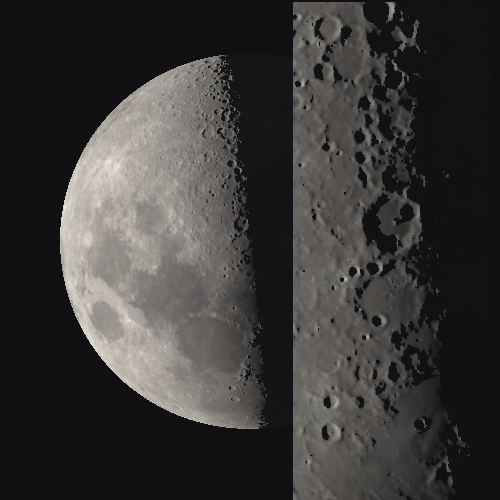 | ||
| First Quarter perigee moon at 22:18 ACDST on January 7. Actual First Quarter is midnight on the 7th and perigee is midnight on the 8th (a 24 hour difference). | First Quarter apogee moon at 23:11 ACST on August 1 at actual First Quarter, apogee is 6 am on the 2nd (an ~7 hour difference). The size difference will be clear in telescopes. | First Quarter Moon at 20:43 ACDST )10:13 UT) on January 7 the inset shows the Lunar X (top) and Lunar V (bottom), the dates and times that the Lunar X can be seen are shown in the table below |


Dates and time Lunar X and V are visible. Typically visible from about 4hours from the starting time, times in colour are daylight saving times.
| Date | UT | AEST | ACST | AWST |
| Feb 5 | 08:13 | 21:13 | 20:43 | 16:13 |
| Apr 5 | 12:43 | 22:43 | 22:17 | 20:43 |
| June 3 | 13:18 | 23:18 | 22:30 | 21:18 |
| Aug 1 | 10:57 | 20:57 | 20:17 | 18:57 |
| Sep 29 | 08:46 | 18:46 | 18:16 | 16:46 |
| Nov 27 | 10:43 | 21:43 | 21:15 | 18:43 |
A year of full Moons showing the variation in size as the moons move from perigee to apogee. I also show the apogee and perigee First Quarter Moons and the dates and times you can see the Lunar X and V. All the moons are shown on the day and time they are full (unless they are below the horizon, in which case the size at astronomical twilight is shown and the time of actual full moon is shown as well), and although this is not the optimal time for size comparisons, you can clearly see the size difference over the year (compare Apr 13 to Nov 5) the original scale for all is 2 degrees of field of view cropped down). Although the field rotation of the Moon makes it less clear, you can also see the effect of libration (January 3 vs May 13)
In 2025 we have two good Perigee Moons in a row (November 5, December 5). However, as you can see the differences are subtle, and it requires a keen eye and good memory to distinguish a perigee "super" Moon from more ordinary moons, the best contrast is with the apogee "mini" moon of April 13, even though this is not a good apogee Moon.
That doesn't mean you shouldn't try though. Daniel Fischer has been able to see the difference, you can read his account and viewing tips here:
http://earthsky.org/space/can-you-discern-supermoons-large-size-with-the-eye-an-observer-says-yes
Photographing them can be more rewarding. You can see images of perigee Moon and apogee Moon pairs from 21 Jan 2019 here and 10 August 2014 here.Tips for photographing them are here.
There is also a nice Total Lunar Eclipse on Monday September 8 in the early morning, so you will have to disturb your sleep to see it.
Labels: apogee, Moon, perigee, public outreach, Yearly Moons
Wednesday, September 18, 2024
Don't forget tonight's Perigee Moon (18 September, 2024)
 |  |
| Full Moon September 18 19:33 ACST (FM 13:00 ACST, Perigee, 18th 22:30 pm -10h) | Full Moon February 24, 23:30 ACDST (apogee 26th +1d 2h) |
This year we have two good Perigee Moons, September 18th and October 17. The differences are in Full Moon size are subtle, especially if you compare tonight's Full Moon with the October 17 Moon which is also a perigee Full Moon.
It requires a keen eye and good memory to distinguish a perigee "super" Moon from more ordinary moons, the best contrast is with the apogee "mini" moon of February 24, even though this is not a good apogee Moon).
That doesn't mean you shouldn't try though. Daniel Fischer has been able to see the difference, you can read
his account and viewing tips here
http://earthsky.org/space/can-you-discern-supermoons-large-size-with-the-eye-an-observer-says-yes
Photographing them can be more rewarding. You can see images of perigee Moon and apogee Moon pairs from 21 Jan 2019 here and 10 August 2014 here.Tips for photographing them are here.
A full Moon at perigee has been called a "Super Moon", this is not an astronomical term (the astronomical term is perigee syzygy, but that doesn't trip off the tongue so nicely), but an astrological one first coined in 1979 (see here).
Still, it is a good excuse to get people out and looking at the Moon, which will be beautiful (although technically the Moon will be full at 1 pm this evening and perigee occurs at 10:30 pm later this evening, if it is clouded out you have another opportunity on October 17). Make sure you are not fooled by the Moon Illusion.
Labels: binocular, Moon, perigee, public outreach, unaided eye
Friday, September 13, 2024
Tomorrow is International Observe the Moon Night! (Saturday September 14, 2024)

The Moon as seen from Adelaide looking Northeast at 19:30 ACST, (astronomical twilight, 90 minutes after sunset) similar views will be seen for other parts of Australia at the equivalent local time (90 minutes after sunset) . Click to embiggen. The insets show the telescopic view of Saturn at this time.
Saturday 14 September is International Observe the Moon Night.
An international initiative to get people out and observe our beautiful
nearest neighbor. You don't need much, just your unaided eyes, but
even binoculars or a small telescope will greatly aid your appreciation
of our Moon.
This weekend the Moon is three days past first quarter and above the North-east horizon not far from the planet Saturn. It also forms another line with the bright stars Altair and Vega. All in all a lovely sight.
While not quite as good as Last Quarter, it is a good phase as the terminator, the light dark boundary
on the Moons surface, is close to may interesting craters that are at
their best at this sun angle.

The prominent dark areas, the Sea of Tranquility, the sea of serenity and the sea of showers (which form the eyes and chin of "the man in the Moon" are easily seen with the unaided eye. Click to embiggen.
Even with modest binocular craters can be seen along the Moons
terminator. A small telescope reveals a wealth of detail, and finding and focusing on the Moon is so much easier than any other class of
astronomical object. You can use this map to identify the features you see (the map is upside down from our perspective). This interactive map will help you explore more.
You may wish to try some astrophotography with a mobile phone or a point and shoot camera. Follow the links for hints on imaging the Moon with these systems.
Even if you don't have a telescope, just go out and look to the
north-east (and the west, where Venus and Spica dominate the horizon, with Scorpius above), the view will be lovely. Around 19:40 you may even see a satellite or two pass over.
If you don't have a telescope, a local astronomical club may be having an International Observe the Moon Night near you. Check out this map for locations.
So if the sky is clear, go out and have a look!
Cloud cover predictions can be found at SkippySky.
Here is the near-real time satellite view of the clouds (day and night) http://satview.bom.gov.au/
Labels: citizen science, Moon, public outreach, unaided eye



 Click to read about or order
 Click to read about or order
 Click to read about or order
 Click to read about or order


