Tuesday, February 24, 2026
Total Lunar Eclipse, Tuesday March 3, 2026
 |  |  |
| North-eastern horizon as seen from Sydney on 3 March at 22:34 AEDST. The Moon is at totality. The inset shows the telescopic/binocular view at this time. Click to embiggen | North-eastern as seen from Adelaide on 3 March at 22:03 ACDST. The Moon is at totality. The inset shows the telescopic/binocular view at this time. Click to embiggen | Eastern horizon as seen from Perth on 3 March at 19:34 AWST. The Moon is at totality. The inset shows the telescopic/binocular view at this time. Click to embiggen |
On the evening of Tuesday, March the 3rd there is a nice total eclipse, the last total eclipse in Australia until December 2028 (which is in the early morning). Fortunately, the eclipse starts in the early evening, and is very convenient, especially if you have young children. This is a nice eclipse with totality lasting 59 minutes.
Times for the eclipse at cities around Australia are below. Western Australia sees the moon rise in the twilight almost completely eclipsed, Central states see the eclipse end around Nautical twilight as the sky is beginning to darken. For the East coast sees the eclipse start either when the sky is fully dark or twilight is just ending. Everywhere will be able to see totality and eclipse end.
You will see some sites calling this a "blood Moon", The Moon does not turn the colour of blood but will go a deep copper colour due to the refraction of red light through our atmosphere.
See here for a map and contact timings in Universal Time for sites outside Australia.
| City | Civil Twilight | Nautical Twilight | Astronomical twilight | Eclipse Start | Totality Start | Maximum Eclipse | Totality End | Eclipse End |
| Adelaide (ACDST) |
20:16 |
20:46 | 21:18 | 20:20 | 21:34 | 22:03 | 22:33 | 23:47 |
| Alice Springs (ACST) | 19:45 | 20:14 | 20:43 | 19:20 | 20:34 | 21:04 | 21:33 | 22:47 |
| Brisbane (AEST) | 18:41 | 19:09 | 19:37 | 19:50 | 21:04 | 21:34 | 22:03 | 23:17 |
| Cairns (AEST) | 19:02 | 19:28 | 19:53 | 19:50 | 21:04 | 21:34 | 22:03 | 23:17 |
| Canberra (AEDST) | 20:04 | 20:35 | 21:06 | 20:50 | 22:04 | 22:34 | 23:03 | 00:17 |
| Darwin (ACST) | 19:29 | 19:54 | 20:19 | 19:20 | 20:34 | 21:03 | 21:33 | 22:47 |
| Hobart (AEDST) | 20:21 | 20:56 | 21:32 | 20:50 | 22:04 | 22:34 | 23:03 | 00:17 |
| Melbourne (AEDST) | 20:24 | 20:56 | 21:28 | 20:50 | 22:04 | 22:34 | 23:03 | 00:17 |
| Perth (AWST) | 19:14 | 19:43 | 20:13 | 17:50 | 19:04 | 19:34 | 20:03 | 21:17 |
| Rockhampton (AEST) | 18:48 | 19:15 | 19:42 | 19:50 | 21:04 | 21:34 | 22:03 | 23:17 |
| Sydney (AEDST) | 19:55 | 20:24 | 20:55 | 20:50 | 22:04 | 22:34 | 23:03 | 00:17 |
| Townsville (AEST) | 19:00 | 19:25 | 19:52 | 19:50 | 21:04 | 21:34 | 22:03 | 23:17 |
Weather: Cloud cover predictions can be found at SkippySky.
Here is the near-real time satellite view of the clouds (day and night) http://satview.bom.gov.au/
Labels: eclipse, lunar eclipse, unaided eye

Tuesday, December 23, 2025
Coming Events: A Year of Southern Astronomy for 2026

The table below shows significant astronomical events that can be seen with the unaided eye or minimal equipment in 2026 in Australia (and to some degree elsewhere in the Southern Hemisphere, occultations and eclipses are very region specific).
This year we get a good Total Lunar eclipse visible Australia wide and at a good time in the evening so all can watch. There are good oppositions of Jupiter and Saturn and a daytime occultation of Jupiter and some nice occultations of Antares.
As well we have some fantastic parings and lineups and good meteor showers.
Close pairings of the Moon and bright planets are given special attention as not only is the Moon a ready guide to locating the planets if you are not familiar with them, these massings are rather beautiful.
Special events are bolded. T indicates a telescope only event. As well as apogee and perigee moons I have also included times when the Lunar X is visible at First Quarter.
| Date | Event |
| January | |
| 03 January 2026 | Full Moon |
| 04 January 2026 | Earth at Perihelion. |
| 04 January 2026 | Moon close to Jupiter in the morning |
| 07 January 2026 | Moon close to Regulus in the morning. |
| 10 January 2026 | Jupiter at opposition, when it is biggest and brightest as seen from Earth |
| 11 January 2026 | Moon close to Spica |
| 15 January 2026 | Moon close to Antares in the morning (occultation 4:37 AEDST, 18:00–19:22 UT 14th) |
| 23 January 2026 | Saturn near crescent Moon in evening (4° apart) |
| 26 January 2026 | First Quarter |
| 28 January 2026 | Moon near Pleiades |
| 30 January 2026 | Moon at perigee. |
| 31 January 2026 | Moon close to Jupiter |
| February | |
| 01 February 2026 | Moon near Beehive cluster (1.3° apart) |
| 02 February 2026 | Full Moon Moon near Regulus |
| 11 February 2026 | Moon near Antares |
| 020 February 2026 | Moon near Saturn in evening twilight (5° apart) |
| 24 February 2026 | Moon near Pleiades |
| 24 February 2026 | waxing Moon near Jupiter in the evening (4° apart) |
| 24 February 2026 | "Lunar X" visible in telescopes at twilight (from 07:31 UT on for ~ 4 hours) T (perigee First Quarter) |
| 27 February 2026 | Moon close to Jupiter (4° apart) |
| March | |
| 2 March 2026 | Moon Near Regulus (0.4° apart) |
| 3 March 2026 | Full Moon, Total Lunar Eclipse early evening |
| 10 March 2026 | Moon near Antares |
| 16 March 2026 | Mercury and Mars close in the morning twilight (4° apart) |
| 21 March 2026 | Earth at Equinox |
| 26 March 2026 | Moon close to Jupiter (4° apart) |
| 29 March 2026 | Moon close to Regulus (closest early morning 30th) |
| April | |
| 02 April 2026 | Full Moon |
| 07 April 2026 | Moon close to Antares (0.7° apart) |
| 15-16 April 2026 | Thin crescent Moon forms lineup with Mercury, Mars and Saturn in the Morning twilight. Mars around 4° from thin crescent Moon on the 16th |
| 19 April 2026 | Venus near to thin crescent moon in evening twilight (4.7° apart) |
| 19 -22 April 2026 | Mercury, Mars and Saturn form a triangle in the morning twilight. Mercury and Saturn closest on the 20th. |
| 23 April 2026 | Waxing Moon close to Jupiter (3.6° apart) in the evening |
| 24 April 2026 | "Lunar X" visible from 10:50 UT T |
| 26 April 2026 | Waxing moon close to Regulus in early evening |
| May | |
| 02 May 2026 | Full Moon |
| 02 May 2026 | Venus close to the Red star Aldebaran in the evening twilight |
| 04 May 2026 | Moon close to Antares in the morning twilight |
| 6-7 May 2026 | Eta Aquariid meteor shower |
| 14 May 2026 | Crescent Moon near Saturn in the morning twilight (3°) |
| 15 May 2026 | Crescent Moon near Mars in the morning twilight (3°) |
| 19 May 2026 | Crescent Moon near Venus in the evening twilight (3°) |
| 20 May 2026 | Crescent Moon near Jupiter in the evening twilight (3°) |
| 23 May 2026 | Moon close to Regulus in the evening sky |
| 31 May 2026 | Full Moon (Blue Moon and apogee Moon, apogee June 1 ). Occultation of Antares in early evening twilight. |
| June | |
| 08 June 2026 | Venus near to Pollux in the evening twilight (5°) |
| 10 June 2026 | Venus close to Jupiter in the evening twilight (2°) with Mercury below |
| 17 June 2026 | Crescent Moon close to Jupiter in the evening twilight, with Mercury below and Venus above forming a kite pattern |
| 18 June 2026 | Waxing Moon close to Venus in evening twilight (0.3°) |
| 21 June 2026 | Earth at solstice |
| 22 June 2026 | First Quarter, Lunar X visible at 0941 UT T |
| 25 June 2026 | Mercury and Jupiter close in the evening twilight forming a line with Venus |
| 29 June 2026 | Mars near the Pleiades |
| July | |
| 04 July 2026 | Mars close to Uranus (0.5°) between Pleiades and Hyades, Binocular or Telescope. |
| 07 July 2026 | Earth at aphelion |
| 10 July | Venus and the bright star Regulus close. |
| 12 July 2026 | Mars near bright red star Aldebaran (5° apart) |
| 17 July 2026 | Crescent Moon in between Regulus and Venus in the evening twilight |
| 21 July 2026 | Moon near Spica |
| 25 July | Moon near Antares, closest in morning sky |
| 29-30 July 2026 | Southern Delta Aquarids meteor shower in morning |
| 30 July 2026 | Full Moon |
| August | |
| 07 August 2026 | Moon close to the Pleiades. |
| 09 August 2026 | Moon close to Mars: 4.4° S, Occultation of Elnath (Beta Tauri) in the early morning ~ 4-5 am AEST) |
| 15 August 2026 | Venus, crescent Moon and Spica form a line in evening sky |
| 16 August 2025 | Venus near to the crescent Moon (2°) in the evening sky |
| 17 August 2026 | Moon near Spica (3° apart) in the evening sky |
| 20 August 2026 | Lunar X visible 06:30 UT T, First Quarter Moon |
| 21 August 2026 | Moon close to Antares: 0.7° |
| 28 August 2026 | Full Moon, partial Lunar eclipse not visible from Australia |
| September | |
| 01 September 2026 | Venus close to Spica: 1.4° in the evening sky |
| 07 September 2026 | Moon close to Mars: 3° in the morning sky |
| 09 September 2026 | Moon close to Jupiter: 0.8° in the morning twilight. |
| 14 September 2026 | Venus close to crescent Moon (0.6° apart) with Spica and Mercury below in the evening. |
| 17 September 2026 | Moon close to Antares in the evening sky. Occultation in south-eastern states and South Australia around midnight. |
| 19 September 2026 | Apogee First Quarter Moon |
| 23 September 2026 | Earth at Equinox |
| 26 September 2026 | Mercury very close to Spica: 0.9° in the evening twilight. With Venus above. |
| 27 September 2026 | Full Moon. |
| October | |
| 04 October 2026 | Saturn Opposition |
| 05 October 2026 | Moon near Mars: 1.2° in the morning |
| 06 October 2026 | Moon close to Jupiter in the morning |
| 07 October 2026 | Mercury near Venus: 5° in the evening twilight. |
| 12 October 2026 | Mars in the heart of the Beehive cluster |
| 12 October 2026 | Moon near Venus 3.3° in the evening twilight with Mercury above |
| 13 October 2026 | Moon near Mercury 2.3° in the evening twilight with Venus below. Asteroid 4 Vesta at opposition (Magnitude 6.5, binoculars or telescope) |
| 21-22 October 2026 | Orionid meteor shower |
| 28 October 2026 | Moon close to the Pleiades: 1° |
| November | |
| 2 November 2026 | Waning Moon near near Mars (1° apart) in the late morning sky |
| 3 November 2026 | Waning Moon very near Jupiter (0.5° apart) in the morning sky, daytime occultation. Visible from most of Australia except NE QLD. T |
| 7 November 2026 | Thin crescent moon close to Venus, with Spica nearby, in the morning twilight. |
| 10 November 2026 | Venus close to Spica in morning twilight sky |
| 16 November 2026 | Mars close to Jupiter in the morning twilight, forming a triangle with Regulus. |
| 18/19 November 2026 | Leonid Meteor Shower |
| 25 November 2026 | Full Moon (almost perigee Moon), Mars close to Regulus, forming a triangle with Jupiter, in the morning twilight. |
| 26 November 2026 | Opposition of Uranus (not far from Pleiades, easy binocular target, possible unaided eye) |
| 28 November 2026 | Jupiter, Mars and Regulus form a triangle |
| December | |
| 1 December 2026 | Waning Moon close to Mars, forming an attractive grouping with Jupiter and Regulus |
| 13 December 2026 | Jupiter closest to Regulus (2° apart) in morning sky, forming a shallow triangle with Mars. |
| 14/15 December 2026 | Geminid Meteor shower in the morning. No moon interference this year. |
| 17 December 2026 | First Quarter Moon, Luna X visible 09:35 UT T |
| 22 December 2026 | Earth at solstice |
| 24 December 2025 | Perigee Full Moon (“Super Moon”) |
| 28 December 2025 | Jupiter close to the waning Moon in the morning twilight, forming a triangle with Regulus and with Mars nearby. |
Labels: Asteroid, Conjunction, eclipse, Jupiter, Mars, Moon, Opposition, Saturn, unaided eye, Venus, Yearly Sky Events
Sunday, August 31, 2025
Total Lunar Eclipse September 8, 2025
 |  |  |
| Western horizon as seen from Sydney on 8 September at 4:12 AEST. The Moon is at totality. The inset shows the telescopic/binocular view at this time. Click to embiggen | Western horizon as seen from Adelaide on 8 September at 3:42 ACST. The Moon is at totality. The inset shows the telescopic/binocular view at this time. Click to embiggen | North-Western horizon as seen from Perth on 8 September at 2:12 AWST. The Moon is at totality. The inset shows the telescopic/binocular view at this time. Click to embiggen |
On the morning of September the 8th there is a nice total eclipse, the first in Australia since November 2022. which, sadly you will have to be up very early on a work Monday morning to see. this is a nice deep eclipse with totality lasting 1 hour, 22 minutes.
Times for the eclipse at cities around Australia are below. Western Australia sees all the eclipse, Central states see the eclipse end around Nautical twilight as the sky is brightening. For the east coast totality ends around Nautical Twilight, when the sky is brightening but the eclipse will still be obvious. The eclipse ends after Civil Twilight when the sky is bright, and around the time of moon set (strictly the eclipse has not ended, I have not included the times of the penumbra phases). You will see some sites calling this a "blood Moon", The Moon does not turn the colour of blood but will go a deep copper colour due to the refraction of red light through our atmosphere.
See here for a map and contact timings in Universal Time for sites outside Australia.
| City | Civil Twilight | Nautical Twilight | Astronomical twilight | Eclipse Start | Totality Start | Maximum Eclipse | Totality End | Eclipse End |
| Adelaide (ACST) |
6:00 | 5:31 | 5:02 | 1:57 | 3:01 | 3:42 | 4:23 | 5:27 |
| Alice Springs (ACST) | 6:15 | 5:50 | 5:24 | 1:57 | 3:01 | 3:42 | 4:23 | 5:27 |
| Auckland (NZT) | 6:06 | 5:36 | 5:06 | 4:26 | 5:29 | 6:11 | - | - |
| Brisbane (AEST) | 5:31 | 5:02 | 5:24 | 2:27 | 3:31 | 4:12 | 4:53 | 5:57 |
| Cairns (AEST) | 6:15 | 5:50 | 5:06 | 2:27 | 3:31 | 4:12 | 4:53 | 5:57 |
| Canberra (AEST) | 5:48 | 5:19 | 4:29 | 2:27 | 3:31 | 4:12 | 4:53 | 5:57 |
| Christchurch (NZT) | 6:16 | 5:43 | 5:10 | 4:26 | 5:29 | 6:11 | - | - |
| Darwin (ACST) | 6:25 | 6:00 | 5:35 | 1:57 | 3:01 | 3:42 | 4:23 | 5:27 |
| Hobart (AEST) | 5:27 | 4:59 | 4:25 | 2:27 | 3:31 | 4:12 | 4:53 | 5:57 |
| Melbourne (AEST) | 6:05 | 5:35 | 5:05 | 2:27 | 3:31 | 4:12 | 4:53 | 5:57 |
| Perth (AWST) | 6:00 | 5:32 | 5:04 | 00:27 | 1:31 | 2:12 | 2:53 | 3:57 |
| Rockhampton (AEST) | 6:05 | 5:28 | 5:11 | 2:27 | 3:31 | 4:12 | 4:53 | 5:57 |
| Sydney (AEST) | 5:40 | 5:11 | 4:42 | 2:27 | 3:31 | 4:12 | 4:53 | 5:57 |
| Townsville (AEST) | 6:15 | 5:49 | 5:23 | 2:27 | 3:31 | 4:12 | 4:53 | 5:57 |
Weather: Cloud cover predictions can be found at SkippySky.
Here is the near-real time satellite view of the clouds (day and night) http://satview.bom.gov.au/
Labels: eclipse, lunar eclipse, Moon, unaided eye
Thursday, March 13, 2025
Twilight Partial Lunar exclipse (Friday 14 March, 2025) and Livestreams of the Total Eclipse
 |  |  |
| Evening sky on March 14 looking east as seen from Brisbane at 18:15 AEST, 10 minutes after Moon rise, the inset is the moon a | Evening sky on March 14 looking east as seen from Melbourne at 19:45 AEDST, 5 minutes after Moon rise | Evening sky on March 14 looking east as seen from Sydney at 19:35 AEDST, 20 minutes after Moon rise |
On the early evening of Friday, 15 March there is a partial lunar eclipse low in the twilight in the Eastern sates. The Moon rises as the eclipse is finishing with only a small portion of the moon is in the deepest part of Earth's shadow (elsewhere in the world sees a Total Lunar Eclipse).
Live streams of the eclipse can de see at:
Time and date March 14 16:00 AEDST: https://www.timeanddate.com/live/eclipse-lunar-2025-march-14
Virtual telescope Live webtv March 14 17:00 AEDST: https://www.virtualtelescope.eu/webtv/
Griffith University in California March 14: https://www.youtube.com/watch?v=BguB5KSBYd0
| City | Moon rise | Umbral eclipse ends |
| Brisbane | 8:05 AEST | 18:41 AEST |
| Melbourne | 19:40 AEDST | 19:47 AEDST |
| Sydney | 19:14 AEDST | 19:47 AEDST |
Labels: eclipse, live-stream, lunar eclipse, Moon, partial, unaided eye
Friday, January 10, 2025
Coming Events: A Year of Southern Astronomy for 2025

The table below shows significant astronomical events that can be seen with the unaided eye or minimal equipment in 2025 in Australia (and to some degree elsewhere in the Southern Hemisphere, ocultations and eclipses are very region specific).
This year we get a good Total Lunar eclipse visible Australia wide. We get multiple occultations of the bright star Antares. There are good oppositions of Mars and Saturn. Comet C/20024 G3 ATLAS may be visible low in the evening twilight at the end of January, if it survives its passage around the Sun.
As well we have some fantastic parings and lineups and good meteor showers (although the moon is a pest).
Close pairings of the Moon and bright planets are given special attention as not only is the Moon a ready guide to locating the planets if you are not familiar with them, these massings are rather beautiful.
Special events are bolded. T indicates a telescope only event. As well as apogee and perigee moons I have also included times when the Lunar X is visible at First Quarter.
| Date | Event |
| January | |
| 03 January 2025 | Crescent Moon near Venus in evening twilight. |
| 04 January 2025 | Earth at Perihelion, Crescent Moon close to Saturn in evening twilight. |
| 07 January 2025 | First Quarter perigee moon |
| 10 January 2025 | Moon near Jupiter in evening. |
| 14 January 2025 | Moon near Mars in evening. |
| 16 January 2025 | Mars at opposition, when it is biggest and brightest as seen from Earth |
| 18 January 2025 | Venus and Saturn at their closest (2° apart) |
| 16-25 January 2025 | Comet C/20024 G3 ATLAS may be visible low in the evening twilight. |
| February | |
| 01 February 2025 | Saturn near crescent Moon in evening (4° apart) |
| 02 February 2025 | Venus near crescent Moon in evening (~6° apart) |
| 05 February 2025 | "Lunar X" visible in telescopes at twilght (from 0813 UT on for ~ 4 hours) T |
| 07 February 2025 | waxing Moon near Jupiter in the evening (4° apart) |
| 09 February 2025 | waxing Moon near Mars in the evening (5° apart) |
| 15 February 2025 | Venus at maximum brilliance |
| March | |
| 1 March 2025 | Saturn and Mercury near to thin crescent Moon (2° apart for Mercury) very low in evening twilight, will require binoculars. |
| 2 March 2025 | Crescent Moon near Venus in evening twilight (5°) |
| 6 March 2025 | Waxing Moon near Jupiter in evening twilight (6°) |
| 09 March 2025 | Waxing Moon near Mars in evening sky (6°), Moon close to Pollux |
| 14 March 2025 | Occultation of bright star Beta Virginis around midnight |
| 20 March 2025 | Earth at Equinox |
| 21 March 2025 | Occultation of bright star Antares just after midnight |
| April | |
| 03 April 2025 | Crescent Moon near Jupiter in Evening twilight. |
| 05 April 2025 | "Lunar X" visible from 12:43 UT T |
| 05-06 April 2025 | Mars around 5° from waxing Moon |
| 13 April 2025 | Apogee Full Moon |
| 25 April 2025 | Saturn and Venus close in the morning twilight forming a triangle with the thin crescent Moon |
| 26 April 2025 | Crescent Moon close to Mercury in the morning twilight |
| May | |
| 01-10 May 2025 | Asteroid 4 Vesta at opposition in the evening, potentially visible to the unaided eye. |
| 01 May 2025 | Saturn and Venus close in the morning twilight (3°) |
| 01 May 2025 | Jupiter near the thin crescent moon in the evening twilight |
| 04 May 2025 | First Quarter Moon close to Mars (4° apart) in the evening. |
| 6-7 May 2025 | Eta Aquariid meteor shower |
| 23 May 2025 | Crescent Moon near Saturn in the morning twilight (4°) |
| 24 May 2025 | Crescent Moon near Saturn in the morning twilight (4°) |
| 28 May 2025 | Crescent Moon near Jupiter in the evening twilight (7°) will require binoculars |
| June | |
| 01 June 2025 | Mars near to thin crescent Moon (3° apart) in evening sky. |
| 03 June 2025 | |
| 10 June 2025 | Occultation of Antares in early evening sky |
| 19 June 2025 | Waning Moon close to Saturn in morning skies |
| 21 June 2025 | Earth at solstice |
| 22 June 2023 | Crescent Moon near Venus in morning skies |
| 27 June 2025 | Thin crescent Moon close to Mercury in evening twilight |
| 30 June 2025 | Mars close to crescent Moon in evening sky. |
| July | |
| 04 July 2025 | Earth at aphelion, Venus close to Uranus (2°) |
| 08 July 2025 | Occultation of Antares in late morning sky |
| 12-14 July | Venus close to Aldebaran, making a second "eye" for Taurus the Bull. |
| 8 July 2025 | Thin crescent moon near Mercury (6° apart) low in evening twilight |
| 16-17 July 2025 | Saturn near waning Moon (6° apart) in the evening sky |
| 22 July 2025 | Venus near the crescent Moon in morning sky |
| 23 July | Jupiter near the thin crescent Moon in morning sky |
| 29-30 July 2025 | Southern Delta Aquarids meteor shower in morning |
| 1-31 July 2025 | Saturn close to Neptune (2-1°) in morning sky |
| August | |
| 01-31 August 2025 | Saturn close to Neptune (1-2°) in morning sky |
| 01 August 2025 | Lunar X visible 10:47 UT T, apogee First Quarter Moon |
| 3-4 August 2025 | Venus close to star Propus (𝝶 Geminorum, 1°) |
| 12-13 August 2025 | Jupiter and Venus close (1°) the morning sky |
| 12 August 2025 | Saturn near the waning Moon (4° apart) in the evening sky |
| 20 August 2025 | Jupiter near crescent Moon (6° apart) in morning sky |
| 21 August 2025 | Venus near thin crescent Moon (7° apart) in morning sky |
| 26 August 2025 | Mars near to thin crescent Moon (4° apart) in evening sky. |
| September | |
| 4-10 September 2025 | Jupiter close (0.5° apart) to Wassat (Delta Geminorum) closest on 7th |
| 08 September 2025 | Total eclipse of the moon (around midnight, 7th in WA) |
| 08 September 2025 | Saturn close to the Full Moon (4° apart) in evening sky (alos close dring the Lunar eclipse in the early hours of the morning. |
| 17 September 2025 | Jupiter near crescent Moon (6° apart) in morning sky |
| 21 September 2025 | Saturn at Opposition |
| 22 September 2025 | Earth at Equinox |
| 20 September 2025 | Venus very close to Regulus in the morning twilight (0.5° apart) and close to the thin resent Moon (4° apart). Will need binoculars and a level horizon |
| 24 September 2025 | Thin crescent Moon near Mars (4° apart) in evening twilight |
| 29 September 2025 | Lunar X visible 08:46 UT T |
| October | |
| 03 October 2025 | Asteroid Ceres at opposition binocular visible |
| 06 October 2025 | Moon near Saturn (9° apart) in the evening sky |
| 07 October 2025 | Jupiter in the heart of NGC 2420 T |
| 14 October 2025 | Jupiter near Last Quarter Moon (6° apart) in morning sky |
| 19 October 2025 | Mercury near Mars (2° apart) in evening twilight |
| 21-22 October 2025 | Orionid meteor shower |
| 23 October 2025 | Thin crescent Moon near Mars (4° apart) in evening twilight, forming a triangle with Mercury |
| November | |
| 2 November 2025 | Moon |
| 5 November 2025 | Perigee Full Moon ("super" Moon) |
| 11 November 2025 | Jupiter near waning Moon (6° apart) in morning sky |
| 13 November 2025 | Mercury near Mars (2° apart) low in the evening twilight |
| 21 November 2025 | Thin crescent Moon, Antares and Mars form a triangle low in the evening twilight |
| 18/19 November 2025 | Leonid Meteor Shower |
| 21 November 2025 | Opposition of Uranus (not far from Pleiades, easy binocular target, possible unaided eye) |
| 27 November 2025 | Lunar X visible 10:47 UT T |
| 29 November 2025 | Waxing Moon near near Saturn (4° apart) in the evening sky |
| December | |
| 5 December 2025 | Perigee Full Moon ("super" Moon) |
| 7 December 2025 | Jupiter near waning Moon (4° apart) in morning sky, forming a line with the bright star Pollux. |
| 14/15 December 2025 | Geminid Meteor shower in the morning, some Moon interference |
| 19 December 2023 | Mercury, the thin Crescent Moon and the bright star Antares from a triangle low in the morning twilight, might need binoculars |
| 21 December 2025 | Earth is at Solstice |
| 27 December 2025 | Neraly First Quarter Moon near near Saturn (4° apart) in the early evening sky |
Labels: Asteroid, Conjunction, eclipse, Jupiter, Mars, Moon, Opposition, Saturn, unaided eye, Venus, Yearly Sky Events
Sunday, April 07, 2024
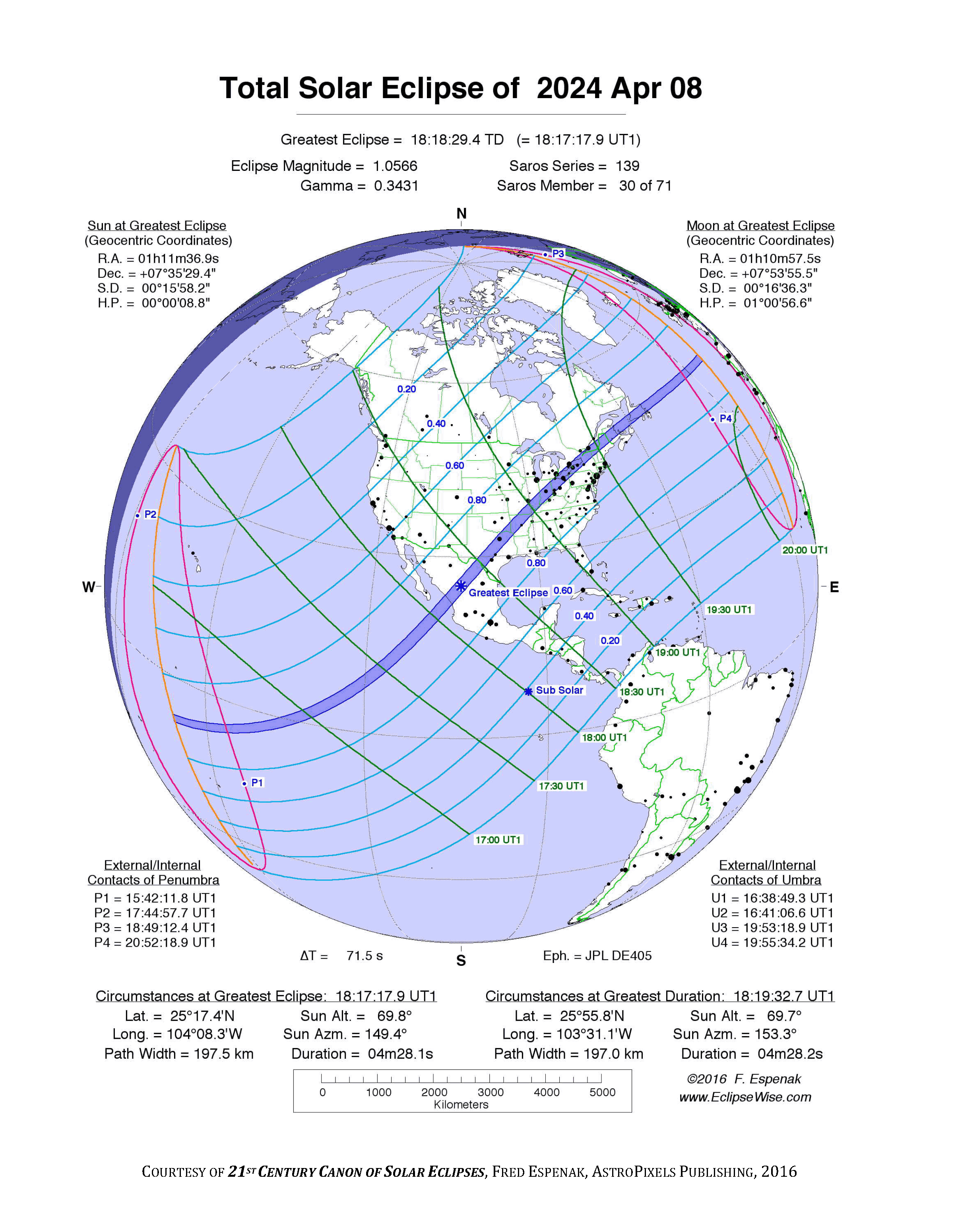
Live streams of the 2024 Total Solar Eclipse (8 April UT).
 |  |
| Total Solar Eclipse as seen from Dallas, Texas on 8 April (US time 9April in Australia). Simulated in Stellarium. | Chart of the path of the solar eclipse from Fred Espenak's eclipse site |
Sadly, none of the 2024 total solar eclipse is visible from Australia. However, there are several live streams of the event we Southern Hemispherians can log into. Again, sadly, the eclipse is starting at 16:38 UT on the 8th, and is greatest at 18:17 UT. This translates to around 2 am and 4 am on the 9th (Tuesday) in Eastern Australia, so you have to be up very, very early. If you are a diehard eclipse fan, here are some live streams for you (many may be oversubscribed or choked for band width, so you may have to hop around to find one that works).
Time and date: Live-stream starts 2 am AEST on the 9th. https://www.timeanddate.com/live/eclipse-solar-2024-april-8
Virtual Telescope Project: Live-stream starts around 3 am AEST on the 9th. https://www.virtualtelescope.eu/webtv/
NASA TV. Live-stream starts around 3 am AEST on the 9th. https://science.nasa.gov/eclipses/future-eclipses/eclipse-2024/live/
Exploratorium. https://www.exploratorium.edu/eclipse
Space.com. Live-stream stars around 3 am AEST on the 9th. https://www.space.com/watch-total-solar-eclipse-april-8-online-free-livestreams
Labels: eclipse, live-stream, solar eclipse, webcast
Saturday, January 06, 2024
Coming Events: A Year of Southern Astronomy for 2024

The table below shows significant astronomical events that can be seen with the unaided eye or minimal equipment in 2024 in Australia (and to some degree elsewhere in the Southern Hemisphere, ocultations and eclipses are very region specific).
This year we get a Penumbral Lunar eclipse best visible from eastern Australia. We get multiple occultations of Saturn (some daylight only). A couple of occultations of the Pleiades, and an occultation of the bright star Antares (only visible western and central Australia). There are good oppositions of Jupiter and Saturn. Mars is at opposition in January 2025 but we get a good run up to it. We also get a comet in September/October, C/2023 A3 Tsuchinshan-ATLAS, which may be a fizzer but just might be spectacular.
As well we have some fantastic parings and lineups and good meteor showers.
Close pairings of the Moon and bright planets are given special
attention as not only is the Moon a ready guide to locating the planets
if you are not familiar with them, these massings are rather beautiful.
Special events are bolded.
| Date | Event |
| January | |
| 03 January 2024 | Earth at Perihelion |
| 09 January 2024 | Crescent Moon near Venus in morning twilight. |
| 10 January 2024 | Crescent Moon near Mercury in morning twilight. |
| 14 January 2024 | Crescent Moon close to Saturn in evening twilight. |
| 18 January 2024 | First Quarter Moon near Jupiter in evening. |
| 20 January 2024 | Occultation of the Pleiades (Perth best from 21:14 AWST, also Adelaide, Darwin good, just 17 Tau, Brisbane, Hobart, Sydney) |
| 28 January 2024 | Mars and Mercury very close (0.2° apart) |
| February | |
| 08 February 2024 | Venus near crescent Moon in morning (5° apart) |
| 9 February 2024 | Mercury near crescent Moon in morning (~5° apart) |
| 11 February 2024 | Thin Crescent Moon and Saturn close low in the evening twilight (5° apart) |
| 15 February 2024 | waxing Moon near Jupiter in the evening (4° apart) |
| 21-24 February 2024 | Venus and Mars around 1° apart in the morning twilight. |
| 25 February 2024 | Apogee (mini) Full Moon |
| March | |
| 9 March 2024 | Venus close to thin crescent Moon (3° apart) low in morning twilight |
| 1-9 March 2024 | Mercury within 5° or Venus in morning twilight |
| 13-14 March 2024 | Crescent Moon near Jupiter in evening twilight |
| 20 March 2024 | Earth at Equinox |
| 22 March 2024 | Saturn very close to Venus (0.6° apart), very difficult low in the morning twilight |
| 25 March 2024 | Apogee (mini) Full Moon |
| 25 March 2024 | Penumbral Lunar Eclipse |
| April | |
| 6-7 April 2024 | Crescent Moon brackets Mars and Saturn in the morning twilight. |
| 8 April 2024 | Crescent Moon and Venus close low in the morning twilight |
| 11 April 2024 | Saturn and Mars spectacularly close (0.4° apart) in morning sky. |
| 10-11 April 2024 | Crescent Moon near Jupiter in the evening twilight |
| 19 April 2024 | Mercury and Venus close low in the morning twilight (difficult, requires binoculars and a level horizon) |
| May | |
| 04 May 2024 | Daytime occultation of Saturn (east coast from around 9 am) |
| 05 May 2024 | Early Morning occultation of Neptune (east coast from around 4 am) |
| 05 May 2024 | Crescent Moon very close to Mars (0.3° apart) in morning twilight. |
| 6-7 May 2024 | Eta Aquariid meteor shower |
| 06 May 2024 | Crescent Moon near Mercury in the morning twilight |
| June | |
| 03 June 2024 | Mars near to thin crescent Moon (3° apart) in morning sky. |
| 4-5 June 2024 | Jupiter and Mercury close (3° apart) low in morning twilight (binocular event) |
| 21 June 2024 | Earth at solstice |
| 27 June 2023 | Saturn is occulted by the moon just after 23:00, low on the eastern horizon (eastern states and SA) |
| July | |
| 2 July 2024 | Mars near crescent Moon (5° apart) in morning sky. |
| 3 July 2024 | Jupiter near crescent moon in the morning sky, at this time Jupiter forms a second eye for Taurus the Bull being 6° from the other eye, bright red Aldebaran) |
| 5 July 2024 | Earth at aphelion, waning Moon near Saturn in the morning sky. |
| 8 July 2024 | Thin crescent moon near Mercury (6° apart) low in evening twilight |
| 16 July 2024 | Mars and Uranus very close (0.5° apart) in the morning sky. |
| 24 July 2024 | Saturn near waning Moon (5° apart) in the evening sky |
| 25 July 2024 | Mercury near Regulus (6° apart) in the evening twilight. |
| 29-30 July 2024 | Southern Delta Aquarids meteor shower in morning |
| 30 July 2024 | Occultation of Pleiades (from around 5 am local time on). |
| 31 July 2024 | Jupiter near crescent moon (6° apart) in morning sky. |
| August | |
| 06 August 2024 | Mercury, Venus and crescent Moon form a triangle to the evening twilight |
| 15 August 2024 | Jupiter and Mars very close (0.3° apart) in morning sky |
| 20-21 August 2024 | The Moon brackets Saturn. |
| 28 August 2024 | Jupiter, Mars, the waning Moon and the bright Star Elnath form a triangle in the morning sky |
| September | |
| 05 September 2024 | Venus close (1° apart) to thin crescent Moon in the evening sky at the end of twilight |
| 08 September 2024 | Saturn at Opposition |
| 09 September 2024 | Mars close (1° apart) to open cluster M35 |
| 10 September 2024 | Occultation of bright star Antares, west, central North (Perth, Darwin, Alice Springs) everywhere else sees a close approach or graze low to the horizon |
| 17 September 2024 | Perigee ("super") Moon near Saturn, occultation in Northern Australia in late twilight (Brisbane, Alice Springs Darwin), close everywhere else. |
| 18 September 2024 | Venus close (3° apart) to the bright star Spica |
| 22 September 2024 | Earth at Equinox |
| 24 September 2024 | Moon near Jupiter in morning sky |
| 26 September 2024 | Moon near Mars in morning sky |
| 09-27 September 2024 | C/2023 A3 Tsuchinshan-ATLAS may be visible low in the morning twilight, if it hasn't broken up, it may be quite bright. |
| October | |
| 5-62 October 2024 | Venus bracketed by thin crescent Moon |
| 13 October on 2024 | C/2023 A3 Tsuchinshan-ATLAS may be visible low in the evening twilight, rapidly rising higher in the evening sky, if it hasn't broken up, it may be quite bright, even visible to the unaided eye. Venus keeps pace with the comet. |
| 14 October 2024 | Saturn close (5° apart) to the Moon in the evening sky. |
| 21-22 October 2024 | Moon brackets Jupiter in the morning sky. |
| 21-22 October 2024 | Orionid meteor shower, last quarter Moon interferes. |
| 25 October 2024 | Crescent Moon near Mars (5° apart), Moon very close to bight star Pollux in morning sky |
| 26-27 October 2024 | Venus close to the bright red star Antares in evening sky. |
| November | |
| 3 November 2024 | Mercury close to thin crescent Moon (2° apart) in evening sky |
| 5 November 2024 | Crescent Moon near Venus (2° apart) in evening sky sky |
| 10 November 2024 | Mercury close to bright red star Antares (2° apart) in evening sky |
| 11 November 2024 | Waxing Moon near Saturn (5° apart) in the evening sky |
| 14 November 2024 | Possible early burst of Leonid meteors, moonlight interference |
| 17 November 2024 | Waxing Moon near Jupiter in the evening sky |
| 18/19 November 2024 | Leonid Meteor Shower, significant Moon interference. |
| 17 November 2024 | Waxing Moon near Jupiter in the evening sky, opposition of Uranus |
| 21 November 2024 | Waxing Moon near Mars (5° apart) in the evening sky |
| 30 November 2024 | Mars close to Beehive cluster (2° apart) in the evening sky. |
| December | |
| 5 December 2024 | Venus near crescent Moon (5° apart) in the evening sky |
| 8 December 2024 | Saturn very close to waxing Moon, daytime occultation in Northern Australia (5:30 pm Darwin) |
| 8 December 2024 | Opposition of Jupiter |
| 14/15 December 2024 | Geminid Meteor shower in the morning, significant Moon interference |
| 14 December 2023 | Waxing Moon near Jupiter (5° apart) in the evening sky |
| 18 December 2024 | Mars near waning Moon in the evening sky |
| 21 December 2023 | Earth is at Solstice |
| 29 December 2024 | Mercury near Moon (6° apart) low in the twilight morning sky |
Labels: Asteroid, Conjunction, eclipse, Jupiter, Mars, Moon, Opposition, Saturn, unaided eye, Venus, Yearly Sky Events
Saturday, October 28, 2023
Partial Lunar Eclipse, Western Australia (Morning October 29)

From the rest of Australia, the Moon will have set before any significant amount of eclipse happens. A tiny sliver of the eclipse is seen from Adelaide just before the Moon sets.
Labels: eclipse, lunar eclipse, Moon
Tuesday, April 18, 2023
Livestreams for the Hybrid Solar Eclipse April 20, 2023

If you can't be at Northwest cape for the April 20, Hybrid Solar eclipse, then you can watch it on several live streams set up for the purpose.
The live streams should start around 10:00 am AWST (11:30 am ACST, 12:00 AEST, 0136 UT) Totality is 11:29 AWST (13:30 ACST, 14:00 AEST)
Perth Observatory: https://perthobservatory.com.au/astronomy/solar-eclipse-live-stream
Time and date: https://www.timeanddate.com/live/eclipse-solar-2023-april-20
Gravity discovery Center: https://www.youtube.com/watch?v=IWEv1DWel3Y
For a guide to the partial eclipse seen from the rest of Australia See my eclipse page (don't forget do NOT look directly at the Sun! and use safe solar observing techniques):
http://astroblogger.blogspot.com/2023/04/hybrid-solar-eclipse-april-20-2023.html
Labels: eclipse, solar, solar eclipse, Sun
Tuesday, April 11, 2023
Hybrid Solar Eclipse, April 20, 2023


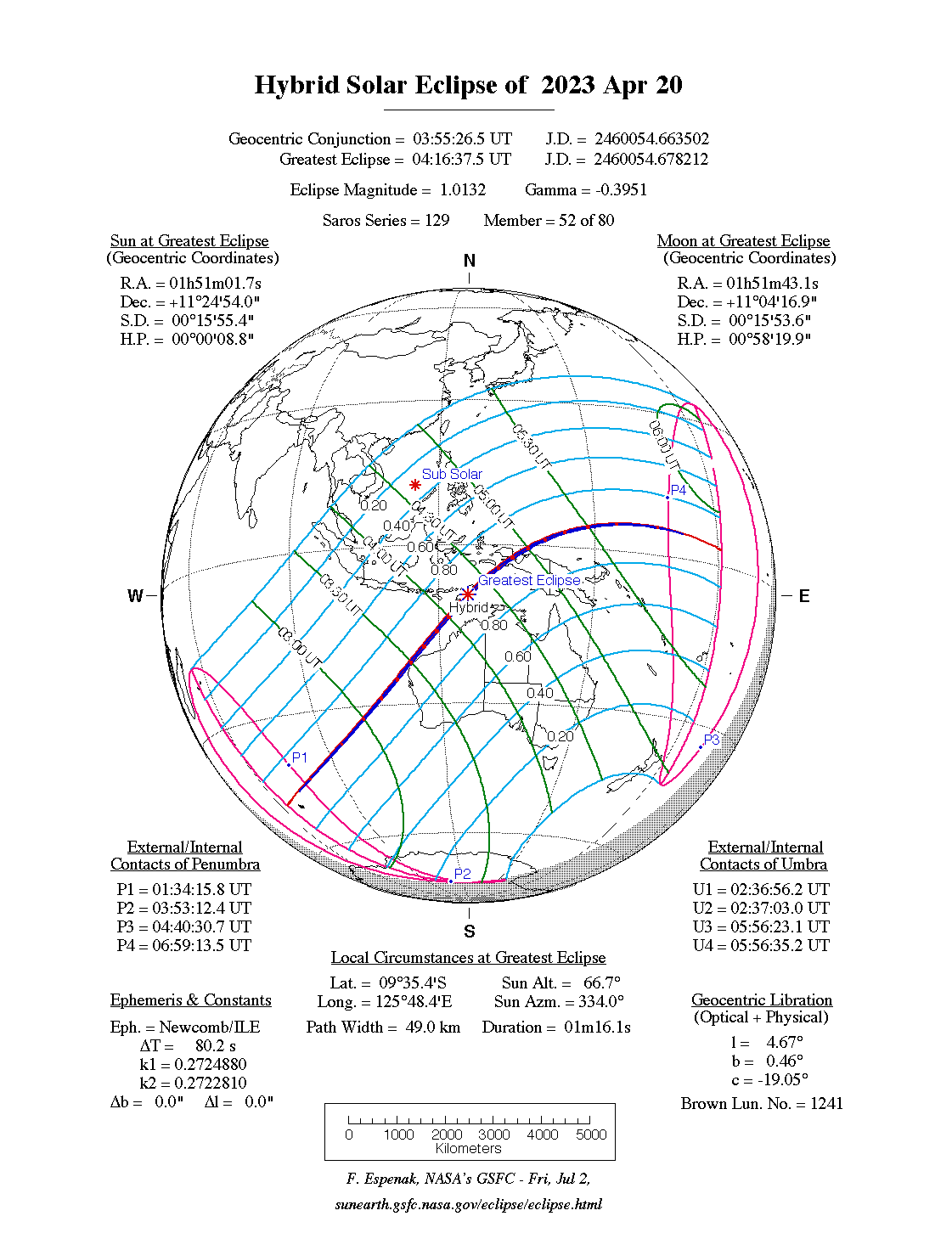
On 20th April the Sun will be eclipsed at the very edge of Australia, the path of totality will pass over the northwest cape in WA, being visible from Exmouth and Learmonth. If you haven’t already booked your campsite or hotel, it is too late, it was all booked out months ago. This is a hybrid eclipse, which annular in some parts of its path and total in others.

The rest of Australia sees a partial eclipse, with WA having the best view, Broome and Geraldton see >80% of the Sun covered: Darwin 80%, Perth 71%, Cairns 50%, Townsville 36% and Adelaide 21%. the partial eclipse begins around 10 am local time WA, 12 pm central states and 1 pm Eastern states (see table below for detailed times and eclipse coverage for selected cities, for places in between these cities the coverage will be about midway and the times similar).
A map showing eclipse times in Universal Time is here.
Do NOT look directly at the Sun! Do not use so called filters. Over exposed film, smoked glass, CD's, chip packets etc. used as filters are NOT, repeat NOT safe. Only special solar-rated viewing spectacles from astronomical suppliers should be used (for one example see here), they may cost a bit, but your eyesight is without price. Never
use eyepiece filters for telescopes. These can crack at inopportune
times and destroy your eyesight. In the annular eclipse path, as there
is always some of the solar disk visible, at no time is it safe to view the eclipse with the unaided eye.
The easiest and cheapest way to observe this event is by making a
pinhole in a stiff square of cardboard and projecting the image of the
Sun onto a flat surface. You are basically making a simple pinhole
camera, which will reveal the changes to the Suns outline quite
satisfactorily. A card with a 1 mm hole should be projected onto a
surface (eg white paper, or a white wall) about 20 cm away, a 5 mm hole
should be projected onto a surface 1 to 1.5 meters away.
You need to create a reasonable sized image, so you need a fair distance
between the pinhole and the surface you project the image on. This will
mean the image is going to be fairly dim, so you also need some sort of
sun shield to keep in image in shadow. I use the longest available
postpac postal tube, with alfoil over the top (and the pinhole in the
alfoil), and wide ring of stiff cardboard to ensure that the image of
the sun is projected into a dark area. This link will show you several
methods to make pinhole projection systems.
You are not limited to holes in cardboard, I have used Water crackers and colanders and gaps between leaves as projection systems.
You can also use binocular and telescopic projection systems. This link will show you how to make safe solar viewing and telescope projection systems. Here is my step by step guide to making a binocular projection system, and a guide to aiming your binoculars or telescope when you can't actually look at the Sun. And this is the projection system I use with my refractor telescope.
Remember, do NOT look directly at the Sun, as irreparable eye damage or blindness can occur (see this video for a graphic demonstration).
| City | Eclipse Start | Mid Eclipse | Eclipse End | % Sun covered |
| Adelaide (ACST) | 12:22 | 13:29 | 14:34 | 21 |
| Alice Springs (ACST) | 12:13 | 13:37 | 15:01 | 48 |
| Brisbane (AEST) | 13:44 | 14:45 | 15:42 | 16 |
| Broome (AWST) | 10:22 am | 11:53 am | 13:27 | 89 |
| Cairns (AEST) | 13:25 | 14:49 | 16:05 | 42 |
| Canberra (AEST) | 13:28 | 14:21 | 15:11 | 10 |
| Darwin (ACST) | 12:18 | 13:52 | 15:25 | 81 |
| Geraldton (AWST) | 09:59 am | 11:22 am | 12:50 | 82 |
| Hobart (AEST) | 13:25 | 14:06 | 14:47 | 5 |
| Melbourne (AEST) | 13:15 | 14:09 | 15:01 | 11 |
| Perth (AWST) | 10:00 am | 11:21 am | 12:47 am | 71 |
| Sydney (AEST) | 13:37 | 14:29 | 15:19 | 10 |
| Townsville (AEST) | 13:27 | 14:47 | 16:00 | 36 |
Cloud cover predictions can be found at SkippySky.
Here is the near-real time satellite view of the clouds (day and night) http://satview.bom.gov.au/
Labels: eclipse, solar eclipse, Sun
Wednesday, January 11, 2023
Coming Events: A Year of Southern Astronomy for 2023

The table below shows significant astronomical events that can be seen with the unaided eye or minimal equipment in 2023 in Australia (and to some degree elsewhere in the Southern Hemisphere, ocultations and eclipses are very region specific).
This year we get a Partial Lunar eclipse best visible from western Australia. A Total Solar eclipse is visible from the tip of Western Australia and everywhere else sees a partial eclipse (best from WA and central north). There are good oppositions of Jupiter and Saturn. We also get an occultation of the Pleiades and a binocular comet.
As well we have some fantastic parings and lineups and good meteor showers.
Close pairings of the Moon and bright planets are given special
attention as not only is the Moon a ready guide to locating the planets
if you are not familiar with them, these massings are rather beautiful.
Special events are bolded.
| Date | Event |
| January | |
| 3 January 2023 | Moon between Mars and Pleiades |
| 5 January 2023 | Earth at Perihelion |
| 21 January 2023 | Crescent Moon near Mercury in morning twilight. |
| 23 January 2023 | Saturn, Venus and Crescent Moon close in the evening twilight |
| 26 January 2023 | Crescent Moon close to Jupiter |
| February | |
| 4 February 2023 | Comet C/2022 E3 visible above northern horizon (binocular) |
| 11-13 February 2023 | Comet C/2033 E3 comes close to Mars the enters the Hyades (binocular) |
| 19 February 2023 | Crescent Moon and Mercury close in the morning twilight |
| 22 February 2023 | Crescent Moon near Venus in evening twilight |
| 23 February 2023 | Crescent Moon close to Jupiter. |
| 28 February 2023 | Waning Moon close to Mars |
| 26-30 February 2023 | Venus and Jupiter come close together ahead of a spectacular conjunction in March |
| March | |
| 2 March 2023 | Venus and Jupiter in a spectacular close approach (0.5 degrees) in evening twilight |
| 3 March 2023 | Mercury very close (1 degrees) to Saturn deep in morning twilight |
| 20 March 2023 | Crescent Moon and Saturn close in early morning twilight |
| 21 March 2023 | Earth at Equinox |
| 24 March 2023 | Crescent Moon and Venus close in evening twilight |
| 28 March 2023 | Waning Moon close to Mars. |
| April | |
| 12 April 2023 | Venus near the Pleiades. |
| 16 April 2023 | Saturn and crescent Moon close in morning sky. |
| 20April 2023 | Total Solar Eclipse; Exmouth WA (partial in the rest of Australia) |
| 23April 2023 | Crescent Moon close to Venus in evening sky |
| 26 April 2023 | Waxing Moon close to Mars in evening sky |
| May | |
| 5/6 May 2023 | Penumbral eclipse of the Moon |
| 6-7 May 2023 | Eta Aquariid meteor shower |
| 14 May 2023 | Waning Moon close to Saturn in the morning sky |
| 18 May 2023 | Mercury, Jupiter and crescent Moon form a triangle in morning twilight |
| 23 May 2023 | Crescent Moon below Venus in the evening sky |
| 24-25 May 2023 | Mars with waxing Moon nearby |
| June | |
| 3 June 2023 | Mars in heart of Beehive cluster (M44), Venus forms line with Castor and Pollux |
| 10 June 2023 | Saturn near waning Moon in morning sky |
| 14 June 2023 | Crescent Moon near Jupiter in morning sky, Venus near Beehive cluster in evening sky |
| 17 June 2023 | Thin Crescent Moon, Mercury and red star Aldebaran form a line low in the morning twilight |
| 22 June 2023 | Earth at solstice |
| 22 June 2023 | Crescent Moon forms triangle with Mars and Venus in evening sky |
| July | |
| 7 July 2023 | Earth at aphelion, waning Moon near Saturn in the morning sky. |
| 8 July 2023 | Venus at greatest brilliance |
| 10 July 2023 | Venus, Mars and the bright star Regulus form a triangle in the evening twilight |
| 12 July 2023 | Crescent Moon close to Jupiter in the morning sky |
| 19 July 2023 | Thin Crescent Moon close to Mercury low in evening twilight |
| 20 July 2023 | Crescent Moon, Venus and bright star Regulus for a triangle in the evening twilight |
| 21 July 2023 | Mars near crescent Moon in the morning twilight |
| 26 July 2023 | Venus, Mercury and Regulus form a triangle |
| 30 July 2023 | Mercury Very close (0.5 degrees) to Regulus, Venus close by |
| 29-30 July 2023 | Southern Delta Aquarids meteor shower |
| August | |
| 2 August 2023 | Perigee Full Moon (“super” Moon) |
| 3 August 2023 | Saturn close (2 degrees) to Moon in evening sky |
| 8-9 August 2023 | Jupiter near waning Moon |
| 18 August 2023 | Thin crescent Moon forms triangle with Mercury and Mars in evening twilight |
| 19 August 2023 | Thin crescent Moon forms line with Mercury and Mars in evening twilight |
| 27 August 2023 | Saturn at opposition |
| 30 August 2023 | Saturn near waxing Moon in evening |
| 31 August 2023 | Perigee Full Moon (“Super” Moon) also Blue Moon |
| September | |
| 4 September 2023 | Jupiter close to waning Moon in evening sky |
| 12 September 2023 | Thin crescent Moon close to Venus in dawn sky |
| 16-17 September 2023 | Crescent Moon near Mars |
| 23 September 2023 | Earth at Equinox |
| 27 September 2023 | Saturn close to the waxing Moon |
| October | |
| 1-2 October 2023 | Jupiter and waning Moon near in evening sky |
| 11 October 2023 | Venus and crescent Moon close in morning sky |
| 24 October 2023 | Saturn and the waxing Moon close in evening sky |
| 21-22 October 2023 | Orionid meteor shower |
| 28 October 2023 | Twilight partial eclipse of the Moon (best from WA) |
| 29 October 2023 | Jupiter and the Full Moon close in evening sky |
| 30-31 October 2023 | Ocultation of the Pleiades (before midnight 30th to early morning 31st) |
| November | |
| 3 November 2023 | Opposition of Jupiter |
| 10 November 2023 | Crescent Moon near Venus in morning sky |
| 14 November 2023 | Opposition of Uranus |
| 18 November 2023 | Leonid Meteor Shower |
| 20 November 2023 | Waxing Moon near Saturn in the evening sky |
| 25 November 2023 | Waxing Moon near Jupiter in Evening sky |
| 29 November 2023 | Occultation of bright star Beta Tauri in morning sky |
| December | |
| 10 December 2023 | Venus and crescent Moon close |
| 14 December 2023 | Geminid Meteor shower in the morning |
| 14 December 2023 | Mercury near thin crescent Moon low in the twilight |
| 17-18 December 2023 | Waxing Moon near Saturn in the evening |
| 22 December 2023 | Earth is at Solstice |
| 22 December 2023 | Jupiter near waxing Moon in the evening |
| 23 December 2023 | Asteroid Vesta at opposition |
| 31 December 2023 | Venus, Mercury and Mars form a triangle low the twilight morning sky |
Labels: Asteroid, Conjunction, eclipse, Jupiter, Mars, Mercury, Moon, Opposition, Saturn, unaided eye, Venus, Yearly Sky Events



 Click to read about or order
 Click to read about or order
 Click to read about or order
 Click to read about or order