Saturday, May 30, 2026
"Blue" Apogee Full Moon (with Occulation) 31 May, 2026
 |  |
| Full Moon May 31 18:42 ACST, 90 minutes after sunset as seen from Adelaide, similar views will be seen form the rest of Australia at the equivalent local time (click to embiggen). | Full Moon May 31 18:17 ACST Antares is just coming out of occultation ("Blue" apogee moon +19hrs apogee 15:02 1st June, Full Moon 19:15 31st.) |
The Full Moon this Sunday May 31 is a "Blue" apogee Moon, the second full Moon in a month, and also (almost) at its furthest from Earth. Astronomical Full Moon is at 19:15 31st, astronomical apogee is 9hrs later on 15:02, 1st June. See if you can fix its image in your mind for comparison with our two perigee Moons, November 25th and December 24. The differences are in Full Moon size are subtle.

There is also a difficult occultation of Antares, the brightest star in Scorpio. This starts low in the twilight and is mostly visible from the east coast, but egress of Antares may be easier to view. For details see my Occultation of Antares page for major city times.
Labels: apogee, Blue Moon, Moon, Occultation

Wednesday, January 13, 2021
2021: From "Super" Moon to "Mini" Moon and back, a year of full Moons
 |  |  |
| Full Moon January 29, 0:500 AEST | Full Moon February 27 18:00. Minimum libration -30h | Full Moon March 29 05:00 AEST, Perigee +35h March 10. |
 | 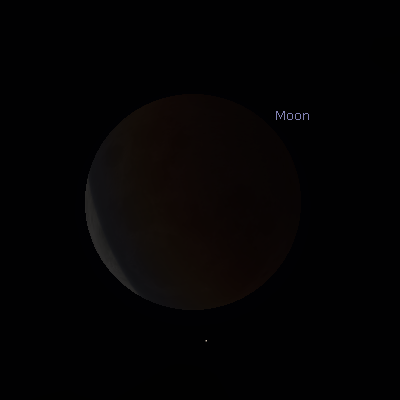 |  |
| Full Moon April 27 14:00, perigee April 28 + 11h | Full Moon May 26 21:00, perigee May 26 -9h Total Lunar Eclipse. 21:10 | Full Moon June 25 05:00, perigee June 23 -24h |
 |  |  |
| Full Moon July 24 13:00. | Full Moon August 22 22:00. Maximum Libration +24 h | Full Moon September 21 10:00. |
 |  | 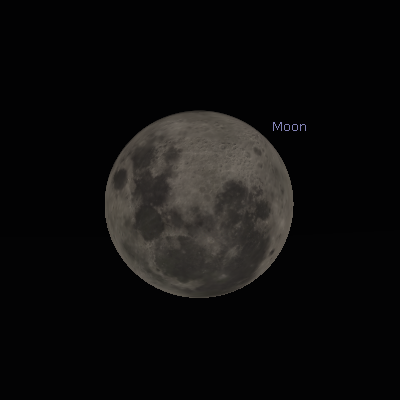 |
| Full Moon October 21 01:00, | Full Moon November 19 19:00, apogee +41h. Twilight Partial Lunar eclipse | Full Moon December 19 15:00 Moon at apogee 18th -26h |
A year of full Moons showing the variation in size as the moons move from perigee to apogee. All the moons are shown on the day and time (AEST) they are full (unless they are below the horizon, in which case the size at astronomical twilight is shown), and although this is not the optimal time for size comparisons, you can clearly see the size difference over the year (compare April 27 to November 19) the original scale for all is 2 degrees of field of view cropped down to about two lunar diameters width). Although the field rotation of the Moon makes it less clear, you can also see the effect of libration.
In 2021 we have two good Perigee Moon is a row (April 27, May 26). One of which is a total Lunar Eclipse Moon (May 26). However, as you can see the differences are subtle, and it requires a keen eye and good memory to distinguish a perigee "super" Moon from more ordinary moons, the best contrast is with the apogee "mini" moons of November 19/December 19).
That doesn't mean you shouldn't try though. Daniel Fischer has been able to see the difference, you can read his account and viewing tips here
http://earthsky.org/space/can-you-discern-supermoons-large-size-with-the-eye-an-observer-says-yes
Photographing them can be more rewarding. You can see images of perigee Moon and apogee Moon pairs from 21 Jan 2019 here and 10 August 2014 here.Tips for photographing them are here.
Labels: apogee, Blue Moon, Moon, perigee, public outreach, unaided eye, Yearly Moons
Tuesday, January 14, 2020
2020: From "Super" Moon to "Mini" Moon and back, a year of full Moons
 |  |  |
| Full Moon January 11, 0:500 AEDST Penumbral eclipse | Full Moon February 09 18:33, perigee + 36h (Feb 11). Minimum libration -2h | Full Moon March 10 04:48 AEDST, Perigee +12h March 10. Minimum libration. |
 |  |  |
| Full Moon April 08 12:35, perigee April 08 + 8h | Full Moon May 07 20:45, perigee April 06 -19h Minimum libration. | Full Moon June 06 05:00, Penumbral eclipse 05:25 |
 |  |  |
| Full Moon July 05 15:00. | Full Moon August 04 02:00. | Full Moon September 02 15:00. Maximum Libration +11 h |
 |  |  |
| Full Moon October 2 07:00, | Full Moon October 31 (WA only, Blue Moon for WA 23:00 AWST) (apogee 05:47 AEDST) | Full Moon November 1 02:00, apogee -20h. Minimum libration +27h |
 |  |  |
| Full Moon November 30 21:00 Blue Moon, all states except WA Penumbral eclipse Eastern states 19:43 Minimum libration | Full Moon December 30 14:00 | Full Moon 2021 January 30 06:19 |
A year of full Moons showing the variation in size as the moons move from perigee to apogee. All the moons are shown on the day and time they are full (unless they are below the horizon, in which caase the size at astronomical twilight is shown), and although this is not the optimal time for size comparisons, you can clearly see the size difference over the year (compare April 8 to October 31) the original scale for all is 2 degrees of field of view cropped down to about two lunar diameters width). Although the field rotation of the Moon makes it less clear, you can also see the effect of libration.
In 2020 we have two Perigee Moon is a row (or four if you cont the Feb and May ones which only barely scrape in as perigee Moons). However, as you can see the differences are subtle, and it requires a keen eye and good memory to distinguish a perigee "super" Moon from more ordinary moons, the best contrast is with the apogee "mini" moon of October 31/November 1).
That doesn't mean you shouldn't try though. Daniel Fischer has been able to see the difference, you can read his account and viewing tips here
http://earthsky.org/space/can-you-discern-supermoons-large-size-with-the-eye-an-observer-says-yes
Photographing them can be more rewarding. You can see images of perigee Moon and apogee Moon pairs from 21 Jan 2019 here and 10 August 2014 here.Tips for photographing them are here.
There is also a "Blue" Moon. On October 31 in WA and November 30 in the rest of Australia (due to time Zones).
Labels: apogee, Blue Moon, Moon, perigee, Yearly Moons
Thursday, January 25, 2018
A Rare Total Eclipse on a Blue Moon, Wednesday January 31, 2018
 | 
|  |
| North-eastern horizon as seen from Sydney on 31 January at at 23:15 pm AEDST. The eclipse is about halfway to totality. The inset shows the telescopic/binocular view at this time. Click to embiggen | North-eastern horizon as seen from Adelaide on 31 January at 10:51 pm ACDST. The eclipse is about halfway to totality. The inset shows the telescopic/binocular view at this time. Click to embiggen | Eastern horizon as seen from Perth on 31 January at 21:15 pm AWST. The eclipse is about halfway to totality. The inset shows the telescopic/binocular view at this time. Click to embiggen |
On the evening of Wednesday 31 January there will be the an excellent total eclipse of the Moon, the first since September 2015 (for Australians, the last one was 4 April 2015 as we could not see the September eclipse).

"Blue" Moons are not actually blue but are the second full moon to occur in a month. They are uncommon and lunar eclipses on a blue Moon are rarer. While you will see North American sites claiming this is the first "blue" Moon in 152 years, for Australia our last ‘blue moon’ total eclipse was on 30 December 1982. As well, a few times a century, there are two blue Moons a year, 2018 is such a year with ‘blue moons’ in January and March. The last time we had two ‘blue moons’ was in 2010.

You will also see some sites calling this a "blood Moon", The Moon does not turn the colour of blood, but will go a deep copper colour due to the refraction of red light through our atmosphere. This will be a fairly deep eclipse with the Moon becoming quite dark. You may even see the Beehive cluster become visible to the unaided eye next to the Moon during totality.
The 31 January eclipse starts after twilight has ended in the eastern and central states. In Western Australia the partial phase begins at civil twilight, and totality starts when the sky is fully dark. Totality is long and deep, over an hour compared to only 12 minutes long for the 4 April eclipse in 2015. See timings table below.
You don't need special filters or fancy equipment to watch the lunar eclipse, you just need your eyes and somewhere comfortable to sit and watch. Watching earth's shadow creep across the Moons face, as the stars begin to appear again is quite beautiful. The moon is very obvious to the east-north east. Binoculars or a telescope are a plus, but not necessary.
A guide I wrote for the October 2014 lunar eclipse to taking photos of the eclipse is here.
On the East coast, the eclipse starts after when the sky is quite dark at 9:48 pm AEST (10:48pm AEDST) and Totality is at 10:51 pm AEST (11:51 pm AEDST), so the Moon will appear to be a burnished copper disk in a dark sky full of stars. As totality fades you will see the stars extinguish.
In the central states the eclipse starts just after Nautical twilight at 9:18 pm ACST (10:18 pm ACDST) and Totality begins at10:21 pm ACST (11:21 pm ACDST) after the sky is fully dark. Central states will also see the eclipsed Moon in all its coppery glory and if you wait past midnight you can see the stars fade as the Moon returns.
In WA, the eclipse starts just after civil twilight and the moon will look quite dramatic as it climbs above the horizon with the earth's shadow creeping across its face , but totality will occur when the sky is fully dark. The eclipse starts at 7:48 pm AWST and Totality begins at 8:51 pm AWST.
The eclipse starts reasonably high in the sky (except WA where it starts close to the horizon) and is good viewing from almost anywhere. Totality is around midnight in the central and eastern states, a bit late for the kids but it is school holidays. This such a good eclipse it is worth letting them stay up.
New Zealand sees the eclipse in the early morning of the following day (February 1).
See here for a map and contact timings in Universal Time for sites outside Australia.
| City | Civil Twilight | Astronomical twilight | Moonrise | Eclipse Start | Totality Start | Maximum Eclipse | Totality End | Eclipse End |
| Adelaide (ACDST) | 8:51 pm | 10:00 pm | 8:11 pm | 10:18 pm | 11:21 pm | 12:00 pm | 00:38 am | 01:42 am |
| Alice Springs (ACST) | 7:47 pm | 8:45 pm | 7:11 pm | 7:45 pm | 9:24 pm | 11:00 pm | 11:38 pm | 00:42 am |
| Auckland (NZT) | 9:02 pm | 10:13 pm | 8:15 pm | 00:47 am | 01:51 am | 02:29 am | 03:07 am | 04:11 am |
| Brisbane (AEST) | 7:08 pm | 8:09 pm | 6:28 pm | 9:48 pm | 10:51 pm | 11:30 pm | 00:08 am | 01:12 am |
| Cairns (AEST) | 7:20 pm | 8:45 pm | 6:41 pm | 9:48 pm | 10:51 pm | 11:30 pm | 00:08 am | 01:12 am |
| Canberra (AEDST) | 8:45 pm | 9:56 pm | 7:58 pm | 10:48 pm | 11:51 pm | 00:30 pm | 01:08 am | 02:12 am |
| Christchurch (NZT) | 9:29 pm | 10:55 pm | 8:40 pm | 00:47 am | 01:51 am | 02:29 am | 03:07 am | 04:11 am |
| Darwin (ACST) | 7:41 pm | 8:34 pm | 7:07 pm | 7:45 pm | 9:24 pm | 11:00 pm | 11:38 pm | 00:42 am |
| Hobart (AEDST) | 8:39 pm | 10:02 pm | 7:53 pm | 10:48 pm | 11:51 pm | 00:30 pm | 01:08 am | 02:12 am |
| Melbourne (AEDST) | 9:02 pm | 10:15 pm | 8:20 pm | 10:48 pm | 11:51 pm | 00:30 pm | 01:08 am | 02:12 am |
| Perth (AWST) | 7:46 pm | 8:51 pm | 7:10 pm | 7:48 pm | 8:51 pm | 9:30 pm | 10:08 pm | 11:12pm |
| Rockhampton (AEST) | 7:10 pm | 8:08 pm | 6:31 pm | 9:48 pm | 10:51 pm | 11:30 pm | 00:08 am | 01:12 am |
| Sydney (AEDST) | 8:28 pm | 9:35 pm | 7:46 pm | 10:48 pm | 11:51 pm | 00:30 pm | 01:08 am | 02:12 am |
| Townsville (AEST) | 7:17 pm | 8:13 pm | 6:40 pm | 9:48 pm | 10:51 pm | 11:30 pm | 00:08 am | 01:12 am |
Labels: astrophotography, Blue Moon, eclipse, Moon, public outreach
Sunday, June 06, 2010
Mars and Regulus are close!
 If you have been watching the evening skies you will have seen Mars and Regulus drawing closer together. They look quite a sight now close together in the evening (the two brightest objects in the lower left hand side of the image, Saturn is top right, click to embiggen).
Mars is at its closest to Regulus on Monday June 7. The Morning of Monday June 7 is when Jupiter is close to the waning crescent Moon, and Jupiter and Uranus are at their closest on the 8th.
Labels: Blue Moon, Jupiter, Mars, Saturn, unaided eye observation
Sunday, March 28, 2010
Blue Moon Tuesday March 30, 2010
 The Full Moon on March 30th at 21:00 AEDST, similar views elsewhere in Australia at equivalent local time.
The Full Moon is Tuesday March 30 (for Australians). This is a "Blue" Moon, in modern terms the second full Moon in a month. We also had a "Blue" Moon in January. "Blue" Moons roughly occur once every 2.5 years, but to have two in the same year is rarer, roughly once every 20-25 years.
Unlike in January, when the Moon was the biggest it will be this year, this Moon will be fairly ordinary.
Sunday, January 31, 2010
Blue Moon from Hot Earth
 If you though the Full Moon last Staurday night (30 January, 2010) was big, it was. The Moon was the biggest we will see this year, due to the full Moon falling on the night of the Moons closest approach to Earth.
It was also a "Blue" Moon, the second full Moon of the Month. This year, we will have a second "Blue" Moon in March.
Labels: astrophotography, Blue Moon, Moon
Friday, January 29, 2010
Opposition of Mars (and a blue Moon), Saturday January 30 2010
 The "Blue" Moon and Mars, looking north-east at 10:00 pm local daylight saving time as seen from Australia.
This Saturday Mars is at opposition, where it is biggest and brightest as seen from Earth. It is also the night of the "Blue" Moon, and the Moon this night will have the largest apparent diameter of the year. So all in all a good night.
Mars will be easy to spot, it rises not long after the Moon and will be the bright red object left of the Moon.
 Mars through binoculars. A few nights after opposition, Mars and the beautiful Beehive Cluster will be within the same binoculars filed of view.
Most of you remember the Mars Hoax email back in August, whch has circulated every two years since the Great opposition in 2003, which claimed that Mars would look as big as the Moon. Well, as you can clearly see tomorrow night it is not, Mars will just be a bright dot next to the Full Moon.
In binoculars (see image left) Mars will still be a bright dot. You will only see Mars as a disk in a telescope, and then you will need a medium to large telescope to see any detail. Still, even if you are just seeing a small disk, you are looking at an alien world, sister to our own, where robots are ceaselessly braving the harsh environment to gain knowledge. That's got to be impressive.
 Mars as seen at this opposition through a 6" telescope with a 12 mm eyepiece.
So why is the opposition of Mars so rubbish this year. Basically because Mars is nearly at its furthest from the Sun, and Earth is nearly at its closest. Amongst other things it means light takes nearly 9 hours to reach Earth from Mars, while in 2003, it took only 5 hours.
Yeah, Okay you say, but why does it vary, why isn't Mars at the same distance each opposition? Because Mars's Orbit is not a whole number of earth orbits long, so the dates of perihelion and aphelion for Mars and Earth drift with respect to each other. (see the Hoax page for a more detailed description and this page for a better description).
So the upshot is that 2010 and 2012 are pretty poor oppositions, and we have to wait until 2018 fro a really good one (although 204 and 2016 won't be too bad).
Labels: Blue Moon, Mars, Opposition
Sunday, June 14, 2009
What is the Moon REALLY Made Of?
 Tony Travaglia of Otago, New Zealand has done it again! He's taken this fantastic image of the Moon and it's spectrum. I can't wait to see what else he photographs with his new spectrograph.
Saturday, May 30, 2009
Don't Forget the "Blue" First Quarter Moon!
Thursday, April 30, 2009
Half a Blue Moon is better than no Blue Moon.
 Idly looking at my lunar tables recently, I noted that May has two First Quarter Moons (2nd and 31st respectively in Australia). This shouldn’t be a surprise. It takes approximately 29.4 days for the Moon to go from any given phase to return to that phase, so if a given phase falls on the 1st or 2nd of a month, it will turn up again on the 30th or 31st (of course, 28 day long February messes things up).
Yet, we are (sort of) surprised when we get two Full Moons in one month. Because the time from Phase to Phase (eg Full Moon to Full Moon) is 29.4 days, and the average length of a month is 30.4 days[1], any lunar phase will be roughly a day earlier in the following month (except the February to March roll-over, for obvious reasons). So the Lunar phases drift through the months.
For example, a Full Moon that starts on the 1st of a given month it will take roughly 30 months (or 2.5 years) to occur on the 1st again, (again, this get messed up a bit by 28 day February).
At least part of our surprise is due to the vast majority of us not remembering the previous blue moons 2.5 years in the past (hey, I can’t remember what I had for breakfast, so remembering that is a bit of an ask), and partly our disinclination to remember Solar and Lunar system data and do long division in our heads.
We express that surprise with a special name for the second of two Full Moons that occur in the same month[2], a "Blue Moon", this has come to be synonymous with something occurring rarely (Once in a Blue Moon). Although, at an average of once every 2.5 years it’s not that rare.
But why don’t we have a special name for the second of two First Quarter Moons? Or for two consecutive New Moons, or Last Quarter Moons in a month? After all, they will be as rare as two consecutive Full Moons (roughly every 2.5 years). In part, it’s due to the importance of the Moon in our lives, or for those of us in the industrialised world, the lives of our grandparents. In the days before artificial lighting was wide spread and of high quality, the light of the Full Moon was needed if you wanted to hold an event at night. The Full Moon was a signpost to agricultural activities (Harvest Moon anyone), and a visible calendar. So of course people will take notice when two Full Moons occur in a month.
When two New Moons occur in a month, who but the astronomers will know or care? Likewise for two Last Quarter Moons, unless you are an astronomer, fisherperson or a farmer you are not likely to be up early enough to see a Last Quarter Moon, let alone realise that there are two of them in a month. But First Quarter Moons, we all can see them, and for many of us they are companions on our way home from work. True, the impact of Last Quarter Moons on our collective psyche is less (notice how in movies or paintings or cartoons the Moon is almost always Full, or a narrow crescent, First Quarter Moons feature very rarely), but still as an easily observable Moon Phase I think we should have a name for them.
How about a “Half-Blue” Moon? Any suggestions?
Dates of “Blue Moons”, ie months were two of any given lunar phase fall in the same month (not just two full Moons in a month the standard definition). Note that every year has at least one “Blue Moon” of some type.
| Date | New | FQ | Full | LQ |
| 1999 | - | - | May | Oct |
| 2000 | July | - | - | - |
| 2001 | - | Apr | Nov | - |
| 2002 | - | - | - | August |
| 2003 | May | Nov | - | - |
| 2004 | - | - | Jul | - |
| 2005 | Dec | - | - | May |
| 2006 | - | Aug | - | - |
| 2007 | - | - | Jun | Dec |
| 2008 | Jan | - | - | - |
| 2009 | - | May | - | - |
[1] Because we run a solar calendar, and the Lunar “year” is shorter than the solar one. People seem to object to the seasons moving through the year more than the Lunar phases moving through the year. Also, rather inconveniently the solar year is 365.24 days long, making it impossible to design a stable calendar of integer day length, hence months with different days in them and leap years.
[2] This usage is actually due to a writer from Sky & Telescope, earlier usages seem to have been “the third of four full moons in 3 months”.
Labels: Blue Moon, miscelaneous, Moon
Saturday, June 30, 2007
Venus and Saturn together!
 Venus and Saturn setting on the evening of Friday, June 29. Click image to enlarge it, Regulus is the brightish star above the pair near the top of the image.
The dance of the planets climaxes tonight and tomorrow night (June 30th, July 1st) when Venus and Saturn are at their closest. Of course, most of southern Australia and the eastern seaboard are under cloud, or being flooded, or just recovering from floods, so viewing this event may not be easy.
Still, do make an effort, this is a fairly rare and attractive event. The best times to look are between 6:00 pm and 8:00 pm (your local time), Venus will be very easy to recognise, being the brightest object in the north -west sky, Saturn will be the dimmer object only about a fingerwidth away. In a small telescope you can see both Saturn and Venus together in a lowpower objective. This will be very nice.
Also, tonight (Saturday June 30th) is a Blue Moon.
Labels: astrophotography, Blue Moon, Observational Astronomy, Saturn, Venus
Tuesday, June 26, 2007
Blue Moon This Saturday
If you want to sing the "Blue Moon" song on saturday night, here are the lyrics (along with a range of other Moon songs).



 Click to read about or order
 Click to read about or order
 Click to read about or order
 Click to read about or order


