Thursday, February 17, 2011
Tyche, it's not Nibiru (and probably not even real)
 It was inevitable, after the British newspaper The Independent overhyped some researchers claims about the possible existence of a jovian (or larger) mass planet out in the Oort belt, some Nibiru folks have jumped on this.
The Bad Astronomer has already dealt with the likelihood of there actually being a planet out there, so I won't go into any detail. Just to briefly recap though, statistical analysis of long term comets suggested (with marginal statistical significance), more comets were bring ejected from the Oort cloud in the plane of the ecliptic than elsewhere, and the researchers hypothesised that there was a Jovian (1-4 Mjup) mass planet disturbing the Oort cloud. You can read their latest paper here.
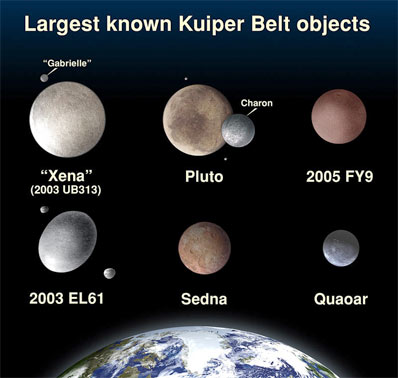 The take home message from this paper is that, should Tyche exist (the proposed name for the planet should it in fact exist), is that it is, at its closest 2,000 au from the Sun. Depending on the mass of course, the bigger the planet is, the further it is from the Sun to produce the effects seen. A 5 MJup planet would have to be 6,000 au away (roughly 1/10 of a light year). To give a feel for this scale of this distance, Pluto is roughly 40 au away, Eris (Xena) at its most distant is roughly 98 au away and Sedna at its most distant is 960 au away (currently it is a mere 90 au away).
That's a loooonnnng, long way way (nearly a light month at 2,000 au, over a light month at 6,000 au). Very simply, if Tyche does exist it's not going to turn up in the inner solar system in 2012 (and it is not Nibiru).
Of course, it is not clear that the Nibiru folks are conflating Tyche and Nibiru, they might just be claiming that the possible existence of Tyche justifies the possible existence of Nibiru, but when you have people getting all flustered about a 22 ° halo, it's hard to know what they think.
But then again, the paper helps out there, the authors have searched the IRAS archives extensively, and they conclude there is no 1-4MJup planets out to 2,000 au, so Nibiru is not out there.
Of course, instead of jumping at and down at the latest press release, or images of haloes, the Nibiru folks could have been actually looking for themselves. The IRAS archives are publicly available, there are heaps of remote telescopes that you can buy time on to serach with and of course, most decent amateur scopes would be able to pick out a Mjup planet at Pluto's distance, so there are many avenues for searching. And if Nibiru is going to be in the inner solar system in 2012, then they have a good idea where to look.
So why aren't they looking for real?
Labels: Pseudoscience, scepticism, weirdness

Monday, November 08, 2010
Why ...
... is the second largest referrer URL to astroblog some Divorce Lawyers site?
Labels: weirdness
Wednesday, March 17, 2010
Cower in Terror....Only not right now.
 Gliese 710 hurtles towards an unsuspecting Sun (which is too dim to be seen in this Celestia image*)
Passed on by commenter JupiterIsBig. Be afraid, be .. somewhat afraid.. for the star Gliese 710 is hurtling our way and will cause a lethal hail of comets in .. well.. in 1.5 Million years. I'm not starting building the impact shelters yet. By the time it comes close we will probably be able to move stars around at will anyway (or be long extinct, one or 'touther).
What does this demon star of doom look like. Well, if you could see it from Australia tonight, (which you can't as it is below the horizon), you would need a small telescope to see the inauspicious magnitude 9.2 star just below eta serpens. It may look harmless now, safely 63 light years away, but whoompph! By a mere 1.5 million years it will be within 1.1 light years and will wreak havoc with our Oort cloud and Kuiper Belt, causing an umm, maybe a 5% increase in comet impacts?
Yes, I'm shaking in my boots.
The abstract of the paper is here, and the full paper here.
*sadly, tragically, you can set the date to 1.5 million years ahead in Celestia, but it doesn't move the stars according to their radial velocity. I'll try and come up with a fix.
Labels: miscelaneous, peer-reviewed research, weirdness
Tuesday, February 03, 2009
What the heck was that?
Walking back from the rubbish bin, I was taken aback by the sight of two bright stars close together. For a moment I was confused, I didn't remember any bright pairs in the north-east. I then realised that the one on the left was Betelgeuse and the one on the right was ... completely unknown.
As I watched it slowly faded, going from about magnitude zero to magnitude 4 in around a minute (or a bit more). I couldn't see it moving though (or if it was it was moving vvveeerrryyy slowly.
It might have been a satellite, but its lack of movement suggests it wasn't, and neither Heavens Above nor the Skymap satellite database show anything in that region (just above mu Orionis) at around 20:50 ACDST. It might be some weird glint off a geostationary satellite, but I don't have access to geostationary satellite TLE files. I could also be a "point Meteor" where a meteor is coming into the atmosphere almost driectly along yor line of sight, although the slowlness of the fading seems to make this unlikley.
So a small mystery. Anyone able to shed any light?
As I watched it slowly faded, going from about magnitude zero to magnitude 4 in around a minute (or a bit more). I couldn't see it moving though (or if it was it was moving vvveeerrryyy slowly.
It might have been a satellite, but its lack of movement suggests it wasn't, and neither Heavens Above nor the Skymap satellite database show anything in that region (just above mu Orionis) at around 20:50 ACDST. It might be some weird glint off a geostationary satellite, but I don't have access to geostationary satellite TLE files. I could also be a "point Meteor" where a meteor is coming into the atmosphere almost driectly along yor line of sight, although the slowlness of the fading seems to make this unlikley.
So a small mystery. Anyone able to shed any light?
Labels: Observational Astronomy, weirdness
Wednesday, November 28, 2007
gla·brous (adj)
 Glabrous gla·brous –adjective Zoology, Botany. having a surface devoid of hair or pubescence.
I .. I can't tell you why, but I had to draw this to exorcise an image in my mind. Imagine the figure saying "Are you my Mummy?"
I .. I still think I have to move to Alice Springs, as far away from the ocean as possible.
Curse you PZ Myers!!!
Labels: weirdness
Tuesday, June 19, 2007
Heavy Metal on Titan
Via NewScientist, this is an MP3 file that lets you hear Deep Purple's "Smoke on the Water" as if played on Titan and Venus. That's assuming you could find instruments and a band that could survive crushingly dense superhot sulfuric acid atmospheres (or astoundingly frigid ones). The first clips is as it sounds on Earth, then on Titan, the sound is deep and rich and finally on Venus, despite being hot and heavy, the sound is surprisingly thin and tinny (but try increasing the volume). The combination of low temperature and slightly higher pressure on Titan means that sound is transmitted more efficiently. For the full paper explaining the atmospheric effects on sound, go here.



 Click to read about or order
 Click to read about or order
 Click to read about or order
 Click to read about or order


