Monday, November 11, 2019
Live Streaming and Webcasts of the Transit of Mercury (12 November/11 November UT)
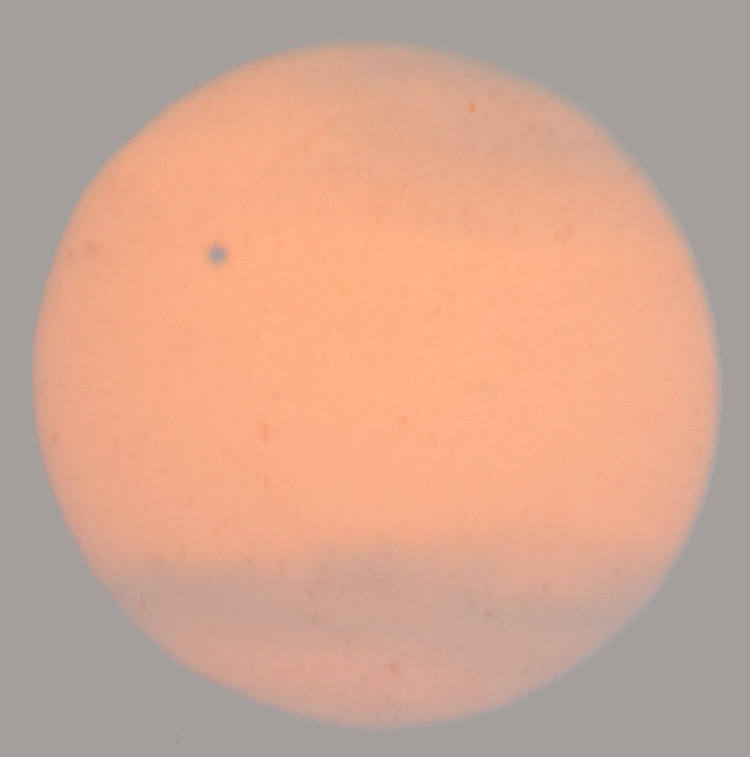
 Transit of Mercury as seen from Australia in November 2006 at around
8:30am, click to enlarge. Mercury is the tiny dot roughly in the
centre-top.
Transit of Mercury as seen from Australia in November 2006 at around
8:30am, click to enlarge. Mercury is the tiny dot roughly in the
centre-top.Sadly, Australia will not get to see it (we will get to see the next in 2032 though). However, there are any number of live web-casts you can follow.
While these are all at horrible times here in Australia, if you are a late stayer or an early riser, you can catch a rare event.
| Event | Universal Time | AEDST |
| Contact I | 12:35:27 | 23:35 (11th) |
| Contact II | 12:37:08 | 23:37 (11th) |
| Greatest Transit | 15:19:48 | 02:19 (12th) |
| Contact III | 18:02:33 | 05:04 (12th) |
| Contact IV | 18:04:14 | 05:04 (12th) |
Webcasts:
Time and date: https://www.timeanddate.com/live/
Space.com: https://www.space.com/mercury-transit-2019-viewing-guide.html
Vimeo: https://livestream.com/GriffithObservatoryTV/MercuryTransit2019
Royal Observatory: https://www.rmg.co.uk/discover/explore/when-is-the-next-transit-of-mercury
Labels: live-stream, Mercury, transit, webcast

Monday, May 09, 2016
Watch the Transit of Mercury on Streaming TV (tonight, May 9)
 Transit of Mercury as seen from Australia in November 2006 at around 8:30am, click to enlarge. Mercury is the tiny dot roughly in the centre-top.
Virtual Telescope Project: http://www.virtualtelescope.eu/webtv/
Global Star Party: https://www.youtube.com/watch?v=EX-quH2cFyw
Slooh: http://live.slooh.com/stadium/live/transit-of-mercury-2016
Saturday, September 06, 2014
The ISS zooms past Saturn, Mars and Antares

After a long spell of missing the International Space Station (no passes, cloud, driving kids about), tonight's bright pass did not disappoint.
A beautifly clear sky, slightly pale from moonlight. The ISS climed up past Acturus, brightening as it went, the quiclly falsed past Saturn, Mars, throgh the head of the Scorpion, past Antares then glided over the Southern sky.
Very nice indeed. I should have used a shorter exposure, as the ISS rapidly shot through the Scorpion, but here is a 3 frame animated GIF of the flyover.

There a few more nice bright passes this week, but none quite so beautiful as seen from Adelaide.
Labels: ISS, Mars, Saturn, transit
Monday, June 18, 2012
The Transit of Venus, The Movie
The Transit of Venus movie from iTelescope.Net, the Research School of Astronomy and Astrophysics and the Australian Astronomical Observatory. The live webcast from Siding Spring was made into a Youtube video by Peter Lake.
Enjoy.
Enjoy.
Labels: iTelescope, transit, Venus
Monday, June 11, 2012
Still More Venus Transit Awesomeness
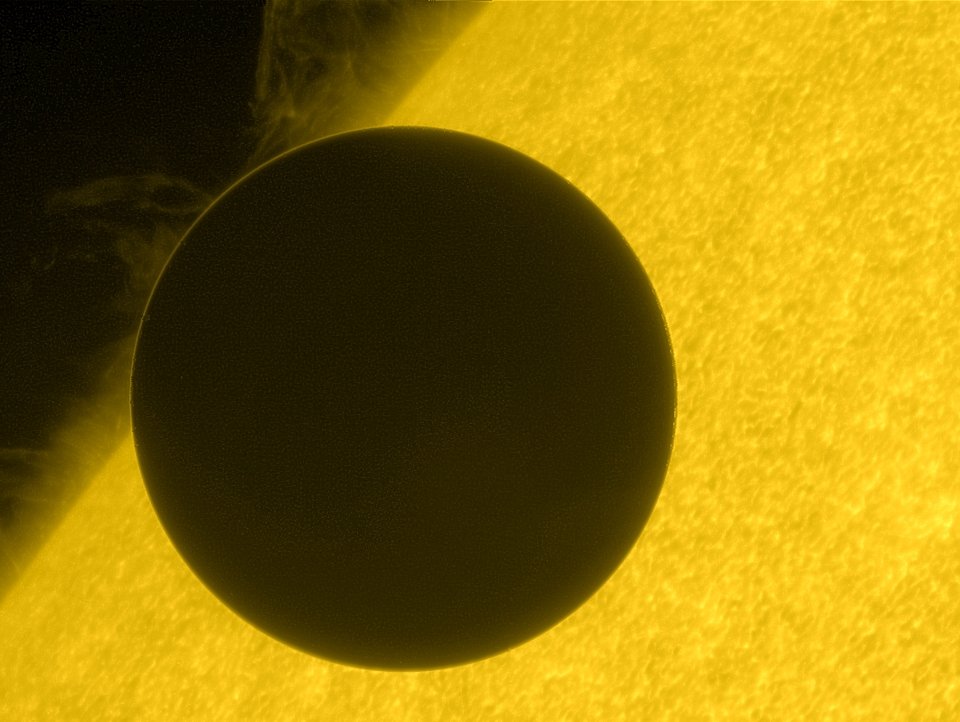
There is still more Venus Transit awesomeness out on the web. You may have seen some of these before, but they bear revisiting.
Firstly, run, don't walk to see Thierry Legault's amazing image of the
Then there is the Hinode image of Venus's atmosphere being backlit by the Sun, which made Astronomy Post of the Day.
Another Astronomy Post of the Day was this image of Venus on the rising Sun. And here's another great Venus Sunrise from Will Gater.
Ice in Space has a magnificent image of the week with Venus transiting the Sun in Hydrogen Alpha light. The ABC's Transit of Venus page has an image gallery and videos as well.
Labels: astrophotography, transit, Venus
Sunday, June 10, 2012
Images from My Transit of Venus, June 6 2012

|  |
| My first image of Venus at 10:26 am ACST when the clouds had broken. | Near mid transit at 11:04 am. The varying colours are due to the cameras auto exposure function, and its lag when clouds come over. |
 | 
|
| After a cloud interlude, Venus approaches the Sun's limb | Just before 3rd contact at 1:52 pm ACST |
 I had great plans for the Transit of Venus on June 6 2012, the last until 2117. I had made a binocular projection system, I had my 4" Newtonian telescope with a glass aperture solar filter, a home-made Baader filter for my 8" Newtonian telescope and a mini Baader filter for my Olympus camera.
Wednesday dawned cloudy. Actually, when I first woke up the sky was mostly clear, but huge slabs of cloud moved over where the Sun would be shortly before Sunrise, ending any hope I had of seeing first and second contact.
This was the pattern for the day, large parts of the sky would be sparkly blue, except where the Sun was. Due to the weather I made a decision to only use the binocular projection system and my 4" Newtonian scope, as these systems could be moved around a lot more quickly than the homogeneously heavy 8". Also, although I have a time drive on the 8", it drifts slowly. With brief patches of blue coming over the Sun at short, widely spaced intervals, the time to realign the scope would be too long to catch the breaks. So I stuck with the simpler systems.
An added complication was that SmallestOne was sick and had to stay home too. He wasn't THAT sick, well enough to watch TV and play computer games, but I still had to keep an eye on him and give him his medications at the prescribed times. So I divided my time between moaning at the clouds, looking after SmallestOne, watching the live webcasts and rushing out when gaps in the cloud came up.
 I had a great Transit. I took heaps of shots through the 4" scope. Most were useless, with cloud coming over just as I was imaging, or the scope shaking with the wind. Getting the focus right was a pain too. But I could watch the progress of the transit with the binocular projection system easily while I fiddled with the camera.
Some people came over and I showed them the transit with the projection system (I had to move quickly to stop one person trying to look through the eyepiece rather than at the card the image was projected on. Even SmallestOne came out and had a look (he wasn't impressed). Compare this transit with my Transit experience in 2004.
Even though I thought I had carefully placed my scope, just as third contact was coming up, the Sun went behind a tree. So I rapidly moved the scope and binoculars, and hurriedly realigned and refocused in time to see Venus approach the Sun's limb.
And the clouds came over again.
Nonetheless, I was able to get sufficient shots to see third contact and just before fouth contact (I though I had 4th contact but I was fooled by the low magnification image). I have made the final series of images into the animation below. It's a bit jerky as at lot of frames were unusable due to cloud. The weird tiny black speckles are due to the GIF to AVI translation. Images taken using infinity to infinity imaging a Canon IXUS and a 4" reflector with aperture filter and 25 mm eye piece, the camera was held in place by a commercial adapter (see image of the scope above).
Animation of third and fourth contact. Images were imported into GIMP as layers, aligned using the difference function and manual alignment, the cropped, exported as an animated GIF, then converted to AVI with ImageJ.
Reflecting after it was all over, what was really good was the degree to which the astronomical community, both amateur and professional, put a lot of time into making sure the general public got to experience the transit, either by making their won projection systems, public outreach events or webcast. As well as thoroughly enjoying my own experience, I'm glad I could help in some small way to let others experience it.
Labels: animation, astrophotography, gimp, imageJ, transit, Venus
Friday, June 08, 2012
Other Peoples Transit of Venus Images and Videos

I'm still processing my images, so I thought I'd put up links to fantastic images that people have sent me or pointed me to. Cynthia Ma's image to the left is great.
Comet Al has a brilliant series of images and a great animation taken using a simple projection system.
Rob Kaufmann has a wonderful shot from Bright Victoria, he had less luck with second contact due to turbulence as this video shows. Chris Wyatt has a great video of second contact from Burren Junction, NSW. Chris of SiriusCybernetics has some great shots. Hristo Pavlov got some nice images from Sydney despite the weather. Adam Marsh has a nice series of photos. Roland Gesthuizen has a great Storify essay.
In the international section a good video from Taiwan. The transit of Venus with a seagull http://flic.kr/p/bUB2bF and with a plane http://flic.kr/p/bUBcP8. A cloudy one from Dorset by Stuart http://flic.kr/p/cbY8bb and of course a huge Flickr gallery http://www.flickr.com/photos/tags/transitofvenus/
The Bad Astronomer has a great Transit gallery too.
UPDATE: I forgot Andrew Thomas' stunning images at his blog, Dennis Persyk's transit images and astronomy boy's transit images. Sorry folks!
Labels: astrophotography, Cynthia Ma, transit, Venus
Wednesday, June 06, 2012
Sic Transit Venus

The iTelescope SSO webcam is going well with some dropouts,
http://www.ustream.tv/channel/itelescope
The Universe Today webcam is going strong.
http://www.universetoday.com/95630/watch-the-transit-of-venus-live/
Can't currently connect to the RiAus livestream or the transit.org livestream, and astronomers without borders website has disappeared.
http://home.mira.net/~reynella/skywatch/transven12.htm#webcams
UPDATE: The Sun is toying with me!
The transit seen from the Solar Dynamic Orbiter http://ow.ly/i/FYep/original
UPDATE: the RiAus Adelaide livestream is overwhelmed, but the Perth one should come online soon.
http://livestreaming.riaus.org.au/
UPDATE 9:57 am: My first (out of focus) mobile phone image http://astroblogger.blogspot.com.au/2012/06/mobile-phone-transit.html
SDO transit movie: http://www.youtube.com/watch?
UPDATE 10:18 am: Nice picture here https://p.twimg.com/AuqrJzfCMAAm_h3.jpg


UPDATE 10:40 am: SDO images here http://venustransit.gsfc.nasa.gov/
RiAus Perth livestream online and looking good http://livestreaming.riaus.org.au/
UPDATE 11:47 am: Long stretch of clear sky, several pictures taken aroun mid transit, mobile phone images still disappointing despite crispness of projected image http://astroblogger.blogspot.com.au/2012/06/venus-at-mid-transit-by-mobile.html
Apparent a backhoe has gone through the cable providing livestreaming to several sites.
UPDATE 12:38 pm: Recharging camera batteries, lots of pictures. They may not be great. UQLD has a livestream http://www.mso.anu.edu.au/public/transit/transit.php
UPDATE 12:51 pm: Clouds again, livestream from exploratorium at Manua Loa, http://virtualtelescope.bellatrixobservatory.org/webtv.html
intermittent cloud at Siding Spring

UPDATE 2:55 pm: Battled clouds and trees but saw Venus egress. Pretty amazing. Will have to sort out images and make an animation now.
Labels: transit, Venus, webcam
Tuesday, June 05, 2012
Twas the Night Before the Transit...

...and all through the house, not a creature was stirring except those astronomers frantically getting ready for the transit.
The historic transit of Venus is tomorrow (6 June), starting early in the morning. While some of you will have taken time off work (or made simple observing devices to take to work), not everybody can do this. Also, your locality may be clouded out. Webcams to the rescue!
My transit website has a list of live web-feeds, and links to sites with even more web-feeds. But of these many links I’d like to draw attention to two:
The iconic Siding Spring Observatory will have a live feed courtesy of iTelescope.Net, the Research School of Astronomy and Astrophysics and the Australian Astronomical Observatory. The web-cast will start on June 6, 2012 at 8am local time at Siding Spring (June 5, 2012 at 22:00 UTC). http://www.ustream.tv/channel/itelescope
The Royal Institute of Australia will also have a live stream: http://riaus.org.au/events/livestreaming-of-the-transit-of-venus/
As well there are a number of public viewings.
If you still want to make some projection systems, then there is a step by step guide for making a cheap binocular projection system here http://astroblogger.blogspot.com.au/2012/05/step-by-step-guide-to-making-binocular.html
and how to know where to point your telescope when you can’t look through the viewfinder. http://astroblogger.blogspot.com.au/2012/05/okay-so-how-do-i-point-my-telescope-at.html
And don’t forget the excellent Venus Transit Series over at The Conversation.
The Transit of Earth from Mars, November 10, 2084

The cool thing about transits of Earth from Mars is you also get to see the Moon as well. The image to the left is the Stellarium simulation of the transit of Earth on 2084.
The next transit of Venus to be seen from Mars is in 2030.
Labels: Mars, stellarium, transit, Venus
The 2012 Transit of Venus in Stellarium

Anyway, copy the following script to a file called venus_transit.ssc, put it in the scripts folder, then run it through the scripts tab in the configuration menu. Enjoy!
====================>8 cut here >8==================
//
// Name: Venus Transit
// License: Public Domain
// Author: Ian Musgrave
// Description: Simple script to demonstrate the transit of Venus from Adelaide.
//
core.wait(1);
core.clear("natural");
// Turn off constellation lines and labels if on, flag planets.
ConstellationMgr.setFlagLines(false);
ConstellationMgr.setFlagLabels(false);
SolarSystem.setFlagPlanets(true);
core.wait(1);
// OK, move to the proper location and date for the Transit, time is UT
// you can change this to your location in decimal Long lat
// note stellarium does Long Lat not lat long like everyone else
// Select the Sun and track it
core.setDate("2012:06:05T22:09:29");
core.setObserverLocation(138.59863, -34.92866, 10, 0, "Adelaide, Australia");
core.selectObjectByName("Sun", false);
StelMovementMgr.setFlagTracking(true);
core.wait(2);
// Zoom in on the Sun
StelMovementMgr.zoomTo(0.6, 2);
core.wait(2);
// Speed up the action
core.setTimeRate(250);
// When Transit over set to normal speed and zoom out
core.waitFor("2012:06:06T06:59:28");
core.setTimeRate(1);
StelMovementMgr.zoomTo(60, 2);
Labels: stellarium, Sun, transit, Venus
Sunday, June 03, 2012
Podcast of My Radio Interview on the Transit of Venus
Well, the session was recorded and you can hear it at the 891 Sunday Morning Blog. My apologies to real astronomers fro some imprecision in my language.
For those listening (or who listened to the show and wanted to know). My guide to safe binocular projection systems is here.
The live streams/webcasts I mentioned are:
- Siding Spring Observatory and iTelescopes ustream site for the transit.
- Livestreaming at RiAus
And don't forget the Astronomical Society of South Australia will hold a public viewing in Adelaide Festival Plaza (behind Parliament House) form 7:30 am weather permitting. There is a a public lecture on the transit which will take place at 8 pm in the Kerr Grant Lecture Theatre, Physics Building, the University of Adelaide.
Labels: eclipse, podcasts, public outreach, Radio, science communicators, transit, Venus
Saturday, June 02, 2012
Preparing for the Transit of Venus?
 Morning sky on Wednesday
June 6 looking north-east as seen from Adelaide at 7:45 am local
time in South Australia showing the Sun. The left inset shows the
appearance of Venus seen
telescopically at this time with Venus just entering the Sun's disk.
The right inset shows the appearance of the Sun and Venus near maximum
transit. Similar views will be
seen elsewhere at the equivalent
local time (click to embiggen)
Morning sky on Wednesday
June 6 looking north-east as seen from Adelaide at 7:45 am local
time in South Australia showing the Sun. The left inset shows the
appearance of Venus seen
telescopically at this time with Venus just entering the Sun's disk.
The right inset shows the appearance of the Sun and Venus near maximum
transit. Similar views will be
seen elsewhere at the equivalent
local time (click to embiggen)It's 4 and a bit days until the last Transit of Venus until 2117. This weekend is an ideal time to set up your telescopes and binoculars and do some test runs to make sure everything will run smoothly on the day.
Make sure your digital cameras batteries are well charged (ad if you are using a telescope drive, that its batteries are fresh too). Send some time of the weekend getting a feel for the focus requirements of you camera after you have the scopes or binoculars ste up.
Don't forget to check out my Transit of Venus site with timings, observing hints, public viewings and webcams.
Labels: astrophotography, transit, Venus
Friday, June 01, 2012
On the Radio Yet Again!
This Sunday (3 June) I will be on Ashley Walsh's program on 891 ABC Adelaide at 11:40 am ACST (UTC +10:30) talking about the upcoming Transit of Venus on Wednesday (and the Lunar Eclipse on Monday). Tune in around 11:30 just n case we start early.
Labels: public outreach, Radio, science communicators, transit, Venus
Thursday, May 24, 2012
Transit of Venus, June 6 2012
 My image of the 2004 Transit of Venus, taken with a Pentax K SLR and actual film.
 It's two weeks now until the Transit of Venus, the last one we will see until 2117. The rare transits of Venus occur when Venus passes directly between us and the Sun.
This occurs roughly ever 100 years or so, then there are two in quick succession, eight years apart.
The last was in June 2004, you can see my images from that transit here. The next starts just after sunrise on Wednesday June 6 (in Australia and New Zealand). June 5 in other parts of the world)
 Safe solar projection rig for observing the sun with binoculars. Note that this is for projecting an image onto a card or a wall (I was using a wall here). NEVER look though the eyepiece of a projection system pointed in the vicinity of the Sun. See here for step by step details of making a binocular projection system, showing projection onto a surface.
 The transit can be viewed without fancy equipment, using safe solar projection techniques. If you are at work, you can pop out and view it at lunchtime with simple, portable kit.
The best views will be with with telescopes, but you don't need lots of money to watch this once in a life time event.
I have set up a webpage for this years transit of Venus. It has timings of when the transit starts and ends for various Australian cities, viewing tips, and links to webcasts, public viewing and more information. I've also added it to the links on the side of the blog. I will be also adding more details of actually constructing some of these projection systems.
So go and have a read, and start preparing for the transit!
Labels: astrophotography, transit, Venus
Thursday, February 03, 2011
Kepler -11, Kepler Bags A Very Strange Solar System


Left Panel: The Kepler-11 solar system, 6 confirmed planets orbiting around a sun-like star, all within what would be the orbit of Venus. Right Panel: Kepler-11c transit as seen from Kepler-11d, with 11B about to transit next. Kepler-11 system visualized in Celestia (click to embiggen).
The Kepler spacecraft has been really busy. Hot on the heels of the magma world Kepler-10b comes a very different solar system, Kepler-11. Kepler 11 is a multi-planet solar system, with 6 confirmed planets it ties with HD 10180 the biggest solar system known to date ( HD may have a 7th planet, but it is currently unconfirmed, Gliese 581 may have 6 planets, but two of the planets are currently unconfirmed).
However, this solar system is unlike that of ours. Kepler-11 is a Sun-like G class star, around the same size and luminosity as our Sun. However, its stable of detected planets all huddle well inside the equivalent of the orbit of Venus. They zip around their central star in a handful of days, and the two innermost are quite close to each other. Of the 6, 4 are Neptune-like and two, b and f, are most likely water worlds (boiling water in the case of b).
Multi-planet systems are rather rare, of the 521 planetary systems found by transit and radial velocity measurements, only 59 are multiple planetary systems. This is most likely an artifact of how we discover exoplanets; small planets are hard to find against a background of big planets, as are planets with long orbital periods. Also, with transiting planets the system has to be in the right orientation to have the outer planets observably transit.
Of course, you can visualize this system in Celestia. First you need to create a file in the extras folder that has the star Kepler-11 in it (see the Kepler-10b post), I've already created one, and you can download newextrasolar.stc here, then copy into the Celestia extras folder. Then you need the file the sets out the exoplanets (Kepler11abcdef.ssc, download it here and copy into the extras folder), and Robert is your avuncular relative.
So download the files and have a play. (I'll post about the 1200 planets Kepler has found, and the Earth-like ones, tomorrow).
Labels: celestia, exoplanet, extrasolar planet, transit
Wednesday, September 22, 2010
In which I am Revealed as an Idiot
Well, I anxiously awaited the transit of the ISS over the Moon, The cloud, initially socking in the whole sky, cleared over the Moon. I got out Don, the 8" scope, set it up well in advance, time drive was working well. Got out the camera and ran some test videos. All was working well.
With the GPS timer counting down I was fully set up 3 minutes before the passage, and I watched, and waited..
and waited..
and waited...
.. and by the time realised that INV on the CalSky timing link meant "invisible" and lunged for the camera on button, the ISS has crossed the Moon.
Yes, it was a dark pass folks, I should have realised, but I only got the alert just before I left for work, and had to rush to get it out, then I was fooled by the Stellarium ISS tracking, which showed it as a visible pass (AHHRRGGG!!!). Yes, the only way you could have seen this was telescopically, with the dark ISS silhouetted against the Moon (And Yes, I should have double checked when I got home, but I was setting up in between getting kids into baths, washing up etc).
Still, I know my wide field video setup works, even if I have 60 seconds of uninteresting video of the Moon (sigh).
With the GPS timer counting down I was fully set up 3 minutes before the passage, and I watched, and waited..
and waited..
and waited...
.. and by the time realised that INV on the CalSky timing link meant "invisible" and lunged for the camera on button, the ISS has crossed the Moon.
Yes, it was a dark pass folks, I should have realised, but I only got the alert just before I left for work, and had to rush to get it out, then I was fooled by the Stellarium ISS tracking, which showed it as a visible pass (AHHRRGGG!!!). Yes, the only way you could have seen this was telescopically, with the dark ISS silhouetted against the Moon (And Yes, I should have double checked when I got home, but I was setting up in between getting kids into baths, washing up etc).
Still, I know my wide field video setup works, even if I have 60 seconds of uninteresting video of the Moon (sigh).
Labels: astrophotography, ISS, Moon, transit
Friday, June 11, 2010
Update on the ISS Transit and Occultation
Why yes, they were both clouded out. Did you need to ask?
Actually, for the ISS transit there was a small window of opportunity between the rain and the cloud. I rushed outside to set up, and got involved in an amusing tangle of gear. The transit probably happened while I was trying to unjam the mounting I had jammed in my haste to set up. The the clouds came over again.
And this morning the rain was kind enough to wake me in time for the occultation, should it have been visible behind the clouds.
Actually, for the ISS transit there was a small window of opportunity between the rain and the cloud. I rushed outside to set up, and got involved in an amusing tangle of gear. The transit probably happened while I was trying to unjam the mounting I had jammed in my haste to set up. The the clouds came over again.
And this morning the rain was kind enough to wake me in time for the occultation, should it have been visible behind the clouds.
Labels: Moon, Occultation, Pleiades, transit
Wednesday, June 09, 2010
The ISS passes in front of the Sun in Adelaide.
 On Thursday June 10 at 14:51:46 the International Space Station will cross the Sun as seen from Adelaide.
To see this event you will
a) need to practise safe solar projection techniques (see also here and here). NEVER look directly at the sun, or use so called solar filters. Especially with binoculars or telescopes. For a dramatic example of what happens when you look at the sun directly through a telescope; look at this video...nasty isn’t it.
b) be quick, the ISS crosses the Sun in 2 seconds.
 So you will need an accurate clock or timer and to be staring intently at the image (or have a fast camera).
Of course, this is in the afternoon during a work day, so watching may not be feasible, but if you can organise to watch please do so.
ISS path at14:50- 14:52 Thursday June 10 as seen from Adelaide.
Sunday, February 21, 2010
ISS and Shuttle Shoot the Moon in South Australia
 Track of ISS and Shuttle around maximum height above ground (roughly 20:34 -20:36 ACDST, this image is printable, click to embiggen).
Short notice sorry, but if you live in South Australia (and places close to the SA/Vic or SA/WA border) you can see the International Space Station (ISS) and the Space Shuttle pass in front of the Moon at around 20:34 or 20:36 (Heavens above and the Human Spacecraft centre have a two minute difference in the pass time) tonight (Sunday February 21).
If you live in parts of the Northern Territory (eg Alice Springs, you can see the Space Shuttle and ISS but they will not be near the Moon (7:34 pm and 7:38 pm for the Shuttle and ISS pass respectively). In all cases the shuttle and ISS are passing in twilight, the ISS should be easy to see, while the Shuttle may be more difficult. The shuttle is 2 minutes ahead of the ISS. Elsewhere the pair rise during daylight or are not seen at all.
 More realistic view of the sky when the pair are passing over.
From SA, the pair rise in the west and head for the Northwest, passing over the Moon. It's best to start looking around 20:30 so that your eyes are accommodated and you are oriented in the sky. In NT the pair rise in the south and head east (19:30 in NT).
Don't give up if the pair are a little late, this can happen. For local timings see http://www.heavens-above.com/ (require free registration) or http://spaceflight1.nasa.gov/realdata/sightings/ (no registration but data for only a few cities in any given state).
UPDATE: Bah! Humbug! Cloud!
Labels: ISS, Satellite, Space Shuttle, transit, unaided eye



 Click to read about or order
 Click to read about or order
 Click to read about or order
 Click to read about or order