Sunday, March 03, 2013
Yet More Updates on the Potential Impact of C/2013 A1 (Siding Spring) with Mars

This is still further out than the 0.00023 AU close approach of 2012 DA14, which missed us by two Earth diameters.
The calculated probability of the comet hitting Mars now is around 0.08%. See Leonid Elenin's article at SpaceObs for more details.
http://spaceobs.org/en/2013/03/03/probability-of-collision-with-mars/

Friday, March 01, 2013
Further Updates on the Potential Impact of C/2013 A1 (Siding Spring), it gets closer and watching it in STEREO
Events are moving rapidly in the story of C/2013 A1 Siding Spring and its close approach to Mars in 2014.
Leonid Elenin and the ISON team have made new measurements of the comets position, the refined orbit brings it to within 41,000 Km from Mars (we still can't exclude an impact yet though).
Talk about luck, Astroswanny notes that the Mars atmospheric analysis orbiter MAVEN arrives a few days before the comets closest approach.
While the close approach can be seen with telescopes, if you don't have a telescope then you can watch the event in the STEREO H2A instrument.
Hopefully I can get some images of the comet over the next few days and contribute to the effort of making its orbit more accurate.
Leonid Elenin and the ISON team have made new measurements of the comets position, the refined orbit brings it to within 41,000 Km from Mars (we still can't exclude an impact yet though).
Talk about luck, Astroswanny notes that the Mars atmospheric analysis orbiter MAVEN arrives a few days before the comets closest approach.
While the close approach can be seen with telescopes, if you don't have a telescope then you can watch the event in the STEREO H2A instrument.
Hopefully I can get some images of the comet over the next few days and contribute to the effort of making its orbit more accurate.
Labels: comet, impact, Mars, NEO, public outreach, Stereo astronomy, Stereo Satellite
Tuesday, August 24, 2010
Update on Potential Jupiter Impact
Just updating news about the Potential Jupiter Impact of August 20. Over at Sky&Telescope there are reports and links to videos, of two independent observations of the flash. The planetary society also has a good report on the event.
Monday, August 23, 2010
Another Asteroid/Comet Impact on Jupiter
A Japanese amateur astronomer imaging Jupiter on August 20 UT has recorded a flash which may be an impact on the giant planet. The report is here, and you can see a video of the impact flash here. With the 19 July 2009 and 2010 June impacts, it looks like things hitting Jupiter might be more common than we thought.
Friday, June 04, 2010
Something Goes Crash on Jupiter AGAIN!
 Anthony Wesley does it again! This is a still image of his 45 Mb video at the link above showing the flash from an impact on Jupiter. Christopher Go, another superstar of Jupiter observation has a fantastic video of the same event.
Back on 19 July last year Anthony Westley observed a dark spot on Jupiter that was probably the result of an impact. Ironically, today the Bad Astronomer was reporting on a paper that suggests the July 2009 impactor was an asteroid.
Just after I read the BA's article the intertubes exploded with news of Wesley's find and Go's confirmation. There is notification at Ice In Space, and a good discussion thread there. Amateur astronomers world wide will be hanging out to see if they can pick up dark patches as seen with Wesley's first discovery and the Shoemaker-Levy impact.
The Bad Astronomer follows up with more information, and there is lots of action at the planetary society blog too. Aussies keep an eye on the Ice in Space Forum and get your 'scopes out!
Unfortunately for Australians, the impact site returns to Jupiter's Earth facing side during our daytime (2:30-7:30 UT).
Thursday, October 08, 2009
LCROSS will go BANG on the Moon this Friday
But we in Australia (New Zealand, South-East Asia) won't see it. The Lunar Crater Observation and Sensing Satellite will crash into crater Cabeus this Friday at 11:30 UT, that's 22:30 AEDST, 22:00 ACDST and 20:30 AWDST. Unfortunately from our point of view the Moon doesn't rise until after 11:00 pm (23:00 AEDST). NASA's viewing guide is here. NASA TV will cover the impact starting at 10:15 UT, that's 21:15 AEDST, 20:45 ACDST and 19:15 AWDST. Be prepared for the intertubes to be jammed though.
Wednesday, July 22, 2009
Something Goes Crash on Jupiter
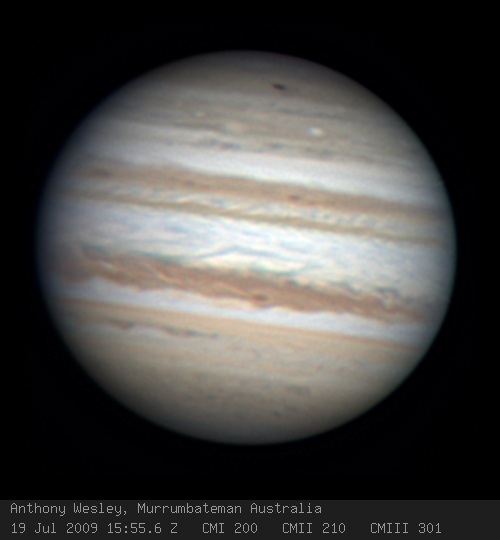 Image Credit Anthony Wesley on 19th July 2009 at 1554UTC from Murrumbateman Australia.
On July 19th Australian amateur astronomer Anthony Wesley photographed a dark patch on the surface of Jupiter (top of image) reminiscent of the impact scars left by the impact of comet Shoemaker Levy.
Images from the Infrared Telescope Facility in Hawaii show a bright spot at the location of the "Scar" indicating that this is the result of an impact event. More information, images and an animation of the "scar" can be found at Spaceweather.
 Image Credit NASA/JPL/Infrared Telescope Facility.
Thursday, June 18, 2009
Speaking of Things Crashing into the Moon
 Kaguya Impact: image by Jeremy Bailey and Steve Lee on the IRIS2 instrument of the Anglo Australian Telescope.
...The Japanse Space Agencies Kagyua (SELENE) Moon observation satellite crashed into the Moon not far from crater Gill on June 11, 2009. Australian amateurs observed but didn't pick up the impact. It was picked up by the IRIS2 instrument of the Anglo Australian telescope. The success of this instrument might be due to it's higher infrared sensitivity. Over at Lunar Networks there is a discussion of the impact of Kagyua, some more images, and SMART-1's observations of the impact site.
Friday, December 19, 2008
Impact Craters in Google Earth
 While I'm on the subject of useful programs for amateur astronomy, Google earth has a number of useful features. You can get databases of impact structures (such as the Arcaman crater in South Australia pictures).
There are about 25 impact structures in Australia, ranging from the 90 Km Acraman structure to much smaller ones, here's a partial list
A google earth KML for incorporating impact structures in google earth http://www.thinklemon.com/pages/ge
Here is the Australian edition http://www.thinklemon.com/ge/impact-australia.kmz
There is also a more extensvie database maintained by the Impact Field Studies Group.
Labels: asteroids, craters, impact, Meteors



 Click to read about or order
 Click to read about or order
 Click to read about or order
 Click to read about or order


