Friday, March 31, 2017
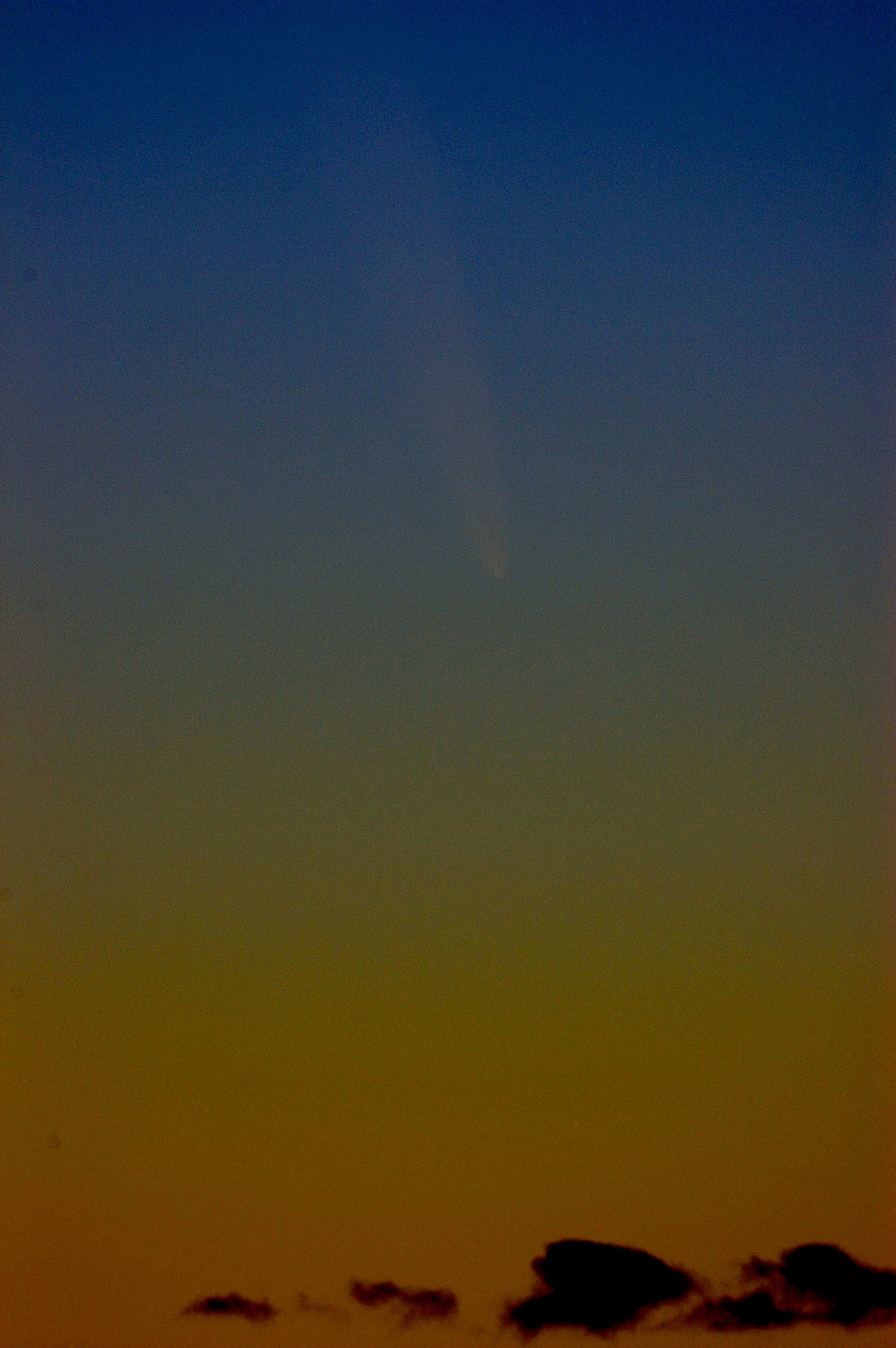
Seeing comet C/2017 E4 Lovejoy from Australia over the next few mornings

Comet C/2017 E4 Lovejoy is Terry Lovejoy's sixth comet. Terry's comets always seem to bring a bit of excitement and this one is no exception.
Comet C/2017 E4 Lovejoy has been brightening rapidly, and now appears to be in outburst with reports coming in of magnitudes around 7.2 - 7.5, theoretically easily visible in good binoculars.

Unfortunately the comet is very low above the northern horizon, and will rapidly disappear, becoming unobservable after April 6 or so.
So the next few mornings will be the best time to see this comet from the southern hemisphere (it doesn't return to our skies until after it has faded considerably).
There are a few good guides to the comet. Bright Altair, flanked by its two attendant stars, is very obvious well above the north-eastern horizon, sweeping down east is the recognisable diamond shape of the constellation Delphinus, sweeping further east and down again the brightest visible star you next encounter is epsilon Pegasi.

The comet is within a binocular field of epsilon Pegasi for the next three mornings, after that sweeping down from epsilon Pegasi should pick it up. Depending on how bright the comet gets it may be visible into nautical twilight (and hour before sunrise). Happy comet hunting.
Labels: binocular, C/2017 E4, comet, comet lovejoy

Saturday, November 30, 2013
Comet C/2012 S1 ISON Keeps On Keeping On (29 November UT)
 |
| |
| Comet C/2012 S1 ISON seen in the SOHO LASCO C3 instrument from 12:30 UT 29 November.It is 0.107AU from the Sun by the end. | C/2011 W3 Lovejoy in SOHO C3 (16 December 2011 UT). Lovejoy is 0.08 AU from the Sun here. Image credit NASA/SOHO |
Comet ISON keeps on going, despite several news reports suggesting its demise, the comet still looks more or less comet like over 24 hours from perihelion (for views of what it looked like then see here, and its subsequent return here and here). For comparison I show the other great survivor, comet C/2011 W3 Lovejoy.
Lovejoy was brighter, and continued to brighten developing a spectacular tail before its ultimate demise. ISON is fading slowly, although what is probably the synchronic tail is developing nicely.
It is still too early to write ISON off yet, but it is also still too early to determine if we can see it in the skies in the next few days.
A nice ABC article immediately post perihelion, which quotes me, is here.
Labels: C/2012 S1 ISON, comet lovejoy, Soho
Thursday, November 28, 2013
Comet C/2012 S1 ISON Brightens More, Prospectes for Perihelion (28 November 2013)
 |  |
| Latest 30 images from the SOHO LASCO C3 instrument animated. Comet ISON skims past delta Scorpii. | Latest 30 low resolution beacon images from the STEREO COR2A instrument animated. The Big blob is Venus. |
We are just over 7 hours away from comet C/2012 S1 ISON reaching perihelion. What an amazing trip it has been, with the comet defying all expectations, stops and starts in brightness increase, dramatic outbursts and fades.
Now on the last leg of its long journey, which began around a million years ago in the Oort cloud at the edge of the solar system, in a few short hours it will skim around a solar diameter from the surface of the sun, being exposed to almost unimaginable heart wich will vaporize the very dust on its surface.
Will it survive is the question on everyone's lips? How bright will it get?
Currently it is outperforming C/2011 W3 Lovejoy, latest brightness estimates put it at around magnitude -3 (a bit dimmer than Venus ), quite a bit above Lovejoy at the same time, and ISON has a more complex tail. The twin tails you see in the LASCO C3 instrument are a broad dust tail and a synchronic dust streamer. No ion tail can be seen in the LASCO C3 image at the moment (info from the latest CBET via Jakub Cerny).
So, what happenes next? Will it disintegrate? For typical Kreutz sungrazer comets with radii under 100 meters, they tend to disintegrate at 10 solar radii from the Sun. ISON is much larger than 100 meteres (somewhere between 1 Km and 2.4 Km in radius), but the 10 Solar radii checkpoint is at around 12:00 UT in a half an hour from now as I type. If it passes this check point, then there is a good chance it will get to perihelion. After that, it's all still up in the air. Karl Battams of the STEREO mission is enthusiastic but cautious. Jakub Cerny has a detailed post here were he expects it not to survive.
How bright will it get? Jakub Cerny reports J. N. Marcus as saying it will not get too much brighter, as the heat from the Sun begins to vaporise the dust grains.
If it survives perihelion, it's grazing approach to the Sun, what happens then? Will it be like Lovejoy and disintegrate a few days later, leaving us with a pale and impressive tail? Perhaps the best analogs will be two sungrazers of around 1 Km radius, the great Southern Comet of 1880 and C/1970 K1, which survived and were reasonably bright with decently long tails for a short time.
So if ISON survies we might expect it to not be as bright as C/2006 P1 McNaught, but brighter than Lovejoy.
The best we can say is "don't count your comets before they are hatched". As the excitement mounts you can watch the comet in various spacecraft instruments (links here) . No matter what happens, this is the first sungrazing comet from the Oort cloud, so the show will be well worth watching.
So happy comet watching folks.
Labels: C/2006 P1 McNaught, C/2012 S1 ISON, comet lovejoy, Soho
Comet C/2012 S1 ISON Brightens, comparison with Lovejoy (28 November 2013)
 |  |  |
| Comet C/2012 S1 ISON in the SOHO Lasco C3 imager at 00:30 UT 28 November 2013 | Comet C/2011 w3 Lovejoy in the SOHO Lasco C3 imager at 09:30 UT 15 December 2011 | Overlay of the two images |
Comet ISON continues to brighten, its head is now brighter than comet Lovejoy at a similar distance from the Sun in the STEREO imager (ISON was at 0.084 AU from the Sun in this image, Lovejoy was closer at 0.079 AU). ISON's tail is a bit wimpier though.
What does this all mean for ISON's chances of survival? Who knows, we just have to keep watching.
Labels: C/2012 S1 ISON, comet lovejoy, comets, Soho
How Bright is ISON? Comparing Comet ISON to Lovejoy
 |  |
 |  |
How bright is comet C/2012 S1 ISON now? It's pretty hard to tell with the images we have, as we don't really have high resolution images with good comparison stars at the moment. So I've compared ISON as it looks now to C/2011 W3 Lovejoy as it looked when it just entered the SOHO LASCO C3 imager and STEREO COR2B imager.
Both comets look roughly the same in the SOHO images, but Lovejoy looks brighter in the COR2B images. Unfortunately I don't know where Lovejoy was with respect to COr2B, so I don't know if this is due to the comet being closer to the camera.ISON looks around the same brightness as
Still, overall it is looking similar to Lovejoy at the moment, perhaps it will perform like Lovejoy?
Labels: C/2012 S1 ISON, comet lovejoy, Soho, Stereo Satellite
Monday, January 09, 2012
Still More Comet C/2011 W3 Lovejoy Goodness
https://sites.google.com/site/robsastropics/comets/comet-c-2011-w3-lovejoy
Stuart Thomson's great images from Victoria
http://www.siriuscybernetics.org.au/Siriuscybernetics/Lovejoy120102.html
And the fantastic animation, 6 days of Lovejoy, from Phil Hart
http://vimeo.com/34639569
I really have to finish processing my comet Lovejoy images.
Labels: astrophotography, comet, comet lovejoy, comets
Wednesday, January 04, 2012
A Gallery of Comet Lovejoy Images
Labels: astrophotography, comet, comet lovejoy, comets
Monday, December 26, 2011
Some Images of Comet Lovejoy
Guillermo Abramson with some very good images form South America.
http://guillermoabramson.blogspot.com/2011/12/ultimas-fotos-del-cometa-lovejoy.html
Labels: astrophotography, comet, comet lovejoy, Kreutz, sun grazer
Wednesday, December 21, 2011
Observing Comet C/2011 W3 Lovejoy's Tail (A Christmas Comet)
 Location of Comet C/2011 W3 Lovejoy at 4:30 am on Thursday 22 December (roughly an hour and a half before sunrise) as seen from Adelaide, similar views should be seen elsewhere in Australia at equivalent local times. Although close to the horizon, a 10 degree tailwill stick up past the bright star above the comets position (click to embiggen).
I saw the tail of comet C/2011 W3 Lovejoy on Wednesday morning at 4:54 am, although from others descriptions and images, its obvious that earlier is better (around 4:00 - 4:30 am) , the tail is quite long, and is readily seen in the earlier hours.
You will need a relatively clear, level horizon, preferably without too many bright lights in the way. You may need to sweep the south-eastern horizon for the tail to pick it up, but once you see the tail you should pick it up with the unaided eye. The comet is fading, but also rising higher in the sky, so the tail should be a bit more obvious over the next few days, it might even be mildly spectacular for Christmas. Certainly worth getting up at Dark O'Clock for, the best comet since C/2006 P1 McNaught.
Labels: astrophotography, comet, comet lovejoy, comets, Kreutz, sungrazer, unaided eye
I SAW IT! (Comet Lovejoy's Tail in the Twilight)
 |  |
Got up at 4:30 am this morning, and the sky was magnificently clear. Struggled into my gear and headed out with binoculars and camera. Unfortunately, the comet was located not only close to the horizon, but towards the greatest concentration of sodium lights in my area and the brightly lit cement factory. With the help of Google SkyMap on my mobile phone (cringe) I located the rough area where the comet should be around 4:50 am.
Soon as I swept with binoculars I could see it, once I knew that I was actually looking at the comet tail (rather than a thin plume of smoke from the cement factory), it was identifiable (just) to the unaided eye.
Like Vello Tabur I could easily identify the tail on images taken with my digital camera (not an SLR). The tail extended past epsilon Scorpii, so was at least 5 degrees long.
The tail was easily identifiable in binoculars out to at least 5:09 am ACDST. At no stage could I see the head though (in contrast to the recent telescopic daylight images), even though faintish stars like epsilon Sco and mu 1&2 Sco were easily visible in binoculars.
So I have to get up a 4:00 am to catch the sky at it's darkest and see if I can get better images of the tail.
I also got to see the ISS shoot between Spica and Saturn and the Moon, so it was a VERY good morning.
Labels: astrophotography, comet, comet lovejoy, comets, Kreutz, sungrazer, unaided eye
Tuesday, December 20, 2011
More Amazing Comet C/2011 W3 Lovejoy Images
 High resolution false colour image of Comet C/2011 W3 Lovejoy from the STEREO H1A imager. Images courtesy of Karl Battams and STEREO/NASA.
Comet Lovejoy moves away from the Sun 18-19 December 2011, false colour, note the development of an ion tail. The long "spikes" from the comet and Jupiter (the other bright object) are imager artefacts. See my animation below.
Some more fantastic images of comet Lovejoy are coming out of the data. Via Karl Battams we have a quicktime movie of Comet Lovejoy in STEREO/SECCHI's EUVI-A imager's 171-Angstrom wavelength camera, showing amazing wiggles in the comets tail.
Then there is an animated H1A view of the comet, processed differently from mine to subtract stars.
Animation of the comet in H1A in false colour to highlight tail details.
Labels: comet, comet lovejoy, comets, Kreutz, Stereo Satellite, sungrazer
Comet C/2011 W3 Lovejoy's Tail Visible
 Location of Comet C/2011 W3 Lovejoy at 4:54 am on Wednesday 21 December (an hour before sunrise) as seen from Adelaide, similar views should be seen elsewhere in Australia at equivalent local times. Although close to the horizon, a 5 degree tail should stick up past the bright star above the comets position (click to embiggen).
I had no luck seeing Comet C/2011 W3 Lovejoy this morning, clouds of course. But two groups did. Peter Sayers in Tasmania (Image via Space Weather) could see it as a just unaided eye object in the twilight, while Vello Tabur couldn't see it in binoculars or unaided eye, but a five degree tail turned up in his DSLR shots.
I'll have another go this morning, hopefully the weather will be kinder, and I will be forearmed with knowledge of comet Lovejoys dimness.
Labels: astrophotography, comet, comet lovejoy, comets, sungrazer
Monday, December 19, 2011
Can We See Comet Lovejoy in the Tuesday MorningTwilight
 Eastern horizon as seen from Adelaide at 5:30 am ACDST on Tuesday Morning December 20. Similar views may be seen from other Australian locations at equivalent local time (cick to embiggen).
While people have seen comet C/2011 W2 Lovejoy in daylight with telescopes, there is no unambiguous report of seeing comet Lovejoy by the unaided eye (the horrible weather hasn't helped).
From the the latest STEREO images (see video below, Mercury and Jupiter are in the frame as well) and telescope reports, it seems that the comet is currently around the brightness of Mercury. Predicting what the comet will do, and how bright any tail will be, is fraught with uncertainty however.
There is a possibility that tomorrow morning (Tuesday Dec 18) we might see a tiny tail and possibly the comet above the horizon in the twilight. The Stellarium image above shows where the comet should be shortly after nautical twilight. You will need a flat, clear eastern horizon for a good chance to see the comet (if it is visible).
It's worth getting up for a look, this has been an extraordinary comet, and it's possible that we may see something beautiful (even though it is more likely we will see nothing).
Labels: comet, comet lovejoy, comets, Kreutz, Soho, Stereo Satellite, sungrazer
Sunday, December 18, 2011
Comet C/2011 W3 Lovejoy and its Ion Tail
 |  |
Left Image: C/2011 W3 Lovejoy in SOHO C3 (17 December UT). Right Image: C/2011 W3 Lovejoy in STEREO beacon (low resolution) images in H1A (17 December, far right). Click to embiggen. Image credit NASA/SOHO and NASA/SECCHI. (earlier images here and here).
Images show brightness of the comet and the development of the ion tail.
The comet has been telescopically imaged in daylight a few times now, see image from Jakub Cerny here and from Jan here.
SOHO animation 17-12-11
STEREO H1A beacon image animation 17-12-11
Labels: comet, comet lovejoy, Kreutz, Soho, Stereo Satellite, sungrazer
Saturday, December 17, 2011
Terry Lovejoy Images his Comet in Broad Daylight
 View of Eastern Horizon at 4:45 am ACDST on Christmas morning as seen from Adelaide, showing the location of comets Lovejoy and Garrad. Comet Lovejoy may remain bright enough to see in binoculars.
 Terry Lovejoy, discoverer of Comet C/2011 W3 Lovejoy, has imaged his eponymous comet in broad daylight with a Celestron C8 telescope and a Canon 350D camera. See the image at IceinSpace
http://www.iceinspace.com.au/forum/showpost.php?s=31c59a570a89e0b8c315123103eff328&p=798668&postcount=38
He estimates the comet as being magnitude -1.2, that's 5 magnitudes greater than the predicted brightness at this time.
Much depends on how fast the comet fades now. It still might be bright enough to see in the predawn twilight tomorrow, but if not, hopefully it will be a binocular comet in time for Christmas.
Labels: comet, comet lovejoy, comets, Kreutz, Soho, Stereo Satellite, sungrazer
Can We See Comet Lovejoy in the Sunday MorningTwilight
 Eastern horizon ass seen from Adelaide at 5:40 am ACDST on Sunday Morning December 18. Similar views may be seen from other Austrlaian locations.
After the astonishing survival and brightening of comet C/2011 W2 Lovejoy, there is a minute possibility that tomorrow morning (Sunday Dec 18) we might see a tiny tail and possibly the comet poke up above the horizon in the twilight.
The possibility is slight, but it's worth getting up for a look.
Labels: comet, comet lovejoy
Comet Lovejoy gets its Tail Back
 |  |
Comet Lovejoy is getting its tail back. If you embiggen the SOHO image you can see the old tail dissipating on the other side of the Sun. Without doing serious astrometery (for which I need the hir res versions of the STEREO images which will come later), my impression is that the comet is brighter.
I'm going to quote Karl Battams in full here because
1700UT: I'm going to hope he doesn't mind me doing this, and steal a quote here from highly-respected astronomer John Bortle: "I trust that most here appreciate that we are witnessing one of the most extraordinary events in cometary history."
Let that sink in a minute, because he is absolutely correct. This is not simply "news-worthy", or even "of great interest"; this is indeed competely extraordinary.
Sungrazing comets, particularly those of the Kreutz-group, have fascinated astronomers for decades, and no doubt terrified civilizations of the past, as their orbits hurled them through the solar atmosphere, resulting in a brilliant daytime illumination of these enormous 'dirty snowballs'. There is arguably no other object in the solar system that goes through such an intense experience as one of these comets. For days now we have been witness to such a beautiful object racing through the STEREO, SOHO and now SDO and PROBA images, blasting through the solar corona, and miraculously re-emerging, albeit with much less of a tail than it started with. And whereas sungrazers of the past have been lost at least temporarily, if not permanently, in the Sun's glare, thanks to an amazing fleet of sun-watching spacecraft we have now been enthralled by this entire passage without a single hour passing by unwitnessed. Purely for the spectacle of the event, and the way it has unfolded before our eyes over the internet, this comet has sealed its place in the history books.
But there is so much more to this than just the spectacle. We have already obtained unprecedented scientific data from five different spacecraft, and I'm very optimistic that over the coming days we will get to add a sixth spacecraft to that list when Hinode analyze their data. The result is an almost overwhelming catalog of visual, narrow-band filtered, extreme ultraviolet, and spectroscopic data of a comet experiencing the most extreme environment the solar system has to offer. We will likely learn about its mass, its physical size, its composition, the size of its dust and dust production rates, and so much more. Objects like this can also provide us with a tremendous amount of information about the solar wind and conditions in the solar corona, which in turn allows us to gain more understanding of the Sun as a driver of "Space Weather" at Earth (it's one of the reasons my group is interested in sungrazing comets).
So I could not agree more with John, and I hope that all of you who are watching these movies are indeed appreciative of just how incredible this has been!
Now head over to Karl's site and see the latest amazing imagery.
Labels: comet, comet lovejoy, comets, Kreutz, Soho, Stereo Satellite, sungrazer
IT LIVES PART 2!!!!!!
 Comet C/2011 W3 Lovejoy as it returns from its encounter with the Sun as seen in the STEREO C2 Behind imager (low resolution beacon images). (Comet Lovejoy bright dot just above the bright streak of comet tail bottom left, not the other bright dot top right). COMET LOVEJOY IS COMING BACK WHILE THE TAIL IS STILL GOING IN!!!!
Astonishing. You get a better idea of what is going on in the animation below.
Previous posts on the return linked here.
Labels: comet, comet lovejoy, comets, Kreutz, Soho, Stereo Satellite, sungrazer
Friday, December 16, 2011
IT LIVES!!!!!!
 |  |
Left Image: C/2011 W3 Lovejoy in SOHO C3 (16 December UT), astonishingly, it has left its tail behind (the comet the is bright object to the right of the occulting disk). Right Image: C/2011 W3 Lovejoy in STEREO beacon (low resolution) images in COR2A (16 December), the disconnected tail can't be seen in this image. Click to embiggen, scroll down for animations. Image credit NASA/SOHO and NASA/SECCHI.
Well, that was amazing! Not only did comet Lovejoy survive its passage over the Sun (captured here is this astonishing SDO animation), but it is still bright, although it has left most of its tail behind. According to Karl Battams, it is the brightest Kreutz comet SOHO has ever seen. And apparently an ion tail has never been seen on a Kreutz comet before.
There is intense discussion on the Comets ML list. Is comet Lovejoy bigger than we thought, are we seeing vaporizing iron? This comet, as well as being spectacular, will certainly add to our current meagre knowledge of Kreutz comets.
Congratulations Terry on an amazing discovery, and once again congratulations to the STEREO, SOHO and SDO teams for capturing this amazing comet.
What a ride! Earlier images and animations, Solar exit, Solar contact, 16 Dec approach, 15 Dec, 13 Dec, 12 Dec.
Animation showing the comet going behind the occulting disk then coming out without its tail.
Lovejoy heads towards the STEREO Ahead C2 occulting disk and comes out the other side sans tail. Low resolution beacon data, drop out of data in the middle so you miss the comet going behind the occulting disk.
Labels: comet, comet lovejoy, comets, Kreutz, Soho, Stereo Satellite, sungrazer
Comet Lovejoy Exits the Sun
 Comet C/2011 W3 Lovejoy goes behind the COR1 occulting disk in the COR1 low resolution beacon images from the STEREO behind spacecraft.
Comet Lovejoy exits the sun in these SDO images (video)
http://t.co/I4TiZ1xq See also here and here for amazing videos.
But the comet has not re-emerged in the COR1 images yet, looking at the SDO images, it might just be an organized debris cloud that will evaporate by the time the it passes into the COR1 field of view.
Video showing comet Lovejoy entering the STEREO COR1B imager and not coming out (yet). Low resolution Beacon images.
Congratulations to the STEREO and SDO team for some fantastic images and science! See Karl Battams page here for updates.
Labels: comet, comet lovejoy, comets, Kreutz, Stereo Satellite, sungrazer



 Click to read about or order
 Click to read about or order
 Click to read about or order
 Click to read about or order