Thursday, November 28, 2013
Comet C/2012 S1 ISON Brightens More, Prospectes for Perihelion (28 November 2013)
 |  |
| Latest 30 images from the SOHO LASCO C3 instrument animated. Comet ISON skims past delta Scorpii. | Latest 30 low resolution beacon images from the STEREO COR2A instrument animated. The Big blob is Venus. |
We are just over 7 hours away from comet C/2012 S1 ISON reaching perihelion. What an amazing trip it has been, with the comet defying all expectations, stops and starts in brightness increase, dramatic outbursts and fades.
Now on the last leg of its long journey, which began around a million years ago in the Oort cloud at the edge of the solar system, in a few short hours it will skim around a solar diameter from the surface of the sun, being exposed to almost unimaginable heart wich will vaporize the very dust on its surface.
Will it survive is the question on everyone's lips? How bright will it get?
Currently it is outperforming C/2011 W3 Lovejoy, latest brightness estimates put it at around magnitude -3 (a bit dimmer than Venus ), quite a bit above Lovejoy at the same time, and ISON has a more complex tail. The twin tails you see in the LASCO C3 instrument are a broad dust tail and a synchronic dust streamer. No ion tail can be seen in the LASCO C3 image at the moment (info from the latest CBET via Jakub Cerny).
So, what happenes next? Will it disintegrate? For typical Kreutz sungrazer comets with radii under 100 meters, they tend to disintegrate at 10 solar radii from the Sun. ISON is much larger than 100 meteres (somewhere between 1 Km and 2.4 Km in radius), but the 10 Solar radii checkpoint is at around 12:00 UT in a half an hour from now as I type. If it passes this check point, then there is a good chance it will get to perihelion. After that, it's all still up in the air. Karl Battams of the STEREO mission is enthusiastic but cautious. Jakub Cerny has a detailed post here were he expects it not to survive.
How bright will it get? Jakub Cerny reports J. N. Marcus as saying it will not get too much brighter, as the heat from the Sun begins to vaporise the dust grains.
If it survives perihelion, it's grazing approach to the Sun, what happens then? Will it be like Lovejoy and disintegrate a few days later, leaving us with a pale and impressive tail? Perhaps the best analogs will be two sungrazers of around 1 Km radius, the great Southern Comet of 1880 and C/1970 K1, which survived and were reasonably bright with decently long tails for a short time.
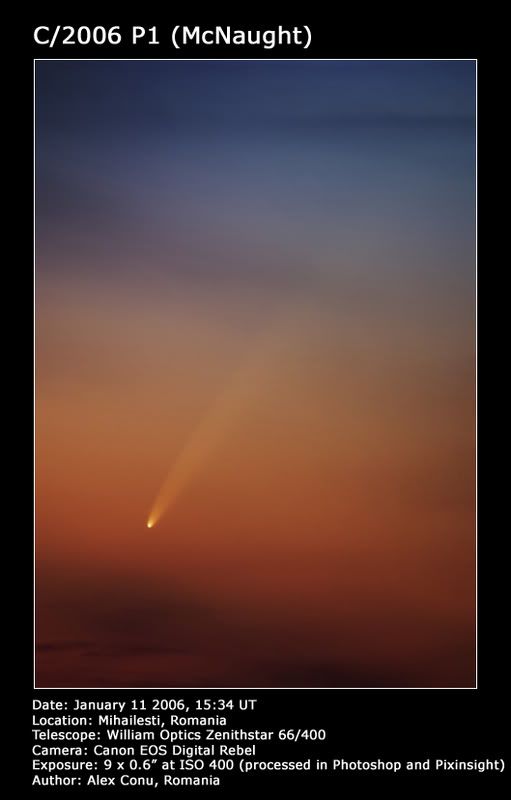
So if ISON survies we might expect it to not be as bright as C/2006 P1 McNaught, but brighter than Lovejoy.
The best we can say is "don't count your comets before they are hatched". As the excitement mounts you can watch the comet in various spacecraft instruments (links here) . No matter what happens, this is the first sungrazing comet from the Oort cloud, so the show will be well worth watching.
So happy comet watching folks.
Labels: C/2006 P1 McNaught, C/2012 S1 ISON, comet lovejoy, Soho

Friday, May 20, 2011
What makes a bright comet? The case of Elenin and Cassini at Saturn
 Elenin "near" Saturn in 2009, click to embiggen.
When an astronomer says a comet is “bright”, it means that the comet will be brighter than magnitude 12. At this magnitude, the comet will be visible to the eye in moderate aperture amateur telescopes, rather than requiring substantial exposure times with film of CCD cameras. To the ordinary person on the Clapham Omnibus, this is still extremely faint; people with good eyesight under ideal dark sky conditions can see objects as dim as magnitude 6.6, over 100 times brighter than a magnitude 12 object.
 Cassini in orbit around Saturn with the location of Elenin shown, Elenin is too dim to be seen, click to embiggen
Not surprisingly, the astronomical use of “bright comet” can cause considerable confusion, especially as most people don’t have a good feel for the brightness of objects in the sky. Comet C/2010 X1 Elenein is a “bright” comet; although it is currently around magnitude 14, it will reach a magnitude of somewhere between 6 (just visible to the unaided eye) and 4 (about as bright as epsilon Crucis, the 5th and dimmest star in the Southern Cross) at its brightest.
Why the variation? The brightness of an object like an asteroid depends on how big it is, how far it is from the Sun and us, and how shiny it is. Calculating the brightness of an asteroid at closest approach is fairly straightforward, even if we are a bit uncertain about how shiny and big it is.
 Gustavo Muller's image of Elenin on August 8, 2011, from the Aerith gallery.
Unlike asteroids, we are not seeing the surface of the comet per se (except when it is very, very far from the Sun), but light reflected from the tenuous haze of dust and gas that boils off the “dirty snowball/icy dirtball” that is a comet. The coma of a comet can extend many thousands of kilometres from the surface.
The Great Comet was around 30km in diameter and had a coma nearly as big as the Sun, comet Halley is 6x15 km and had a coma 100,000 km wide when it last approached Earth, C/2010 X1 Elenin is roughly 3-4 Km and has a coma around 50,000 km wide. The coma is a pretty good vacuum by Earth standards, but there is enough dust and fluorescing gas in this thin haze to make the comet glow brighter than the mere iceball would.
How bright the comet is depends an exactly how active it is (ie how much dust and gas it produces and the size of the coma), which depends on a complex set of properties (if there are lots of rifts in the organic/silicate crust that coats the comet surface to blast out dust and gas, for example). We don’t have an exact handle on exactly what makes a comet bright, and there is substantial discussion on the comet lists about the best way to estimate the development of cometary brightness.
 Light curve of comet Elenin, from Aerith, click to embiggen.
However we have a number of good rules of thumb. Comets that have just dropped in from the Oort cloud, like Elenin, are intrinsically dim. That is they tend produce much more gas than reflective dust and usually do not put on much of a show.
Again, there have been exceptions, comet 2006 P1 McNaught was initially expected to be very bright, around magnitude 2, but ended up around an astounding magnitude -1 when we could first see it again after it passed behind the Sun (although it’s brightness dropped rapidly after that). Still by following the light curve of a comet we can get a good idea of its brightness. The light curve of Elenin is still developing, but it looks on track to be somewhere between just visible to the unaided eye to being dimly visible.
People also confuse the concept of “bright” in terms of a comet and “big”. And example is here:
Elenin passed fairly close to Saturn in Mid-Late 2009. Cassini was in the area, taking pictures of Saturn and it's moons. It had just wrapped up its scheduled mission when project planners extended it.
[snip images]
So a big comet was nearby, and Cassini never saw it? This means either:
A) NASA saw Elenin with Cassini in 2009 (or earlier) and decided not to tell us
B) NASA did NOT see Elenin in 2009 because it's not really a bright comet after all
C) NASA did NOT see Elenin in 2009 due to chance or incompetence.
 Rings of Saturn as seen from Cassini. See the Stars? No, they are all washed out in the image (click to embiggen)
Now there is a couple of issues here, “fairly close” was a large chunk of 1 AU away, what looks “close” on a JPL animation is still an enormous distance way (see the image at the top of the post). And again, the mistaken concept of “bright”. At the time (2009) Elenin was still fairly dim, around magnitude 22, just a tiny bare lump of ice with only the faintest traces of a coma around it, far from the illumination of the Sun.
You can use the JPL horizons program to find out how bright it would seem from Cassini. Turns out it’s around magnitude 22 as well (the comet was closer, but as seen from Saturn and Cassini it would only be partially illuminated).
 Spica as imaged by the Cassini cameras (click to embiggen)
Now have a look at the typical image from Cassini (see above), can you see the background stars? No, Cassini is photographing relatively bright objects, and the typical exposures are too short for all but the brightest stars, let alone a dim comet.
Occasionally the spacecraft does do a long exposure image of the stars, for navigation purposes. The image to the left is just such an image centered on Spica, (alpha Virginis). The dimmest star in this image is magnitude 9, well above the brightness of Elenin. Even if a navigation image has been taken which had been pointing in Elenins direction (in general Cassini wasn’t pointing anywhere near Elenin), it couldn’t have picked the comet up.
 NASA’s failure to pick up Elenin is not due to incompetence, bright comets are not bright for their entire journey around the Sun, but typically brighten substantially only during the closest approaches to the Sun, in principle Cassini could not have picked the comet up. Elenin won’t be spectacular, but at the very least will look nice through binoculars under a dark sky.
Labels: C/2006 P1 McNaught, comets, Pseudoscience
Monday, January 15, 2007
Comet 2006/P1 McNaught Visible in Daylight.
Comet McNaught has been reported to be visible in daylight with the unaided eye. See Spaceweather for an amazing image of this comet in daylight. Magnitudes have been reported from -3 (less bright that Venus) t0 -4 and -5 (much brighter than Venus). This bodes well for Australians (and Southern hemisphereians generally) seeing this comet from Monday 15th Jan on.
This animation (image credit, SOHO/NASA) shows McNaught entering the field of view of the SOHO LASCO C3 camera, Mercury is the bright obect at the bottom, and comet McNaught is, well, pretty obvious. The vertical strips are artefacts of light saturating the instrument. The bottom line is that the comet is bright.
 Image Credit STEREO/NASA
This is reenforced by the appearance of the comet in the STEREO a cameras, the image is greatly saturated, the comet head doesn't look like a comet head at all (more like a hammer head). Again, Mercury shows up as a spike at the bottom of the image. A better image from the STEREO b cameras is here. For some stunning images taken from Earth, see this brilliant image from Italy, taken as the sun was setting. The Spaceweather gallery has many images of the comet. The Bad Astromomer has a cool video, though he looks a bit daggy. Here is another good image from Italy, some great shots from Germany, sunset shots from San Deigo, (and here as well), another terrific shot from the USA, and one from Germany.
 Okay, what about seeing the comet yourself, Well, first you will need a clear, level western horizon (no cvlouds is good too). Start looking about 20 minutes after the Sun has set (this is around 9 pm eastern daylight svaing time, look to the left of due east by about two handspans and you will see bright Venus. Look left again ny two hands soans, and down by one handspan, and you should see the comet as a tiny dot of light just 4 fingerwidths above the horizon. You may need to search a bit for the comet to "pop" out at you, and you will find that binoculars will help locate the comet in the first place. The chart at the side has due east as its rightmost edge. Another, printable spotting map is here. But the one to the left shows about all the stars you will see (Neptune, you won't see, an issue with Sky Map)
Good luck looking for the comet, the brightest in 30 years!
This animation (image credit, SOHO/NASA) shows McNaught entering the field of view of the SOHO LASCO C3 camera, Mercury is the bright obect at the bottom, and comet McNaught is, well, pretty obvious. The vertical strips are artefacts of light saturating the instrument. The bottom line is that the comet is bright.
 Image Credit STEREO/NASA
This is reenforced by the appearance of the comet in the STEREO a cameras, the image is greatly saturated, the comet head doesn't look like a comet head at all (more like a hammer head). Again, Mercury shows up as a spike at the bottom of the image. A better image from the STEREO b cameras is here. For some stunning images taken from Earth, see this brilliant image from Italy, taken as the sun was setting. The Spaceweather gallery has many images of the comet. The Bad Astromomer has a cool video, though he looks a bit daggy. Here is another good image from Italy, some great shots from Germany, sunset shots from San Deigo, (and here as well), another terrific shot from the USA, and one from Germany.
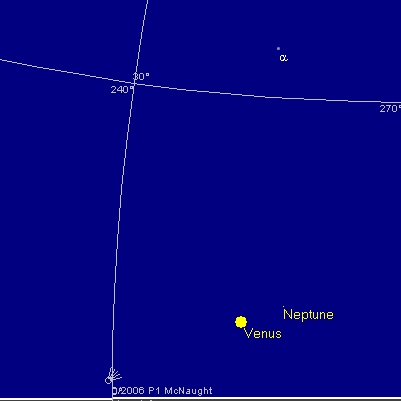 Okay, what about seeing the comet yourself, Well, first you will need a clear, level western horizon (no cvlouds is good too). Start looking about 20 minutes after the Sun has set (this is around 9 pm eastern daylight svaing time, look to the left of due east by about two handspans and you will see bright Venus. Look left again ny two hands soans, and down by one handspan, and you should see the comet as a tiny dot of light just 4 fingerwidths above the horizon. You may need to search a bit for the comet to "pop" out at you, and you will find that binoculars will help locate the comet in the first place. The chart at the side has due east as its rightmost edge. Another, printable spotting map is here. But the one to the left shows about all the stars you will see (Neptune, you won't see, an issue with Sky Map)
Good luck looking for the comet, the brightest in 30 years!
Labels: C/2006 P1 McNaught



 Click to read about or order
 Click to read about or order
 Click to read about or order
 Click to read about or order