Sunday, April 05, 2026
UPATE: Comet C/2026 A1 (MAPS) did not survive
 |  |
| Comet C/2026 A1 (MAPS) before heading into the oculting disk of the LASCO C3 imager | Comet C/2026 A1 (MAPS) debris plume exiting the oculting disk of the LASCO C3 imager |
 |  |
| Comet C/2026 A1 (MAPS) before heading into the oculting disk of the LASCO C2 imager | Comet C/2026 A1 (MAPS) debris plume exiting the oculting disk of the LASCO C2 imager |
 |  |
| Comet C/2026 A1 (MAPS) before heading into the oculting disk of the CCOR-1 imager | Comet C/2026 A1 (MAPS) debris plume exiting the oculting disk of the CCOR-1 imager |

Comet C/2012 S1 (ISON) ISON on the 28/11/2013 before and after its encounter with the Sun.
Comet C/2026 A1 (MAPS) did not survive perihelion, looking a lot like comet C/2012 S1 (ISON) as the debris cloud exited the occulting disks of SOHO Lasco C3, C3 and CCOR-1.
The debris plume is a lot more rarefied than the more condensed ISON plume. But like ISOn we are unlikely to see a C/2011 W3 (Lovejoy) style headless tail.
 |  |
| GIF animation of C/2026 A1 (MAPS) heading into and debris exiting the C3 occulting disk | GIF animation of C/2026 A1 (MAPS) heading into and debris the C2 occulting disk |
Labels: C/2026 A1, comet, Kreutz, sun grazer

Saturday, April 04, 2026
Comet C/2026A1 (MAPS) update and prospects.
 |  |
| Comet C/2026 A1 (MAPS) in the STEREO H1 imager on 30 March. It's the faint streak at the bottom far right. | Comet C/2026 A1 (MAPS) in the SOHO LASCO C3 instrument on the 3rd of April. the "T" shaped head is an imaging artifact. |
C/2026 A1 (MAPS) is a Kreutz family comet, one of a group of related comets that pass close to the sun. Everyone was very excited that it might become an extremely bright ("great") comet. However, it’s brightness increase stalled (everyone gasped) then started up again (everyone cheered), with what looked to be an eruption plume. As the comet neared the sun all eyes turned to solar monitoring satellites to follow its progress (and possible demise).

C/2026 A1 as seen in the GOES-19 CCOR1 instrument.
The comet has passed intact through the STEREO H1 imager (see above) and was in the field of view of the PUNCH (Polarimeter to Unify the Corona and Heliosphere) satellite, It had a magnitude of 6.5 and a tail extending more than 3 degrees. It has now passed into the field of view of SOHO and the CCOR1 chronograph.
In both these imagers the comet continues to survive and brighten. It is now around magnitude 2-1, bright but a bit dimmer than the sungrazers C/2012 S1 (ISON) and C/2011 W3 (Lovejoy). and not dissimilar to C/2012 E2 (SWAN). SWAN disintegrated before it reached the sun, ISON disintegrated on its pass by the sun, Lovejoy survived solar passage then broke up shortly after.
Currently the two most likely outcomes are that the comet disintegrates before it reaches the sun (like comet SWAN) or it breaks up after perihelion and forms a “headless” comet like C/2011 (W3) Lovejoy. In the latter case we may see a bright tail stretching up from the horizon as twilight fades.
However, astronomer Pedro Rincon reports that MAPS is exhibiting "extremely high cohesion" and is "shedding thin layers from its volatile surface." This suggests there may be a possibility that the comet will survive perihelion. Fingers crossed it will survive after perihelion on the 4th.
If it does survive there is the possibility the comet head will be around -3 to -4 magnitude, (about as bright as Venus), but it will fade rapidly and may be difficult to distinguish against the twilight by the time it is above the horizon in Australia.

C/2026 A1 perihelion is 4 April, the soonest we can see the comet head is probably the 6th or 7th depending on how bright it turns out to be. If there is a decent tail we should see it as the twilight fades, possibly as early at the 5th.
Look to the west, bright Venus will be your guide, the comet should be to the west and a bit below. As the twilight fades the comet and its tail may become more visible. As the days progress the comet gets higher, but it will also be dimming rapidly.

Click this link for a printable black and white spotters chart.
We may see the tail in the late twilight, we may be in a C/2011 (W3) Lovejoy situation, where a bright, long headless tail was seen for a couple of days, or a C/2024 G3 Atlas situation, where a modest length but faint tail was visible in the late twilight for nearly a week, depending on how dusty the tail is. Either would be good.

Labels: C/2026 A1, comet, Kreutz, sun grazer
Thursday, August 04, 2016
A Kreutz Comet Meets its Doom
 | 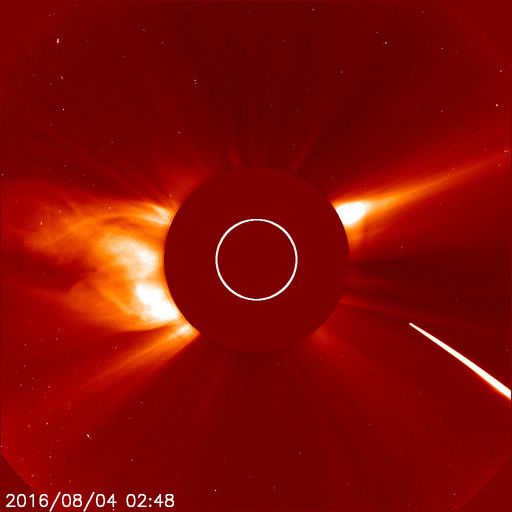 |  |
| Kreutz comet in SOHO LASCO C3 imager on 3 August at its brightest | Kreutz comet in SOHO C2 imager on 4 August. | Kreutz comet in STEREO COR2 imager on 4 August. |
 |  |  |
| Animation of Kreutz comet in SOHO LASCO C3 imager on 4 August. | Animation of Kreutz comet in SOHO C2 imager on 4 August. | Animation of Kreutz comet in STEREO COR2 imager on 4 August. |
On 31 July a small Kreutz comet entered the field of view of the SOHO C3 imager, Kreutz comets are sungrazing comets thought to be the remnants of a large comet which broke up several centuries ago. The comet rapidly brightened, causing Karl Battrams to suggest this is the brightest Kreutz for 21 years.
The comet came to perihelion on August 4 at around 05 UT, at around 1 solar diameter from the Sun. The even was captured by the SOHO C3 and C2 instruments and the STEREO COR2 and COR1 instruments.In the animations above you can see the comet going behind the occultation disks hiding the sun in all these instruments...and not coming out. The comet was vaporized by the intense heat of the sun.
Labels: comet, Kreutz, Soho, Stereo Satellite, sungrazer
Sunday, March 18, 2012
Comet C/2012 E2 (SWAN) Dives into the Sun in STEREO
 Comet C/2012 E2 (SWAN), the official name for Comet SWAN, diving into the Sun as seen from the COR2A instrument of STEREO. (click to embiggen)
The Beacon images I posted earlier were from the behind spacecraft, but the high resolution fits from the behind spacecraft have not been posted yet.
I made an animation, see below. Comet Al has a nice multiframe image.
Animation of comet C/2012 SWAN sundiving in the COR2A instrument of STEREO.
Labels: comet, Kreutz, Stereo Satellite, sungrazer
Thursday, March 15, 2012
Death Dive of Comet SWAN, 14 March 2012
Labels: comet, Kreutz, Soho, sungrazer
Comet SWAN in STEREO H1B, 12 March 2012
 Comet SWAN as seen the the STEREO H1B imager on March the 12th, 2012. Before it's fateful rendezvous with the Sun. The image is inverted so the tail is clearer.
In the animation below you can see the tail twist in the solar wind.
Raw Image source, NASA STEREO. Images stacked and cleaned up in imageJ.
Labels: comet, Kreutz, Stereo Satellite, sungrazer
Comet Swan Enters LASCO C2, and STEREO COR1 and 2
 |  |
 |  |
Bottom Row: SWAN enters the field of view of the STEREO COR1 beacon images. Left image, approaching the Sun. Right image, The faint trace of the comet appears to wrap around the Sun. Image sources, NASA SOHO and STEREO respectively.
Comet SWAN continues it's plunge to the Sun, and appears to be evaporating, in the low resolution STEREO beacon images a faint trace of the comet can be seen rounding the Sun, it's unlikley anything will come out the other side. We will have to wait for the high resolution images to see what is really happening.
Previous posts here and here, a blog post from Comet Al here.
Labels: comet, Kreutz, Soho, Stereo Satellite, sun grazer
Wednesday, March 14, 2012
Comet SWAN enters SOHO Lasco C3 (and a solar storm)
 The new Kreutz Sungrazer comet SWAN, has entered the SOHO lasco C3 imager.
It's reasonably bright and beautifully formed. It is heading straight in for the Sun, and may turn up in the C2 imager tomorrow. I'll also have a look at the STEREO C2 beacon images, but they are pretty low resolution.
Tomorrow the high resolution STEREO images from H1B should be available. I suppose I also should try estimating magnitudes and such.
(UPDATE: Comet Al has made a great animation from H1B on the 11th here)
I made another animation, you can see the comet fly into the solar storm produced by the recent M7.9 flare.
Labels: comet, Kreutz, Soho, Solar flare, sungrazer
Tuesday, March 13, 2012
Kreutz Sungrazer Found in Swan Images
 Is this Kreutz comet seen in the STEREO H1B imager (low resolution beacon image, first piced up by Rob Matson) the SWAN Kreutz comet? (Actually, yes it is, as I was putting this together Karl Battams posted an update identifying the same object).
Another potential Kreutz comet has been picked up. Amazingly, it was picked up in the SWAN imager, no Kreutz comet has been found in this imager before hand. The odds are that this will be a reasonably bright comet, probably not as bright as C/2011 W3 Lovejoy, but still reasonably bright.
Whether it will get bright enough to see with the unaided eye like Lovejoy is an open question. While reasonably bright in the STEREO beacon images, it is not as bright as Lovejoy was.
There are still not enough data points to determine the comets orbit with high accuracy.
Follow the story of the comet over at the Sungrazer Comet site, and at the SOHO comet watchers site.
Video of 20 frames of the H1B low res beacon images. The comet is at the bottom left in the last few frames, entering a coronal mass ejection.
Labels: Kreutz, Soho, Stereo Satellite, sungrazer
Monday, December 26, 2011
Some Images of Comet Lovejoy
Guillermo Abramson with some very good images form South America.
http://guillermoabramson.blogspot.com/2011/12/ultimas-fotos-del-cometa-lovejoy.html
Labels: astrophotography, comet, comet lovejoy, Kreutz, sun grazer
Wednesday, December 21, 2011
Observing Comet C/2011 W3 Lovejoy's Tail (A Christmas Comet)
 Location of Comet C/2011 W3 Lovejoy at 4:30 am on Thursday 22 December (roughly an hour and a half before sunrise) as seen from Adelaide, similar views should be seen elsewhere in Australia at equivalent local times. Although close to the horizon, a 10 degree tailwill stick up past the bright star above the comets position (click to embiggen).
I saw the tail of comet C/2011 W3 Lovejoy on Wednesday morning at 4:54 am, although from others descriptions and images, its obvious that earlier is better (around 4:00 - 4:30 am) , the tail is quite long, and is readily seen in the earlier hours.
You will need a relatively clear, level horizon, preferably without too many bright lights in the way. You may need to sweep the south-eastern horizon for the tail to pick it up, but once you see the tail you should pick it up with the unaided eye. The comet is fading, but also rising higher in the sky, so the tail should be a bit more obvious over the next few days, it might even be mildly spectacular for Christmas. Certainly worth getting up at Dark O'Clock for, the best comet since C/2006 P1 McNaught.
Labels: astrophotography, comet, comet lovejoy, comets, Kreutz, sungrazer, unaided eye
I SAW IT! (Comet Lovejoy's Tail in the Twilight)
 |  |
Got up at 4:30 am this morning, and the sky was magnificently clear. Struggled into my gear and headed out with binoculars and camera. Unfortunately, the comet was located not only close to the horizon, but towards the greatest concentration of sodium lights in my area and the brightly lit cement factory. With the help of Google SkyMap on my mobile phone (cringe) I located the rough area where the comet should be around 4:50 am.
Soon as I swept with binoculars I could see it, once I knew that I was actually looking at the comet tail (rather than a thin plume of smoke from the cement factory), it was identifiable (just) to the unaided eye.
Like Vello Tabur I could easily identify the tail on images taken with my digital camera (not an SLR). The tail extended past epsilon Scorpii, so was at least 5 degrees long.
The tail was easily identifiable in binoculars out to at least 5:09 am ACDST. At no stage could I see the head though (in contrast to the recent telescopic daylight images), even though faintish stars like epsilon Sco and mu 1&2 Sco were easily visible in binoculars.
So I have to get up a 4:00 am to catch the sky at it's darkest and see if I can get better images of the tail.
I also got to see the ISS shoot between Spica and Saturn and the Moon, so it was a VERY good morning.
Labels: astrophotography, comet, comet lovejoy, comets, Kreutz, sungrazer, unaided eye
Tuesday, December 20, 2011
More Amazing Comet C/2011 W3 Lovejoy Images
 High resolution false colour image of Comet C/2011 W3 Lovejoy from the STEREO H1A imager. Images courtesy of Karl Battams and STEREO/NASA.
Comet Lovejoy moves away from the Sun 18-19 December 2011, false colour, note the development of an ion tail. The long "spikes" from the comet and Jupiter (the other bright object) are imager artefacts. See my animation below.
Some more fantastic images of comet Lovejoy are coming out of the data. Via Karl Battams we have a quicktime movie of Comet Lovejoy in STEREO/SECCHI's EUVI-A imager's 171-Angstrom wavelength camera, showing amazing wiggles in the comets tail.
Then there is an animated H1A view of the comet, processed differently from mine to subtract stars.
Animation of the comet in H1A in false colour to highlight tail details.
Labels: comet, comet lovejoy, comets, Kreutz, Stereo Satellite, sungrazer
Monday, December 19, 2011
Can We See Comet Lovejoy in the Tuesday MorningTwilight
 Eastern horizon as seen from Adelaide at 5:30 am ACDST on Tuesday Morning December 20. Similar views may be seen from other Australian locations at equivalent local time (cick to embiggen).
While people have seen comet C/2011 W2 Lovejoy in daylight with telescopes, there is no unambiguous report of seeing comet Lovejoy by the unaided eye (the horrible weather hasn't helped).
From the the latest STEREO images (see video below, Mercury and Jupiter are in the frame as well) and telescope reports, it seems that the comet is currently around the brightness of Mercury. Predicting what the comet will do, and how bright any tail will be, is fraught with uncertainty however.
There is a possibility that tomorrow morning (Tuesday Dec 18) we might see a tiny tail and possibly the comet above the horizon in the twilight. The Stellarium image above shows where the comet should be shortly after nautical twilight. You will need a flat, clear eastern horizon for a good chance to see the comet (if it is visible).
It's worth getting up for a look, this has been an extraordinary comet, and it's possible that we may see something beautiful (even though it is more likely we will see nothing).
Labels: comet, comet lovejoy, comets, Kreutz, Soho, Stereo Satellite, sungrazer
Sunday, December 18, 2011
Comet C/2011 W3 Lovejoy and its Ion Tail
 |  |
Left Image: C/2011 W3 Lovejoy in SOHO C3 (17 December UT). Right Image: C/2011 W3 Lovejoy in STEREO beacon (low resolution) images in H1A (17 December, far right). Click to embiggen. Image credit NASA/SOHO and NASA/SECCHI. (earlier images here and here).
Images show brightness of the comet and the development of the ion tail.
The comet has been telescopically imaged in daylight a few times now, see image from Jakub Cerny here and from Jan here.
SOHO animation 17-12-11
STEREO H1A beacon image animation 17-12-11
Labels: comet, comet lovejoy, Kreutz, Soho, Stereo Satellite, sungrazer
Saturday, December 17, 2011
Terry Lovejoy Images his Comet in Broad Daylight
 View of Eastern Horizon at 4:45 am ACDST on Christmas morning as seen from Adelaide, showing the location of comets Lovejoy and Garrad. Comet Lovejoy may remain bright enough to see in binoculars.
 Terry Lovejoy, discoverer of Comet C/2011 W3 Lovejoy, has imaged his eponymous comet in broad daylight with a Celestron C8 telescope and a Canon 350D camera. See the image at IceinSpace
http://www.iceinspace.com.au/forum/showpost.php?s=31c59a570a89e0b8c315123103eff328&p=798668&postcount=38
He estimates the comet as being magnitude -1.2, that's 5 magnitudes greater than the predicted brightness at this time.
Much depends on how fast the comet fades now. It still might be bright enough to see in the predawn twilight tomorrow, but if not, hopefully it will be a binocular comet in time for Christmas.
Labels: comet, comet lovejoy, comets, Kreutz, Soho, Stereo Satellite, sungrazer
Comet Lovejoy gets its Tail Back
 |  |
Comet Lovejoy is getting its tail back. If you embiggen the SOHO image you can see the old tail dissipating on the other side of the Sun. Without doing serious astrometery (for which I need the hir res versions of the STEREO images which will come later), my impression is that the comet is brighter.
I'm going to quote Karl Battams in full here because
1700UT: I'm going to hope he doesn't mind me doing this, and steal a quote here from highly-respected astronomer John Bortle: "I trust that most here appreciate that we are witnessing one of the most extraordinary events in cometary history."
Let that sink in a minute, because he is absolutely correct. This is not simply "news-worthy", or even "of great interest"; this is indeed competely extraordinary.
Sungrazing comets, particularly those of the Kreutz-group, have fascinated astronomers for decades, and no doubt terrified civilizations of the past, as their orbits hurled them through the solar atmosphere, resulting in a brilliant daytime illumination of these enormous 'dirty snowballs'. There is arguably no other object in the solar system that goes through such an intense experience as one of these comets. For days now we have been witness to such a beautiful object racing through the STEREO, SOHO and now SDO and PROBA images, blasting through the solar corona, and miraculously re-emerging, albeit with much less of a tail than it started with. And whereas sungrazers of the past have been lost at least temporarily, if not permanently, in the Sun's glare, thanks to an amazing fleet of sun-watching spacecraft we have now been enthralled by this entire passage without a single hour passing by unwitnessed. Purely for the spectacle of the event, and the way it has unfolded before our eyes over the internet, this comet has sealed its place in the history books.
But there is so much more to this than just the spectacle. We have already obtained unprecedented scientific data from five different spacecraft, and I'm very optimistic that over the coming days we will get to add a sixth spacecraft to that list when Hinode analyze their data. The result is an almost overwhelming catalog of visual, narrow-band filtered, extreme ultraviolet, and spectroscopic data of a comet experiencing the most extreme environment the solar system has to offer. We will likely learn about its mass, its physical size, its composition, the size of its dust and dust production rates, and so much more. Objects like this can also provide us with a tremendous amount of information about the solar wind and conditions in the solar corona, which in turn allows us to gain more understanding of the Sun as a driver of "Space Weather" at Earth (it's one of the reasons my group is interested in sungrazing comets).
So I could not agree more with John, and I hope that all of you who are watching these movies are indeed appreciative of just how incredible this has been!
Now head over to Karl's site and see the latest amazing imagery.
Labels: comet, comet lovejoy, comets, Kreutz, Soho, Stereo Satellite, sungrazer
IT LIVES PART 2!!!!!!
 Comet C/2011 W3 Lovejoy as it returns from its encounter with the Sun as seen in the STEREO C2 Behind imager (low resolution beacon images). (Comet Lovejoy bright dot just above the bright streak of comet tail bottom left, not the other bright dot top right). COMET LOVEJOY IS COMING BACK WHILE THE TAIL IS STILL GOING IN!!!!
Astonishing. You get a better idea of what is going on in the animation below.
Previous posts on the return linked here.
Labels: comet, comet lovejoy, comets, Kreutz, Soho, Stereo Satellite, sungrazer
Friday, December 16, 2011
IT LIVES!!!!!!
 |  |
Left Image: C/2011 W3 Lovejoy in SOHO C3 (16 December UT), astonishingly, it has left its tail behind (the comet the is bright object to the right of the occulting disk). Right Image: C/2011 W3 Lovejoy in STEREO beacon (low resolution) images in COR2A (16 December), the disconnected tail can't be seen in this image. Click to embiggen, scroll down for animations. Image credit NASA/SOHO and NASA/SECCHI.
Well, that was amazing! Not only did comet Lovejoy survive its passage over the Sun (captured here is this astonishing SDO animation), but it is still bright, although it has left most of its tail behind. According to Karl Battams, it is the brightest Kreutz comet SOHO has ever seen. And apparently an ion tail has never been seen on a Kreutz comet before.
There is intense discussion on the Comets ML list. Is comet Lovejoy bigger than we thought, are we seeing vaporizing iron? This comet, as well as being spectacular, will certainly add to our current meagre knowledge of Kreutz comets.
Congratulations Terry on an amazing discovery, and once again congratulations to the STEREO, SOHO and SDO teams for capturing this amazing comet.
What a ride! Earlier images and animations, Solar exit, Solar contact, 16 Dec approach, 15 Dec, 13 Dec, 12 Dec.
Animation showing the comet going behind the occulting disk then coming out without its tail.
Lovejoy heads towards the STEREO Ahead C2 occulting disk and comes out the other side sans tail. Low resolution beacon data, drop out of data in the middle so you miss the comet going behind the occulting disk.
Labels: comet, comet lovejoy, comets, Kreutz, Soho, Stereo Satellite, sungrazer
Comet Lovejoy Exits the Sun
 Comet C/2011 W3 Lovejoy goes behind the COR1 occulting disk in the COR1 low resolution beacon images from the STEREO behind spacecraft.
Comet Lovejoy exits the sun in these SDO images (video)
http://t.co/I4TiZ1xq See also here and here for amazing videos.
But the comet has not re-emerged in the COR1 images yet, looking at the SDO images, it might just be an organized debris cloud that will evaporate by the time the it passes into the COR1 field of view.
Video showing comet Lovejoy entering the STEREO COR1B imager and not coming out (yet). Low resolution Beacon images.
Congratulations to the STEREO and SDO team for some fantastic images and science! See Karl Battams page here for updates.
Labels: comet, comet lovejoy, comets, Kreutz, Stereo Satellite, sungrazer



 Click to read about or order
 Click to read about or order
 Click to read about or order
 Click to read about or order


.gif)


