Friday, February 19, 2021
Seeing Mars tonight after Perseverance's Landing(19 February 2021)
 |  |
| Evening sky at 21:37 ACDST (90 minutes after sunset), on Thursday, February 19
facing north-west as seen from Adelaide. Mars is the brightest object
low above the north-western horizon, aside from the nearby Moon, with
Uranus nearby. Mars is drawing closer to the Pleiades cluster. Similar views will be seen elsewhere in Australia at the equivalent local time (90 minutes after sunset), click to embiggen. | The approximate view from Perseverance's landing site looking south east tonight (well actually, it's around 1 am, earth rises not long before local sunrise). |
Mars tonight is a little different. If you have clear skies (unlike me) look to the north-west. You eye is immediately drawn to the almost first quarter Moon. below and too the west (left) is the bright orange dot that is Mars.
Tonight, Mars is occupied by one more robot, the rover Perseverance (Percy) joins Curiosity roving over the surface of Mars after a nail biting descent using a sky-crane. Amongst the bevy of science instruments is the experimental helicopter Intrepid. It is rather mind-boggling to think we may soon have a helicopter gallivanting around Mars.
Percy landed almost precisely on target in Jezero Crater, wher it will drill samples of an ancient river delta for signs of life. The samples will be returned to earth by a later mission is all goes well.
The river delta landing site of Percy is almost 4,000 kilometers from Curiosities landing site in the ancient lake-bed of Gale crater.
The first images from Percy by the hazard cameras were received shortly after landing (you can see the public raw images here) and we can expect a trove of new images as the other instruments come on line.
If Percy was o take an image of the night-sky towards dawn, it would look something like the image above.
Percy and Curiosity will shortly joined by the Chinese lander from it's Tiawen-1 orbiter, which successfully achieved orbit earlier, along with the UAE's orbiter Hope. This is a bumper yera for Mar's planetary science, and we will never look at Mars in the same way from now on.
Labels: Earth from Mars, Mars, spacecraft

Wednesday, September 13, 2017
Follow Cassini's last moments (15 September)

As I write, the Cassini spacecraft, which for 13 years has been sending back astounding images of Saturn, it's rings and Moons, is 1 hours and 22 minutes from its final fiery plunge into Saturn's atmosphere.

Cassini's death dive is to ensure any earth bacteria which may have survived on the spacecraft do not contaminate Saturn's Moons.
You can follow Cassin's path in virtual reality at Where is Cassini Now? The final plunge will occur sometime around 11:54 UT (which is 21:54 AEST). There will be ;live coverage form NASA https://www.nasa.gov/nasalive and the ESA.
Live coverage starts at around 21:00 AEST (11:00 UT) on the 15th.
Other Cassini end of mission information is here.
https://saturn.jpl.nasa.gov/mission/grand-finale/overview/
http://www.esa.int/Our_Activities/Space_Science/Cassini-Huygens/How_to_follow_Cassini_s_end_of_mission
Any Australian astronomer who has access to a one meter or greater telescope with planetary imaging capability should try and capture the fireball. As per IceinSpaces call.
=============================================================
*** A CALL OUT TO AUSSIES WITH ACCESS TO A ONE METRE TELESCOPE WITH PLANETARY IMAGING ***
On 15th September 2017, we will sadly bid farewell to the Cassini Mission ending with the spacecraft being hurled into Saturn's atmosphere. Australia has front row seating for this event. The attached simulation shows the view of Earth from Saturn at the time of Cassini's entry. There's a chance that telescopes of one metre aperture may catch the fireball. Exmouth in W.A. has excellent opportunity as Saturn will be 53 degrees above the horizon.
Time of event due: 10pm AEST / 12 UT.
Extensive info in this link:
https://arxiv.org/ftp/arxiv/papers/1708/1708.05036.pdf
=================================================================

Labels: Satellite, Saturn, spacecraft
Wednesday, November 12, 2014
The Towering Cliffs of Comet 67P/Churyumov–Gerasimenko
 |  |
| Agilkia, the Philae landing site, looks pretty okay in this image (image credit ESA). Click to embiggen | But with a different lighting angle you can see it (indicated by box) is perched near a pretty worrying cliff. (image credit ESA). Click to embiggen |
Lighting angle can make a huge difference to how a place looks. With the lighting above, Philae's landing environs look relatively smooth, with some scalloping. With the light at a different angle, the "scalloping" is revealed as terrifying cliffs.
Labels: 67P, comet, spacecraft
BREAKING NEWS! Philae Lives! (Philae heads towards comet 67P)

XKCD's wonderful cartoon of Philae leaving Rosetta and heading for comet 67P, the cartoon updates so every time you visit there will be a different image of the journey.
Philae has separated from Rosetta and is heading towards the comet.
Until the lander and Rosetta are lined up properly we won't have any telemetry, the first telemetry should be at 12:00 UT (that's 11 pm AEDST).
BREAKING NEWS! Telemetry acquired from
The ony problem has been the nitrogen thruster that was supposed to hold the lander down as the harpoons and ice screws deployed has apparently failed. Unless the surface is rally solid, this should not be a problem. Everything else seems to be working fine.
The lander is heading towards Comet 67P/Churyumov-Gerasimenko at a leisurely 2 Km per hour, it should arrive at the landing site in around 5 hours at 3:00 am AEDST (16:02 UT).
the Livestream is here http://new.livestream.com/ESA/cometlanding
Labels: 67P, comet, spacecraft
Tomorrow we Land on a Comet
 |  |  |
| Small bodies landed (or about to be landed on) by spacecraft. Asteroid Itokawa size 540m x 270m x 210m (image Credit JAXA) | Comet 67P size 4.1×4.5 Km (image credit ESA) | Asteroid Eros size 34.4×11.2×11.2 Km (image credit JPL/NASA) |
Tomorrow (Wednesday) at 04:03:20 UT, if all has gone well, the Philae lander will separate from the Rosetta spacecraft and begin its descent to Comet 67P/Churyumov-Gerasimenko, by 16:02:20 UT Philae will have either landed on the comet, or crashed, or bounced off and gone spinning into space (for Australians, that is 3 pm Wednesday and 3 am Thursday). Either way this represents a remarkable achievement.
Humans have done some extraordinary things in space, we have landed a laser wielding, atomic powered robot on Mars with a sky crane, parachuted a probe into the freezing methane clouds of Titan, sent a probe ballooning in the searing hell that is Venus's atmosphere, but nothing compares to this.
Mars, Venus and Titan are all challenges on their own, but compared to comets they are staid. They orbit predictably, they rotate predictably, gravity is predictably down and we had a reasonably good idea of what their surfaces are like (well Titan was a gamble, the probe could have landed in one of the methane seas).
But comets are a different kettle of fish, while their orbits are more or less predicable (given that outgassing can push them off course), they tumble rather than rotate and they vent gas and small particles that can .. inconvenience .. a spacecraft in a rather terminal way.
Comet 67P is even more of a nightmare, instead of a sort of battered potato shape most people expected, it is like a rubber duck from the dungeon dimensions. Flat plains are interspersed with boulder fields, craters and towering cliffs. The concepts of up and down on this weirdly spinning object are more like an Escher drawing than our traditional concept of a planet or asteroid.
 |  |  |
| Asteroid Itokawa from 4.1 Km (image Credit JAXA) | Agilkia, landing site of Philae from around 10 Km (image credit ESA). Even the safe site is a lot more bramatic than the two asteroid we have visited. | Eros surface from around 10 Km (image credit JPL/NASA) |
While we have sent spacecraft scooting past comets before, even fired a copper slug into one, but we have never attempted to land on one. We have sort of landed on two asteroids. Itokawa, where the Hayabusa probe sort of bumped into it (and bounced off again with a precious dust sample) rather than landed per se, and Eros, where the Shoemaker orbiter wasn't actually designed to land but was rather crashed slowly on it. Itokawa is around 10 times smaller than 67P, and Eros 10 times larger, both giving entirely different challenges.
In contrast, Philae is designed to soft land and stay on the comet for months, taking measurements as the comet heats up. The descent will be slow, and it should touch down relatively softly, given the complicated calculations required to land the craft of the around 1 Km square patch of level surface Philae is aiming for, nestled in between boulders and scarps (and a rather dramatic cliff).

Unlike Itokawa and Eros, which had rather plain surfaces (even if scattered with alarming boulders), 67 P is a nightmare of chaos. Missing the landing site will be catastrophic.
If it succeeds in making it to the landing spot safely, Philae has a harpoon (a SPACE HARPOON!) to help anchor it to the surface as well as the equivalent of crampons on the lander feet.
The Agilkia site seems to be faily level, and covered with what looks like snow, but this is probably unconsolidated dust. What it is on top of nobody knows. While the comet has the overall density, and possibly the structural strength, of a snowbank, exactly how the material that makes up the comet, (rock, dust, ices, organic gunge) is organised is unclear.
Will there be a layer of rock cemented with ice, a layer of mostly ice, a messy honeycomb of rock and ice fragments with lots of space between? Will the dust layer be too deep and fragile for Philae to hold on to? Will the lander plummet into the surface like a rock thrown at a snowbank?
These are all questions that will be answered on the day. So until then we have to take a deep breath and wait. You can make a model of Rosetta while you wait.
You can watch the comet landing livestream here http://new.livestream.com/ESA/cometlanding
It will remain live until 19:00 UT (6 am Australian time).
In the meantime, you can watch this video of amateur images of 67P. http://vimeo.com/111177163
Labels: 67P, comet, spacecraft
Wednesday, August 06, 2014
Latest Images of Comet 67P from the arrival of Rosetta
 |  |
| Arrival image (screen capture) click to embiggen | close up of end of comet |
UPDATE: The high resolution images are at http://www.esa.int/Our_Activities/Space_Science/Rosetta/Highlights/Postcards_from_Rosetta
and more here http://www.esa.int/Our_Activities/Space_Science/Rosetta/Highlights/Closer_and_closer
Image of the neck jet here https://twitter.com/AwesomeAstroPod/status/496994108435877888/photo/1
Labels: 67P, comet, public outreach, space probe, spacecraft
Rosetta Arriving at comet 67P NOW!

The Livestream for the Rosetta comet orbiter and lander arriving at comet 67P is on mow, Australians may find the livefeed dropping out and in though.
Livefeed at http://rosetta.esa.int/
Also https://twitter.com/hashtag/RosettaAreWeThereYet?src=hash
Final correction burn under way, but no pictures yet.
Rosetta has arrived! https://twitter.com/nickthompson/status/496957205300928512/photo/1
Planetary society blog on the arrival http://www.planetary.org/blogs/emily-lakdawalla/2014/08060249-were-at-the-comet-rosetta.html
And now the ESA story, with more pictures and animation http://www.esa.int/Our_Activities/Space_Science/Rosetta/Rosetta_arrives_at_comet_destination


Labels: comet, public outreach, space probe, spacecraft
Sunday, January 19, 2014
WAKE UP ROSETTA! The Rosetta Spacecraft Wakes up on Monday
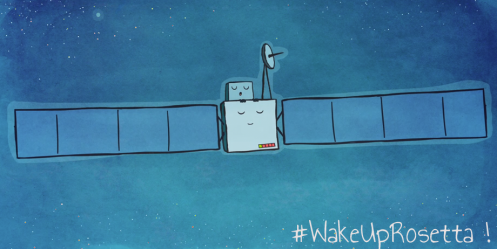
Some spacecraft perform there missions flawlessly, some get to within a whisker of the mission and fail, every comet fan is crossing their fingers (or cultural equivalent), that Rosetta safely wakes up and completes the final leg of its 10 year flight to comet Comet 67P/Churyumov–Gerasimenko.
A good article about the mission is here. Another at the Waiting for ISON blog. Source of the above image.
FOr Australians, "Wake Up Rosetta" echoes the Wiggles "WAKE UP JEFF".
Labels: space probe, spacecraft
Saturday, July 20, 2013
Waving at Planets (Saturn and Mercury) in the Rain.
 |  |
| Waving at Mercury for the MESSENGER photo on Friday night | Waving at Saturn just now (Saturday morning) for the Cassini photo. |
Despite the cold, wind and the rain I managed to get up this morning to wave at Saturn. I had a good chat with Ashley Walsh on ABC local radio about why it's a good idea to wave at the ground this morning, as Saturn was well below the horizon in Australia when Cassini snapped our picture. The interview was accompanied by the hammering of hail. Then at the alloted hour I donned raincoat and trudged out for my wave.
At least the hail had stopped. I had a few minutes of fellowship with folks worldwide who were also waving. Then I raced back inside to stop being blown away by the wind.
Things were slightly easier last night when we waved at Mercury (also below the horizon), we just had to wait for a gap in the rain.
Everyone who participated can get a certificate from here.
Now back to bed.
Labels: Mercury, public outreach, Saturn, spacecraft
Friday, July 19, 2013
Don't Forget To Wave at Saturn (and Mercury) this Saturday (July 20, 2013)

Don't forget, on Saturday July 20, at 7:27 am AEST, 6:57 am ACST and 5:27 an AWST, (that’s July 19, 21:27 UT), the space probe Cassini will look back to Earth and take a picture of our planet.
Of course, Saturn is well below the horizon from Australia. But by getting out there and participating, you will have taken part in one of only 3 of portraits of Earth taken from a spacecraft in the outer solar system.
And besides NASA needs more photos of crazy Aussies waving at the ground. Don't forget to post your images to them for their Flickr account or Facebook page.
You can find out more at NASA’s photobomb site, there are community events at “The Day The Earth Smiled” and a live webcast of Saturn while Cassini snaps us at the Virtual Telescope.
The Australian ABC Online has a good report of this event, as well as a photo-gallery of portraits of Earth from space.

The times MESSENGER will be photographing Earth are 11:49, 12:38 and 13:41 UT, this translates out into 21:49, 22:38 and 23:41 AEST on the evening of both the 19th and the 20th here in Australia (subtract half a hour for central states and two hours for WA).
Again, Mercury will be well below the horizon in Australia when this happens. Follow exactly the same steps as looking for Saturn above (although this time it will be at a decent hour in the evening).
Labels: public outreach, Saturn, spacecraft
Monday, August 27, 2012
In Memoriam Neil Armstrong

In honour of Neil Armstrong, who died yesterday at the age of 82, I got my family and our visiting hemi-demi relatives to wink at the Moon. Then I got my small telescope out and showed them Mare Tranquillitatis, the Sea of Tranquillity, where Neil made his epic step.
The I showed them the triangle of Mars, Saturn and Spica, then showed them Saturn and Mars through the telescope.
As a geek child I was obsessed with the missions to the Moon, we had a copy of National Geographic with a fold out of the Apollo instument panel, and I used to sit in frontof it pressing the pictures buttons and switches and imagining it was me going to the Moon.
I clearly remember the moment when Neil stepped on the Moon, seen on our tiny, grainy black and white TV. Unfortunately, I can't remember anything before of after that section. Perhaps my memories have been suborned to the continual replay of that iconic image.
Regardless, Neil was one of my heroes, the first person to set foot on another world. And I will honour his memory by showing people the wonders of the sky and the strangely shaped patch on the Moons' face where humans once walked (and, of course, winking).
If anybody wants to send me images of the Moon they took while winking at it, I will be pleased to post them.

Another way you can honour Neil's memory is to help Map the Moon.
A series of interviews with Neil Armstrong, strangely with an Australian accountant, can be found here.
A report on the ABC online news site is here.
6 memorable letters from Neil Armstrong are here.
The Bad Astronomers take is here.
And finally, this XKCD cartoon is very appropriate.
Labels: history, Moon, spacecraft
Sunday, August 26, 2012
Wink at The Moon Tonight
 Neil Armstrong, the first human to walk on the Moon, died earlier today at age 82. The family of Neil has asked that when people look up at the Moon, to wink at it in memory of him.
Labels: history, Moon, spacecraft
Tuesday, August 07, 2012
Curiosity Parachutes to Mars, snapped by the MRO

Labels: Mars, space probe, spacecraft
Monday, August 06, 2012
There are Three Mars Rovers Hidden in this Picture; Can You Find Them?

The difference between this picture and the ones here and here, is that Curiosity is resting safely on the surface in Gale Crater.
Now Opportunity has another companion, which will trundle around for at least two years if all goes well (My title is wrong by the way, I forgot Sojourner, that makes 4. See this picture for all three generations. Hat tip to Stuart)
Watching the landing was an immense buzz, XKCD sums up today perfectly. (Yes, we landed a rover the size of a car on Mars using a SkyCrane! How cool is that! Antidote here)
Now we wait for the images and science results, the first images from the touchdown are here. I've put two of the best up below. More images coming at 18:00 UTC (that's 4 am AEST)
UPDATE: HiRISE has confirmed that they imaged Curiosity on its way down, pictures not released yet, they will be released at the 16:00 UTC press briefing.
 |  |
| Front right wheel via Hazcam showing Curiosity's shadow. Image credit JPL/NASA | Rear right wheel via Hazcam, everything is dusty from the landing kicking up dust. Image credit JPL/NASA |

Labels: Mars, space probe, spacecraft
Live blogging Curiosity's Landing
People are eating peanuts for luck.

1 minute to separation of cruise ship
Cruise stage separation successful
Control rockets warming up, 7 minutes to re-entry
5 minutes to re-entry all well
Of course, due to light speed delay, it's all over for real. Time travel is heck!

Curiosity has begun guided re-entry, Odessy is picking up Curiosity!!
2 minutes to landing
Parachutes opened, all under controlled,
Under powered flight, sky range ready
Skcrane started
touchdown!!!!!

Screen shot of rover wheel image
All images screen shots from NASA TV Livestream
Labels: Mars, spacecraft
Sunday, August 05, 2012
What will Earth Look Like from Curiosity's Landing Spot on Mars?
 |  |
| The morning sky on Mars from Curiosity's landing site at 3:30 UT, 2 hours before Curiosity lands (simulated in Stellarium; click to embiggen) | Location of Curiosity on Mars, courtesy of Mars24 (click to embiggen) |

In the morning sky, as seen from Curiosity's landing site, Earth, Venus and Mercury will form a straight line. On the day of landing Phobos will zip past the trio as dawn approaches.
Earth will be 3/4 gibbous a s seen from Mars, with Australia facing the Red Planet. Australia's Canberra Deep Space Communication Complex will play a vital role n communicating with the rover when it lands. Sometime after the landing Curiosity will start sending back images, the raw images can be seen here as they are uploaded.

For information on where you can watch the coverage of Curiosity's landing live (or as live as you get with an 8 minute light speed lag) see my previous post.
The map of the Curiosity landing site was from the Mars24 Mars clock application (hat tip to Emily Lakdawallah).
Labels: Mars, space probe, spacecraft
Friday, August 03, 2012
Watch Curiosity Land (or not) on Mars
The Mars Curiosity Rover will descend to Mars while Mars itself forms an attractive triangle in the sky. At 05:31 UTC on August 6 (that's 3:31 pm AEST, 3:01 ACST, 1:31 pm AWST, so okay, you won't be seeing Mars in the sky from Australia while the landing occurs).
Curiosity will touch down in Gale crater on Mars. That is if it survives the "seven minutes of Terror", when Curiosity decelerates for its landing (with a pretty amazing "sky crane").
You can watch the events as they unfold on NASA TV, the observing schedule is here (The times are all in Pacific Daily time (US), but the broadcast starts at 03:30UT Aug 6, 1:30 pm AEST Aug 6).
Alternatively CSIRO will be hosting a landing Party at the Canberra Deep Space Communications Complex with live Ustream coverage (try checking in around 1:00 pm AEST), or the Curiosity twitter stream. There is also a live ustream from the landing party at the Victorian Space Science Education Centre.
Then there's the Bad Astronomer, Fraser Cain and Pamela Gay, doing a Google+ Hangout on August 6th starting at 03:00 UTC (1:00 pm AEST) on August 6.
You can also follow a simulation of the spacecraft's arrival using NASA's Eyes on the Solar System 3-D interactive (Free browser plug-in required).
UPDATE: Raw images from Curiosity can be found here when (if) it starts transmitting back.
As well as all this activity, the HiRISE camera on the Mars Reconnaissance Orbiter will try and take a shot of Curiosity landing.
Labels: Mars, spacecraft
Monday, June 25, 2012
Astounding Southern Hemisphere Auroral Image From Space
Labels: aurora, spacecraft
Monday, January 16, 2012
Phobs Grunt has Come Down
Labels: Satellite, spacecraft
Sunday, January 15, 2012
Phobos Grunt Updated Predictions
Most predictions are still for 15 January UT, roughly around 20 h UT but with spreads of error on the order of 9 hours to one and a half hours (see here, here, here and here for a variety of predictions). The tightest prediction now puts the re-entry off the coast of Africa.
From Australia's point of view, the spacecraft will come down sometime on early Monday 16th, CalSky (and the Phobos Grunt site) has a pass over Adelaide at 6:54 am AEDST, with reentry at 7:12 AEDST +/- 3 hours. So it may be possible for Australians to see the craft-reenter.
Labels: Satellite, spacecraft, unaided eye observation



 Click to read about or order
 Click to read about or order
 Click to read about or order
 Click to read about or order


