Wednesday, May 16, 2012
Finding Hubbles Hidden Treasures

Yet there are thousands of images that have never been seen by the public. So Hubble is throwing open its archives to the public to look for interesting images.
Some assembly is required, you will need to do some processing of the image data. There is a series of tutorial to help you though.
There is even a competition with prizes (see here and here), but you have to hurry. The competition closes May 31!
More information from the Hubble site:
- How to find hidden treasures in the archive
- What is image processing?
- Hubble’s Hidden Treasures 2012 Contest
- Hubble's Hidden Treasures 2012 Image Processing Contest
- Who is organising this?
What, you are still here? Hie thee to the Hubble site this instant.
Labels: astrophotography, citizen science, competition, hubble

Thursday, July 21, 2011
A Fourth Moon for Pluto (and a Celestia File)
 Composite image showing the orbital notion of Pluto's moons, including the new P4 (click to embiggen). Image Credit Hubble Space Telescope.
I'm probably the last person to blog this, but a team at the Hubble Space Telescope has discovered a new moon for Pluto.
The tiny moon, charmingly named S/2011 P1 (or P4) at this stage, is somewhere between 13-34 Km in diameter. It orbits between Nix and Hydra, and is probably like then the remnants of a giant impact early in Pluto's history. Interestingly, it was found during a survey looking for rings around Pluto.
The extra moon has re-ignited the "Pluto is a planet" debate, but as asteroids have multiple moons, I don't think this will fly.
You can find more detail and commentary at the Planetary Society Blog and the Bad Astronomer (and Wikipedia). So rather than add more, I'm going to do what I do best, and give you a Celestia file.
 Visualisation of P4 in Celestia (click to embiggen).
Pluto, Charon, Nix and Hydra are already in Celestia 1.6 so just copy the data between the lines into a file called newpluto.ssc (or whatever you like), and copy that file into the Celestia extras folder.
The data is quite preliminary (I've just copied a lot from Hydra), and will be updated in the near future, but for the moment the visualization isn't too far off the real thing.
========newpluto.ssc===============
# Newest Moon of Pluto
# http://science.nasa.gov/science-news/science-at-nasa/2011/20jul_p4/
"Pluto IV:134340 Pluto IV:S/2011 P1" "Sol/Pluto"
{
Class "minormoon"
Texture "asteroid.jpg" # "spectrally neutral"
Mesh "asteroid.cms"
Radius 17 #upper limit
InfoURL "http://en.wikipedia.org/wiki/Moons_of_Pluto"
OrbitFrame {
EquatorJ2000 { Center "Sol/Pluto-Charon" }
}
EllipticalOrbit
{
Epoch 2455740.5 # 2011 June 28
Period 32.1 # mean
SemiMajorAxis 59000 # mean
Eccentricity 0.00 # mean
Inclination 96.362 #Using Hydra
AscendingNode 223.077 #Using Hydra
ArgOfPericenter 45.4 #Using Hydra
MeanLongitude 322.4 #Using Hydra
}
Albedo 0.18
}
================================================
Labels: celestia, hubble, Moon, Pluto
Friday, May 06, 2011
596 Scheila - Asteroid Collision not Cometary Outburst?
 Image Credit: Steve Larson of the University of Arizona's Catalina Sky Survey (CSS), December 11, 2010, Catalina 0.68-meter Schmidt telescope.
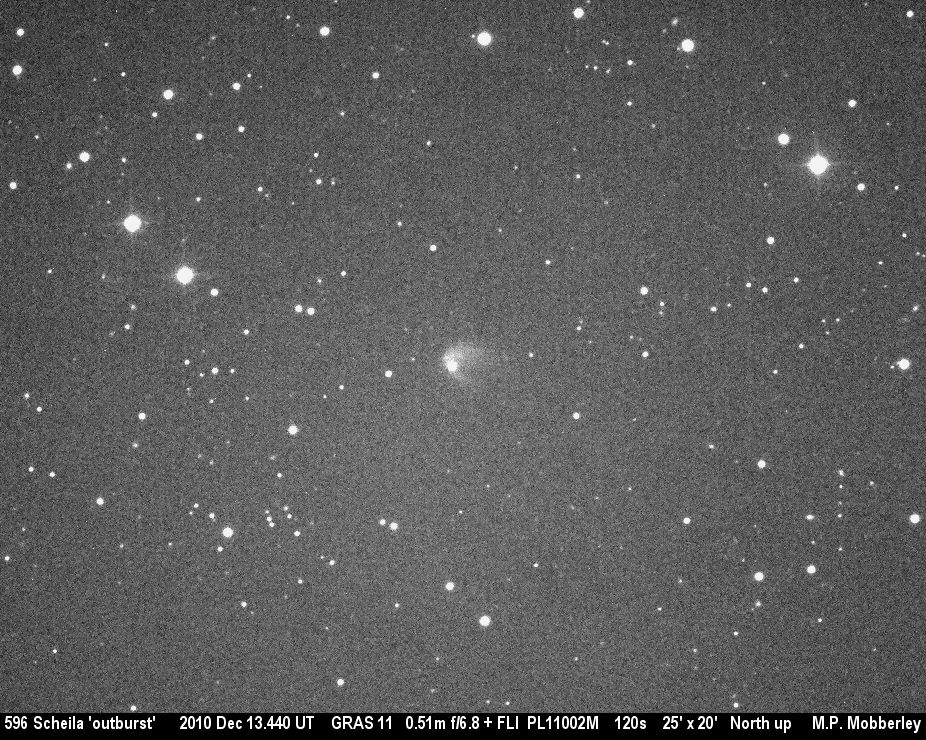
 Back in December 2010 the Catalina Sky Survey picked up a remarkable comet-like outburst from the asteroid 596 Schelia. Multiple observers soon confirmed this outburst, including several members of the Global-rent-a-scope community.
If you want to see some good images of the comet-like coma around 596 Scheila, here is Martin Moberly's image taken on G-11, J-F Soulier's images, W-T Hsu's images, and Joseph Brimacombe has some amazing animations here and here, as well as some great images (my own images were pretty ordinary).
Scheila is a 113 Km diameter rock, one of 4 "T" class asteroids, which have a number of comet like features and are related to "D" class asteroids, which may be captured Kuiper belt objects. Scheila joined a growing list of asteroids like 3200 Phaethon which have shown comet-like characteristics. The question hotly debated at the time as whether this was a true outburst of buried cometary material, or the results of an impact. The asymmetric plumes of material were puzzling, and not entirely consistent with a cometary outburst.
 Image Credit: NASA/Hubble.
A recent publication (PDF here) may resolve this debate. Shortly after the outburst was announced, the spacecraft SWIFT used its Ultraviolet/Optical Telescope (UVOT) to capture multiple images and, most importantly, a spectrum of the asteroid.
A cometary outburst sends a mass of dust, gas and water vapor into space. Ultraviolet sunlight then breaks up the water into hydroxyl and hydrogen. Other gases are also transformed into compounds with a characteristic UV-spectra. But none of the emissions most commonly identified in comets, such as hydroxyl or cyanogen, show up in the UVOT spectrum.
The combination of dust distribution and spectra strongly suggests that what we saw was the result of an asteroid collision, rather than a cometary outburst. This is pretty amazing, the chance that we would see the aftermath of an asteroidal collision before the dust settled, so to speak, is pretty slim. Two months after the first observation the dust tail had dissipated.
The press release says:
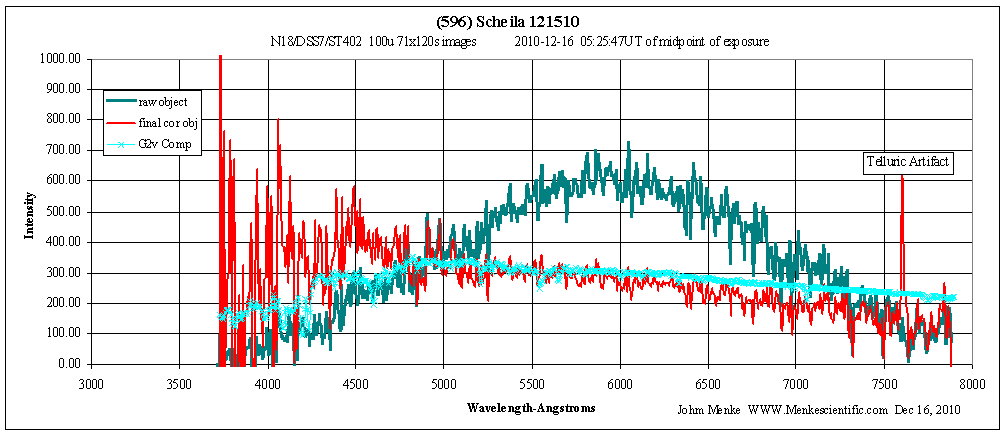
"The Hubble data are most simply explained by the impact, at 11,000 mph, of a previously unknown asteroid about 100 feet in diameter," said Hubble team leader David Jewitt at the University of California in Los Angeles. Hubble did not see any discrete collision fragments, unlike its 2009 observations of P/2010 A2, the first identified asteroid collision.Amateurs played an important role in monitoring Scheila, for example the time sequence of J-F Soulier's images show the evolution of the coma. The SWIFT spectra result was anticipated by this spectrum at John Menke's site, which looks like a lot of dust, as well as susequent amateur and professional spectra (as detailed at J-F Soulier's site ). Given that the Global -rent-a-scope community played a role in confirming and monitoring the activity of 596 Schelia, these results should be of great interest to them. What would have been nice would have been a way to collate all the amateur images and spectroscopic results to systematically follow the evolution of the outburst.
Centauri dreams has a good discussion of the paper, and NASA has produced a really great video that explains the findings.
Labels: asteroids, Global Rent-a-Scope, hubble
Friday, February 05, 2010
Pluto - we're Looking at YOU
 Hubble Images of Pluto: Image credit M. Buie /NASA, ESA, Southwest Research Institute
Often you see illustrations of Pluto as being white, but really, it's red. This is just one more link showing the Pluto is a big Kuiper Belt object (these are red too, due to UV action on the organic compounds in their ices). The black parts in the image probably represent organics that have been polymerized into taryy gunk.
 Back in 1994 Hubble took some images of Pluto and made a map of the distribution of reddish patches. Not bad since Pluto is pretty small even in Hubble, and a lot of features are only a couple of pixels wide. Now Hubble has released a new map,which shows changes since 1994, the north pole gets brighter and the south pole darker over 10 years. There are some more images here, and a great animation of Pluto rotating here. Sure, it's interpolated to heck and back, but it sure is fun.
Thursday, February 04, 2010
Hubble Sees a Cosmic Smash
 Image Credit NASA, ESA, and D. Jewitt (University of California, Los Angeles). Photo No. STScI-2010-07
Comet P 2010/A2 was always a strange beast, one of the few known comets that orbited in the main asteroid belt. Well, turns out to be weirder than that, a close-up view from the Hubble Space telescope suggests that the tail of P 2010. A2 is not a cometary tail, but a debris tail resulting from the collision of two asteroids. See also here.
Labels: asteroids, comets, hubble
Thursday, September 10, 2009
Hubble Beyond Amazing
 Starbirth in the Eta Carina Nebula. Image Credit Hubble- NASA.
So, if you have been living under a rock, in a cave, with earmuffs on, you will not know that NASA have released amazing images from the refurbished Hubble telescope. The Bad Astronomer has interesting details and pictures, Tom has his favourite shot, and Starts with a Bang has a nice paean to the Hubble instrumentation.
Labels: Astronomy, astrophotography, hubble
Wednesday, May 13, 2009
Speaking of the Hubble Telescope ...
... the wide field planetary camera 2 will be removed as part of the service mission. Some of the most memorable Hubble images come from the WFPC, so Starts with a Bang is doing a series on "the Best of the WFPC" entitled "The Camera that Changed the Universe". The first instalment is here.
Labels: hubble, Science Blogging
Tuesday, May 12, 2009
On This Day ....
.... in 1820 (GMT), the HMS Beagle was launched at Woolwich Naval Dockyard. The Beagle was to carry Charles Darwin of his voyage of discovery to South America and Australia. This seminal trip resulted in the landmark "On the Origin of Species", which changed biology forever.
.... Today, the space shuttle Atlantis blasted off to deliver the final service mission to the Hubble Space Telescope. This service should extend the telescopes life to about 2014, and provide significant upgrade in its functioning. Check Heavens Above to see if you can see the shuttle and the ISS together.
.... Today, the space shuttle Atlantis blasted off to deliver the final service mission to the Hubble Space Telescope. This service should extend the telescopes life to about 2014, and provide significant upgrade in its functioning. Check Heavens Above to see if you can see the shuttle and the ISS together.
Labels: evolution, hubble, Space Shuttle
Tuesday, April 24, 2007
Happy 17th Anniversary Hubble!
 Image Credit NASA/ESA/Hubble
The Hubble Space Telescope is 17 years old today. In commemoration, Hubble has released this astounding, breath taking image (click to enlarge, you won't regret it). For an instrument that has been sending back breath taking images, this one has surely topped the lot.
To quote the press release:
The image shows a 50 light-year-wide view of the tumultuous central region of the Carina Nebula where a maelstrom of star birth – and death – is taking place.Eta Carina and its nebula is one of my favorite sky places, this image will make me look at it in a different light! (Many thanks to Stuart for the heads up!) (and don't forget comet Lovejoy!)
Labels: Carina nebula, hubble



 Click to read about or order
 Click to read about or order
 Click to read about or order
 Click to read about or order