Saturday, June 06, 2009
My New Toy
 I've just bought myself a new toy. An adaptor which clamps over the eye-piece/eye tube of my telescope and allows me to attach my digital camera (in this case my Canon IXUS, but any digital camera will work).
Why, you ask, should I bother to do this, since I have a webcam adapted to my telescopes, and a standard SLR adaptor?
Well, if I want to take images of the whole Moon (or Sun), say during an eclipse, the webcam is useless, and holding the camera to the eyepiece is pretty ordinary.
 As for the SLR, it's getting harder and harder to find a place that actually handles astrophotography film any more. Plus waiting up to a week to get my images back is pretty ordinary too.
The adaptor fits in my my low cost philosophy. For $100 AUD you can get a good adaptor. These images were taken with a fairly standard digital camera, like many people already have, and all the images were taken with an unguided 4" reflector.
This emphasises that you can take good astrophotography without expensive equipment. The adaptor also fits the microscope at work, and I've been taking images of my cells for publication as well.


Labels: astrophotography, Moon

Wednesday, July 27, 2005
A New Toy

I've been busy with beginning of Semester stuff and a few deadlines, so the blog has been quiet. But thanks to Stuart I've been introduced to a new toy. It's a photorealistic planetarium program called Stellarium. A screen shot is reproduced here. It is gorgeous, it is wonderful it gives wonderful sky views and best of all it is FREE!!!
But, and there always is a but isn't there, it is painfully S L O O O W. It is glacial. This is probably due to all the photorealistc rendering they do. My favorite CPU hog, the 3D spaceflight simulator Celestia (run, don't walk, to this site NOW) is positively zippy by comparison. When these guys say you need a fast CPU, they are not kidding. Even setting the time in the program is a series of painful waits (it is almost, but not quite, worth the effort to set up scripts to turn Celestia into a planetarium program).
So I won't be giving up SkyMap any time soon, if you want a free Sky Charting program for astronomical observation, then try Cartes du Ciel. But if I want to impress visitors with demonstrations of the sky, or generate photorealistic horizons for my web page, then Stellarium is it.
Friday, April 27, 2007
Blogging break, with added telescope
I will take a slight break from blogging, as today my Father-in-Law walked in with an Orion SkyViewEQ 8. It's an old one he got off a mate who wasn't using it any more. It has a CLOCK DRIVE!!! So although Hughie has relented, and rain is pouring down, I'll be setting up my new toy. So I'm off the air, sorry.
Thursday, March 19, 2009
Blogging the Starry Messenger - Jupiter
 Comparing Galileo's drawing of Jupiters Moon's (top) with a modern prediction for the Moon's appearance at that time (Below). For a drawing using a fairly ordinary telescope , drawn by hand and then made into a woodcut, it's pretty accurate (scaling between the images is different, sorry).
The small stars in Galileo's diagram represent Jupiter's Moons.
Continuing my reading of Galileo's Sidereus Nuncius (The Starry Messenger).
Galileo's audience have been shocked by the revelation that the Moon was not a perfect object. They were stunned when the Milky was was revealed to be not an etheric glow in the celestial spheres, but myriads of stars to small to be resolved to the unaided eye. But the next revelation was the most amazing.
Galileo was the first to discover completely new worlds.
On the seventh day of January in this present years 1610, at the first hour of night, when I was viewing the heavenly bodies with a telescope, Jupiter presented itself to me. And because I had prepared a very excellent instrument for myself, I perceived (as I had not done before on account of the weakness of my previous instrument) that there were three bright starlets beside the planet, small indeed, but very bright.The " very excellent instrument" was probably no more than 20x in magnification (you can get a replica yourself). Now, Galileo was not expecting new planets, indeed nothing would have lead anyone to expect there could be more than the 7 classical planets. But he did note that the three starlets to the east of Jupiter were aligned with the ecliptic. Unusual and interesting, but not the harbinger of new worlds. Imagine yourself looking at three tiny stars near Jupiter, how would your realise that these dots were Moons, not stars?
The next night though the three stars were on the western side of Jupiter.
Now, as Jupiter was travelling westward at the time, there was no way that fixed stars could turn up on the western side of Jupiter. The penny still hadn't dropped, but Galileo now sets watch on Jupiter and the starlets. After two further observations, it was clear that the starlets never moved far from Jupiter, and were travelling in the ecliptic line. Galileo writes:
I now decided beyond all doubt that there existed in the heavens three stars wandering about Jupiter as do Venus and Mercury around the Sun, ... [at this time Galileo had not seen all four Moons]Note how cheekily Galileo inserts a heliocentric idea in the text, true it could be referring to Tycho Brahes system, but throughout the Starry Messenger there is more than a hint of heliocentrism. However, his discoveries were so astonishing that most people ignored the heliocentrism and attacked the existence of mountains on the Moon, and Moons around Jupiter.
Most of the rest of the book is list after list of Jovian Moon positions. Given that the man had just discovered new worlds, the dry list may come as some surprise. However, it had an important point, and people scoured this section very attentively. Galileo had to establish beyond doubt that the starlets really did circle Jupiter. One way was to establish orbital periods for the starlets, which require two things, accurate measurement of the starlet positions, and some way to identify individual Moons. The furthest starlet was easy, no other Moon went so far from Jupiter, but distinguish three near identical points of light as they merged and separated was an enormous task. Galileo did not achieve it in the Starry Messenger, but did later on. He did get an approximate orbital period for the outermost starlet (IV, which we now call Callisto), and this approximate period got him in trouble later. Also, he was able to show by comparing the motion of Jupiter and the starlets to the fixed stars, that the starlets moved in latitude and longitude exactly with Jupiter. The Moons orbited Jupiter.
But now we have not one planet revolving around another while both run through a great orbit around the sun; our own eyes show us four stars that wander around Jupiter as does the Moon around the earth, while all together trace out a grand revolution about the sun in the space of twelve years.Naughty Galileo again! More heliocentrisim snuck in. He also resorted to atmospheres to explain the apparent dimming of the Moons as they approached Jupiter (this is really an optical effect due to the brightness of Jupiter).
The existence of the Moons was attacked as soon the the Starry Messenger was published. There was some reason to be sceptical. Galileo's telescopes were far from perfect instruments, and there were know artefacts in them. But Galileo's careful observations put paid to those sorts of arguments. The orbital features of the starlets could not be explained by mere artefact.
Many attacks were supremely foolish, even by the standard of the times. Francesco Sizzi argued that for metaphysical reasons, there could be no more than seven planets, therefore the Medician stars could not be real. Sizzi had even seen the Medician stars himself. But Sizzi also had a more subtle argument up his sleve. If the Mediciean stars were Moons, he said, then they should show a consistent periodic orbit like our Moon. But the orbits he derived from Galileo's observations did not agree with Galileo's stated orbital period. Which was because Sizzi had based his orbits on an incorrect figure. There were several observational errors in the printed work, not surprising given the difficulties of making measurements with the primitive telescope, and Sizzi started his calculations from an erroneous position for Callisto, and them compounded his problem by taking Galileo's approximate orbital period as an exact one.
At this remove, it is hard to understand these attacks, but in those days mere measurement was not match for metaphysics. People were supposed to start from metaphysical reasoning and argue to a conclusion. Observations and measurements came a poor second. However, eventually people like Sizzi were won around by just these measurements. After extended conversations with Galileo, Sizzi derived reasonable orbits and became his supporter.
Gallileo's Starry Messenger is a slim book, most of it is taken up with dry recitations of the positions of the Medician stars; Jupiter's Moons. But it held twin revolutions. It began the shattering of the Ptolemaic astronomy, and heralded the heliocentric solar system. And in shattering the Aristotelian version of the cosmos, and emphasising precise and careful measurement, it ushered in the modern era of science, where metaphysics was discarded and observation and careful testing of hypotheses became the standard.
Twin revolutions, started by a tube that today we would consider a toy.
Blogging the Starry Messenger - Introduction
Blogging the Starry Messenger - The Telescope
Blogging the Starry Messenger - The Moon
Blogging the Starry Messenger - The Stars
Labels: blogs, Galileo, Science Blogging
Sunday, December 11, 2005
Sandy Creek Redux
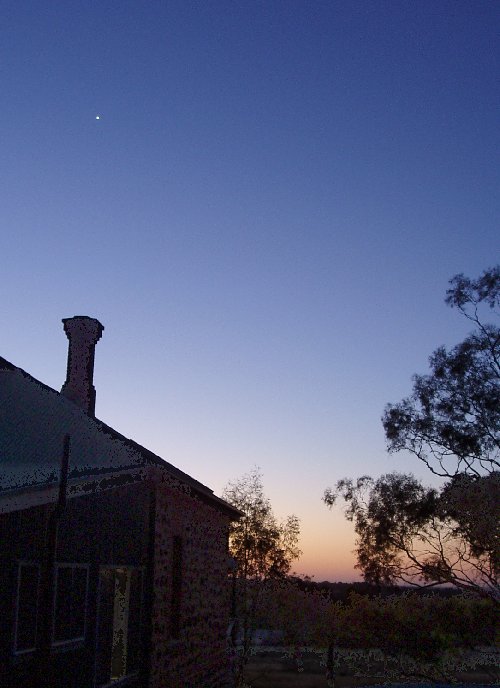 Venus setting over the Sandy Creek Youth Hostel (as always, click to enlarge).
I love going to Sandy Creek. Well, as I've written before, I don't so much love the going to part. Smallest one going beserk, the rushing around to leave on time, the discovery down the road that some vital toy or game has been left behind. That I could live without. But being at Sandy Creek YHA is a delight. Clear skies, beautiful bush walking tracks just outside your front door of a variety of lengths that the kids can do at least a bit of walking on. The variety of animals that live around you is pretty astonishing too.
Last time we were at Sandy Creek the fields were lush and green, wattles and orchids were flowering, and Venus, Jupiter and Spica floated above the roof. This time the fields were burnt blond, broom and grevillias were flowering and Venus kept solo vigil above the youth hostel chimney.
 They have been putting in new walks at Sandy Creek to replace the old eroded walks. We stumbled over part of the new tracks last time. This time we did the new Wren walk all the way around. Saw some large Euros (a kind of wallaby). In the afternoon we played bush cricket, got boomerangs stuck in the trees and futilely tried to fly kites. Pointed out Venus in the daylight and saw it as a crescent in binoculars.
Then we had a big birthday bash for the Bettdeckererschnappender weisles hemi-semi-demi cousin. Risoto and chocolate cake with sparklers, the lot.
After that I showed the kids and the adults crescent Venus, the Moon (Copernicus really vividly sharp, and mountains casting long shadows), Mars (it was pretty much a rudy disk in my 50 mm refractor) and Orions Nebula. With the Moon past first quarter the nebula wasn't spectacular, but the skies were darker than Largs North without the Moon, so it was pretty good. The adults were more entranced that the kids, because the kids were pretty well exhausted. But everyone enjoyed looking at the sky.
We finished off with coffee on the Veranda, watching the lowering Moon silvering the fields before us. What a way to spend the weekend.



 Click to read about or order
 Click to read about or order
 Click to read about or order
 Click to read about or order


