Sunday, February 02, 2014
Giant Sunspot AR1944 Returns (as AR 1967)
Giant sunspot AR1944 has rotated back onto the face of the Sun, and has been renamed AR1967. It is still big enough to be seen with simple eclipse glasses and no magnification (no pictures, at 43 degrees C I'm not going to get my scope out).
The sunspot is still active, and may yet hurl some geoeffective coronal mass ejections towards us.
The sunspot is still active, and may yet hurl some geoeffective coronal mass ejections towards us.
Labels: Solar flare, Sun, sunspot

Sunday, January 12, 2014
Say Farewell to Sunspot AR1944

Focus not so crash hot today. Click to embiggen
See previous images here.
Thursday, January 09, 2014
Sunspot AR 1944 Still Looking Awesome
 |  |  |
| Sunspot AR 1944 imaged using my Canon IXUS (400 ASA) and 4" Newtonian (infinity to infinity focussing with a 25 mm eyepiece) on 9 January at 7:00 pm AEST, AR 1944 is the largest one just above the middle. Click to embiggen | Sunspot AR 1944 imaged using my Canon IXUS (400 ASA) and 4" Newtonian (infinity to infinity focussing with a 25 mm eyepiece) on 7 January at 8:00 pm AEST, AR 1944 is the largest one in the middle. The white circle at the top is lens reflection. Click to embiggen | Sunspot AR 1944 imaged using my Canon IXUS (400 ASA) and 4" Newtonian (infinity to infinity focussing with a 25 mm eyepiece) on 5 January. There are multiple sunspots, AR 1944 is the one shaped like Australia (see inset) with New Zealand off to the right. Click to embiggen |
Giant Sunspot AR 1944 is still awesome as it begins to rotate off the Sun (compare the images above taken on the 9th (today) with the 7th and the 5th). I could still easily see it this afternoon with just eclipse viewing glasses, I've used a bigger Zoom than before (not intentionally, I was trying to match the previous images) I used two pairs of glasses to try and enlarge the preview image, so I think my focus is better.
For aurora fans waiting breathlessly, the geomagnetic storm hasn't hit yet.
Wednesday, January 08, 2014
Aurora Alert, January 9-10 2014

Remember giant sunspot AR1944? Well it let off an X class flare which produced an Earth-directed Coronal Mass Ejection.
This is anticipated to arrive at Earth on January 9 (Thursday) around 08:00 UT (which is 19:00 AEDST) +/- 7 hours! (so it could arrive as early as midday or as late as 2 am on the morning of the 10th).
NOAA predicts G2 and G1 class geomagnetic storms, which have the potential to produce aurora in Tasmania, Southern Victoria, Possibly Southern WA and South Island New Zealand. The Australian IPS has an anodyne prediction of "active".
The Moon is at First Quarter, so will not interfere much, and will be low in the late evening if the storm arrives later. As always, look to the south and look for shifting glows (greenish red for Tassie and NZ, red for Victoria and WA), dark sky sites are best. Some idea of the sorts of things it might be possible to see is http://astroblogger.blogspot.com.au/2013/07/images-from-saturday-nights-aurora.html
NOAA predictions
http://www.swpc.noaa.gov/wsa-enlil/
http://www.swpc.noaa.gov/ftpdir/forecasts/three_day/01080030three_day_forecast.txt
Labels: aurora, Solar flare, sunspot
Tuesday, January 07, 2014
Giant Sunspot AR 1944 Keeps on Growing
| |
| Sunspot AR 1944 imaged using my Canon IXUS (400 ASA) and 4" Newtonian (infinity to infinity focussing with a 25 mm eyepiece) on 7 January at 8:00 pm AEST, AR 1944 is the largest one in the middle. The white circle at the top is lens reflection. Click to embiggen | Sunspot AR 1944 imaged using my Canon IXUS (400 ASA) and 4" Newtonian (infinity to infinity focussing with a 25 mm eyepiece) on 5 January. There are multiple sunspots, AR 1944 is the one shaped like Australia (see inset) with New Zealand off to the right. Click to embiggen |
Giant Sunspot AR 1944 continues to grow, it is now almost dead centre of the Sun (compare the images above taken on the 7th (today) and the 5th). I could still easily see it this afternoon with just eclipse viewing glasses despite the thin haze of cloud. Shortly after the image above was taken, the Sun sank below the roof top, so my focus is not as good as before.
It is readily visible in safe solar projection systems. This link will show you how to make safe solar viewing and telescope projection systems. Here is my step by step guide to making a binocular projection system, and a guide to aiming your binoculars or telescope when you can't actually look at the Sun. And this is the projection system I use with my refractor telescope.
For aurora fans waiting breathlessly, while AR 1944 has the complex magnetic field that can produce X class flares it has so far failed to produce any. Today's M class flare was from another sunspot group. .
Sunday, January 05, 2014
Giant Sunspot AR 1944 Easily Visible with Safe Solar Observing Techniques.

Giant Sunspot AR 1944 is big enough to be seen without magnification, just using eclipse viewing glasses. I could easily see it this afternoon with just eclipse glasses (I did get the scope out as well, as you can see above).
It is readily visible in other safe solar projection systems. The following link will show you several methods to make pinhole projection systems.
You can also use binocular and telescopic projection systems. This link will show you how to make safe solar viewing and telescope projection systems. Here is my step by step guide to making a binocular projection system, and a guide to aiming your binoculars or telescope when you can't actually look at the Sun. And this is the projection system I use with my refractor telescope.
For aurora fans, AR 1944 has the complex magnetic field that can produce X class flares. If a strong flare goes off in the next day or so we may be in for aurora-producing conditions.
(Hat tip to Suzy Webb and Andrew Wall)
Labels: aurora, solar, sunspot
Friday, May 11, 2012
Sunspot 1467 via Binoculars


To the left is an image of the Sun and Sunspot 1467, the Sunspot group that has been blasting out M class flares for the past few days made with safe solar projection. On the right is the binocular lashup I made to take it. The Pizza box sun screen is required to keep the projected image in a reasonably dark spot. The image was projected onto a piece of paper stuck to a handy pillar on the verandah. It was quite clear to the eye, but getting the camera to focus on it was not so successful.
Thursday, May 10, 2012
More Flares Incoming! Aurora Possibilities Ahead.

In addition to the flares I reported earlier, there was a M5.8 event around 2:30 pm. Looks like we could be in for some aurora one way of the other. Spaceweather gives a 50% chance of geomagnetic storms in high latitudes in the next 24-48 hours.
In regard to the May 7 flares, solar storm watch says the May 7 CME's will miss us http://
Labels: aurora, Solar flare, Sun, sunspot
Monday, May 07, 2012
Prepare for Flares, Active Sunspot 1467 Arrives with a Bang (and a possible geomagnetic storm)!

On Sunday and this morning my mailbox got hit with news of several M class flares. These all emanated from the Sunspot region 1467, which had just rotated onto the face of the Sun (big group just on the left of the image).
Sunspot region 1467 is massive, one of the biggest sunspot groups in years, and should be easily observable with safe solar projection.
None of the flares that crackeled off are headed in our direction, but it is very likely the a couple will fire off when the Sunspot group is more or less facing us.
But we might get to see aurora before then, there is a geomagnetic alert for 9 and 10 May, with the possibility of isolated minor storms. So Tasmania and Southern New Zealand might have a chance of aurora.
Labels: aurora, Solar flare, Sun, sunspot
Friday, March 30, 2012
The Return of Sunspot 1429
Sunspot 1429, which produced several strong flares and was responsible for some nice aurora, is rotating back onto the face of the Sun we see. It is still active, and we might have a chance of aurora (although by the time it is facing us directly, strong Moonlight will interfere). See more here.
Labels: Solar flare, sunspot
Sunday, November 06, 2011
Sunspot 1339 Bubbles with Flares
 Sunspot Group 1339 (that's the rally big group to the left of Centre). Image credit SOHO/NASA.
Sunspot Group 1339 has been firing off M class flares nearly continuously. My email in-box is groaning under their weight. The orientation of the sunspot group is not quite good enough for there to be a good chance of auroras, but the possibility is there, so keep an eye out over the next few days.
Also, if it keeps up firing off M class flares the chances of seeing aurora are higher.
This sunspot group is big enough to seen with safe solar projection techniques.
Labels: Solar flare, sunspot
Thursday, August 04, 2011
The Sun Erupts (possibility of Aurora)
 |  |
Sunspot Group 1261 has been basting out flares like crazy, with a very strong M9 flare just recently. According to Space weather the first of the coronal mass ejections should hit us at around 9 am Friday morning (plus or minus 7 hours).
Another may follow, and the most recent and powerful wasn't really aimed at Earth. Still, things are looking up aurora wise.
Thursday, March 10, 2011
Sunspot 1166 Launches a Massive Flare
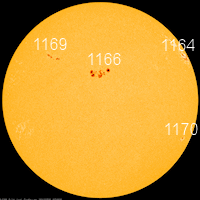 Sunspot group 1166 was the site of an X1.6 class flare about an hour ago (12:00 pm). This is a pretty significant flare, and should be sufficiently aligned with Earth to have a good chance of producing aurora. Currently the only warning from the Australian IPS is for a chance of activity today from the flares of yesterday from Sunspot Group 1164. See also Spaceweather.
We will have to wait a little while to see if this flare will have the potential for aurora.
UPDATE via Spaceweather:
Newly-arriving coronagraph data from the Solar and Heliospheric Observatory show no bright CME emerging from this eruption. Some material was surely hurled in our direction, but probably not enough for significant Earth-effects.
Labels: aurora, Solar flare, sunspot
Tuesday, February 15, 2011
Aurora Alert 15 Feb! Sunspot Group 1158 Fires Off
 Sunspot group 1158 has fired off an M Class flare. This is the first flare of any size headed towards Earth in a long time. Sunspot group 1158 has been bubbling along for a while, and fired off another M class flare this morning.
The Coronal Mass Ejection (CME) from the first flare should hit sometime between February 15 and 16, people in high latitudes (eg Tasmania and Southern New Zealand) should be on the look out for aurora. However, the Australian IPS has not yet issued a geomagnetic alert, so it might be a fizzer from the Southern hemisphere.
Aurora can occur anytime, but it is often best to look after midnight. However, due to the complexities of the interaction between the CME and the Earths magnetic field, a CME strike is not guaranteed to produce an aurora.
UPDATE: 1158 Just blasted out an X1 class flare, not sure if it was Earth directed though.
Thursday, January 21, 2010
So it Begins
 SOHO MIDI Magnetogram
Even though a new solar cycle (cycle 24) has begun, there has not been much sunspot or aurora action, in fact, 260 days of last year were spotless and there has been very little flare activity.
That changed yesterday (Jan 20), with a series of C and M class flares were blasted out by sunspot 1041 (on the edge of the Suns image bottom left). Two of the flares were the biggest seen for years (M2 & M1.7). See Spaceweather for an image of the large zone from the STEREO spacecraft. The Sun may finally be climbing from solar minimum.
Unfortunately for aurora watchers, even thought coronal mass ejections were produced, these are aimed away from Earth and will not provide any aurora. However, if 1041 remains active, there is a good chance of aurora, at least at high latitudes, in the coming week. For amazing images of colliding aurora, see here.
Sunday, December 09, 2007
Sunspot 978


Image Credit NASA/SOHO.
Solar Minimum has persisted for a while, and the Sun has been free of any substantial sunspots (or any sunspots at all) for quite a while. However, this has changed with the appearance of Sunspot 978. Actually its a complex of Sunspots, covering around 6 times the area of the Earth. The image to the left shows Sunspot group near the middle left hand edge. I tried viewing this sunspot directly with solar film, and using binocular projection, but I couldn't make it out. Family duties (including destroying our TV reception while trying to fix it [don't ask]) prevented me from setting up the telescope, but I might have a go tomorrow.
As for the C3 image next to the Sunspot image. Wondering where Mercury has been lately? It's the bright "star" on the middle of the right hand side of the image. The next brightest dot near the bottom right of the image is Antares.
This video (from SOHO archives)Shows a nice solar flare as Mercury heads in towards the Sun, while Antares heads out.
Labels: Mercury, Soho, Sun, sunspot
Tuesday, July 10, 2007
Sunspot 963 looks good
 Sunspot 963, image Credit SOHO/NASA
Sunspot 963 has just rotated onto the face of the Sun. It has a beta type magnetic field, and has produced a lot of C class flares. It has to potential to produce geoeffective solar flares capable of generating aurora. Of course, on the track record of past sunspots, its just as likely to go quiet.
Space Weather has lots of great images and links, like the shots of the ISS going past sunspot 963, and of the sunspot itself as well as a great movie of the spot flaring.
Labels: Soho, Solar flare, sunspot
Sunday, June 03, 2007
Sunspot 960 putting on a show
 Image Credit, NASA/SOHO.
Since last writing, Sunspot 960 has let off two more serious flares (and a host of minor ones), including a powerful M7.4 flare. You can see the details of that flare here, and here is some of the STEREO imagery of that flare.
It may be likely that Sunspot 960 will be visible with safe solar projection techniques. It is also becoming more likely, given its activity and the complex beta-gamma magnetic field, that Sunspot 960 could generate aurora.
Friday, June 01, 2007
Sun flares again
 Image Credit NASA/SOHO
The Sun just blasted out a M1.1 and C9.8 flare today. It's probably not from Sunspot group 958, the prominent group on the left hand side, but something sneaking up over the horizon (image courtesy of Space Weather).
If the spot keeps up its activity, we might get some geomagnetic action, perhaps even an aurora.
UPDATE: The Sun just let off two more M-class flares. Last time this happend though, the spot went quite soon as it moved into a position where it could produce aurora.
Labels: aurora, Soho, Solar flare, sunspot
Thursday, May 17, 2007
Sunspot 956, a sunspot to watch
 Image Credit NASA/STEREO
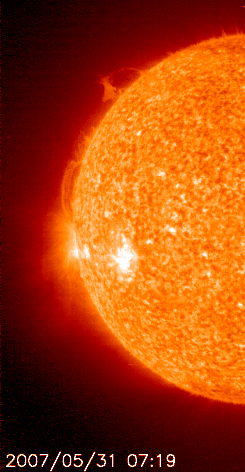
Sunspot 956 (the bright area on the left of the solar image) has been reprted by Spaceweather to have let off a C1 class flare. This was picked up by radio recivers in the US, although no flare alerts came from the Aussie IPS.
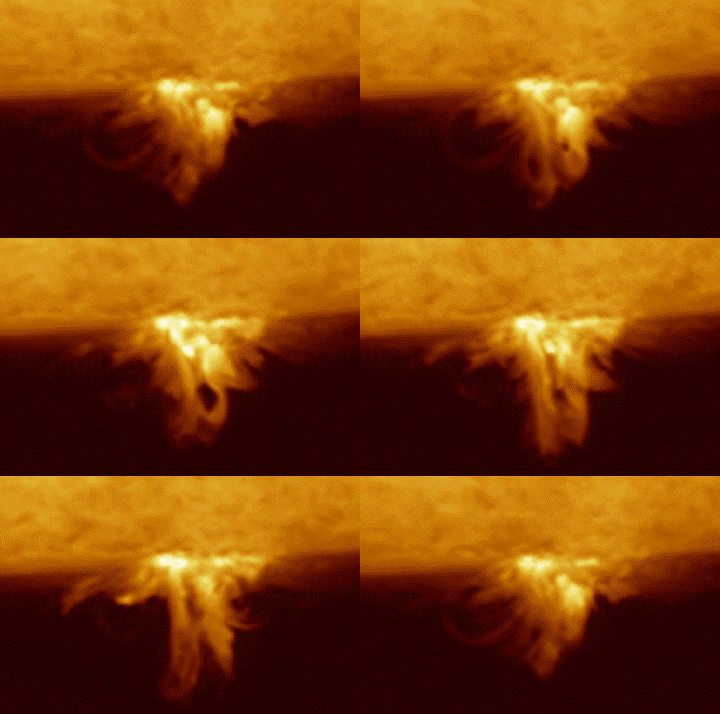
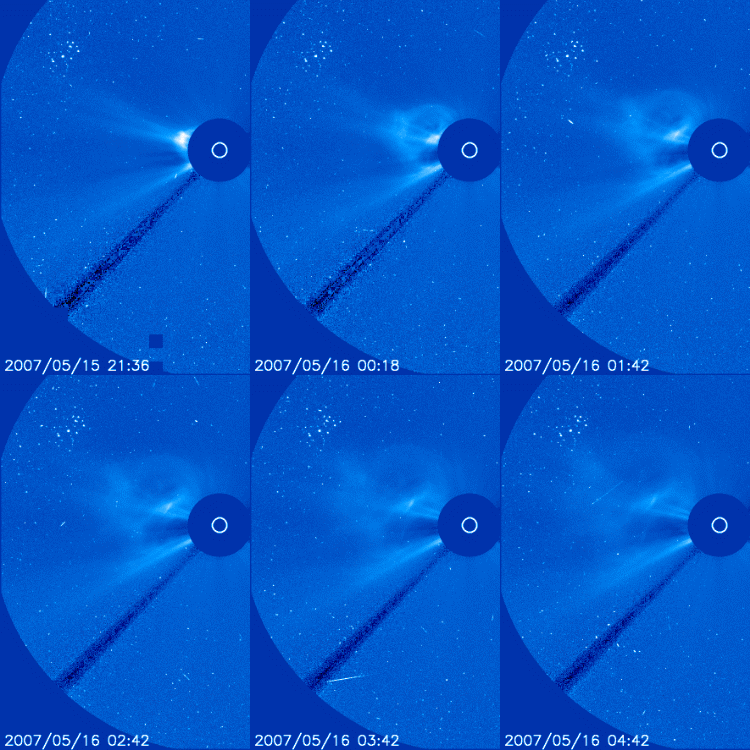
Spaceweather also has a nice animation showing a coronal mass ejection blasting out towards the Pleiades (the star cluster in the top left of the animation image).
Keep an eye on Sunspot 956, there could be big thing coming from it.
Labels: Solar flare, Sun, sunspot



 Click to read about or order
 Click to read about or order
 Click to read about or order
 Click to read about or order