Thursday, April 25, 2024
Occultation of Sigma Scorpii, morning, April 27, 2024
 |  |  |
| North-west morning sky on Saturday, April 27 as seen from Adelaide at 02:01 ACST. The Moon is just about to cover (occult) the bright star Sigma Scorpii. The inset shows the moon at 3:32 ACST as the moon moves off Sigma Scorpii. Click to embiggen | North-west morning sky on Saturday, April 27 as seen from Melbourne at 02:48 AEST. The Moon is just about to cover (occult) the bright star Sigma Scorpii.The inset shows the moon at 4:15 AEST as the moon moves off Sigma Scorpii. Click to embiggen | North-east evening sky on Friday, April 26 as seen from Perth at 23:49 AWST. The Moon is just about to cover (occult) the bright star Sigma Scorpii. The inset shows the moon at 1:06 AWST on the 27th as the moon moves off Sigma Scorpii. Click to embiggen |
On the morning of Saturday, April 27, the bright star Sigma Scorpii (Alniyat) in the head of the Scorpion is occulted by the Moon. Sigma Scorpii is one of the two bright stars flanking the bright red star Antares.
The occultation occurs with the Moon high above the north-western horizon at the start for the eastern and central states. Perth sees the occultation start just before midnight above the north eastern horizon. Darwin misses out although Sigma Scorpii will be seen very near to the Moon. Disappearance and appearance times are given in the table below. Other locations will see the occultation at a similar time for cities at a similar latitude.
While the occultation is visible to the unaided eye, the sight will be better in binoculars or a small telescope. Set up ahead of time so that you can be sure everything is working well and you can watch the entire event comfortably. Sigma Scorpii will be clearly visible to the unaided eye near the Moon.
To the east, Saturn will rise while the occultation is ongoing, followed by Mars. Around dawn the lineup Of Saturn, Mars and Mercury will be seen.
| Place | Disappears Bright Limb | Reappears Dark Limb | Astronomical Twilight |
| Adelaide ACST | 02:01 | 03:32 | 05:23 |
| Brisbane AEST | 03:12 | 04:27 | 04:52 |
| Canberra AEST | 02:55 | 04:24 | 05:11 |
| Darwin ACST | - | - | 05:41 |
| Hobart AEST | 02:58 | 04:15 | 04:51 |
| Melbourne AEST | 02:48 | 04:15 | 05:29 |
| Perth AWST | 23:49 (26th) | 01:06 | 05:23 |
| Sydney AEST | 03:01 | 04:28 | 05:03 |
Labels: binocular, Moon, Occultation, star, unaided eye

Monday, February 13, 2017
My Images of the Occultation of Regulus (11 February, 2017)
 |  |
| Occultation of Regulus, showing Regulus getting closer to the Moon from 11:20:44 until 11:42:37 ACSDT, just before disappearance. I had to overexpose the Moon to see image Regulus clearly, and have overlain a normally exposed image of the Moon for reference. Click to embiggen. | Animation of the frames in the previous panel, click to embiggen. |
 |  |
| The Moon and Regulus at 11:43:20 I have zoomed in compared to the images above (click to embiggen as Regulus is harder to see due to the Moons light) | The Moon and Regulus at 11:43:38 with Regulus just touching the Moon's surface. (click to embiggen as Regulus is harder to see due to the Moons light) |
After a disappointing morning, where comet 45P was completely clouded out, I was resigned to the occulataion of Regulus being clouded out. With intermittent cloud coming over, I set up the 4" Newtonian with my Canon IXUS in infinity to infinity mode of a 20 mm eyepiece (rather than the 8" with time drive and CCD cam).
Despite the cloud I was able to get images of almost up to Regulus going behind the Moon (it was just touching) before the cloud came over and blocked my view. Given the cloud, I didn't hang around for egress but went to bed. While my recorded almost occulataion time was 11:43:38 and the predicted time was 11:42:40 my camera clock is not accurate enough for this kind of timing.
So a successful occultation campaign. Let's hope the May 4 occultation of Regulus is clear.
Labels: astrophotography, Moon, Occultation, star, telescope
Sunday, July 06, 2014
The Moon, Mars and Spica, Sunday 6 June 2014
 |  |  |
| Chart of tonight's sky at 22:00 ACST as seen from Adelaide, similar views will be seen at the equivalent local time (eg 22:00 AEST) elsewhere. | The Moon, Spica (left) Mards (above) and Saturn (far right) as seem from my backyard around 19:00 ACST. The blob down the bottom is an imaging artefact. Taken with my Canon IXUS 400 ASA 2 second exposure. | Close up of Moon, Mars and Spica 3X Zoom on the Canon IXUS as before. |
If you have clear skies at the moment go out right now, and look up in the north/north-western sky. There you will see Mars, the Last Quarter Moon and the bright star Spica all grouped in a lovely triangle. Go on, go out and have a look.
Labels: Conjunction, Mars, Moon, star
Wednesday, April 16, 2014
Don't Forget, Venus Occults Lambda Aquarii Morning April 17, 2014

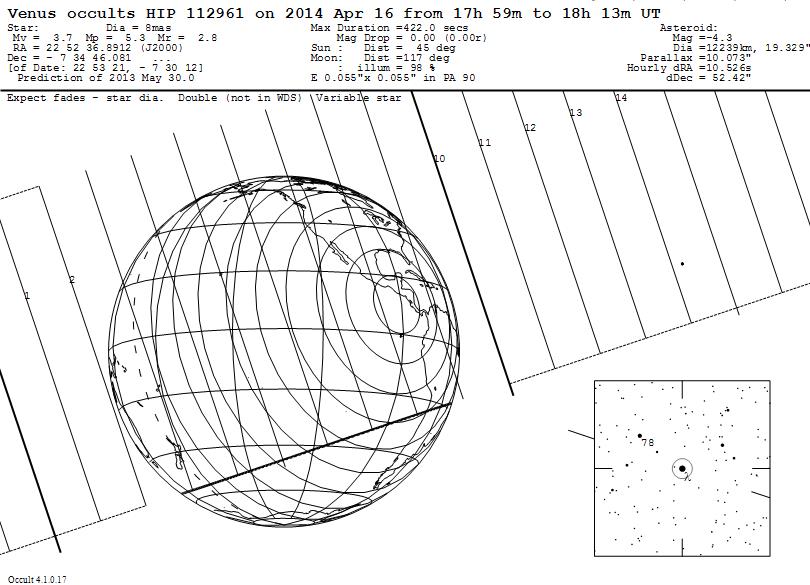
Don't forget that tomorrow morning at 3:59 am AEST (3:29 am ACST) Venus will occult the bright star Lambda Aquarii.
This is a rare occurrence, and the sight of the Star exiting from Venus's dark side will be quite different to a Lunar occultation due to Venus's atmosphere.
Brisbane has the best view, with Venus being higher than all other locations when it occults the star. For more details, charts and timings see my Venus occultation page.
Labels: Occultation, star, Venus
Wednesday, April 02, 2014
Venus Occults the Bright Star Lambda Aquarii April 17, 2014


A rare occultation of a bright star by the planet Venus occurs on April 17 in Australia and New Zealand (April 16 UT). Magnitude 3.7 Lambda Aquarii will pass behind Venus starting at 17:59 UT and finishing roughly 5 minutes later at 18:04 UT. What this translates out into local times on the morning of April 17 is shown in the table below (actually there is some variation in time by up to 30 seconds or more, but you should be watching well before hand).
Venus's thick atmosphere will make this occultation different from those of the Moon, where the stars wink out almost instantaneously (unless they are skimming along some mountains). You may be able to see the star begin to peek though Venus's atmosphere before reappearing (the bright side will be too bright to see the star immerse itself in the atmosphere, unless you have some serious kit).
While in Australia the occultation takes place before astronomical twilight, in most places it is quite low to the horizon. In Adelaide it is under a handspan from the horizon, Brisbane has the best view with the occultation nearly three handspans above the horizon. So for most places you will need a fairly clear, level horizon for this occultation.
In New Zealand the occultation occurs with Venus high in the sky, but near nautical twilight.
You WILL need a telescope to see this, Venus's light will overwhelm unaided eye views, and to some degree binocular views, but anyway the really cool part is to see the star emerge from Venus's atmosphere, which you can only see with a telescope.
| City | Occultation Start | Occultation End | Height Above Horizon |
| Adelaide (ACST) | 3:29 am | 3:34 am | 5° |
| Alice Springs (ACST) | below horizon | below horizon | - |
| Auckland (NZT) | 6:01 am | 6:04 am | 33° |
| Brisbane (AEST) | 3:59 am | 4:04 am | 16° |
| Cairns (AEST) | 3:59 am | 4:04 am | 9° |
| Canberra (AEST) | 3:59 am | 4:04 am | 13° |
| Darwin (ACST) | below horizon | below horizon | - |
| Hobart (AEST) | 3:59 am | 4:03 am | 11° |
| Melbourne (AEST) | 4:00 am | 4:03 am | 15° |
| Perth (AWST) | below horizon | below horizon | - |
| Rockhampton (AEST) | 3:59 am | 4:04 am | 11° |
| Sydney (AEST) | 3:59 am | 4:04 am | 15° |
| Townsville (AEST) | 3:59 am | 4:04 am | 10° |
| Christchurch (NZT) | 5:59 am | 6:03 am | 30° |
You can see some discussion in the Ice in Space forums here, with more information. A fairly impenetrable map is here.
Hat tip to Rob Kaufman for alerting me to this occultation.
Labels: Occultation, star, Venus
Tuesday, January 08, 2013
Occultation of Spica by the Moon, 6 January 2013, the Follow-Up
 |  |
| Widefield image taken at around 5:00 am ACDST, Infinity to infinity focusing, Canon IXUS through a 20 mm eyepiece on a 4" unguided Newtonian (click to embiggen any image) . | Close-upimage taken at around 5:26 am ACDST, Infinity to infinity focusing, Canon IXUS through a 20 mm eyepiece on a 4" unguided Newtonian. As Spica came close to the Moon, I changed the zoom factor on the IXUS to 3x get a close-up view. |
 |  |
| Overlay of 10 widefield images using ImageJ, because the scope was unguided, the images don't register very well | Overlay of 9 close-up images using ImageJ, because the scope was unguided, the images don't register very well. Bumped the scope at the last minute, so I missed Spica going behind the Moon. |
Animation made from the 10 wide-field frames, stacked and registered in ImageJ
Animation made from the 9 close-up frames, stacked and registered in ImageJ
Labels: animation, imageJ, Moon, Occultation, star, telescope
Friday, June 01, 2007
Surface images of Altair
Other stars, such as Vega, Alderamin, and Betelgeuse have been mapped before (I didn't know that), but this is the first time a main sequence star has been mapped.



 Click to read about or order
 Click to read about or order
 Click to read about or order
 Click to read about or order