Monday, February 25, 2013
Book Review: How it Began

Chris Impey uses a similar approach in his book "How it Began", only as well as going up from Earth to solar system to the galaxy and beyond, he takes us back in time as well, to where it all began. Doing a good, accessible book on the origin of the Universe is always a hard task, as our ideas on the origin may seem simple but have hidden, lurking complications in them.
By starting with the familiar, Chris sneaks up on these central ideas a step at a time, in an engaging way. As well as the central time travel metaphors, each chapter is top and tailed with the authors imagined viewpoint of this journey. I was a bit less enthusiastic about this device, sometimes it worked well, and sometimes it felt a bit contrived. I suspect this is more to do with how I visualize the same events (one day, Chris, myself and Larry Niven can get together and discuss what would happen to an astronaut on Pluto), but the critical thing is that these bookends didn't distract from the story.
In each section Chris mixes explanation, historical snippets and his own personal experience. As he has a wealth of directly relevant personal experience these episodes enhance the story rather than diverting it (I winced in sympathy at the story of shattered glass astrophotography plates). They are welcome rests on the path to enlightenment.
In a book where you are trying to explain abstruse physical theory, where the scale of the universe beggars our own earthbound experience, metaphors and analogy will inevitably be used. Chris does these devices well, I found one a little strained, but the majority were fresh, clever and very helpful (I really liked the dancer in the white suit with a partner in a dark dress for explaining Doppler wobbles for detecting exoplanets, but the analogy of the shadow of his partners feather boa to explain transits didn't work for me).
The mark of a good book is when you learn something new about a field you thought you had covered, and despite having a reasonable familiarity with most of the material, I learnt a thing or two from this book. I didn't know about the race to measure parallax for example. Even if you are well versed in these areas, Chris's book tells the story in such a refreshing way that it is worth reading to see how he explains it.
Explaining our theories of how the Universe began is always fraught, but Chris does it with aplomb, the steps leading up to string theory, and the shattered hopes that came with it are well described, the various "what caused the Big Bang" ideas are fairly surveyed. One of the things I really liked was the clear explanation of the various versions of "alternative universe" theories, which often leaves people puzzled. In fast moving fields like observing exoplanets, events have caught up with the book, but in a good way. A couple of places I found myself saying "yes, you called it".
Despite the recent advances this book will relevant for many years to come. From Earth to exoplanets, from dark matter to the Big Bang, Chris covers them all with aplomb, as we might expect from someone who teaches cosmology to Buddhist monks.
If you don't have much background in astronomy and want to learn more about the Universe, this book is for you. Even if you have a very good grounding in cosmology, this book is worth a read for the historical perspectives and the personal tales, and the analogies which you can pinch to explain things to your friends.
I give it four and a half out of five Quasars.
Labels: book review, review

Wednesday, February 15, 2012
Book Review: The Changeling Detective
First things first, before reading any further, put on the Angels song "Am I Ever Going to See Your Face Again" as loud as compatible with domestic harmony.
First things second,I liked this eBook novella, I really, really liked it. Now I have to qualify this statement.
Because I know the author, Phillip Berrie. Heck, he's one of my best friends (despite the fact I haven't actually spoken to him for a decade, that's my hyper disorganization). We've bush walked together, played chess and D&D together and he's had me help out on his real-time RPG's. Without out him, I would have never won an award for role playing a demented squirrel. And he supported my nascent attempts at writing fiction.
So you can see that I could be a wee bit biased when I praise his eBook. Now I need to convince you that the praise is worthy.
For as long as genres have been genres, their supposed boundaries have been transgressed. Almost as soon as we had hard bitten, roughly hansom detectives with monosylabic names, their trench-coated forms have been found trudging the streets of Mars or Magical Kingdoms (or Magical Kingdoms on Mars). It's giving nothing away to reveal that "The Changeling Detective" is located in the Sci-Fi**/Fantasy spectrum of "Trench-coat" Detective fiction*.
The Sci-Fi/Fantasy trench-coat detective crossover has given us an enormous number of variants on the central detective character. We've had ordinary humans in a magical world (Garrett; TunFair), magical Humans in an "ordinary" world (Harry Dresden; Chicago), marginally magical (and marginally competent) Humans in a magical world (Thraxas; Turai), we've had vampire detectives, robot dectectives, steampunk anti-magical detectives and bird-like alien detectives who live in inverted cones on Mars. Does the world need another Sci-Fi/Fantasy detective novel?
Heck yeah! The central character's ability (cue David O'Dohert's "very mild superpowers") is refreshingly original and cleverly thought out. Okay, so it's vaguely related to the powers of the bad guy in Larry Niven's "the Meddler", and the powers of the bad guys in "Faded Steel Heat", but the characters ability is sufficiently different, and drives the story in interesting directions, that these vague antecedents are irrelevant. You will note I haven't told you what the ability is (or the name of the central character). We'll, I'm not going to, even though the ability is revealed in the first chapter, the pleasant surprise of finding out what it is (and the clever ways it is used) is worth it.
Okay, having said that I have given readers of this review A Clue, see if you can work it out.
"The Changeling Detective" has appropriate nods to the trench-coat detective genre, but with refreshing twists and playful inversions of tropes. There is the obligatory attractive red-haired woman (Glenn Cook, I'm looking at you), but whose role is anything but eyecandy or the clichéd roles normally reserved for this archetypical character. Her story takes the plot in an parallel direction to the one triggered by the main character (cue the Angels again "She Keeps No Secrets From You"), and she plays important roles in the action.
The "Changelingverse" is a modern day world very similar to our own, there are no clouds of pixies or bands of grumpy dwarfs, and no pseudomedieval castles loom over the action. There are gormless bartenders, nosey neigbours and zombie savvy kids (no zombies actually feature in the novella though).
Oh, yes, there's action, the plot fairly kicks along at a cracking pace (but not in the Hollywood sense of "the plot's not making sense? Here's an explosion or two to distract you"). The plot also has as many twists and turns as the back road to Mt. Tambourine** so even as a somewhat jaded Krimi*** reader I was turning the pages to see what happened next.
You may notice I haven't given a synopsis of the plot. A large chunk of the plot evolves from the central characters ability, so I can't discuss the plot without revealing the ability. Suffice to say there's a Dame With A Case, bad guys with guns, gunshots, sirens in the night and enough of the Trenchcoat Detective tropes to keep Sam Spade happy. The ability is consistent in the Changelingverse (with plenty of "hey that's cool" and "how is the ability going to get them out of that" moments), no Deux ex Machinations occur and there is a sufficent smattering of the self-depreciating humour Australians are famous for.
The novella ends on a cliff-hanger, in the sense that although the immediate plot issue is resolved, there are clear loose ends that make you impatient for the next novel (in the same way the Jo Nesbo's detective solves the immediate crime, but the unresolved story of his partners murder leads into and ties together the next few novels).
My only real issue with "The Changling Detective" is that there isn't a good feeling of "sense of place". While the story is set in modern day Canberra, Australia's capital, it could be anywhere in the English speaking world. I've been to a number of the locations mentioned in the novella, and I didn't feel the book took me there.
True, Phil has two serious barriers to making a real sense of place. Firstly, it is Canberra, famously described as "a bloody good paddock ruined". It's the kind of place that makes Milton-Keynes and Bonn look exciting. Getting a sense of place from such a setting is difficult, even if you do mention Tuggeranong (but then, maybe the bland anonymity is its sense of place).
Secondly, the work is a novella, and you are up against space. It takes more than driving a Holden into a kangaroo while eating a meat pie to give a sense of place, just like it takes more than Jo Nesbo mentioning Fiords, rollmops and towns called Hallorgenvasenbaad gives you the sense of place in Norway, and more than walking out into a cloud of Pixies for Glenn Cook to give you the feeling of TunFair.
It takes space to subtley draw this out. It's easier for Jo Nesbo, his novels are 500+ page doorstops (even when you throw in Nazi's, Skinheads and gypsy crimelords there's plenty of space for exposition of "place"). In a novella you have to draw the plot more tightly, and Phil has used no cheap shortcuts. I am pleased to report no character cracks a tinny of Fosters in the whole novella. I think Phil has done a good job in the face of these limitations.
So if you want a fresh and engaging Sci-Fi/Fantasy trench-coat detective story whose character has a novel ability, and whose plot moves along at a cracking pace, I highly recommend "The Changling Detective". I give it 4.5 enchanted daggers out of 5 and I'm waiting for the next instalment.
* As opposed to police procedural, Sherlock Holmsian and "little old lady" versions of the detective genre
**Don't give me grief over Sci-Fi vs SF or whatever acronym you wish to use, I was there in the 70's. The arguments were pointless then and are still pointless.
*** see what I did there. Also, don't try this road in a camper van if you don't want a heart attack every 100 meters
**** one of the few lasting effects of my European postdoctoral stint is a tendency to call murder mystery novels Krimi's, helped along by our Swedish friends sendinging us Scandinavian Krimi's. Hence the Jo Nesbo references.
Labels: book review
Thursday, May 20, 2010
Book Review: Paradise Regained.
And what solutions they are. Avid science fiction fans will already be familiar with proposals to mine the Moon for Helium three, to use asteroids for mining and comets for water and to have orbital power stations, but these innovations will capture other readers’ imaginations.
However, all but the hardest of hard science fiction fans cannot fail to be moved by gravity tractors, and solar concentrators (which, after all, are designed to move asteroids and comets) and “Dyson Dots”. You may have heard of Dyson Spheres, the hypothetical all encompassing shells of matter Freeman Dyson proposed advanced technical civilizations would build around stars to capture all available solar energy. “Dyson Dots” are much less grand, but still quite amazing. Basically they are variants of the solar sail, but which can be much heavier as unlike the standard solar sail, which we want to move around, the Dyson Dot sails are meant to stay in place acting as a sunscreen, reducing the amount of sunlight reaching the earth in order to combat global warming. A fleet of solar sails just in front of the L1 point would effectively lower solar insolation without getting in the way of most astronomical activities Unless you are looking at the Sun, of course.
The scale of this is staggering; you would need 70,000 10 km square solar sails, weighing about 37 million metric tons to reduce the solar constant by 0.25 percent. This array of solar sails has to be held in place by an intricate array of software constantly checking the position of the elements and modulating the sails.
When I say Dyson Dots are less grand than Dyson Spheres, they are still stunningly, mind beggaringly HUGE in scale.
While the authors emphasise the grand sweep of their ideas, they do point out the limitations of space based systems and other drawbacks, for example the act of mining the Moon will raise dust that will interfere with other Moon-based industries.
BUUTTT … You knew there would be a but didn’t you. Events have overtaken some aspects of the book. The Constellation program, which would have supplied the ARES 5 heavy lifter, has been discontinued. In an effort to provide a broad sweep of history in a short space many aspects of biological evolution and the rise of civilization are turned into cartoon parodies of themselves. My “favourite” howler was in the section on evolution, on page 23, where the authors say “… a shellfish mutated to develop a crude interior skeleton. The first armoured fish … had evolved.” NO NO NO! This is so wrong its not funny. Another problem is the age of many of the suggested readings. No one could really argue with Attenborough’s “Life on Earth”, it’s a sensational book even now, but finding it will be problematical. Also, the science has moved on. There’s a lot of really good contemporary books out there (eg Richard Fortey’s “Life; an unauthorized Biography”; heck, even Bill Bryson’s “A Brief History of Almost Everything” would have been good).
As well, the authors are pitching Space as a solution to environmental problems, with global warming as a particular case study. Unfortunately, global warming needs to be dealt with very soon. We are already committed to significant warming, and need to have mitigation systems in place before 2050 or even further warming will cause significant problems. To get the Dyson dots in place needs massive resources, NASA’s proposed Ares 5 would have been able to launch 188 metric tons, so you would need around 200,000 Ares 5 launches to build a sunshield (see above). Even if the Ares had not been canceled, you would need to launch an Ares 5 every day for 100 years to build your Sunsheild. We can’t even get a ISS supply mission happening once a week. Or you do it in space using asteroid mining. But you still have to develop and launch your space mining and orbital factory facilities. You still have to head out, find appropriate asteroids, guide them back into Earth orbit, mine them and build and launch 70,000 solar sails into the L1 point. That’s not going to happen before 2050 even with the best will and crash space development programs. Our children and grandchildren will be facing severe global climate problems before the very first solar sail is launched. And the cost! People who are quibbling over the cost of cap and trade vs carbon tax initiatives would faint (or go into apoplexy) at the cost of a Dyson Dot solution.
In summary, a fantastic, gorgeous broad sweep book buzzing with ideas, marred by technical errors and conceptual problems.
Labels: book review
Thursday, May 14, 2009
The Hunt for Planet X – Book Review
 You should read this post while listening to Jimmy and the Keys "They Demoted Pluto"
It all started with Uranus. Before Herschel found Uranus lurking amongst the stars, people were quite content with the idea that the solar system contained 6 planets (and an increasing number of Moons, once the shock of Galileo’s discovery of the Medicean Stars had abated). But with Uranus swimming into view, people began to wonder if there were more worlds lurking out there, and hunt them.
So the hunt for “planet X” began, X the unknown, for every discovery of a new world, where X became known and named, there was always another X to take its place in the minds eye, and so the search continues on.
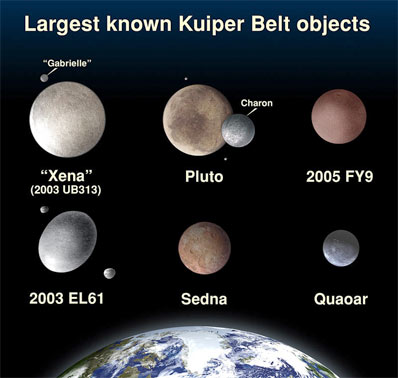
For a subject that evolves over years and in the slow watches of the night, Govert Schilling gives us a rollicking, fast-paced and information packed guide to this never-ending quest in his book “The Hunt for Planet X” (ISBN: 978-0-387-77804-4). I am also envious of his wonderful way with words. One of the big bugbears with communicating scientific information to the general public is how to make it accessible, without dumbing down or oversimplifying. I think he succeeds admirably, generating some memorable images along the way. I have to steal his image of comets as icypoles melting on a footpath.
Almost every aspect of the search for for Planet X is here, from the supposed sun-hugging Vulcanoids, to the discovery of Ceres (briefly a planet before it was demoted), to Nemesis (and Nibiru) the discovery of the Kuiper belt and the giant ice dwarfs, to the the discovery of Pluto and the controversy over Pluto being a planet, it’s all here. Govert Schilling brings it all to life too, the excitement of discovery, the frustration of searching, the personalities of the researchers. People I have known for years as dry names on the mastheads of scientific publications come alive and hope, dream and exult over photographic plates and digital images.
 And you learn a lot too, I’ve been reading out this sort of work for ages, following popularisations and scientific papers, but Govert Schilling bought out new aspects for me to understand (I think I finally “get” planetary migration mechanisms now as a result of his explanation). The demolition of the Nibiru myth is masterful too. There are some bits that could do with a bit more detail. Having read “The Neptune File”, his exposition of the controversy over Neptune’s discovery is quite good, but I would have liked more than an assertion that Tom Standage overstates his case.
There is a climax to this book, rather than just a list of (exciting) discoveries. And that is the demotion of Pluto. This thread is masterfully woven into the story; the origin of the solar system and its evolution, the origin of comets, the hunt for ice dwarfs all lead up to the powerful story of the meeting that demoted Pluto. By the end of the book, you can understand why that happened (although you still may not agree with it), and what it means in our new understanding of the solar system.
A fantastic book, get a hold of a copy soon.
Labels: book review, Pluto



 Click to read about or order
 Click to read about or order
 Click to read about or order
 Click to read about or order


