Thursday, September 16, 2010
Geo-xcentricities; you too can be Galileo with just a pair of binoculars (and gaffer tape)
 There’s been a lot of blank disbelief on the blogosphere of late, due to the announcement of a conference on Geocentrism (Galileo was Wrong). Geocentrism is the belief that Earth is the centre of the Universe and everything revolves around it. You would think that, 400+ years after Galileo, people would have cottoned on the the idea that the Earth orbits the sun, the sun orbits the galactic centre and the Milky Way galaxy does … well …complicated stuff with other galaxies, but basically we worked out long ago that the Earth is not the centre of the solar system, let alone the Universe.
Other people, especially Ethan at Starts with a Bang and the Bad Astronomer, have dealt with the technical details (and I have an earlier discussion here and here). My goal is to get you, the ordinary person on the Clapham omnibus (or in my case, the Outer Harbour train, where I am writing this), to try and demonstrate the Earth is heliocentric for yourself and to do so with common household materials. After all, science is at heart a practical endeavour, and non-professionals should be able to find the evidence for themselves.
So for this journey into the starry spheres, we will need a pair of binoculars, a camera tripod, some cardboard and alfoil, and lots of gaffer tape. We also have some luck, as the sky is currently cooperating in the Geocentrism debunking stakes.
First we have to ask ourselves, which “geocentric” theory are we disproving. The classic geocentric theory is that of Ptolemy, in which the planets, Moon and the Sun all orbit the Earth. The most famous variant of this is Tycho Brahe’s helio-geocentric system, where the Sun and Moon orbits the earth and everything else orbits the Sun. There are important differences in the systems which we will explore later.
 First off, let’s look at the phases of Venus. For this you will need binoculars and the camera tripod. You will also need a way of attaching the binoculars to the tripod. These days I use a special attachment (but this requires modern binoculars that have a screw thread on the body), but in the past I have used gaffer tape to good effect. Why attach the binoculars to the tripod? Because otherwise there will be too much shaking for you to see the image properly.
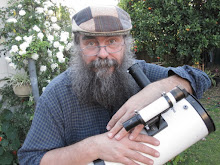
The image to the left is the setup I use for observing Sunspots (we come to that later), showing the binoculars gaffer taped to the tripod.
At the moment, Venus is prominent above the western horizon. Point your binocular lash-up at Venus, in my 10x50 binoculars Venus is very small but is a disk which has a distinct “half –Moon” shape. If your binoculars don’t have decent anti-glare coatings, you may have to observe in the early twilight in order to see Venus’s shape without internal reflections from the binocular lenses getting in the way.
 As you watch over the coming weeks, you will see Venus expand in size and become more crescent- shaped. Sketch the shape so you can follow its progress. This is so fast you should see a visible change in just one week. By mid-October Venus will be a thin crescent almost 2/3rds bigger than when you started observing. By late October Venus has nearly doubled in size and is a thin, glistening wire. Then Venus vanishes into the Suns glare and reappears in the morning. Over the next few months you can watch Venus shrink and become a tiny disk.
And now you have demolished the Ptolemaic geocentric system. Venus does have phases in this system, but quite unlike what you see here (I leave it too the reader to work out what a Ptolemaic systems Venus phases would look like, you can see a model of Ptolemaic Mercury here, which will give you a good idea). And you have only taken almost 6 months to do it (what, you thought it would be easy). As a reward, here's an animation of the Phases of Venus.


Left image Jupiter above the eastern horizon, Right Image, Venus above the western horizon, both at the same time in the evening (around 8pm ish in mid September 2010).
 Jupiter and three of its moons imaged with a mobile phone.
 But Ah! The Medicean Stars, now known as the Galilean Moons, they will shuttle backwards and forwards during the nights as you watch. The realisation that these “stars” were Moons of Jupiter were not a blow to any form of geocentrism per se, although they were the second of a series of powerful blows against the Aristotelian physics that underpinned Ptolemy’s system, which aided its demise. Determining that these specks actually orbited Jupiter, and were not just accidentally there, took a lot of effort.
Try keeping track of these sparks, and without reference to an almanac, try and determine their orbits (heck, try and keep track of which near identical points of light are which). It may take a while, you will need to keep careful sketches, and track the Moons and Jupiter with respect to the stars as Jupiter moves through the heavens, but a) You are sketching Venus anyway and b) it will be well worth it (hey, you proving things for yourself!).
 The next bit is more demanding. The Phases of Venus demolished the Ptolemaic Geocentric system, but the Tychonian- Geo-heliocentric system had Venus phases just like a pure heliocentric system (which is not surprising, as Tycho’s system is an inverted Copernican system). To eliminate the Tychonian system, we need to observe sunspots.
Luckily the Sun is coming out of its quiet phase, so you will have some to record. For this you will need to set up a safe binocular projection system (as shown above), where the image of the Sun is projected onto a surface so you can record the Sunspots. NEVER LOOK DIRECTLY AT THE SUN WITH BINOCULARS AS SEVERE EYE DAMAGE WILL RESULT.
Anyway, while you are recording the Phases of Venus and the orbits of Jupiters’ Moons, record the passage of Sunspots over the Suns face, over the 5-6 months you are recording the susposts, you will notice the path taken by the sunspots moves up and down. This is due to the Earths orbit not being exactly in the plane of the Suns rotation. In a geocentric system, with the Sun orbiting the earth once a day, this variation would show up on a daily basis, but what you observe can only be seen in a heliocentric system.
So, congratulations, you have just demonstrated that geocentric models don’t describe the solar system we see using very simple tools. It took a while, and was hard work, but you have demonstrated it yourself, and all the blovation of geocentricists won’t take that away (yes, Stellar parallax gets all the glory, but annual Sunspot variation was a powerful blow to Tychonian geocentric models). If you want to, you can take this further by making your own Foucault's Pendulum.
Labels: Copernicus, Galileo, Science Blogging, science matters

Wednesday, April 15, 2009
Tycho Brahe gets a Shave
Back in March I wrote a post “Occam's Razor and the Two World Systems”, where I discussed the idea propounded by William Wallace that Occam’s razor failed when applied to the transition from the Ptolemaic geocentric solar system to the Copernican heliocentric solar system. Mr Wallace replied on that post and I promised to respond, but life (and various asteroids and comets) got in the way. Rather than add new comments there. I’ll take this up as a new post.
The starting point of the old post was Mr Wallace’s contention:
The only point of similarity between Ptolemy’s system and Tycho’s system was the Earth was immobile in both systems, but in Tycho’s, everything but the Moon rotated around the Sun. Again, the key features of Ptolemy’s system, the equant and the great epicycles were absent from Tycho’s formulation. This may seem like mere pettifoggery, after all, both Ptolemy and Tycho had the Earth as the centre of the solar system, but Ptolemy’s system was not just “everything goes around the Earth”. Tycho had explicitly rejected the Ptolemaic system, all the key features of the Ptolemaic system, taken all the planets and placed them around the Sun and grounded his system on a reformulation of the Copernican system.
We now know that stellar parallax could not be measured with instruments available then. It wasn’t obvious back then, and there were several attempts to measure the stellar parallax. Tycho established that the stellar parallax had to be less than 0.1 degree. However, this did not falsify the Copernican model as negligible parallax was an a priori feature of the Copernican system.
Tycho was well aware of this, and his argument was not that the lack of parallax showed that the Earth did not move, but that if the parallax was so small the distance between Saturn and the stellar sphere would have to be 700 times the distance between the Sun and Saturn. A provident creator would not be so wasteful of space and produce such asymmetry in his creation.
So we can see that the stellar parallax argument as used by Tycho is in the end not a scientific argument.
So what was the measurement that convinced Tycho to reject the Ptolemic system? Ironically, it was a parallax measurement. One of the predictions of the Copernican system was that Mars would be closer to Earth than the Sun at opposition; while in the Ptolemaic system Mars would always be more distant from the Sun. Tycho’s careful measurements of the parallax of Mars showed that Mars was closer to Earth than the Sun. Similar measurement of Venus’s parallax by Tycho also confirmed Copernican predictions. Copernicus was right, Ptolemy was wrong, and Tycho unhesitatingly rejects Ptolemy. But in the end Tycho rejects both Ptolemy and Copernicus.
[1] The equant was seen as a particular drawback to Ptolemy’s system, if one wanted to explain planetary motion in terms of uniform circular motion, and Copernicus reformulation of planetary motion so that the equant was dispensed with. This was seen by contemporary astronomers and mathermaticians and a great benefit of the system. Tycho too saw the equant as something undesirable, and the great epicycles of Ptolemy as unparsimonius.
[2] Tycho got rid of Librations, but generally his scheme was Copernicus’s recast from Earth’s frame of reference.
[3] Ironically, Tycho’s system made the acceptance of the Copernican system easier. It made people familiar with the Copernican system, and smashed key sections of Aristotelian physics which have proved a barrier to acceptance of he Copernican system.
Sources:
The Reception of Copernicus’s Heliocentric Theory 1973 ed Jerzy Dobryzcki, Reidle esp Chapter 3.
Copernicus, On the Revolution of the Heavenly Spheres (translation AM Duncan 1976) Barnes & Nobel
The Copernican Revolution 1957, TS Kuhn Harvard University Press
The Book Nobody Read 2004, O Gingerich, Walker & Company
The starting point of the old post was Mr Wallace’s contention:
I have a counter example, from science, fully described here, where Occam's razor fails. The idea that the "simplest explanation is probably right" was falsified when Tycho Bryhe [sic] rejected heliocentricism for geocentricism, based on his analysis of the best available data.Once again, I must emphasise that Occam’s razor is not the simplest explanation is probably right, but let’s pick up on Mr. Wallace’s comments. I’m going to do this slightly out of order, so as to address particular issues that arise from the quotes more logically
There were three systems, Copernicus, classical Ptolemaic, and neo-Ptolemaic (or Tycho's). Both Ptolemy's and Tycho's could be accurately described as geocentricism. I just want to clarify that I don't think I ever claimed--and I certainly never intended to claim--that Tycho held a purely Ptolemaic view of the solar system. He held a geocentric view, more consistent with Ptolemy's than Copernicus's (though Kepler's was arguably more akin to Copernicus's than Tycho's was to Ptolemy's.)This is so very, very wrong. Tycho’s system was not a neo-Ptolemaic system, as I describe below, Tycho explicitly rejected the Ptolemaic system based on observational evidence. Tycho accepted most of Copernicus’s system, but balked at a moveable Earth and produced a Heliocentric-geocentric system (not a geocentric system, for another animation of the respective systems see here). Indeed it is an “inverted Copernican” system, basically a remapping of the Copernican system into a reference frame centred on Earth. Tycho’s system contains nothing of Ptolemy; there are no equants, no great epicycles and so on[1]. I’ll emphasise that again, Tycho’s system was not a re-jigging of Ptolemy, it was an inversion of Copernicus’s system.
The only point of similarity between Ptolemy’s system and Tycho’s system was the Earth was immobile in both systems, but in Tycho’s, everything but the Moon rotated around the Sun. Again, the key features of Ptolemy’s system, the equant and the great epicycles were absent from Tycho’s formulation. This may seem like mere pettifoggery, after all, both Ptolemy and Tycho had the Earth as the centre of the solar system, but Ptolemy’s system was not just “everything goes around the Earth”. Tycho had explicitly rejected the Ptolemaic system, all the key features of the Ptolemaic system, taken all the planets and placed them around the Sun and grounded his system on a reformulation of the Copernican system.
Tycho's system required fewer calculations and was consistent with all known measurements. Copernicus's was not consistent with observations.Tycho's system required roughly the same number of calculations as Copernicus’s, as it was basically Copernicus’s translated into Earths reference frame [2]. Tycho fully accepted Copernican geometry, used Copernican planetary models, and where he did not explicitly do his own calculations, he used planetary tables based on Copernican models. Where Tycho was more accurate than Copernicus, it was through his greater observational accuracy, not any superiority of his model. Indeed, when he talks of his system, he notes that he has kept all the superior features of the Copernican system. Ironically, it was Tycho’s own measurements of the opposition of Mars in 1582 that showed that the Copernican model was in better agreement with the observed retrograde motion of Mars than the Ptolemaic model.
And yet Copernicus' model defied experimental verification, using the best astronomical apparatus of the time (Tycho's).Actually, that’s not true. There was a key test of the Ptolemic vs Copernican system and the Copernican system came through with flying colours. It was one of the key results that forced Tycho to reject the Ptolemaic system. However, that test tends to be ignored these days because of modern commentators focusing on the issue of stellar parallax.
We now know that stellar parallax could not be measured with instruments available then. It wasn’t obvious back then, and there were several attempts to measure the stellar parallax. Tycho established that the stellar parallax had to be less than 0.1 degree. However, this did not falsify the Copernican model as negligible parallax was an a priori feature of the Copernican system.
Tycho was well aware of this, and his argument was not that the lack of parallax showed that the Earth did not move, but that if the parallax was so small the distance between Saturn and the stellar sphere would have to be 700 times the distance between the Sun and Saturn. A provident creator would not be so wasteful of space and produce such asymmetry in his creation.
So we can see that the stellar parallax argument as used by Tycho is in the end not a scientific argument.
So what was the measurement that convinced Tycho to reject the Ptolemic system? Ironically, it was a parallax measurement. One of the predictions of the Copernican system was that Mars would be closer to Earth than the Sun at opposition; while in the Ptolemaic system Mars would always be more distant from the Sun. Tycho’s careful measurements of the parallax of Mars showed that Mars was closer to Earth than the Sun. Similar measurement of Venus’s parallax by Tycho also confirmed Copernican predictions. Copernicus was right, Ptolemy was wrong, and Tycho unhesitatingly rejects Ptolemy. But in the end Tycho rejects both Ptolemy and Copernicus.
My ultimate point about Tycho's rejection of Copernican theory was that applying principles of modern science sometimes leads one astray.Erm. Mr. Wallace. This is what you said:
I have a counter example, from science, fully described here, where Occam's razor fails...In this case, it was Tycho’s system failed the Occam’s razor test. It requires more assumptions than the Copernican system, introduces two centres of motion, introduces more problems with motions and whilst reproduces the retrograde motions of the planets, it no longer provides these motions as a natural consequence of the orbits of the planets. Altogether it is far less economical than the Copernican system and no longer explains the precession of the equinoxes and is affected by solar eccentricity (and this was pointed out at the time). Occam’s razor doesn’t fail, because Occam’s razor was not used to make the choice between the Copernican and Tychonian systems. What was the basis of Tycho’s rejection of the Copernican system? Let Tycho tell us in his own (translated) words.
Since all these results [parallax measurements of Mars and Venus] did not all agree with the Ptolemaic hypotheses I was urged afterward to put more and more confidence in the Copernican invention. The exceedingly absurd opinion that the Earth revolves uniformly and perpetually nevertheless made up a very great obstacle, and in addition the irrefutable authority of the Holy Scripture maintained the opposite view. [emphasis added]It wasn’t the principles of modern science that lead Tycho astray.
[1] The equant was seen as a particular drawback to Ptolemy’s system, if one wanted to explain planetary motion in terms of uniform circular motion, and Copernicus reformulation of planetary motion so that the equant was dispensed with. This was seen by contemporary astronomers and mathermaticians and a great benefit of the system. Tycho too saw the equant as something undesirable, and the great epicycles of Ptolemy as unparsimonius.
[2] Tycho got rid of Librations, but generally his scheme was Copernicus’s recast from Earth’s frame of reference.
[3] Ironically, Tycho’s system made the acceptance of the Copernican system easier. It made people familiar with the Copernican system, and smashed key sections of Aristotelian physics which have proved a barrier to acceptance of he Copernican system.
Sources:
The Reception of Copernicus’s Heliocentric Theory 1973 ed Jerzy Dobryzcki, Reidle esp Chapter 3.
Copernicus, On the Revolution of the Heavenly Spheres (translation AM Duncan 1976) Barnes & Nobel
The Copernican Revolution 1957, TS Kuhn Harvard University Press
The Book Nobody Read 2004, O Gingerich, Walker & Company
Labels: Copernicus, creationism, Galileo
Wednesday, March 11, 2009
Occam's Razor and the Two World Systems
Over at my blogging buddy ERV's place, there's a lot of arguing going on [1], which at one stage segued into a silly argument about Occam's Razor and the Heliocentric vs Geocentric theories (See William Wallace's post and subsequent posts, and William Wallace's own webpost on this topic).
First off, Occam's razor is not "Choose the simplest explanation". Occam said entia non sunt multiplicanda praeter necessitatem, which can be translated as "entities must not be multiplied beyond necessity"[2]. These days, in science we understand Occam's razor as (quoting Wikipedia)
As well, you need to understand that in describing cosmological systems, the preference from antiquity to Galileo was to explain heavenly motions in terms of uniform, circular motions. We may see this as weird or foolish now, but it wasn't back then. Now, on to William Wallace.
A little explanation. If the Earth is the centre of the universe, with the planets and fixed stars revolving around it with uniform circular motions, you should see the all the planets move smoothly across the sky at the same pace and the same brightness. But they don't. The inner planets, Mercury and Venus, never move far from the Sun and change radically in brightness. The outer planets move across the sky, then stop, reverse their motion, stop again, then move back the way they were going in the first place. Any geocentric explanation has to explain this retrograde motion.
Ptolemy solved these problems. First, he had the planets not orbit the earth directly, but orbit a point that itself orbited the Earth. This is the epicycle (for an animation see here). Mercury and Venus required somewhat more complicated solutions (see here for an animation of Mercruy in a geocentric system) than for the outer planets. Even so, this system still didn't quite work. Ptolemy also introduced the equant, the planets did not in fact orbit the Earth, but orbited a point some distance away from the Earth. It worked, and the Ptolemaic geocentric system was the standard description of the Solar system until the time of Copernicus. Copernicus, of course, moved the centre of the universe to the Sun, and had all the planets, including Earth, revolve around that.
Now, in terms of Occam's razor, Copernicus's heliocentric system should have been an outright winner. Both the Ptolemaic system and the Copernican system explained retrograde orbits and the reason Venus and Mercury never travelled far from the Sun, but the Copernican system got rid of the ad hoc large epicycles, the retrograde motions of the planets were natural results of the planets orbiting the Sun, as was the explanation of Venus and Mercury not moving far from the Sun, as they orbited inward of the Earth. Most importantly, the ad hoc equant was removed. In the time of Copernicus, getting rid of the equant was more important than many other innovations, as the equant represented a departure from the ideal of explaining the solar system using uniform, circular motion.
The Copernican system also explained things the the Ptolemaic system didn't. It gave a natural explanation for the ordering of the orbits of the planets, it also explained the precession of the equinoxes and the seasons. So, not only did the Copernican system explain the same facts as the Ptolemaic system with fewer ad hoc assumptions, it had greater explanatory power. It did require the assumption that the Fixed stars were very far away, but that was no more ad hoc than the Ptolemaic assumption that they were relatively near. So, in the Occam's razor stakes, it should have won hands down, and indeed the Copernican system was popular with northern European astronomers. Southern European, not so much.
So, along comes Tycho Brahe, he makes the most accurate observations of the stars and planets ever and he ....
Rejects the Ptolemaic system. He makes a system where all the planets bar Earth orbit the Sun (animation here) and the Sun with its panalopy of planets orbits the Earth. It's a kludge, an obvious kludge. The orbits of Mars and the Sun intersected for criminies sake! In terms of Occam's razor, Tycho's helio-geocentric system fails, introducing unwarranted assumptions. The parallax issues was a problem, but again, if the fixed stars were far away (as they were), then parallax would not be observable.
The observations of the phases of Venus by Galileo, and of the Moons of Jupiter meant that the Ptolemaic system (which Tycho rejected) was wrong. Interestingly, Galileo observed changes in the timing of the eclipses of the Moons of Jupiter that could be accounted for only by the parallax changes due to an orbiting Earth, but didn't realise it. In 1613 the annually periodic seasonal variations of sunspot trajectories across the sun's disc was discovered. This fitted with the hypothesis of a rotating earth, and not one of an orbiting Sun. Then in 1729 James Bradley discovered stellar aberration, which can be only explained by a rotating, orbiting Earth. Finally in 1838 , Friedrich Bessel made the first successful measurements of stellar parallax.
Tycho did not accept the Copernican system, but neither did he accept the geocentric Ptolemaic system. His rejection of the Copernican system in favour of a more complicated system of his own devising was a failure of Tycho, not of Occam's razor. Indeed, the Earth does rotate around the Sun, and choosing Occam's razor would have given us the right result (As Tycho's system made more unwarranted assumptions than the Copernican system - Stars close to earth, two centres of rotation and crossing orbits).
[1] Well, it's basically over now, that's what I get by being distracted by the sky. But I have a point I want to make.
[2] He also said Pluralitas non est ponenda sine necessitate which translates as "plurality should not be posited without necessity."
First off, Occam's razor is not "Choose the simplest explanation". Occam said entia non sunt multiplicanda praeter necessitatem, which can be translated as "entities must not be multiplied beyond necessity"[2]. These days, in science we understand Occam's razor as (quoting Wikipedia)
When multiple competing hypotheses are equal in other respects, the principle recommends selecting the hypothesis that introduces the fewest assumptions and postulates the fewest entities.
As well, you need to understand that in describing cosmological systems, the preference from antiquity to Galileo was to explain heavenly motions in terms of uniform, circular motions. We may see this as weird or foolish now, but it wasn't back then. Now, on to William Wallace.
I have a counter example, from science, fully described here, where Occam's razor fails. The idea that the "simplest explanation is probably right" was falsified when Tycho Bryhe [sic] rejected heliocentricism for geocentricism, based on his analysis of the best available data.Okay, there are several things wrong with this. One: Occam's razor isn't "simplest explanation is probably right" (see above). Secondly, Tycho Brahe didn't reject heliocentrism for geocentricism.
A little explanation. If the Earth is the centre of the universe, with the planets and fixed stars revolving around it with uniform circular motions, you should see the all the planets move smoothly across the sky at the same pace and the same brightness. But they don't. The inner planets, Mercury and Venus, never move far from the Sun and change radically in brightness. The outer planets move across the sky, then stop, reverse their motion, stop again, then move back the way they were going in the first place. Any geocentric explanation has to explain this retrograde motion.
Ptolemy solved these problems. First, he had the planets not orbit the earth directly, but orbit a point that itself orbited the Earth. This is the epicycle (for an animation see here). Mercury and Venus required somewhat more complicated solutions (see here for an animation of Mercruy in a geocentric system) than for the outer planets. Even so, this system still didn't quite work. Ptolemy also introduced the equant, the planets did not in fact orbit the Earth, but orbited a point some distance away from the Earth. It worked, and the Ptolemaic geocentric system was the standard description of the Solar system until the time of Copernicus. Copernicus, of course, moved the centre of the universe to the Sun, and had all the planets, including Earth, revolve around that.
Now, in terms of Occam's razor, Copernicus's heliocentric system should have been an outright winner. Both the Ptolemaic system and the Copernican system explained retrograde orbits and the reason Venus and Mercury never travelled far from the Sun, but the Copernican system got rid of the ad hoc large epicycles, the retrograde motions of the planets were natural results of the planets orbiting the Sun, as was the explanation of Venus and Mercury not moving far from the Sun, as they orbited inward of the Earth. Most importantly, the ad hoc equant was removed. In the time of Copernicus, getting rid of the equant was more important than many other innovations, as the equant represented a departure from the ideal of explaining the solar system using uniform, circular motion.
The Copernican system also explained things the the Ptolemaic system didn't. It gave a natural explanation for the ordering of the orbits of the planets, it also explained the precession of the equinoxes and the seasons. So, not only did the Copernican system explain the same facts as the Ptolemaic system with fewer ad hoc assumptions, it had greater explanatory power. It did require the assumption that the Fixed stars were very far away, but that was no more ad hoc than the Ptolemaic assumption that they were relatively near. So, in the Occam's razor stakes, it should have won hands down, and indeed the Copernican system was popular with northern European astronomers. Southern European, not so much.
So, along comes Tycho Brahe, he makes the most accurate observations of the stars and planets ever and he ....
Rejects the Ptolemaic system. He makes a system where all the planets bar Earth orbit the Sun (animation here) and the Sun with its panalopy of planets orbits the Earth. It's a kludge, an obvious kludge. The orbits of Mars and the Sun intersected for criminies sake! In terms of Occam's razor, Tycho's helio-geocentric system fails, introducing unwarranted assumptions. The parallax issues was a problem, but again, if the fixed stars were far away (as they were), then parallax would not be observable.
The observations of the phases of Venus by Galileo, and of the Moons of Jupiter meant that the Ptolemaic system (which Tycho rejected) was wrong. Interestingly, Galileo observed changes in the timing of the eclipses of the Moons of Jupiter that could be accounted for only by the parallax changes due to an orbiting Earth, but didn't realise it. In 1613 the annually periodic seasonal variations of sunspot trajectories across the sun's disc was discovered. This fitted with the hypothesis of a rotating earth, and not one of an orbiting Sun. Then in 1729 James Bradley discovered stellar aberration, which can be only explained by a rotating, orbiting Earth. Finally in 1838 , Friedrich Bessel made the first successful measurements of stellar parallax.
Tycho did not accept the Copernican system, but neither did he accept the geocentric Ptolemaic system. His rejection of the Copernican system in favour of a more complicated system of his own devising was a failure of Tycho, not of Occam's razor. Indeed, the Earth does rotate around the Sun, and choosing Occam's razor would have given us the right result (As Tycho's system made more unwarranted assumptions than the Copernican system - Stars close to earth, two centres of rotation and crossing orbits).
[1] Well, it's basically over now, that's what I get by being distracted by the sky. But I have a point I want to make.
[2] He also said Pluralitas non est ponenda sine necessitate which translates as "plurality should not be posited without necessity."
Labels: Copernicus, creationism, Galileo



 Click to read about or order
 Click to read about or order
 Click to read about or order
 Click to read about or order


